Talk:Ming Dynasty
From Wikipedia, the free encyclopedia


[edit] Nothing in decline about the Yellow River flood in 1642
More info is needed about this flood which killed about 300,000 people. Anyone interested in doing some research?
[edit] Use of Pinyin
172: try to use Pinyin romanization. But if you determined to use other methods, provide redirect links to their respective Pinyin titled pages.Wikipedia talk:Naming conventions (chinese) would be helpful. -- User:kt2
I will from now on. I'm sorry.
- It's okay and you don't need to be sorry. BTW you don't have to use Pinyin in your sections but just redirect the links to Pinyin titled pages. Wade-Giles is still being used among Chinese history researchers.
-
- I disagree. For consistency it is best to stick to a single system of transliteration, and pinyin is now the most widely known and used system. Marco polo 19:59, 20 April 2007 (UTC)
[edit] Error in date
I think there is a mistake in the date but I don't know the correct answer : "Hung-wu increasingly concentrated power in his own hands and in 1830 abolished the Imperial Secretariat"
Koxinga 12:37 12 Jun 2003 (UTC)
"and in any case restrictions on emigration and ship building were largely lifted by the mid-17th century."
Surely this is a mistake?, the Ming dynasty had collapsed by that time, 1644, they were in no position to ban or allow anything.
[edit] Meaningless phrase.
The phrase `capsized by a tablet' is meaningless, but I'm not sure what was intended.
[edit] Section should be removed.
Fall of Ming dynasty
It is a poorly written article. It is layered in a lot of objectivity. It is does not contain factual data for an encyclopedia.
adam.lang 12:37 12 Jul 2005 (UTC)
[edit] Split
This article should be split. Maurreen (talk) 07:07, 4 August 2005 (UTC)
- How do you mean? 22:30, 24 August 2005 (UTC)
- The majority of the Zhu Yuanzhang stuff has been deleted it was almost word for word identical to the Zhu Yuanzhang article.The "Fall of the Ming dynasty"material has been split off into its own article.Cetot 01:25, 6 September 2005 (UTC)
[edit] Muslim Ming Dynasty
Is there a proper source for the claims that the Ming Dynasty could have been Muslim?
- What happed to the info on that? It was interesting reading. You should at least put the deleted text in the talk page. --Dangerous-Boy 05:56, 20 January 2006 (UTC)
- What a silly assertion that the emperors were Muslim (although they certainly hired a large entourage of Muslims and dealt constantly with Muslim merchants); anyone who knows about the history of the emperor's daily lives and writing can tell you they were anything but Muslim, Christian, Jew, or any other Abrahamic-based religious person. Show me this so-called evidence, please.--Pericles of AthensTalk 03:29, 2 January 2008 (UTC)
[edit] Wikification
I don't know if this article will ever get wikified unless someone knowledgeable about the subject does it. -- Kjkolb 09:19, September 4, 2005 (UTC)
-
-
- Your prayers have been answered; glad to be of service. Lol.--Pericles of AthensTalk 03:48, 2 January 2008 (UTC)
-
- What is all this discussion stuff? Do we really need this stuff on the article? Colipon+(T) 23:57, 4 September 2005 (UTC)
-
- As far as I can tell its basically virtual history a list of turning points at which the Ming dynasty could have saved itself, with the "discussion" bit being what could have been done differently.Interesting in its own way but confusing if you can't tell which bits are fact and which bits speculative.Cetot 01:25, 6 September 2005 (UTC)
[edit] Yu Ninjie's map?
What happened to it? --Dangerous-Boy 06:01, 20 January 2006 (UTC)
[edit] Why is this article marked for copyediting?
I've glanced over about half of the article, and I can't see any terribly badly worded sections or prevalent mispellings. I've removed the copyedit tag, but of course feel free to add it again if anyone wishes.
- Look at the first paragraph of the section "Exploration to isolation." I have no idea what the paragraph is talking about. With the numerous spelling and grammatical errors, it seems to me that someone just insert it there randomly. 70.133.9.25 03:09, 12 June 2007 (UTC)
[edit] Cao or chao?
I thought the correct pinyin of 朝 was chao?Erik-the-red
[edit] "Exploration to Isolation" - Qs:
Help! This section is really confusing - I have the impression that it's attempting to summarize a mish-mash of different theories about material exchange during the Ming period [AND how that may or may not relate to the overall decline of the dynasty]. The problem is, the summaries are so short that they not only contradict each other, they are sometimes internally contradictory. So, for example:
- what is this connection between the commercial and religious lobbies - how and why do their interests overlap?
- What exactly are the 'anti-clerical efforts of the Confucian scholar gentry' and how is the state funding them?
- If Zheng He is a quintessential outsider to the establishment, and his trips were opposed by the literati, but supported by the merchants, then how can they be described as more political than economic?
- And how can they be both intended "to enroll further states as tributaries and mark the dominance of the Chinese Empire" while being "unlike European voyages of exploration later in the 15th century... not intended to extend Chinese sovereignty overseas" ?
This seems like a fairly complicated, nuanced argument that might deserve some more explanation - does anyone know these sources? Then we've got this thing about Mongols (?) and pirates (?) and silver (blaming the entire fall of the dynasty on silver strikes me as possibly a slight overkill), and at the very last the traditional argument about stagnation. If all these theories are going to get thrown together, it would be so helpful for the reader if there was some synthesis to indicate how they relate to each other. If anyone can shed some light, that would be great. Otherwise, I'll try to figure it out since I'll be doing a fair amount of reading on the Ming d. over then next few months. Isocephaly 04:18, 7 October 2007 (UTC)
-
- Hold your horses there cowboy, don't underestimate the influence of economic devastation caused by the sudden drop in available silver, the common medium of exchange that was keeping the Ming economy scooting by. I've deleted much of the garbage you're talking about though; it looks like a completely new article after I've touched it.--Pericles of AthensTalk 03:26, 2 January 2008 (UTC)
[edit] Expansion
I just expanded the intro significantly; the introductory information I have just added will soon be elaborated on in the body of the article. Hold on to your butts people and be patient, this article is going to need a lot of work.
If people have sources and wish to contribute, some key things must be focused upon:
- China's entry into a new global commercial connection with the Old and New worlds
- China's grand construction, public works, and naval projects
- China's internal economy and economic policies/reforms
- The difference in Ming society and culture from the beginning of the dynasty to the end
- The emergence of consumer culture and blending of merchant and gentry class
- Silver, silver, and more silver! ...And then less of it.
- Literature and the arts
- Technology and engineering
I hope these points will spark some ideas in your heads.--Pericles of AthensTalk 08:36, 24 November 2007 (UTC)
-
- I will be doing some mass deletions of unsourced statements now, and if anyone has a problem with any specific deletion, please bring this to attention. Otherwise, I am going to give this entire article a good cleansing and a rewrite all over.--Pericles of AthensTalk 20:03, 24 November 2007 (UTC)
-
- I love how this article rants on and on and on about Hongwu—as if he had anything to do with the Ming Dynasty after Yongle set it on a completely different course—and then all of the sudden it switches gears to talking entirely about the decline of the dynasty in the 17th century. What the hell??? This leaves the reader with a gaping sense of confusion with all that happened in between the reign of Hongwu in the 14th century and the decline in the 17th century.--Pericles of AthensTalk 20:53, 24 November 2007 (UTC)
-
- I will be doing some mass deletions of unsourced statements now, and if anyone has a problem with any specific deletion, please bring this to attention. Otherwise, I am going to give this entire article a good cleansing and a rewrite all over.--Pericles of AthensTalk 20:03, 24 November 2007 (UTC)
[edit] Stick a fork in it, it's done!
Seriously, this turkey is just about overcooked at the size of 101 KB. It has swelled past what some might consider acceptable limits. Please! No one add anything to this article! Unless it is seriously necessary; even then, bring it up on the talk page here before adding it, so that a compromise can be made about size and content. Thanks.--Pericles of AthensTalk 05:04, 27 December 2007 (UTC)
- Don't mean to pry(and maybe I'm wrong), but are you sure YuanChong Huan got European firearms from his cook? Good job with the article btw.
>GnipTalk 12:02, 29 December 2007 (UTC)
- Well, you shouldn't be asking me whether I'm sure Yuan got firearms from his cook who had European contacts; you should be contacting Jonathan Spence, who said so on page 24 of the book I cited. Lol. I'm just the messenger dude, representing views from scholarly sources. No original research allowed in my camp. Yaarr.--Pericles of AthensTalk 08:54, 29 December 2007 (UTC)
- Well, I guess the cook had a lot more influence than what I assumed an average cook had. I always assumed it was Yuan himself who got the European cannons. If you feel like it I would ask you to tell me a little more about this guy Gnip 4:02, 29 December 2007
- I wish I could, Spence just mentions it in passing while discussing a much broader topic than cooks. Lol. To be honest, I was a little curious about this guy myself, but Spence does not care to go into detail about everything (otherwise his already hefty book would be twice as long).--Pericles of AthensTalk 20:27, 30 December 2007 (UTC)
- Well, I guess the cook had a lot more influence than what I assumed an average cook had. I always assumed it was Yuan himself who got the European cannons. If you feel like it I would ask you to tell me a little more about this guy Gnip 4:02, 29 December 2007
[edit] "Simào de Andrade"
Not so spelt in Portuguese: the linked article on Fernão Pires de Andrade has got it wrong. I've corrected the spelling. --NigelG (or Ndsg) | Talk 19:15, 16 January 2008 (UTC)
-
- The original version is how Mote's book Cambridge History of China spells it, but I'll give you the benefit of the doubt, since you seem pretty certain (I've never attempted to learn Portuguese, although I know a bit of Spanish).--Pericles of AthensTalk 04:10, 17 January 2008 (UTC)
- It's well known that errors like this tend to propagate themselves. If you do a Google search on "Simao de Andrade" (with or without the accent), & restrict it to Portuguese pages (Advanced search), you'll see that my spelling is correct. Pedantry: dontcha just love it?! --NigelG (or Ndsg) | Talk 10:12, 17 January 2008 (UTC)
- Lol, indeed.--Pericles of AthensTalk 10:17, 17 January 2008 (UTC)
- It's well known that errors like this tend to propagate themselves. If you do a Google search on "Simao de Andrade" (with or without the accent), & restrict it to Portuguese pages (Advanced search), you'll see that my spelling is correct. Pedantry: dontcha just love it?! --NigelG (or Ndsg) | Talk 10:12, 17 January 2008 (UTC)
- The original version is how Mote's book Cambridge History of China spells it, but I'll give you the benefit of the doubt, since you seem pretty certain (I've never attempted to learn Portuguese, although I know a bit of Spanish).--Pericles of AthensTalk 04:10, 17 January 2008 (UTC)
[edit] Rebellion of Cao Qin
I just created this article, which has lots of valuable info for the mid Ming Dynasty and the Ming Mongols section of this article.--Pericles of AthensTalk 10:17, 17 January 2008 (UTC)
[edit] Congrats on FA promotion


Congratulations to all concerned! Thoroughly deserved. --NigelG (or Ndsg) | Talk 10:45, 22 January 2008 (UTC)
-
- Woo-hoo! I'm so happy! This is awesome! Thanks everybody.--Pericles of AthensTalk 13:07, 22 January 2008 (UTC)
[edit] Mingshi- the English online version?
Mingshi is the official history book of the Ming dynasty. I want to read this historiography which is translated into Enlish in the Internet. I had tried to find something like this but I found nothing. Can anyone here give me the link of the English online version of Mingshi? Thanks so much,--Redflowers (talk) 09:00, 15 February 2008 (UTC)
-
- So far I've only been able to find snippets and tiny sections of the overall text translated from Zhongwen into English. I find it hard to believe no one has provided an available English online version, but this is unfortunately the case from what I've seen in Google searches.--Pericles of AthensTalk 01:42, 16 February 2008 (UTC)
[edit] Puritan slant?
I was surprised to see (unless I missed it) nothing on the sexual habits of the Ming. How did they reproduce? I hear there is some good material, about love of women as well as love of youths, in Timothy Brook's book The Confusions of Pleasure: Commerce and Culture in Ming China. If no one here has it I will look for it. Haiduc (talk) 11:47, 18 February 2008 (UTC)
-
- I left a message on your talk page.--Pericles of AthensTalk 22:58, 18 February 2008 (UTC)
-
-
- I have taken the paragraph, which strikes me as being overlong to begin with, and have moved things around to allow the excursion into sexuality. I'll be happy to help edit if you like.
-
There was a rich variety of occupations and employments one could choose or inherit from a father's line of work. This would include—but certainly was not limited to—coffinmakers, ironworkers and blacksmiths, tailors, cooks and noodle-makers, retail merchants, tavern, teahouse, or winehouse managers, shoemakers, seal cutters, pawnshop owners, and merchant bankers engaging in a proto-banking system involving notes of exchange.[187][89]
Brothels also did a thriving business, catering to the tastes of the refined upper classes. Refined gentlemen enjoyed the favors of girls as well as boys, who fetched a much higher price....
Urban shops and retailers sold a variety of goods such as special paper money to burn at ancestral sacrifices . . .
--Haiduc (talk) 19:27, 19 February 2008 (UTC)
-
- Sounds like a good start. Can we work on this later? I'm going to be very busy tonight. Thanks.--Pericles of AthensTalk 01:38, 20 February 2008 (UTC)
- I've added two sentences to the section on this subject, although not worded exactly as you've suggested here. Cheers!--Pericles of AthensTalk 22:24, 21 February 2008 (UTC)
- Sounds like a good start. Can we work on this later? I'm going to be very busy tonight. Thanks.--Pericles of AthensTalk 01:38, 20 February 2008 (UTC)
--LaGrandefr (talk) 13:55, 28 March 2008 (UTC)
[edit] Mediation: Map Dispute
| Extended Discussion | |||||||||||||||||||||||||||||||||||||||||||||||||||||||||||||||
|---|---|---|---|---|---|---|---|---|---|---|---|---|---|---|---|---|---|---|---|---|---|---|---|---|---|---|---|---|---|---|---|---|---|---|---|---|---|---|---|---|---|---|---|---|---|---|---|---|---|---|---|---|---|---|---|---|---|---|---|---|---|---|---|
| The following is a discussion that has been placed in a collapse box for improved usability. | |||||||||||||||||||||||||||||||||||||||||||||||||||||||||||||||
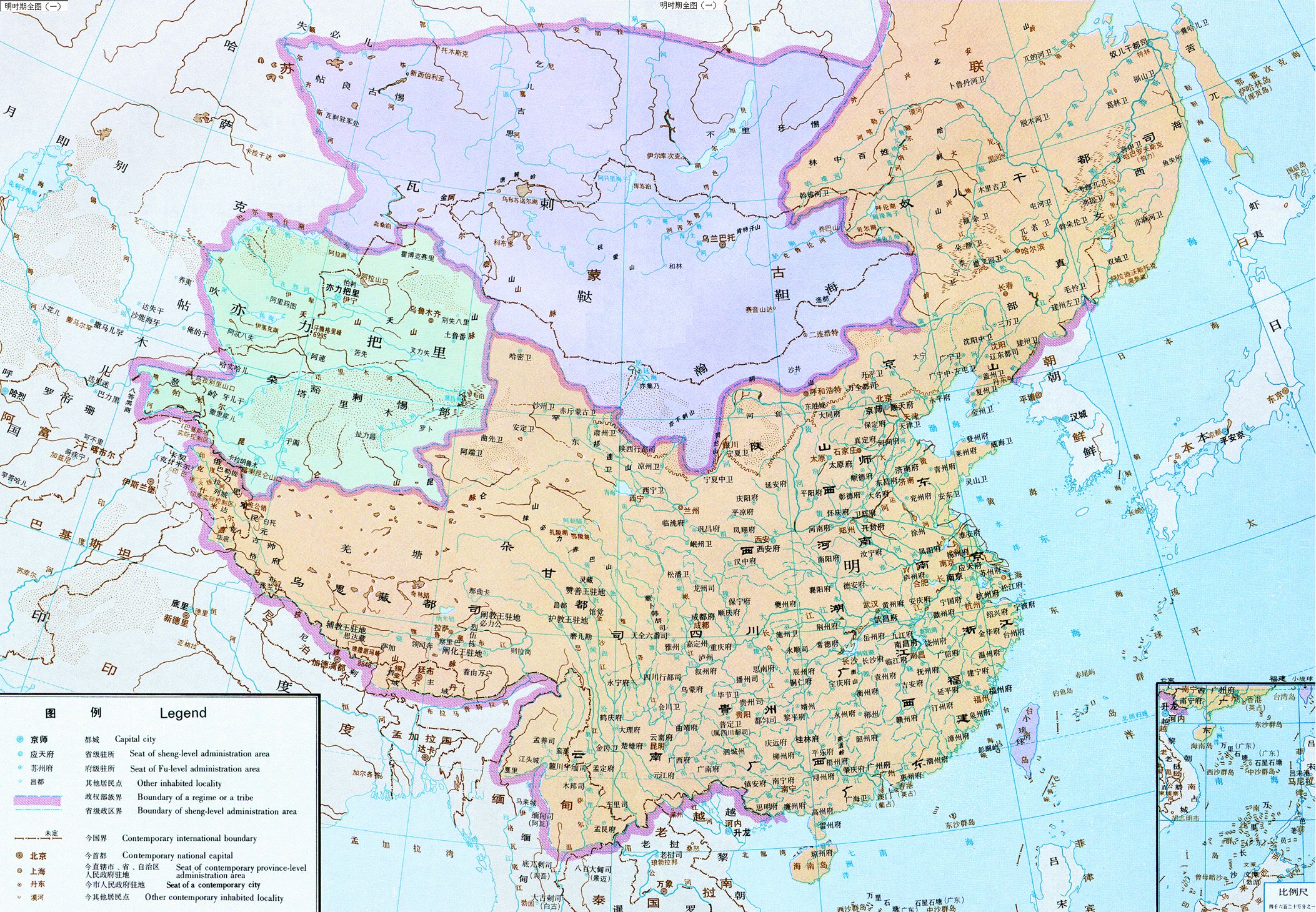
[edit] One more sentenceI added a sentence about Wylie's book chapter to wrap up the argument of the side in favor of the view that Tibet was more autonomous than Wang and Nyima assert. Any more info can be placed in a new article, if someone wishes to create one.--Pericles of AthensTalk 17:55, 8 April 2008 (UTC) [edit] Someone is crazy? [edit] Yes, someone is crazyAside from the gigantic, erroneous extra territory in Manchuria that this map claims for the Ming, Tibet was also never part of the Ming Empire; they were merely a tributary state of the Ming. From Alex McKay's book The History of Tibet (2003, Routledge, ISBN 0415308429) on page 65:
Tibet was not dominated by China again until the 18th century during the high Qing Dynasty. Showing a map of the Ming that includes its vassal states is misleading to the general reader unaware of what is under direct administration and what is a vassal state. In fact, this map makes no attempt to distinguish what is vassal and what is not. It simply places all under a gigantic yellow blob. How is this helpful or encyclopedic, I ask?--Pericles of AthensTalk 11:50, 28 March 2008 (UTC)
[edit] You'll need better sources than "TravelChinaGuide.com"Dude, you are placing "TravelChinaGuide" and primary source documents written in the Ming Dynasty from "China Tibet Information Center" that have not been commented on by a secondary scholarly source...over McKay's book I just cited above? Tibet was merely a tributary state, any claim of authority the Ming court had over Tibet was nominal and did not reflect any administrative reality. Your obstinate statement "I don't see the debate" clearly shows that you do not understand what a scholarly source is. A commercial entity like "TravelChinaGuide" is not a peer-reviewed university research team; by using it, you are making your argument incredibly weak and unsubstantiated. And you have also failed to address my point that this map does not adequately distinguish the difference between what was directly administered and what was a vassel entity.--Pericles of AthensTalk 12:40, 28 March 2008 (UTC)
What? What does this even mean?--Pericles of AthensTalk 13:25, 28 March 2008 (UTC)
How does this refute what I've stated about scholarly sources?Pericles of AthensTalk 13:25, 28 March 2008 (UTC)
So, if I was to follow your argument that Tibet was not a "country" but simply an administered part of the Ming Empire due to its obligation of appearing at the Ming court with tribute, then by extension, Joseon Korea and the Malacca Sultanate were also part of the Ming Empire, because, afterall, they paid tribute to the Ming court too. I'm sorry, your arugment does not hold water; even more important, you're not backing this up with any sources to refute McKay's book. Tisk, tisk.--Pericles of AthensTalk 13:25, 28 March 2008 (UTC)
Because Ming-China1.jpg does not distinguish between what is a vassal state and what was under direct administration of the Ming Empire, while Ming-Empire2.jpg does not claim any territory that is undue to it. I don't care if the Fairy Godmother made one, and Jesus Christ and Elvis worked together to author the other map. One is patently false and one is closer to reality.--Pericles of AthensTalk 13:25, 28 March 2008 (UTC)
Now your logic escapes me. How does this justify the use of a map that does not distinguish Tibet as a tributary, but rather lumps it under the Ming Empire in the same way it could for Korea and Malacca? Hell, while we're at it, why not say that Borneo, Champa, Hormuz, the Philippines, Calicut, and Cambodia were all part of the Ming Empire, because they paid tribute to the Ming court as well. You don't see how ridiculous your argument is?--Pericles of AthensTalk 13:25, 28 March 2008 (UTC)
[edit] My evidences which show that LaGrandefr's map was wrongI think I am with PericlesofAthens because I have enough evidences to say that the original map was still right and the new map uploaded by LaGrandefr which is very pro-Chinese colonialism (they want to occupy Tibet with many shameful ways and many crazy reasons) and I know that's wrong from the first time I see it. Open your eyes and see the true map of Ming Dynasty (Hmm, I think you must learn more about Chinese History, LaGrandefr but not the brainwash education from Chinese Communists!):
I think this silly discussion should be stop and revert back to the better last version which was OK. I think I will invite some admins if this problems still happening in next 2-3 days. Angelo De La Paz (talk) 15:17, 28 March 2008 (UTC)
Angelo De La Paz (talk) 16:07, 28 March 2008 (UTC)
-artfaces.com -tibet.cn -onlineopinion.com.au -tibetinfor.com -tibet-tour.com -china.org.cn -tibettravel.info -presscluboftibet.org -howstuffworks.com -china-embassy.ch -flying.com.tw -bbc.co.uk -tibet-trip.com -guoxue.com -fmcoprc.gov.hk -peacehall.com -tibet.gov.cn etc.
[edit] Stop it before too lateAs you can see that the people here are disagree with your new map (included myself, a Chinese mix and recently User:Josuechan) because we know you are wrong. Mostly sources have showed that the map of China under Ming Dynasty was smaller (only Eastern part of nowaday China). Find out on Google: Don't worry! I will invite some main contributors of WikiProject China and some admins as soon as possible. But now, I am giving the last chance for you! Angelo De La Paz (talk) 16:58, 28 March 2008 (UTC)
[edit] State your argument clearlyLaGrandefr, I am still unclear as to what your argument is, or what you think your "sources" are explaining. Are you arguing that Tibet was a sheng (province) of the Ming Dynasty? <-- Which would be totally false and absurd. Or are you arguing that it does not matter that the map you are propagating (i.e. Image:Ming-China1.jpg) does not distinguish (by using different and separate colors for political entities) what was directly administered and what was an independent yet vassal tributary state neighboring the Ming? As to your point about "showing opinions", I'm sorry, what you are doing is original research if you are relying on the pictures of primary source documents from "China Tibet Information Center", which is not a scholarly journal article or a peer-reveiwed and published book. Since you are not a historian and have not written a book on Ming-Tibet relations, you have no authority to make judgments about Ming court documents stating things such as "We gave the Tibetan Lama such and such titles today, because he is under the power of the Great Ming, mu-ha-ha-ha!", etc. and things along those lines (note I am being half-serious here). It's about primacy of sources, LaGrandefr. A book published by Routledge (i.e. McKay's book) is to be trusted over "TravelChinaGuide.com". If I can't make you understand that simplest of simple ideas, then a Wikipedia administrator will make you understand that.--Pericles of AthensTalk 15:59, 28 March 2008 (UTC)
I'm sorry, but feigning ignorance is no excuse, you can access his book on Google Books right here: http://books.google.com/books?id=DVZ0gdBp6u0C&printsec=frontcover&dq=History+of+Tibet&sig=Nhl4nuR2V9ToeePc6hzXPm891tA#PPA65,M1 It's not even just McKay, it's a well-known historical fact that Tibet was not part of the Ming Empire, which is what you are trying to suggest in a very poor and pathetic fashion. If you are obstinate and choose to disregard this clear-cut evidence from McKay's book (and others, shall I gather more texts?), then you certainly do not belong on Wikipedia. However, you might want to consider writing novels and historical fiction, since that seems to be your interest.--Pericles of AthensTalk 16:11, 28 March 2008 (UTC)
No, let's not do that at all. Your argument should be grounded in secondary source scholarly articles or books and NOTHING else. Capiche?--Pericles of AthensTalk 16:47, 28 March 2008 (UTC)
Again, with the ".com" sites; you honestly don't understand why those sites should be avoided? Always stick to ".edu" sites if you want anyone to take your argument seriously.--Pericles of AthensTalk 16:47, 28 March 2008 (UTC)
It's also the job of every Wikipedian to make sure those "sources" aren't full of BS. Quite frankly, I find all of these ".com" sites of yours a laughingstock compared to any serious research done by professors and historical authors who publish through university presses or respected journals or trade presses. You should be ashamed of yourself as a Wikipedian.--Pericles of AthensTalk 16:47, 28 March 2008 (UTC)
You say it means nothing at all, yet you earlier tried to legitimize your "house-of-cards" argument by using "TravelChinaGuide". So which is it? Trustworthy as a credible source? Or an untrustworthy commercial site geared towards encouraging tourism that any serious historian wouldn't consider even glancing at? The answer should be painfully obvious.--Pericles of AthensTalk 16:47, 28 March 2008 (UTC)
So far you have shown no map to supplement the one you're propagating. You have brought to the table ".com" sites, sites not in English (this is an English wikipedia after all), an embassy site (these are diplomatic politicians, not historians), and PRC government sites that are so far pretty laughable. And if you can find "100,000" books in China that claim the same bizarre thing that you are claiming, then I would like to see them; so far you've shown me not one piece of scholarly evidence that contradicts McKay's book. I repeat, not one. So don't go making claims you can't back up.--Pericles of AthensTalk 16:47, 28 March 2008 (UTC) And on a final note here, the Ming court's granting of nominal noble titles and accepting tribute from Tibet has nothing to do with conquering, ruling, subjugating, and administering Tibet (as the Qing would later do). You seem not to notice the difference.--Pericles of AthensTalk 16:52, 28 March 2008 (UTC)
Maybe just this once I will; ".com" sites are OK to use if you are reporting current events, such as "so and so died today, the public reaction was so and so, this political leader of China said it was a tragic loss, blah, blah, blah." However, ".com" sites are never to be used for making assertions and scholarly analysis of political history. That would be like saying the United States dominated the political administration and politicians of Canada and coerced them into fighting in a historical war (take your pick) because it was America's neighbor, and then citing "Billy-Bob's-Fried-Country-Steakhouse-Grill.com" as evidence.--Pericles of AthensTalk 17:11, 28 March 2008 (UTC) You often edit wikipedia? The websites are cited everywhere in Wikipedia. If you want soooooo much a citation of one book(in fact, the image is based on a book, History altas of China), ok, I will go to buy a book. Please wait some days and please don't change the image all the time. It presents a view point(not mine) after all.--LaGrandefr (talk) 17:23, 28 March 2008 (UTC)
[edit] Other problems, foul source and wrong languageFirst of all, Image:Ming-Empire2.jpg comes from "History and Commercial Atlas of China, Harvard University Press, 1905" while your pathetic image map Image:Ming-China1.jpg claims its source as this commercial ".com" site with ads littering the page: http://military.china.com/zh_cn/history2/06/11027560/20050527/12348629.html Hmm...let's balance this out here logically; one map comes from the Harvard University Press, one of the most distinguished scholarly printing presses in the world, and the other comes from a ridiculous ".com" site with a Super Mario add at the top. I wonder which one is more credible?! Second of all, your map is in German! I'm sorry, but this is an English wikipedia; I hope those from France such as yourself can discern the stark difference between German and English.--Pericles of AthensTalk 17:00, 28 March 2008 (UTC)
[edit] Problems with LaGrandefr's new English MapYou bothered creating a new map, but didn't heed a word of what was discussed here? How many times do I have to repeatedly state it: if you're going to make a map with Tibet included in it, Tibet should not be under the same color of political entity as China proper, the heart of the Ming Empire. It should be given a separate color to distinguish it as a vassal state (and if you include Tibet, why not Korea, which is also shown on the map and was a vassal state?). I'm starting to suspect that you don't know what a vassal state is, one which pays tribute as a foreign country, while a directly-governed province of an empire pays administrator's taxes to the central government. If you still don't know the difference between the two, then there's nothing that I or anyone can do to help you (I wish I could speak French, so that I could better help you understand). I can only revert your new map every time you place it here, and request from a moderator that you steer clear from this article, as you seem to be here merely to jeopardize article stability and ignore others' input regardless of facts from sources demonstrating the false political boundaries of your map. I'm sorry if that sounds harsh, but your refusal to cooperate and listen to the feedback of other editors is astounding.--Pericles of AthensTalk 16:46, 30 March 2008 (UTC)
[edit] New section on TibetI have created a new section on Tibet listing the arguments of scholars who believed that Tibet was a foreign country offering tribute to the Ming court through diplomatic affairs, and the arguments of two scholars who assert that Tibetan officials were employed by the Ming (due to granting of titles) and were offering corvee payments in a domestic system, not as foreigners.--Pericles of AthensTalk 19:18, 30 March 2008 (UTC) [edit] It's incredible!A large paragraph can be removed! & A well-sourced map can be rejected! This is a best English wikipedia! LaGrandefr (talk) 12:30, 31 March 2008 (UTC)
[edit] Content Dispute-Ming Dynasty (Maps)Due to the content dispute, I asked for an admin to fully protect the article, as I am not one myself. I think we all need to take a step back, and cool down. I'm not an admin, but I have mediated a few disputes before. So, here is what I suggest. Each editor (who has been editing this article recently) should calmly state their views, and if possible, show diffs, or provide external sources to verify/add weight to their views. I'd ask we all be civil, and keep a cool head. Cheers, Steve Crossin (talk to me) 14:34, 31 March 2008 (UTC) [edit] Responses
[edit] Further responses

[edit] Countering Wang and Nyima's argument, and in extension, LaGrandefr'sOnce the protection ban on this article is lifted, I intend to add this to the Tibetan sub-section of the article to counter the argument of Wang and Nyima that Tibet was part of the Ming Empire.
The source used is Riggs, Fred W. "Tibet in Extremis," Far Eastern Survey (Volume 19, Number 21, 1950): 224–230. If Tibet was an administered part of Ming China, then why did the Ming avoid intervening in this civil war, which, according to User:LaGrandefr, was on their claimed soil? If Tibet was part of the Ming Empire, then how could rivaling sects within their empire be allied with the Oirat Mongols, the enemies of the Ming Dynasty? If the Ming titles granted to leading Tibetan "officials" had any great significance, then why did the Ming court just sit back and watch the Oirat Mongol federation confer titles onto the same Tibetans? I think User:LaGrandefr, claiming to be an innocent Frenchman, has a PRC political ax to grind in all of his zealous efforts to promote his bogus map while ignoring McKay's book which I cited above, and I'm sure he'll also ignore this as well, because I don't think User:LaGrandefr is here to contribute like other normal Wikipedia editors. In fact, looking at his edit history, he joined recently and all of his edits are focused on this one article. Take a hint, moderators. One should never politicize history so that it can fit nice and neat with the desires of people in current affairs; I hope LaGrandefr contemplates this before making a response.--Pericles of AthensTalk 21:44, 31 March 2008 (UTC)
[edit] ming_1443.pngming_1443.png is not my map, it's drawn by SinoMap Press, which is the only national-level map publisher in China. I know there are many maps about Ming Dynasty, just like User:Angelo_De_La_Paz has given above. But among them, each map is not identical, because each scholar has his own opinion. But ming_1443.png is the only official map up to now, although there are some disputes. Same example like PRC's map, there are also many disputed territories, we can just paste the official map drawn by PRC's government. As for us, we can only note the disputed territories, in my opinion.--LaGrandefr (talk) 13:49, 1 April 2008 (UTC) The original map is here, I won't and can't modify the map according to my willing.--LaGrandefr (talk) 13:49, 1 April 2008 (UTC) [edit] issues for TibetWas Tibet an administered part of Ming China? Different people conclude different results. I introduce you a book, Mingshi(明史), written in 1739 by the succeeding dynasty Qing Dynasty, which is the official Chinese historical works. I think any research (including someone's McKay)will be powerless face to it, because it's the book of book that records the whole offical history of Ming Dynasty and every research about Ming Dynasty should base on it. In this book, it says the territory of Ming begins with Chosŏn in the East, occupies Tubo in the West, includes Annam in the South, reaches the Great Desert in the North.(東起朝鮮,西據吐番,南包安南,北距大磧) And Tubo is the ancient name of Tibet in Chinese. So I don't see where is the dispute.--LaGrandefr (talk) 13:49, 1 April 2008 (UTC)
Certainly Mingshi is much more reliable than Sinomap. However, the map LaGrandefr proposed here is not from Mingshi, but Sinomap. So it's an "official" map in the sense that it's approved by the PRC government. Worse, according to the quoted sentence (計明初封略,東起朝鮮,西據吐番,南包安南,北距大磧用), Vietnam should also be part of Ming, but how come the map didn't include it? So is LaGrandefr opposing his own map? Interesting. In fact, Vietnam has a better claim to be part of Ming because 1) an administrative unit (布政使司) was set up there; 2) Ming army actually occupied the region till mid-Ming. (see Mingshi vol. 40 志第十六 地理一). But these didn't happen to Tibet. Well, well, certainly I'm not suggesting a map that includes Vietnam because such a map would be misleading. A more appropriate treatment is to discuss the subtleties in an appropriate section. It is even more so with Tibet. Josuechan (talk) 16:36, 1 April 2008 (UTC) Josuechan (talk) 16:36, 1 April 2008 (UTC)
[edit] If it hadn't before, your credibility just went down the toilet drain
Which is outlined in the article due to the new section I created, yes. Does this warrant your controversial map to be touted as the lead picture in the article? NO. If you wish to keep your picture, the only compromise I will make is having it placed in the Tibet sub-section, where the issue about scholarly debate is discussed. I ask how is this not sensible, since the other map is valid and is printed by Harvard University Press.--Pericles of AthensTalk 16:52, 1 April 2008 (UTC)
First off, YOU are not a historian, YOU are not qualified to analyze or make judgements about primary source documents (in this case, the Mingshi, written almost 300 years ago), and to say that McKay's book (and other scholars I've mentioned in the article) is invalid because of what is stated in the Mingshi is ridiculous beyond all belief. Unlike modern university research and private publishing without fear of censorship or government interference, the Mingshi was a history commissioned by the Qing court which was in the process of subjugating Tibet to Qing rule; it is a politically-correct and sponsored history, unlike Sima Qian's Shiji, which was independent of political baggage. I think it is safe to say that if Zhang Tingyu, employed by the Qing court, had portrayed the reality of Tibet-Ming relations as we in modern times understand it, Emperor Qianlong would have fired him and hired a new leading editor.--Pericles of AthensTalk 16:52, 1 April 2008 (UTC)
Bravo, Mr. History! Well, I guess dumbing down everything into one sentence proves it alright; surely there was no nuanced narrative to the story of Tibet-Ming relations, surely the Tibetans never wrote about their own affairs, and surely there's no information about Tibet from the time period besides the Mingshi. Sheesh, even Wang and Nyima aren't brazen enough to claim the Ming "occupies Tubo in the West". I'm sorry, but any credibility that the Mingshi had just went down the toilet drain, along with your credibility.--Pericles of AthensTalk 16:52, 1 April 2008 (UTC)
That's because you're placing blind faith and total, unmitigated trust in every sentence of the Mingshi (a politically-sponsored history), which has been found to contain faults and inaccuracies by modern scholars, such as Timothy Brook to name one. Try finding a book written in at least the past 100 years (and not sanctioned by a government entity), and maybe someone won't completely laugh and discard your argument. And the last I checked, you are not a historian and you are certainly not bringing any scholarly sources to the table to back your claims.--Pericles of AthensTalk 16:52, 1 April 2008 (UTC)
No, SinoMap Press does not make "official maps," this is a controversial map contested by scholars that I've already noted in the new Tibet section of the article. Your argument is so lame that I don't even think you're trying anymore to make sense at all. Please, go edit an article that does not require much from scholarly input. I know! You can bring Pee-wee's Playhouse up to featured article status! That would be the perfect article for someone with your level of "professionalism".--Pericles of AthensTalk 16:52, 1 April 2008 (UTC)
I see only one person creating mischief here, and it certainly isn't User:Yaan.--Pericles of AthensTalk 17:17, 1 April 2008 (UTC) [edit] Sockpuppet, perhaps?
^ From Steve's user page, as he requested I keep the argument here. The only person making an egregious mistake here is you, after you have repeatedly ignored scholarly sources on the vassal status of Tibet, not directly-governed status. I seriously question your motives, since you seem to have joined Wikipedia on March 28 simply to plug your dubious map into the Ming article, all the while failing to address the points that other editors have made about the map, SinoMap Press, and scholarly books and articles which refute the boundaries portrayed in your map. Drop this "I'm an innocent little kid with a lolly-pop" act, it's not fooling anyone. In fact, since you've joined, you've also redirected a page, uploaded images with ease, created a custom-made map for upload, and now crafted this table here with wiki command codes, something any new and amateur editor is typically unable to do because they haven't had enough experience (I sure didn't know how to do any of that in my first week of editing). LeGrandefr's table:
Do I smell a previously banned wiki account, or worse, sock puppetry?--Pericles of AthensTalk 17:32, 1 April 2008 (UTC) This quote comes from WP:SOCKPUPPET
Hahahahaha! Dude, every single point in that quotation describes LaGrandefr completely! Oh, I am on to you, buddy.--Pericles of AthensTalk 17:50, 1 April 2008 (UTC)
First off, why are you posting your reply in quotation format? This is the second time you've done that; that's a bit odd. Second, you have not given me plenty of sources, I'm the only one who has supported your argument with the scholarly source of Wang and Nyima, and they make a pretty flimsy argument themselves (which I have fairly displayed and recounted in the new section on Tibet in the article). Thirdly, despite the fact that the Mingshi is the "most authoritative source of all researches about Ming Dynasty" simply because of its scope and size, does not make it infallible or lacking in error. I never said the author(s) "cheated in this official historical works," that is you putting words into my mouth. Good job! The scholars of the Mingshi were of 18th century minds; they read the Ming court documents stating that Tibet was "all under heaven" and was subjugated by titles, and they did not doubt this. I cannot fault them for that, or lacking full comprehensive sources (including Tibetan perspectives on their own affairs) which modern historians now have at their disposal to prove that Tibetan leaders were autonomous. What I said was, if the Mingshi editors understood what we know today in the modern world about Ming-era Tibet, they would not have quickly come to the conclusion that "Tubo was occupied in the West", and arguably Qianlong would have been displeased with that part of the Mingshi if this was the case. Get it??--Pericles of AthensTalk 16:02, 2 April 2008 (UTC)
Personal attack, anyone? First you put words into my mouth that I never said, and then you accuse me of making those statements, as well as being gossipy and stubborn! How innocent of you. That's what we call a strawman argument. I'm on to you pal, as I have reason to believe you are a sockpuppet, and I have a suspicious IP number that might tell all. We'll just wait and see, won't we sugar-bumps?--Pericles of AthensTalk 16:02, 2 April 2008 (UTC) [edit] Final argument of ming_1443.pngAll in all, some guys have exhausted me. Why don't you just open your eyes and accept more opinion? I won't respond any more the gossipy arguments, now that I've offered plenty of sources above. The effect speaks, the tongue needs not, I choose to be silent in waiting the response of admins.
Please don't respond in this section, I just want to wait the final response of admins. Last sentences for some guys, ignorance is the mother of suspicions and truth will conquer.--LaGrandefr (talk) 09:27, 2 April 2008 (UTC) [edit] Other discussionI'm not sure why there's an argument here. There is already more than one map. Why do we need this one? Why do we need so many and what are the reasons for favoring this one over the other? We need to be clear on what the map is depicting. The Westphalian notion of nation-states with clearly delineated boundaries did not exist in Ming China. There were lands administered directly under imperial authorities, lands administered by local authorities with the supervision of imperial authorities, lands administered by tributaries, and unknown lands. --Jiang (talk) 12:57, 2 April 2008 (UTC)
And your point is? Any place not considered China proper or under Chinese dynastic hegemony was consider a "barbarian" land. My question is why are you so hell-bent on this map showing the tributary vassal Tibet under direct Chinese rule, while ignoring other neighboring tributaries which could be classed in the same manner? You've failed to address this point, along with many others, hence my suspicion about your agenda here.--Pericles of AthensTalk 17:10, 2 April 2008 (UTC) [edit] Debunking the Mingshi and LaGrandefr's map ming_1443
[edit] Passage #1This is rich; to further buttress the points of scholars I've already mentioned here on the talk page and in the main article, I point to this chapter "Lama Tribute in the Ming Dynasty" by Turrell V. Wylie, pages 467-473 in the book History of Tibet (Volume II):
So here LaGrandefr is, trying to use the Mingshi (as he states here, his 'Bible' of Ming history) as the prime text to secure and validate his point about rule over Tibet, and even the Mingshi contradicts him! Oh this is too much for words. Irony, much? More to come...--Pericles of AthensTalk 19:30, 2 April 2008 (UTC) [edit] Passage #2Continuing his point on the next page, from pages 469 to 470:
And with that last statement of Wylie quoting the challenged scholar Li Tieh-tseng, do you see now, User:LaGrandefr, why it is wrong and dangerous for YOU to make judgments about the Mingshi, as if you were some qualified historian and professor with a Ph.D? Here is a gigantic error of history embodied in your supposedly faultless Mingshi. With that in mind, you better drop your present argument and pick up a book and start reading, because your argument has just now been destroyed. Still more to come...--Pericles of AthensTalk 19:51, 2 April 2008 (UTC) [edit] Passage #3After quoting Li Tieh-tseng here, Wylie continues by wrapping up his argument here (NOTE: the bolding of text here in two spots is my own doing, not Wyli'es):
Although I'm done with Wylie's source, I'm not done here by far, more to come.--Pericles of AthensTalk 20:48, 2 April 2008 (UTC) [edit] User ResponsesIn the order of appearance, I ask that Wikipedia Users please state their thoughts and opinions in one of the following response slots in regards to the Wylie passages above, the Tibet issue, and LaGrandefr's map. Make sure that you have read all three passages of Wylie's book chapter that I have presented above, in order to write your own comprehensive arguments. I'll start off...
[edit] Irrelevant
Moreover, all the researches of Ming Dynasty are based on Mingshi, which is one of the 24 official Chinese historical works. If it's not reliable, the whole article of Ming Dynasty and all researches of this domain should be doubted. Besides, I want to point out that Qing Dynasty and Ming Dynasty are two mortal enemies, is it logical to exaggerate the territory of enemy? Sorry, I don't see the significance.--LaGrandefr (talk) 11:19, 3 April 2008 (UTC)}}
[edit] The contention here is which map picture will be in the leadIn response to your statements above, LaGrandefr, yes, I've already noted the different scholarly conclusions in the article in the new Tibet section (even the Wylie passage above notes different scholars' opinions, so it's not as if this hasn't dawned on me, LaGrandefr). I am all for presenting all opinions, as per WP:NPOV. In fact, I have no qualms with including your map in the article, as I've stated numerous times above. However, the contentious issue here is not so much my disagreement with SinoPress's map, but where it is placed in the article. With your edit here, you were not content with having the contested SinoPress Map in the new Tibet section; instead, you wanted it in the introductory lead section and in the infobox. Another problem with your map that will confuse readers is comparing it to the other maps in the article. I feel that readers will become confused by your map in the lead as they discover other maps later on that don't show Tibet under Ming control, asking "When did the Ming conquer Tibet?" Which, of course, never happened. They might also ask "If it was conquered, when did the Ming lose control of it?" This is the heart of the issue and the problem with your map being in the lead section. Using Wylie's passage above, the Harvard University Press map I support would be accurate, as it is most clear that Yongle had little sway or power over the Tibetans he granted titles to; in fact, anyone who happened to walk into the palace door with tribute in their hands was labeld a "King" no matter what; it could have been a lama's janitor for all Yongle knew! Lol. More importantly, some Tibetan leaders refused to acknowledge Yongle and declined his invitation to court. The Jiajing Emperor (r. 1521–1567), a staunch Daoist, discarded relations with the Tibetan lamas as if the tribute relationship had never existed; at the same time, the Mongols' relationship with Tibetan lamas was enhanced.--Pericles of AthensTalk 16:33, 3 April 2008 (UTC) [edit] More evidence and a new problem with the SinoPress MapIn addition to the arguments made by scholars Hoffman, Riggs, and Wylie above, here is more evidence I present from Dawa Norbu's China's Tibet Policy (2001, Richmond: Curzon, ISBN 0700704744) on page 51–52 (after discussing Phags-pa Lama and Kubilai Khan):
Aside from Dawa Norbu's strange spelling of "Emperor Shen Xhi" (???), this is yet again a very useful passage in my argument about Tibet's status. It had quite a unique status among the vassal entities paying tribute to the Ming court, but it was not part of the Ming.--Pericles of AthensTalk 05:08, 4 April 2008 (UTC) On Page 58 of the same book:
This creates more problems. If the SinoPress Map is trying to include Inner Tibet (or rather, the eastern half of Tibet) as a place ruled by the Ming (through suzerainty), then why does it include Outer Tibet (the western half of Tibet) as well, which did not acknowledge the Ming? This is another reason why I think it's a bad idea to use SinoPress, which didn't do a very good job on their map if the right intent should be showing that the Ming had suzerainty over Inner Tibet, not Outer Tibet.--Pericles of AthensTalk 05:24, 4 April 2008 (UTC)
I cite a website with .edu ending as you like, [11], it says Ming court sent several military expeditionary forces to pacify Tibet. So you still stick to your opinion? It's not an opinion, LaGrandefr (I'm sensing you're getting a bit hostile, tone it down), it's a fact stated even by the scholars who support your claim, Wang and Nyima. Go sit on that for a while and come back with a cooler head (and preferably credible book and journal sources on your part, which you have not yet fulfilled).--Pericles of AthensTalk 13:58, 4 April 2008 (UTC) I just followed the home page of the ".edu" link you provided, which says:
This is clearly not a scholarly published article; it's a student's personal web page, not a peer-reviewed or acknowledged source. You're really clutching at straws here, LaGrandefr.--Pericles of AthensTalk 14:04, 4 April 2008 (UTC)
[edit] LaGrandefr, you are contradicting yourselfHi, Pericles here. Well, LaGrandefr, I would love to negotiate with you, but you now seem to be contradicting yourself. Earlier, you said:
I can't disagree with that, but now you are saying this:
So tell me, LaGrandefr, this new map you are speaking of with a different color for Tibet and China proper, are you deriving this from a scholarly-sourced map that you have yet to present here with a link? If you were to alter the SinoPress Map to differentiate Tibet and China proper with colors, would that not be a faithful copy of the SinoPress Map, and therefore become your own map that you custom made without a proper source? I hope you see how this contradicts what you stated earlier. If I am understanding you correclty, you are now saying you are abandoning the SinoPress map for another source with a different map that I have not yet seen?--Pericles of AthensTalk 17:57, 4 April 2008 (UTC) [edit] Another issue: the Ming never conquered or occupied TibetThat personal web page of the Purdue University student you used states:
But is this true? In which year did the Ming send an army and in which years were they garrisoned in Tibet? Which Ming military officer commanded the troops that conquered Tibet? How long was the campaign and conquest of Tibet? Is this information in the Mingshi or another source, perhaps? I ask this because the two scholars I cited in the Ming Dynasty article who are in favor of LaGrandefr's argument that Tibet was part of China, Wang Jiawei and Nyima Gyaincain, on page 38 of their The Historical Status of China's Tibet (中国西藏历史地位英, 1997, China Intercontinental Press, ISBN 7801133048), state this:
So there you have it, Wang and Nyima state that the Ming never sent troops to Tibet, and they are the ones supporting your argument! In addition, Dawa Norbu, who I cited above, states that the Mongols to the north were the main threat to the Ming, as the Ming had no worries of military problems rising on the western borders with Tibet so long as a cordial tribute relationship was effective. Strangely enough, Wang and Nyima never elaborate on how the Ming "[punished] law-breaking Tibetan officials," or even why they believe the local forces in Tibet were so heavily indebted to the Ming emperor's support for their very survival; they make a pretty weak point by not backing it up with facts to follow, unlike the other scholars Norbu, Wylie, Hoffman, Riggs, etc. I have shown here.--Pericles of AthensTalk 18:24, 4 April 2008 (UTC) Also, you state this:
LaGrandefr, we've been over this already, as proven by scholar Turrell V. Wylie, you cannot trust the Mingshi as an accurate source when it comes to Tibet. Furthermore, you are using a primary source document that should be analyzed by historians; you are not a historian, so what you are doing amounts to original research, which is not allowed. I'm sorry, but any more direct references to the Mingshi will be ignored as invalid material not checked by modern credible scholars.--Pericles of AthensTalk 18:33, 4 April 2008 (UTC)
[edit] Lead infobox map and a possible new articleFor goodness sake, why are you now always putting your responses in quotation form? This page would be very hard to read for any newcomer in this debate, as I've already quoted you above using that method. Anyway, you state this:
No, you haven't suggested that at all up until this point; before, as seen on your user page, you did not include two maps, but you do have a completely new map because you altered the colors of Tibet and China Proper (and then I asked which scholarly-source you based this new altered map from). As I made clear earlier, I'm not against having a map that shows different colors for Tibet and China Proper, but the boundaries of it has to be based off of a map from a scholarly source, not just something out of thin air that we contrived (that would be original research). So let me get this straight: you are suggesting that the lead infobox contain both the Harvard University Press map and the SinoMap Press map, side-by-side, without one or the other being altered? If so, I wouldn't object to the idea, if you can have it done.--Pericles of AthensTalk 14:19, 6 April 2008 (UTC)
Finally! A name and a year...but those areas only reportedly "submitted" on his western campaign; was there an actual battle we're missing here, though? There certainly wasn't an occupation.--Pericles of AthensTalk 14:19, 6 April 2008 (UTC)
Well, you seem pretty gung-ho in plugging your map into the article without bringing scholarly sources to the table; in fact, I'm the only one who's done that so far. I'm the one who brought Wang and Nyima to the fore; I could have just chosen to ignore the opposing side, but since you've sparked an interest in the issue, I found it necessary to include opposing views to understand the full argument. If this is a seesaw game, I'm sitting on one end by myself without any partner of equal weight.--Pericles of AthensTalk 14:19, 6 April 2008 (UTC)
You advise me, huh? That's ironic, since I've repeatedly had to tell you the same thing on this issue. It's good to see someone's taking my advice.--Pericles of AthensTalk 14:19, 6 April 2008 (UTC)
Well, well, so far I was unaware that you owned any scholarly sources, since you've been so careful to avoid showing them here. As to expanding the Tibet section in this article, no, that will not do. This article has already ballooned in size to a near unacceptable level since I've expanded it beginning in December 2007; there were also complaints in the FAC discussion about how large the overall "History" section was becoming in comparison to the following sections. If you want to include all of this new textual information from "sources that I own", I would suggest creating a separate main article that can be linked in the Tibet sub-section of this article. "Tibet during the Ming Dynasty", perhaps?--Pericles of AthensTalk 14:19, 6 April 2008 (UTC) 
Well, I started quoting you in that quotation format, but that's different from crafting all my responses in quotation format. As for the map, since you acknowledged in the image description that it's based off of both maps, SinoPress and Harvard University Press, I suppose that it is acceptable. As for additional textual information on Tibet during the Ming, that can go in a new separate article linked here as a sister article to this article and a main article for the Tibet section, as the latter in this article is already a bit long as it stands. I think now we can end this long 'seesaw' tirade, as you decribe it. Let's finally have this edit lock removed so that the article can get back on track, shall we?--Pericles of AthensTalk 02:40, 8 April 2008 (UTC) |
|||||||||||||||||||||||||||||||||||||||||||||||||||||||||||||||
| The above is an extended discussion that has been collapsed for improved usability. |


- Finally we reached the agreement. I already asked User:Steve Crossin to unlock this article and watch it at the same time. It's a good idea to create a new article about Tibet during that period. Shall we name it Tibet during the Ming Dynasty or Relations between Ming court and Tibet?
- PS: I wish some guys above not to modify the article just because you don't believe it. It's a respect to others' work and the vandalism is also discouraged in wikipedia. --LaGrandefr (talk) 12:36, 8 April 2008 (UTC)
[edit] One more sentence
I added a sentence about Wylie's book chapter to wrap up the argument of the side in favor of the view that Tibet was more autonomous than Wang and Nyima assert. Any more info can be placed in a new article, if someone wishes to create one.--Pericles of AthensTalk 17:55, 8 April 2008 (UTC)
[edit] Annam in your map
Quick question about the new map that I somehow didn't notice before: why is Annam shown as part of Ming China in 1443? The Ming Dynasty was pushed out of Vietnam in 1428, and the Ming court recognized the new Lê Dynasty as an independent state in 1431; this has been mentioned in the Ming Dynasty article for quite a while now. I hate to say it, but this creates an entirely new problem with your map, no? If you have the time, please revise the map. I'll wait a week for you to revise it, but after that time I think I will replace it. Thank you.--Pericles of AthensTalk 18:06, 8 April 2008 (UTC)
- The north and centre of Manchuria also was never a part of Ming China. --91.64.142.250 (talk) 20:11, 9 April 2008 (UTC)
-
- The negotiation is a combination of 2 maps. Annam is in the map of Havard University, the north and centre of Manchuria is in the map of Sinomap.--LaGrandefr (talk) 12:35, 11 April 2008 (UTC)
- So? That's not a good argument to keep the map, if it is totally inaccurate, since Lê Nhân Tông was the king of all Vietnam in 1443 and was recognized as such by the Ming court. How does that validate China's claim to Annam in 1443, the year your map supposedly portrays? That doesn't make any sense, LaGrandefr. Do you have any conception of what a timeline is? And what the difference is between 1424 and 1443? If you don't revise the map by Tuesday then I will replace your map, as I asserted above, because it is inaccurate in terms of Vietnam. And this time, I have very good grounds to replace it.--Pericles of AthensTalk 13:36, 11 April 2008 (UTC)
- You're so cute, I will change it, Ok? I'm really dead. -_-|| --LaGrandefr (talk) 13:56, 11 April 2008 (UTC)
- Thanks, sugar bumps. I'm glad you see how much sense this makes.--Pericles of AthensTalk 14:00, 11 April 2008 (UTC)
- You're so cute, I will change it, Ok? I'm really dead. -_-|| --LaGrandefr (talk) 13:56, 11 April 2008 (UTC)
- So? That's not a good argument to keep the map, if it is totally inaccurate, since Lê Nhân Tông was the king of all Vietnam in 1443 and was recognized as such by the Ming court. How does that validate China's claim to Annam in 1443, the year your map supposedly portrays? That doesn't make any sense, LaGrandefr. Do you have any conception of what a timeline is? And what the difference is between 1424 and 1443? If you don't revise the map by Tuesday then I will replace your map, as I asserted above, because it is inaccurate in terms of Vietnam. And this time, I have very good grounds to replace it.--Pericles of AthensTalk 13:36, 11 April 2008 (UTC)
- The negotiation is a combination of 2 maps. Annam is in the map of Havard University, the north and centre of Manchuria is in the map of Sinomap.--LaGrandefr (talk) 12:35, 11 April 2008 (UTC)
[edit] Manchuria too
Sinomap is not a neutral academic source, it's worthless. Take a look in The Cambridge History of China Vol. 7 - The Ming Dynasty 1368–1644 Part 1. Result: north and centre of Manchuria was never subject to Ming China! --91.64.142.25 (talk) 11:17, 14 April 2008 (UTC)
Now that you mention it, from page 14 of the Cambridge History book (the bolding of text is my own doing for emphasis):
In order to oversee the Jurchen guards and subdue additional tribes, the Ming in 1409 established a Nurgan Regional Military Commission...near the mouth of the Amur River. Supplying provisions to this northern Ming outpost proved expensive, and the Nurgan Regional Military Commission was abandoned in 1435. The Ming retreat meant the loss of contact with many of the more northerly tribes. Though the existence of Jurchen guards consisted of nothing more than Ming diplomatic and commercial recognition, Jurchen chiefs bore military titles and were viewed as Ming local officials. Since the Ming neither occupied Jurchen territory nor made efforts to tax its population, the Jurchen tribes acquiesced in the fiction of Ming authority. They employed the Ming calendar rather than the traditional twelve-animal cycle; they went by their guard names and their Ming official titles; and they presented tribute and submitted to the required ritual of the Ming court.
Once again, as with Tibet, the Ming did not bother to garrison troops in north and central Manchuria, did not bother to uphold formal taxation like they would in any normal province of the empire, and relied on alliances by granting titles to local rulers who simply paid tribute to the Ming court and kept the Mongols in check.--Pericles of AthensTalk 20:16, 14 April 2008 (UTC)
- LaGrandefr, I've given you plenty of time to revise the map, in fact the entire week which I promised above. I'm sure that somewhere in your busy schedule you could have taken a moment to revise the map considering the Annam issue. I have no choice but to replace your map, since it is terribly inaccurate. You could sit there and argue about Tibet and Manchuria all day long, but the Ming recognized the Le Dynasty of Vietnam as a totally independent state by 1431, and your map is supposed to represent 1443. If I had realized this earlier, I would have never agreed to settle on the current map. If you wish to place your map back into the article, it must first be revised according to the Annam issue above.--Pericles of AthensTalk 04:22, 15 April 2008 (UTC)
-
- I'm sorry for being late to revise the map. The new map is offered now and all the scholarly debate could be shown in the sections of article. Regards.--LaGrandefr (talk) 13:17, 16 April 2008 (UTC)
[edit] Still a problem
I appreciate your efforts, but in your newly revised map, Image:MingEmpire.png, Annam is no longer colored the same as directly-ruled territories, but you have it under the same color as Tibet and Manchuria. What are you getting at here? If you were simply coloring all of the Ming's tributaries as light blue, then why not color Korea light blue as well? After all, it was a tributary to the Ming. Like the Joseon Dynasty of Korea, the Le Dynasty of Vietnam is not contested, the latter was fully independent after 1431, and your map is supposed to represent 1443. I can't believe you still don't get this. Please revise your map again, this time with Vietnam as a blank color, as it is not contested by scholars as being ruled by the Ming, but a well-known fact that it was independent (although paying tribute like Korea, Malacca, Borneo, etc.)--Pericles of AthensTalk 19:16, 18 April 2008 (UTC)
[edit] Protected again
Due to established users editwarring, mostly over the map again, I've protected the article. Please try to reach a consensus this time. I recommend actively reaching out to prior editors of the article, relevant wiki-projects, and any others likely to be able to offer an informed opinion. GRBerry 15:33, 18 April 2008 (UTC)
[edit] Disappointing
What the hell are you guys doing now? Why does the page have to be protected again? And LaGrandefr, if you're going to edit an English Wikipedia, try learning English grammar first. Your nefarious passage on Tibet and the Mingshi that you slopped together in a disheveled fashion without regarding the narrative flow of the sub-section displays an atrocious understanding of English grammar and will be deleted as soon as I can edit the article. With total disregard for the negotiation we had above, you added a gigantic block of new text to a section that we agreed needs its own split article if there was to be further elaboration on the subject of Tibet. Your unthoughtful and poorly-decided placement of the Tibet sub-section in the main government section is unwelcome, as you did not approach any of the editors here to ask their opinion about the organization of the article and where the Tibet sub-section is relevant. Also, how many times on Talk:Ming Dynasty have I been over this issue of the Mingshi with you? You are not qualified to write anything about the Mingshi in regards to Tibet. Period. End of story. No more discussion. If you wish to contribute something, you will do so with secondary scholarly literature. I can't believe that after all this time, after all this debate, you still haven't learned how to obey that fundamental rule about Wikipedia: No Original Research by using primary sources.--Pericles of AthensTalk 15:55, 18 April 2008 (UTC)
[edit] Mingshi and Wylie
In fact, I have a better idea! The Mingshi information you have placed in the article (which I should note you haven't even cited accordingly) can easily be countered by Turrell V. Wylie on why the Mingshi is not a source to be trusted in regards to Tibet. In a way, LaGrandefr, you sort of shot yourself in the foot by adding that information which is simply going to be debunked in the article. Actually, since we agreed above that any new material added should go in a separate article (as this main article is already too large), I will provide Wylie's interpretation of the Mingshi in a separate article I will create called Sino-Tibetan relations during the Ming Dynasty, which will, of course, have your Mingshi info intact (I do ask that you properly cite your sources for goodness sake, at least try to act professional).--Pericles of AthensTalk 16:42, 18 April 2008 (UTC)
[edit] Maps and the pathetic passage
It's interesting to note that LaGrandefr is the only editor who wants to use that sinomap.com map or whatever it is. On the other hand, editors who reverted it back to the original Harvard map include: Balthazarduju, Bertport, Angelo De La Paz, PericlesofAthens, Neo-Jay and myself. Doesn't it tell you something?
For the love of Wikipedia and the English language, please do not add any unsourced, horribly written passage to the article. 1) Mingshi has over a hundred volumes. So saying "according to Mingshi" is not enough; you need inline citations. 2) the passage is simply pathetic, to put it lightly. What does "the Chinese historical official works" mean anyway? And the flow and GRAMMAR! 3) Mingshi is not a reliable source regarding Tibet as argued by PericlesofAthens. So citing Mingshi violates Wikipedia's Reliable Sources guideline.
So my question is, Shall we put a stop to this? Josuechan (talk) 23:24, 18 April 2008 (UTC)
[edit] New article on Ming relations with Tibet
About your new sub-section "Maps and the pathetic passage", those are my exact sentiments, Josuechan. On another note, I've recently created an article on this very topic, calling it Sino-Tibetan relations during the Ming Dynasty.--Pericles of AthensTalk 23:49, 18 April 2008 (UTC)
Although I still detest LaGrandefr's map, he does have a point, in that some scholars still cling to the ridiculous point of view that Tibet was part of the Ming Dynasty. Because of this, his map of the combination of SinoPress and Harvard University maps is warranted, and even as despicable as the former is, it is still a legitimate scholarly viewpoint in the People's Republic of China (I haven't read or heard of any scholars outside of the PRC who support it though). All of this hype really doesn't matter though, because this new article I've created exposes all the smelly BS that LaGrandefr is propagating here. If people want to know the truth about Ming-Tibetan relations, they can simply visit the link to this new article which I will place in this main article's Tibet sub-section once the edit ban is lifted.--Pericles of AthensTalk 23:49, 18 April 2008 (UTC)
- Nice work on the new article! It's really charitable of you to spend your valuable time to edit that horrible passage. But I still think that the passage eventually needs some citations, since as it stands now there's no way for anyone to verify the claims. Of course I'm not suggesting you to do that. Josuechan (talk) 00:44, 19 April 2008 (UTC)
- Great point. I have placed "citation needed" tags on the sentences about the Mingshi in the article.--Pericles of AthensTalk 21:08, 19 April 2008 (UTC)
-
-
- It's so funny, liar exists in the dead of liars. Anyway, all citations are pasted. (In fact, I've already the citations above and PericlesofAthens participate all the discussion, how can you pretend not to know.) For Amnam, one question: was it be part of Ming China? The answer is YES. And the new map donesn't show the date, so it's accurate.
-
-
-
- I may not be able to watch this article all the time, but I hope some guys could think over it.--LaGrandefr (talk) 12:55, 21 April 2008 (UTC)
-
Alright, since you don't speak English I'm not going to make fun of you for these remarks here (although I am laughing right now). Tell me, sweetie pie, where exactly in our discussion above did you properly cite the Mingshi? You did not. You made statements about the Mingshi, but you never gave us proper citations here, or in the Ming article. So to call me a liar for that is a bit slanderous, LaGrandefr, unless you have some evidence (which you don't). Oh, and your recent addition of citations as of this morning to the Tibet during the Ming Dynasty article doesn't count in your argument that I am a "liar", because you just added them today. Also, your refusal to fix Annam spawns a new problem with your map, which I have discussed with you again, and again, and again, etc. etc. I can't believe you still don't understand the difference between Yongle's reign era (1402–1424) when the Ming Dynasty ruled Vietnam, and the year 1443 which your map is supposed to represent, which is 12 years after the Ming court recognized Vietnam as a fully independent state with its own emperor. Why would you want to include a map in an article that doesn't have a definite year for it? That's some lazy-headed slipshod work right there. You're pretty much conceding at this point that your map is inaccurate, but you don't really care, do you! It is grounds for me to keep it out of this article until you revise it. So why don't you fix it for me and come back here, sugar bumps, and then I'll wholeheartedly accept a balanced, non-bias map that has NPOV and accurately portrays the year 1443 as SinoMap Press claims it does. Ok, sweetie-pie?--Pericles of AthensTalk 13:34, 21 April 2008 (UTC)
Speaking of lying I posted this comment recently on Talk:Sino-Tibetan relations during the Ming Dynasty
- Lying about sources cited
- I find it ironic that, earlier today at Talk:Ming Dynasty, User:LaGrandefr accused me of lying when I stated that he never provided any citations for the Mingshi in the main Ming Dynasty article (and not even in Talk:Ming Dynasty, look for yourselves in the long collapsible discussion). He has the audacity to call me a liar, and then creates a huge, disingenuous, and quite unpardonable lie himself on the same day. He cited Patricia Ebrey's 1999 book the Cambridge Illustrated History of China as a source for the campaigns of Deng Yu and Mu Ying and put words into Ebrey's mouth that she did not say (of course, LaGrandefr did not provide a page number). Unfortunately for LaGrandefr, I own the book and am looking at it right now. He used an unknown page from Ebrey's book to make this claim:
-
- Moreover, The Cambridge Illustrated History of China records Ming's several military expeditions to Tibet in the beginning of the dynasty, DENG Yu (鄧愈) and MU Ying (沐英) were sent by the imperial court to conquer Tibet in 1373 and 1378, as a result, Tibetan tribes showed submission to Ming court.
- Looking through the index (I'm holding Ebrey's book in my hand right now), Tibet is only mentioned on pages 13, 110, 118, 129, 130, 164, 173, 175, 227, 267, 295, 303, 305, and 331. And guess what? Not only is Deng Yu or Mu Ying never mentioned in her book, but she also claims the opposite of what LaGrandefr is saying. On page 227, in writing about the later Qing Dynasty conquest of Tibet from 1717 to 1720, Ebrey states this:
-
- Previously Tibet (like Korea and other neighboring states) had acquiesced to tributary status but had not had troops or governors from China proper stationed in its territory. Still, the Qing interfered relatively little in Tibetan affairs, allowing local leaders to do most of the actual governing.
- So tell me, LaGrandefr, what other sources are you using in order to lie and put words into other people's mouths that should never be attributed to them? There's a whole bunch of your statements in this article that I've tagged with {{page needed}} tags, but I wonder how many of them are falsely attributed because of you twisting the sources to say what you want. And don't think this is some issue I have with the Deng Yu and Mu Ying campaigns, since I've recently updated the article using John D. Langlois' Cambridge book chapter to include the info on Ming military intervention. No, this is about honesty, and apparently you have none.--Pericles of AthensTalk 00:40, 22 April 2008 (UTC)
That is exactly what I'm worried about: someone just makes up some claims about Mingshi without any proper citations (publisher, edition, vol, page number) and then pretends the burden lies on the readers to dig through the 300+ volumes to find something that might very well not be there. And LaGrandefr, please refrain yourself from making accusations when you have basically nothing to back up. You're just making fun of yourself and it's not a pretty sight. Josuechan (talk) 10:04, 22 April 2008 (UTC)
-
- Since your good buddy Josuechan has deleted your statements, I don't want to undo his undo in taking a risk by going against his will. So, first of all, do US men have the addiction of responding their own questions? Why do you always ask me a question and then respond it at once? It's funny. Your buddy added Mingshi vol. 40 志第十六 地理一 at 16:36, 1 April 2008, but your pretend to know nothing and added citation needed at the end of each sentence of Tibet during the Ming Dynasty#Assertions in the Mingshi.
- In addition, the new map is a combination of two maps, no longer is the map of SinoMap Press. Annam is shown in your map and it's certainly shown in the new map according to the negotiation. Moreover, Annam isn't shown in the same color with Ming China proper, which can fully satisfy its halfway independence statute, isn't it? I can understand your anxiety of a definite year for the new map, in fact, there's really a moment that Tibet, Jurchens and Vietnam were in Ming China before Vietnamese independence, if we avoid the debates of Tibet. So the new map is technically accurate.
- For Cambridge Illustrated History of China, it's really my lapsus due to the Chinese book name, the citation should be P87, P92 and P23 of the Cambridge History of China ISBN 7500453531. As you also added many other citations to support my argument, I hope we can take it to be a lesson and be careful responsible to our arguments. I know you have Ebey's book since the beginning, so I think I'm not so crazy to do some stupid things like so-called false attribution. Please don't initiate an issue on another one under discussion, you and me should avoid further errors like this. Regards.--LaGrandefr (talk) 11:08, 23 April 2008 (UTC)
- Since most of us do not have access to the Chinese version of that work, would you perharps care to give us author, chapter, section, subsection, context etc., so that we can compare if the english version says the same (I of course assume your "Cambridge History" is a translation of the original one). Or even better, maybe you can give the corresponding page numbers in the english version. Rossabi in the "The Ming and Inner Asia" chapter writes that Tibet even "scarcely had diplomatic relations with the Ming" (vol. 8, p.241, beginning of section "The Ming and the disunited land of the Lamas") and that "neither in the economic nor in the political realms did the Tibetans perceive themselves to be subjects of the Ming court" (p.245, end of section). Yaan (talk) 16:33, 24 April 2008 (UTC)
- P.S. I now see there is a campaign into Qinghai mentioned on p.130 of vol.7: "In May 1377, Teng Yü and and Mu Ying (1345-92), one of the emperor's adopted sons, were put in charge of a punitive expedition to chastise a Tibetan chieftain who had refused to acknowledge Ming rule. This expedition went deep into the region of Kokonor in modern Tsinghai, marching as far west as the K'un-lun mountains. Teng Yü's army pursued the chieftain and his followers relentlessly, killing thousands of them and capturing over a hundred thousand animals. The emperor then ordered Teng Yü to recall his army from this remote region and summoned him back to Nanking. However, Teng died on the way back at the age of forty." etc. It does not seem to mention anything about submission, though, and I did not find references for anything in 1373. Yaan (talk) 17:15, 24 April 2008 (UTC)
- P.P.S. the 1378 expedition is dealt with on p.139. It is mentioned that the expedition was to pacify Tibet and western Sichuan, that a first major victory was won in February 1379 "near T'ao-chou in modern Kansu", that a garrison was established there etc. No mention of any other places, though, and no mention of any submission by Tibetans. Yaan (talk) 17:27, 24 April 2008 (UTC)
- Also, from page 139 of vol. 7, it describes another venture by Mu Ying in 1379 where 30,000 Tibetans and 200,000 domesticated animals were captured. However, the only other instance of Ming armed intervention in Tibet that I have read about is on pages 417–418, the failed venture of the eunuch Liu Yun from 1515–1516, where the secular Tibetan Rinbung prince and the Karmapa lama ambushed Liu's camp and killed half of his entourage (Liu Yun had departed for Tibet from Sichuan with a cavalry host of 1,000 troops). On page 161 it talks about how Tibetans actually invaded Sichuan in 1390 and had to be repelled by Ming forces.--Pericles of AthensTalk 17:29, 24 April 2008 (UTC)
- Since most of us do not have access to the Chinese version of that work, would you perharps care to give us author, chapter, section, subsection, context etc., so that we can compare if the english version says the same (I of course assume your "Cambridge History" is a translation of the original one). Or even better, maybe you can give the corresponding page numbers in the english version. Rossabi in the "The Ming and Inner Asia" chapter writes that Tibet even "scarcely had diplomatic relations with the Ming" (vol. 8, p.241, beginning of section "The Ming and the disunited land of the Lamas") and that "neither in the economic nor in the political realms did the Tibetans perceive themselves to be subjects of the Ming court" (p.245, end of section). Yaan (talk) 16:33, 24 April 2008 (UTC)
Now I don't even know what you're babbling about, LaGrandefr. One, what exactly is it that Josuechan deleted? And two, Josuechan said this on April 1 at 16:36 -->
Certainly Mingshi is much more reliable than Sinomap. However, the map LaGrandefr proposed here is not from Mingshi, but Sinomap. So it's an "official" map in the sense that it's approved by the PRC government. Worse, according to the quoted sentence (計明初封略,東起朝鮮,西據吐番,南包安南,北距大磧用), Vietnam should also be part of Ming, but how come the map didn't include it? So is LaGrandefr opposing his own map? Interesting. In fact, Vietnam has a better claim to be part of Ming because 1) an administrative unit (布政使司) was set up there; 2) Ming army actually occupied the region till mid-Ming. (see Mingshi vol. 40 志第十六 地理一). But these didn't happen to Tibet.
User:Josuechan cited that Mingshi volume in regards to Vietnam, not Tibet. What, you don't know the difference between the two? I'm surprised that you expect me to remember that he cited something about Vietnam, a completely different issue. You never provided any citations for your statements about the Mingshi until you added them to the Tibet during the Ming Dynasty article on the morning of April 21st. That is a fact. So, LaGrandefr, before you delve into another needless rant on the talk page, let's discuss your map a bit further.--Pericles of AthensTalk 16:55, 24 April 2008 (UTC)
Per WP:CITE, a Chinese translation of Ebrey's Cambridge History of China should not be used as a reference in English Wikipedia, since the English version is available. "Because this is the English Wikipedia, English-language sources should be given whenever possible, and should always be used in preference to other language sources of equal caliber." (Let alone, inferior caliber.) Bertport (talk) 20:06, 24 April 2008 (UTC)
[edit] interwiki sw
sw:Ming (nasaba)
[edit] Dispute....again?
 Resolved. Mediation not necessary.
I couldn't help but notice that the article is under dispute yet again. Does this article require mediation again? If so, well, I suppose I should be the one to do it. Steve Crossin (talk) (anon talk) 01:30, 27 April 2008 (UTC)
[edit] Image:MingEmpire.png deleted
In short, crap image with a dubious licence, so it's been deleted. If you re-upload or want it undeleted, I want evidence it's actually copyright expired material, thanks. Nick (talk) 01:48, 27 April 2008 (UTC)
-
- Hah! Well, User:Steve Crossin, it appears that there is little for you to mediate now, since the premier object and focus of this contentious issue has just now been squashed by User:Nick, a Wiki administrator. I will request that this article be unblocked from editing now. I can't wait to fix LaGrandefr's atrocious grammatical mistakes.--Pericles of AthensTalk 03:12, 27 April 2008 (UTC)
- With all due respect, I was the one who asked the admin about the image. Feel free to confirm this with the administrator. I raised the image concern after I saw the dispute again. Note that us mediators are here to help, we are uninvolved in the dispute in any way. Steve Crossin (talk) (review) 03:54, 27 April 2008 (UTC)
-
- Um...ok? I'm not exactly sure how I've offended you (i.e. "With all due respect...") by simply pointing out that there's nothing left for you to mediate (since the whole issue was over the map). In any case this issue over maps should be (temporarily) put aside. What matters most is the substance of the text, which I will get to in a moment.--Pericles of AthensTalk 04:23, 27 April 2008 (UTC)
I just felt the "Hah! Well, User:Steve Crossin, it appears that there is little for you to mediate now...." bit was directed at me. Oh well. It's all good and well :). I'll keep an eye on the page for a few days, just in case it flares up again. Cheers. Steve Crossin (talk) (review) 05:05, 27 April 2008 (UTC)


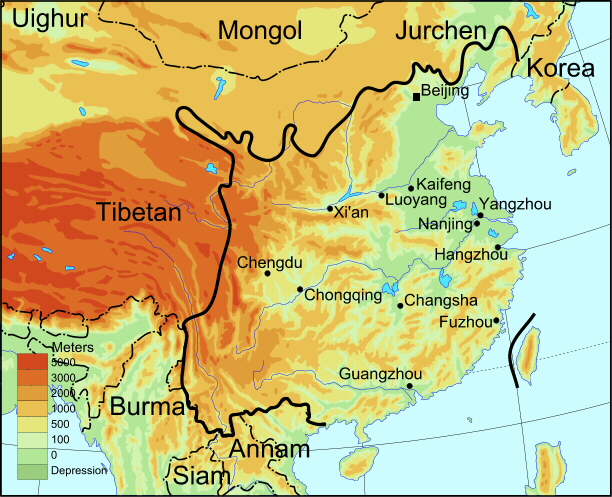
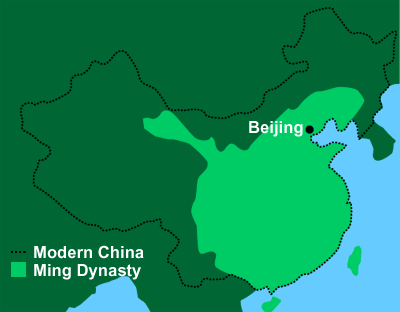
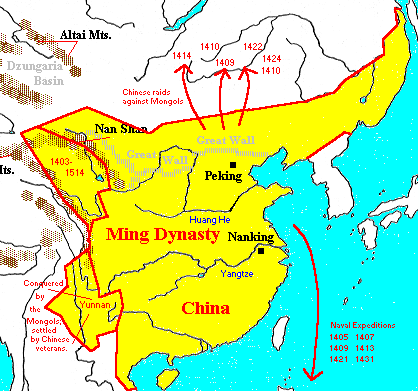


![[3]](http://images.encarta.msn.com/xrefmedia/aencmed/targets/maps/mhi/T028712A.gif)