Haplogroup
From Wikipedia, the free encyclopedia
In the study of molecular evolution, a haplogroup is a group of similar haplotypes that share a common ancestor with a single nucleotide polymorphism (SNP) mutation. Because a haplogroup consists of similar haplotypes, this is what makes it possible to predict a haplogroup from Haplotypes. A SNP test confirms a haplogroup. Haplogroups are assigned letters of the alphabet, and refinements consist of additional number and letter combinations, Example: R1b1. Y-chromosome and mitochondrial DNA haplogroups have different haplogroup designations. Haplogroups pertain to your deep ancestral origins dating back thousands of years. [1]
In human genetics, the haplogroups most commonly studied are Y-chromosome (Y-DNA) haplogroups and mitochondrial DNA (mtDNA) haplogroups, both of which can be used to define genetic populations. Y-DNA is passed solely along the patrilineal line, while mtDNA is passed solely on the matrilineal line.
Classifications of human haplogroups of either sort based on genetic markers, specifically by means of Unique event polymorphisms (UEPs), have been rapidly evolving over the past several years as new markers are found.
Contents |
[edit] Haplogroup population genetics
It is usually assumed that there is little natural selection for or against a particular haplotype mutation which has survived to the present day, so apart from mutation rates (which may vary from one marker to another) the main driver of population genetics affecting the proportions of haplotypes in a population is genetic drift - random fluctuation caused by the sampling randomness of which members of the population happen to pass their DNA on to members of the next generation of the appropriate sex. This causes the prevalence of a particular marker in a population to continue to fluctuate, until it either hits 100%, or falls out of the population entirely. In a large population with efficient mixing the rate of genetic drift for common alleles is very low; however, in a very small interbreeding population the proportions can change much more quickly. The marked geographical variations and concentrations of particular haplotypes and groups of haplotypes therefore witness the distinctive effects of repeated population bottlenecks or founder events followed by population separations and increases. The lineages which can be traced back from the present will not reflect the full genetic variation of the older population: genetic drift means that some of the variants will have died out. The cost of full mtDNA sequence tests has limited the availability of data. Haplotype coalescence times and current geographical prevalences both carry considerable error uncertainties.
[edit] Human Y-chromosome DNA haplogroups
Human Y chromosome DNA (Y-DNA) haplogroups are lettered A through R, and are further subdivided using numbers and lower case letters. Y chromosome haplogroup designations are established by the Y Chromosome Consortium[2].
|
Human Y-chromosome DNA (Y-DNA) haplogroups (by ethnic groups, famous haplotypes) |
|||||||||||||||||||||||||
| most recent common Y-ancestor | |||||||||||||||||||||||||
| | | |||||||||||||||||||||||||
| A | BT | ||||||||||||||||||||||||
| B | CT | ||||||||||||||||||||||||
| DE | CF | ||||||||||||||||||||||||
| D | E | C | F | ||||||||||||||||||||||
| G | H | IJ | K | ||||||||||||||||||||||
| I | J | L | M | NO | P | S | T | ||||||||||||||||||
| N | O | Q | R | ||||||||||||||||||||||
Y-chromosomal Adam is the name given by researchers to the male who is the most recent common patrilineal (male-lineage) ancestor of all living humans.
Major Y-chromosome haplogroups, and their geographical regions of occurrence (prior to the recent European colonization), include:
[edit] Groups without mutation M168
[edit] Groups with mutation M168(mutation M168 occurred ~50,000 bp)
[edit] Groups with mutation M89(mutation M89 occurred ~45,000 bp)
[edit] Groups with mutation M9(mutation M9 occurred ~40,000 bp)
[edit] Groups with mutation M45(M45 occurred ~35,000 bp)
[edit] Groups with mutation M230
[edit] Groups with mutation M70
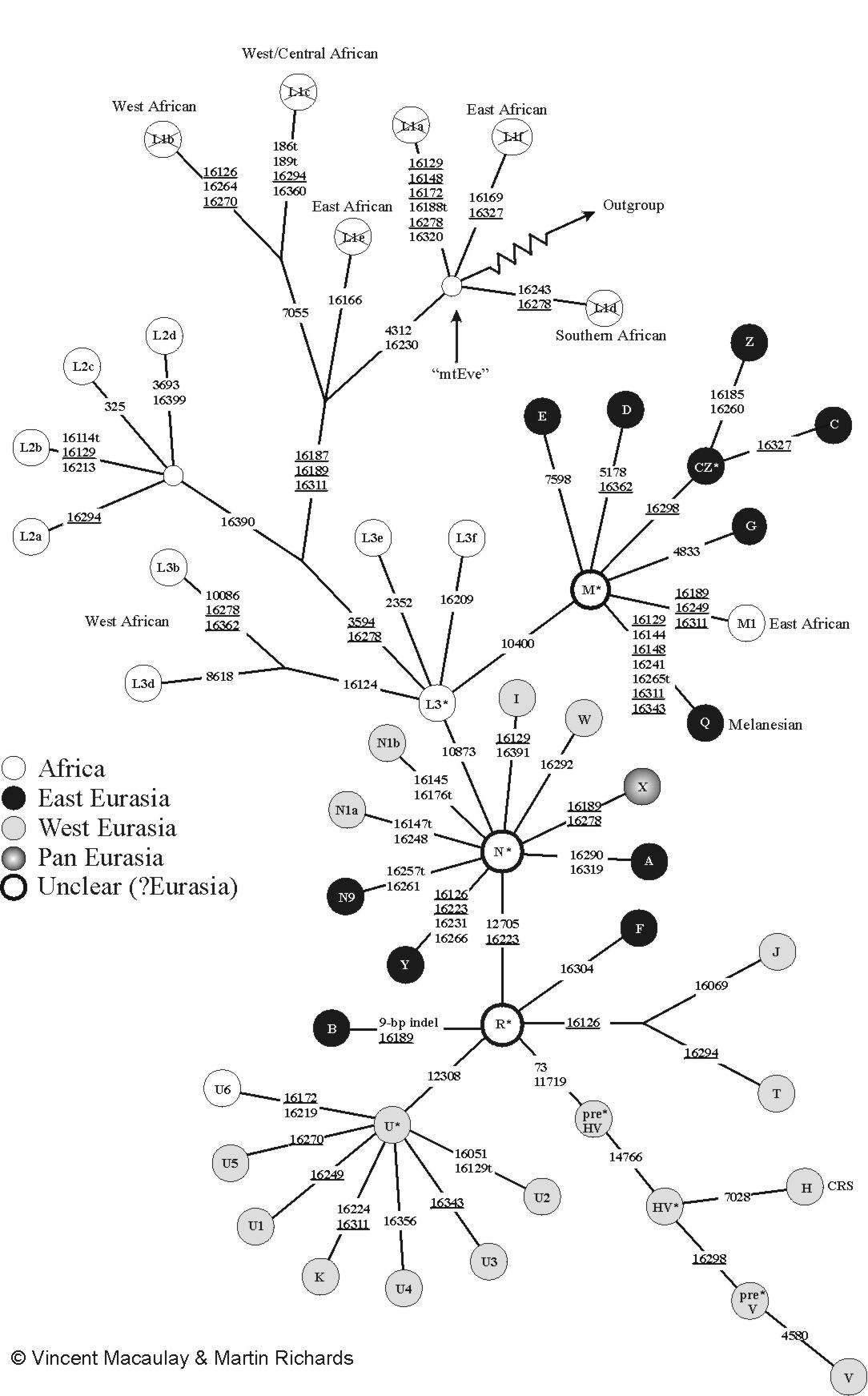
[edit] Human mitochondrial DNA haplogroupsHuman mtDNA haplogroups are lettered: A, B, C, CZ, D, E, F, G, H, pre-HV, HV, I, J, pre-JT, JT, K, L0, L1, L2, L3, L4, L5, L6, L7, M, N, O, P, Q, R, S, T, U, UK, V, W, X, Y, and Z.
Mitochondrial Eve is the name given by researchers to the woman who is the most recent common matrilineal (female-lineage) ancestor of all living humans. [edit] Defining populations
 Haplogroups can be used to define genetic populations and are often geographically oriented. For example, the following are common divisions for mtDNA haplogroups:
The mitochondrial haplogroups are divided into 3 main groups, which are designated by the 3 sequential letters L, M, N. Humanity first split within the L group between L0 and L1. L1 gave rise to other L groups, one of which, L3, split into the M and N group. The M group comprises the first wave of human migration out of Africa, following an eastward route along southern coastal areas. Descendent populations belonging to haplogroup M are found throughout East Africa, Asia, the Americas, and Melanesia, though almost none have been found in Europe. The N group may represent another migration out of Africa, heading northward instead of eastward. Shortly after the migration, the large R group split off from the N. Haplogroup R consists of two subgroups defined on the basis of their geographical distributions, one found in southeastern Asia and Oceania and the other containing almost all of the modern European populations. Haplogroup N(xR), i.e. mtDNA that belongs to the N group but not to its R subgroup, is typical of Australian aboriginal populations, while also being present at low frequencies among many populations of Eurasia and the Americas. The L type consists of Africans, and especially Sub-Saharan Africans. The M type consists of: M1- Ethiopian and Somali populations. Likely due to much gene flow between the Horn of Africa and the Arabian Peninsula (Saudi Arabia, Yemen, Oman), separated only by a narrow strait between the Red Sea and the Gulf of Aden. CZ- Many Siberians; branch C- Some Amerindian; branch Z- Many Saami, some Korean, some North Chinese, some Central Asian populations. D- Some Amerindians, many Siberians and northern East Asians E- Malay, Borneo, Philippines, Taiwan aborigines, Papua New Guinea G- Many Northeast Siberians, northern East Asians, and Central Asians Q- Melanesian, Polynesian, New Guinean populations The N type consists of: A- Found in some Amerindians, Japanese, and Koreans I- 10% frequency in Northern, Eastern Europe S- Some Australian aborigines W- Some Eastern Europeans, South Asians, and southern East Asians X- Some Amerindians, Southern Siberians, Southwest Asians, and Southern Europeans Y- Ainus and Nivkhs; 1% in Southern Siberia R- Large group found within the N type.Populations contained therein can be divided geographically into West Eurasia and East Eurasia. Almost all European populations and a large number of Middle-Eastern population today are contained within this branch. A smaller percentage is contained in other N type groups (See above). Below are subclades of R: B- Some Chinese, Tibetans, Mongolians, Central Asians, Koreans, Amerindians, South Siberians, Japanese, Austronesians F- Mainly found in southeastern Asia, especially Vietnam; 8.3% in Hvar Island in Croatia (Tolk et al 2001) Pre-HV- Found in Arabia and among Ethiopians and Somalis; branch HV(branch H; branch V)- Western Europe, Middle-East; Pre-JT- Arose in the Levant (modern Lebanon area), found in 25% frequency in Bedouin poupulations; branch JT(branch J; branch T)- North, Eastern Europe, Indus, Mediterranean UK- High frequency in Scandinavia, Baltic countries, Mediterranean [edit] Overlap between y-haplogroups and mt-haplogroupsThe ranges of specific y-haplogroups and specific mt-haplogroups overlap, indicating populations that have a specific combination of a y-haplogroup and an mt-haplogroup. Y mutations and mt mutations do not necessarily occur at a similar time, and differential rates of sexual selection between the two genders combined with founder effect and genetic drift can alter the haplogroup composition of a population, so the overlaps are only rough. The very rough overlaps between Y-DNA haplogroups and mtDNA haplogroups are as follows:
[edit] References
3. http://evolutsioon.ut.ee/publications/Tolk2001.pdf [edit] See also
[edit] External links[edit] General[edit] News
[edit] all DNA haplogroups[edit] Y chromosome DNA haplogroups
[edit] Mitochondrial DNA haplogroups |
|||||||||||||||||||||||||||||||||||||||||||||||||||||||||||||||||||||||||||||||||||||||||||||||||||||||||||||||||||||||||||||||||||||||||||||||||||||||||||||||||||||||||||||||||||||||||||||||||||||||||||||||||||||||||||||||||||||||||||||||||||||||||||||||||||||||||||||||||||||||||||||||||||||||||||||||||