King Arthur (film)
From Wikipedia, the free encyclopedia
 |
This article needs additional citations for verification. Please help improve this article by adding reliable references. Unsourced material may be challenged and removed. (March 2008) |
 |
This article or section is in need of attention from an expert on the subject. WikiProject King Arthur or the King Arthur Portal may be able to help recruit one. |
|
|
This article or section is in need of attention from an expert on the subject. WikiProject Military history or the Military history Portal may be able to help recruit one. |
| King Arthur | |
|---|---|
 A USA movie poster for King Arthur |
|
| Directed by | Antoine Fuqua |
| Produced by | Jerry Bruckheimer |
| Written by | David Franzoni |
| Starring | Clive Owen Ioan Gruffudd Mads Mikkelsen Joel Edgerton Keira Knightley Ray Winstone Stephen Dillane Stellan Skarsgård Til Schweiger |
| Music by | Hans Zimmer |
| Cinematography | Slawomir Idziak |
| Editing by | Conrad Buff Jamie Pearson |
| Distributed by | Buena Vista Pictures |
| Release date(s) | July 7, 2004 |
| Running time | 126 min. 140 min. (director's cut) |
| Language | English |
| Budget | $90,000,000 US (est.) |
| Allmovie profile | |
| IMDb profile | |
King Arthur is a 2004 film directed by Antoine Fuqua and written by David Franzoni. It stars Clive Owen as the title character.
The makers of the film claim to present a historically accurate version[1] of the Arthurian legends, supposedly inspired by new archaeological findings. The accuracy of these claims is subject to debate, but the film is unusual in representing Arthur as a Roman soldier rather than a medieval knight.
Contents |
[edit] Plot
Arthur, also known as Artorius Castus (Clive Owen), is portrayed as a Roman cavalry officer and commander, the son of a Roman father and a Celtic mother, who leads a military force of Sarmatian cavalry in Britain at the close of the Roman occupation in 467 A.D. He and his men guard Hadrian's Wall against the Woads, a Celtic people who resist Roman rule, based on the historical Picts,[2] led by their mysterious leader Merlin. He is not the first Arthur - over the years, many of his ancestors have manned the Wall, leading Sarmatian auxiliaries.
As the film starts, Arthur and his remaining men Lancelot (whose voiceover is heard at the beginning and end), Bors, Tristan, Gawain, Galahad and Dagonet - are expecting discharge from the service of the Empire after faithfully serving for 15 years (Lancelot's entry into service as a youth in 452 A.D. is depicted at the very beginning of the film). However, they are dispatched on a final and possibly suicidal mission by Bishop Germanius of Auxerre in the freezing winter to rescue an important Roman family, which includes the Pope's godson, from impending capture by the invading Saxons, who are led by their chief Cerdic and his son Cynric. The knights are charged with this rescue because Rome is retiring from Britain, now considered an indefensible outpost.
In the course of this mission, Arthur encounters and rescues a Woad princess, Guinevere (Keira Knightley), from the imprisonment and torture by the Roman citizen he is charged with rescuing. Guinevere reveals that she is the daughter of Merlin, and Arthur himself is revealed to be half Celt (on his mother's side). His famous sword, Excalibur, is also shown to be his father's, which he drew from the tombstone on Pendragon's burial mound as a boy (inspiring the legend of the Sword in the Stone) in an effort to rescue his mother who died during a Woad attack.
The Roman family is rescued, but the party soon encounter the Saxons at an ice-covered lake. Though greatly outnumbered, Arthur, Guinevere and the knights manage to repel them (by getting the ice to break, drowning many) at the cost of Dagonet's life.
Struck by Rome leaving its subjects to the mercy of the Saxons, Arthur is further disillusioned when he learns that Bishop Pelagius, whose teachings about the equality of all men inspired the brotherhood of his Round Table — has been executed as a heretic by order of Bishop Germanius himself.
In due course, Arthur and his remaining men forsake Roman citizenship and form an alliance with the Woads to fight the Saxons. In the climactic battle, the Battle of Badon Hill, the Saxons are defeated and Cerdic and his son are killed — at the cost of many lives, including Lancelot's and Tristan's.
The film ends with Arthur and Guinevere's marriage. Merlin then proclaims him to be their king. King Arthur and his remaining knights promise to lead the Britons, now united after the Romans leave, against future invaders. The last scene shows Lancelot, Dagonet and Tristan roaming the lands freely as reincarnated horses as told in a legend by Lancelot's father.
[edit] Main cast
- Keira Knightley - Guinevere
- Clive Owen - Arthur
- Ioan Gruffudd - Lancelot
- Mads Mikkelsen - Tristan
- Joel Edgerton - Gawain
- Hugh Dancy - Galahad
- Ray Winstone - Bors
- Ray Stevenson - Dagonet
- Stephen Dillane - Merlin
- Stellan Skarsgård - Cerdic
- Til Schweiger -Cynric
- Sean Gilder - Jols
- Pat Kinevane - Horton
- Ivano Marescotti -Bishop Germanus
- Ken Stott - Marius
[edit] Production
The movie was produced by Jerry Bruckheimer and directed by Antoine Fuqua; David Franzoni, the writer for Gladiator, wrote the screenplay. The historical consultant for the film was John Matthews, an author known for his books on esoteric Celtic spirituality, some of which he co-wrote with his wife Caitlin Matthews. The research consultant was Linda A. Malcor, co-author of From Scythia to Camelot: A Radical Reinterpretation of the Legends of King Arthur, the Knights of the Round Table, and the Holy Grail where the non-Celtic sources for the Arthurian legends are explored.
The film's main set, a replica of a section of Hadrian's Wall, was the largest film set ever built in Ireland, and was located in a field in Ballymore-Eustace Co.Kildare. The replica was one kilometre long, which took a crew of 300 construction workers four and a half months to build. The fort in the film was based on the Roman fort named Vindolanda, which was built around 80 AD just south of Hadrian's Wall in what is now called Chesterholm, in Northern England.
[edit] Connections to Arthurian legend
The film's storyline is mostly original, save for the elements of Saxons as Arthur's adversaries and the Battle of Badon Hill.
Many of the traditional elements of the legends are dropped, like the Holy Grail and Tristan's lover Iseult. The film omits the love triangle between Arthur, Lancelot and Guinevere except for mutual attraction between the latter two.
The knights' characterizations in the legends are also dropped. The boorish and lusty Bors, father of many children, is very different from his namesake whose purity and celibacy allowed him to witness the Holy Grail.
The film does not feature Kay and Bedivere. Along with Gawain, they already appear as Arthur's companions in very early sources, like Culhwch and Olwen in the Mabinogion. The portrayal of Bors, however, is much closer to the traditional depiction of Kay than his legendary namesake.
Lancelot and Galahad are portrayed as having similar ages while according to traditional versions they are father and son respectively (this approach is also found in modern Arthurian fiction - such as Bernard Cornwell's The Warlord Chronicles, in which they are brothers).
In the film, Lancelot fights using two swords. In Arthurian legend the "Knight with Two Swords" is the ill-fated Sir Balin, but this refers to a cursed sword he keeps, not his fighting style.
Guinevere is drastically altered from Arthurian legend - she is portrayed as a barbarian warrior who joins Arthur and the knights in battle. While there was historical precedent for this portrayal (for example, the warrior queen Boudica), no source, early or late, describes Guinevere in this way. Nor is there any evidence for her depiction as a rustic Celt; in fact, in Geoffrey of Monmouth's Historia Regum Britanniae, which contains one of the oldest accounts of the character, Guinevere has Roman blood while Arthur is an indigenous Celt.
Dagonet, a self-sacrificing warrior in the film, has Arthur's court jester as his namesake. The character appears in Le Morte D'Arthur and Idylls of the King.
Tristan has a pet hawk. In Welsh legends, a figure named Gwalchmai is commonly considered identical with Gawain (both are nephews of Arthur); a popular though unlikely proposed meaning of his name is "hawk of May".[3]
The role of traitor, typically ascribed to Mordred, is given a smaller part in the form of a young British scout, played by Alan Devine, who betrays his people to the Saxons. The character is unnamed, but called "British Scout" in the credits. Tristan kills the traitor with an arrow from the other side of Hadrian's Wall during the climactic battle.
Despite the film's historical angle, Merlin was not originally part of the legends. It is generally agreed that he is based on two figures - Myrddin Wyllt (Myrddin the Wild), and Aurelius Ambrosius, a highly fictionalized version of the historical war leader Ambrosius Aurelianus. The former had nothing to do with Arthur and flourished after the Arthurian period. This composite Merlin was created by Geoffrey of Monmouth.
[edit] Historical notes
It would appear that the Arthur depicted in the film is based most closely upon Ambrosius Aurelianus, the Romano-Briton who fought against the Saxons in the 5th century, and was probably the leader of the Romano-British at the Battle of Mons Badonicus (Mount Badon). However, Arthur's full name in the film is Artorius Castus, referring to Lucius Artorius Castus, a historical Roman active in Britain in the 2nd century.[2] It is specified Arthur was given the ancestral name of a legendary leader.
Also, the film is heavily based on the "Sarmatian connection" theory, which holds that the Arthurian legend is based on the activities and legends of Sarmatian heavy cavalry troops, originally from modern-day Georgia, in Britain.[2] Some historians such as Kemp Malone and Linda A. Malcor have proposed that Lucius Artorius Castus himself may have led Sarmatian troops and thus became the "original" historical Arthur; however, since this Artorius lived in the second century, the film's Artorius is probably meant to be his descendant. Despite being Sarmatian, the knights retain their French (i.e. Lancelot) and Celtic-based (i.e. Tristan, original Drustan) names.
[edit] Inaccuracies


Despite the film's historically grounded approach, much artistic licence regarding historical figures, peoples, events, religion and weaponry is taken:
In the film, the Roman legions withdraw from Britain in 467 AD; in reality, it was completed in 410 AD, nearly 60 years before.[4]
Sarmatian cavalrymen did come to Britain in the 2nd century, when 5,500 Iazyges were transported there as auxiliaries during the Marcomannic Wars,[5] but despite the film's suggestions, the evidence for them remaining there until the 5th century is slight. There is some but little evidence for the continued importation of Scythian-born immigrants to late Roman Britain.
The ninth-century Anglo-Saxon Chronicle mentions the arrival of the Saxon leaders Cerdic and Cynric in Britain (at Hampshire) in 495.[6] According to the Chronicle Cynric succeeded Cerdic as king of Wessex in 534 (Cerdic was the founder of the kingdom).[7] Thus the two could not have died at the battle of Mount Badon. The battle is thought to have been fought sometime between 490 to 516.[4]
The Picts are called "Woads".[2][8] This word is a reference to one plant the Picts may have used to make blue paint;[2] however, the use of woad by the Picts is contested by scholars,[5] and the historical Picts were never known by this name.[9] In an interview Antoine Fuqua stated that they used "Wodes" (sic) instead of "Picts" because they thought the latter sounded "a little weird".[10] Nevertheless, John Matthews said in an online article that the name substitution was "meant to echo similar belittling titles given to enemies".[2]
The Saxons are shown attacking Hadrian's Wall from the north. By 467 the Saxons were already occupying parts of Britain far south of the wall,[4] and never invaded Scotland. Later in the film, Cerdic stops a warrior from raping a woman because it would lead to less-than-pure Saxon blood. This is a reference to the long-held belief that the Anglo-Saxons eradicated the Romano-Celts from the eastern part of the island. This contention, largely based on linguistic evidence, has been challenged by modern genetic analysis, which suggests extensive mixing between Anglo-Saxon and Briton populations. Some historians (and fiction writers[11]) have even suggested that Cerdic himself, who bore a Celtic name, was at least part Briton.
Archbishop Germanus' second (and last) mission to Britain was twenty years before (447 AD) and he died the following year.[12] Pelagius is believed to have died decades before 467 AD, likely of old age and nevertheless was not burned at the stake by the ecclesiastical authorities.[13] The Pelagian heresy is misrepresented - it denied original sin, and was not about political freedom as the film implies.[13] The movie implies that the Pope was in control of the Western Empire,[4] although it was actually ruled by the Emperor and de facto controlled by the Magistri Militum and other regional governors.
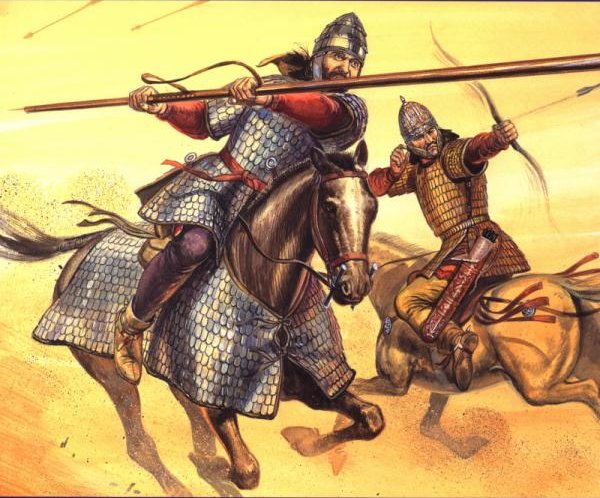
Historically, Sarmatians were armored in the manner of cataphracts (full-length coats of scale armor);[14][15] the film's Sarmatians are armoured with a mishmash of pseudo-Roman, Turkish, Mongol, and Hunnic designs. The Saxons historically used bows (to a limited extent) and spears instead of crossbows during the period. Though there is evidence for the use of some form of crossbows by Romans (calling them manuballistae) and, some claim, the Picts[2] — the weapon was still not widely used in England until much later. Similarly, the Woads use a trebuchet-like weapon to hurl flaming missiles at the Saxons, though the trebuchet was not re-introduced to Britain until the siege of Dover in 1216.[4] The Romans, however, reportedly used an early form of the trebuchet in their sieges.[4] Roman soldiers displayed in the movie are depicted as legionnaires with 2nd century AD armour. By AD 400, legionaries were no longer in use and comitatenses were the new replacements.
The Roman family which Arthur rescues lives north of Hadrian's Wall. This mission would be unlikely because the Wall represented the extent of Roman rule in Britain, except for brief periods of occupation during the second century AD.[4] (It should be noted that Romanized client states such as that of the Votadini did exist north of the wall even into the Sub-Roman era.)
Elements of the film's promotion have likewise been criticized as historically unsound. Its tagline "The True Story Behind the Legend" has been criticized as false.[5][16] A trailer for the film claims that historians now agree that Arthur was a real person because of recent archaeological findings; however, historians do not.[5] There is no consensus amongst historians on Arthur's historicity[17] and no recent archaeological find proves Arthur's existence; the so-called "Arthur stone", discovered in 1998 in securely dated 6th century contexts amongst the ruins at Tintagel Castle in Cornwall, created a brief stir but proved irrelevant.[18][19]
[edit] Reception
 |
Please help improve this article or section by expanding it. Further information might be found on the talk page or at requests for expansion. (March 2008) |
The film received mixed reviews. It has a 32% Rotten rating on Rotten Tomatoes as of 2007-10-10 - with 57 positive of 180 reviews.[20] It has a 6.1/10 rating on the Internet Movie Database as of September 9, 2007.[21]
Some critics viewed the representation of the Roman Catholic Church as unfavorable in comparison to the depictions of pagans, as shown by the unscrupulous Germanus and the priests who help the Roman landowner exploit the British peasants and who lock up Guinevere in prison, as contrasted by the non-Christian knights (especially Lancelot, an atheist) and the freedom-loving Woads.[22] Film critic Fr. Brian Tubbs wrote: "Overall, the film serves up a stereotype of a corrupt, sinister Catholic Church. And Arthur’s character arc goes from idealistic Catholic to neo-pagan. It is Merlin, the pagan mystic, who marries Arthur and Guinevere in the end. And it’s fairly obvious that Arthur is turning his back on more than just the political Rome when he refuses to abandon Hadrian’s Wall in the film’s third and final act."
Robin Rowland criticized critics who disliked the film for its Dark Age setting.[23]
Consultant Linda A. Malcor said: "I think these film-makers did a better job than most could have done when it comes to giving us something besides knights in tin foil and damsels in chiffon. ...[they] deserve a lot of praise for the effort that they made."[16] Fellow Arthurian scholar Geoffrey Ashe's opinion was negative.[16]
[edit] Director's cut
A director's cut of the film has been released; it has extra footage of battle scenes as well as more scenes between Lancelot and Guinevere, whose traditional love triangle with Arthur is only hinted at here.
Several scenes are also omitted from the director's cut, including one where the knights sit around a camp fire asking about their intended Sarmatian life, in which Bors reveals that his children do not even have names, most simply have numbers. In addition, a sex scene between Guinevere and Arthur is shifted to be chronologically after he is informed of the incoming Saxons towards Hadrian's Wall. This seemingly minor change arguably helps the story flow more smoothly. In the original film he is seen in full battle armor, contemplating a broken image of Pelagius on his floor, and then is disturbed by a call to come outside. When he comes outside, he is hastily putting on a shirt, and his hair is disheveled. In the Director's Cut, after an intimate moment between Arthur and Guinevere explaining Arthur's morals, they carry on into their sexual encounter, and are thus disturbed so that Arthur can be briefed on the Saxons. During the sexual encounter, he is wearing the same outfit he wears during the briefing. The scene where he is examining Pelagius's image is removed.
[edit] Notes and references
- ^ A historical approach to the Arthurian legends had already been showcased in film once - in Arthur of the Britons, a 1972-1973 British TV series, and King Arthur, The Young Warlord, a movie-length compilation of some of its episodes.
- ^ a b c d e f g Matthews, John. King Arthur - Key historical facts. Retrieved September 9, 2007
- ^ Bromwich, Rachel. Trioedd Ynys Prydein, pp. 367–371.
- ^ a b c d e f g King Arthur (2004) - 12 factual errors
- ^ a b c d Schultz, Cathy (2004). "KING ARTHUR: Romans and Saxons and Picts, oh my!," History in the Movies
- ^ Anglo-Saxon Chronicle, A.D. 458 - A.D. 500
- ^ Anglo-Saxon Chronicle, A.D. 501 - A.D. 560
- ^ Cathy Schultz, "KING ARTHUR: Romans and Saxons and Picts, oh my!," History in the Movies
- ^ ní Dhoireann, Kym (2004) The Problem of the Woad accessed 1-27-07
- ^ Gilchrist, Todd "Interview: Antoine Fuqua, Keira Knightley and Clive Owen revisit the round table with King Arthur". "It was a little weird in the dialogue when we did a reading, to hear people say 'picts.' It came off kind of odd, for some reason, when they spoke it. So we went with Wodes." accessed 12-18-2006
- ^ Cf. Stephen Lawhead's Pendragon Cycle and David Drake's The Dragon Lord
- ^ "St. Germain", Catholic Encyclopedia
- ^ a b "Pelagius and Pelagianism", Catholic Encyclopedia
- ^ http://www.wargamer.com/articles/gb-articles/dacia/dacia_7.asp
- ^ http://www.civfanatics.net/uploads7/Sarmatian_horsemen.jpg
- ^ a b c Youngs, Ian (2004). "King Arthur film history defended." BBC News Online.
- ^ N. J. Higham, King Arthur, Myth-Making and History (London: Routledge, 2002), pp.11-37 has a good summary of the debate on Arthur's existence.
- ^ "Early Medieval Tintagel: An Interview with Archaeologists Rachel Harry and Kevin Brady", The Heroic Age, 1999
- ^ Green, Thomas. (1998 [2008]) Notes to "The Historicity and Historicisation of Arthur." www.arthuriana.co.uk
- ^ King Arthur at Rotten Tomatoes
- ^ King Arthur at the Internet Movie Database
- ^ USCCB - (Film and Broadcasting) - King Arthur. United States Conference of Catholic Bishops' Office for Film and Broadcasting (2004). Retrieved on 2007-06-16.
- ^ Rowland, Robin (2004). "Warrior queens and blind critics." CBC News
[edit] See also

[edit] External links
- King Arthur at the Internet Movie Database
- "Inspirational Leadership" in King Arthur on Humanscience wikia
|
|||||