Hurricane Gilbert
From Wikipedia, the free encyclopedia
| Category 5 hurricane (SSHS) | ||
|---|---|---|
 Hurricane Gilbert near maximum intensity. |
||
| Formed | September 8, 1988 | |
| Dissipated | September 19, 1988 | |
| Highest winds |
|
|
| Lowest pressure | 888 mbar (hPa; 26.23 inHg) | |
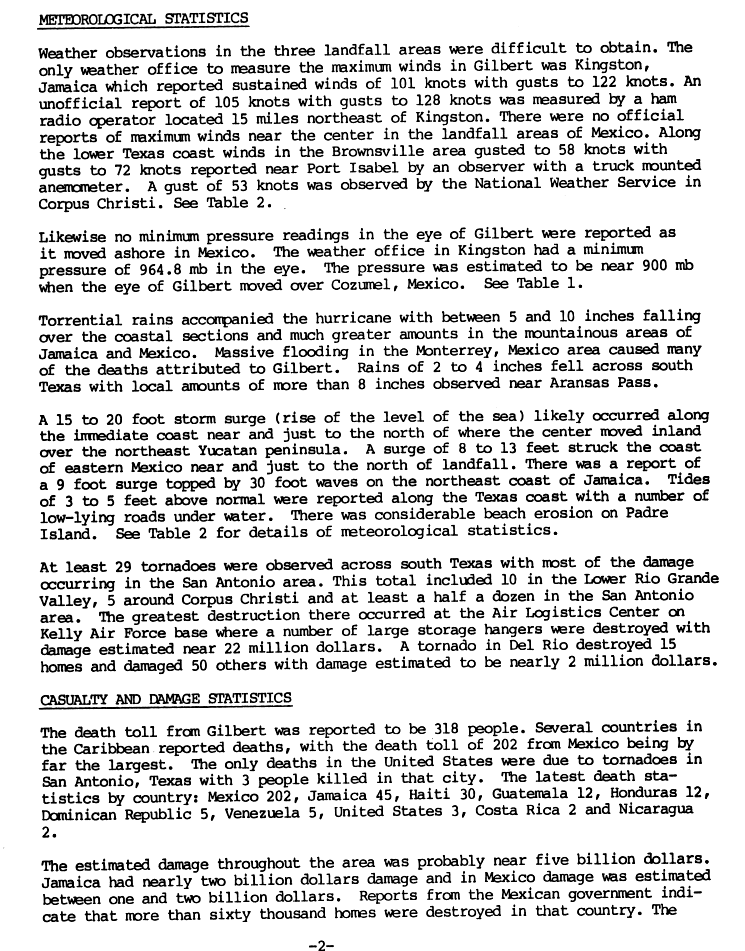
| Fatalities | 341 direct | |
| Damage | $5.5 billion (1988 USD) $10 billion (2008 USD) |
|
| Areas affected |
Windward Islands, Venezuela, Haiti, Dominican Republic, Jamaica, Central America, Yucatán Peninsula, northern Mexico, Texas, South Central United States | |
| Part of the 1988 Atlantic hurricane season |
||
Hurricane Gilbert is the second most intense hurricane ever observed in the Atlantic basin. It was the eighth tropical storm and third hurricane of the 1988 Atlantic hurricane season. Gilbert wreaked havoc in the Caribbean and the Gulf of Mexico for nearly 9 days. In total, it killed 341 people and caused about $5.5 billion (1988 USD, $9.4 billion 2006 USD) in damages over the course of its path.
Contents |
[edit] Storm history


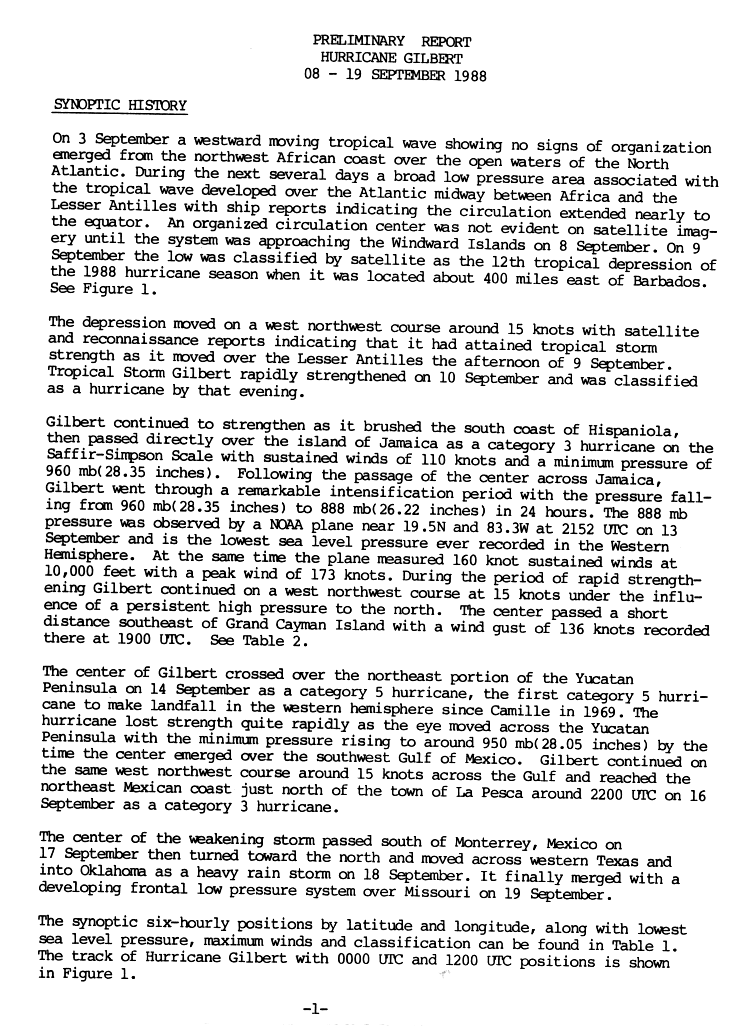
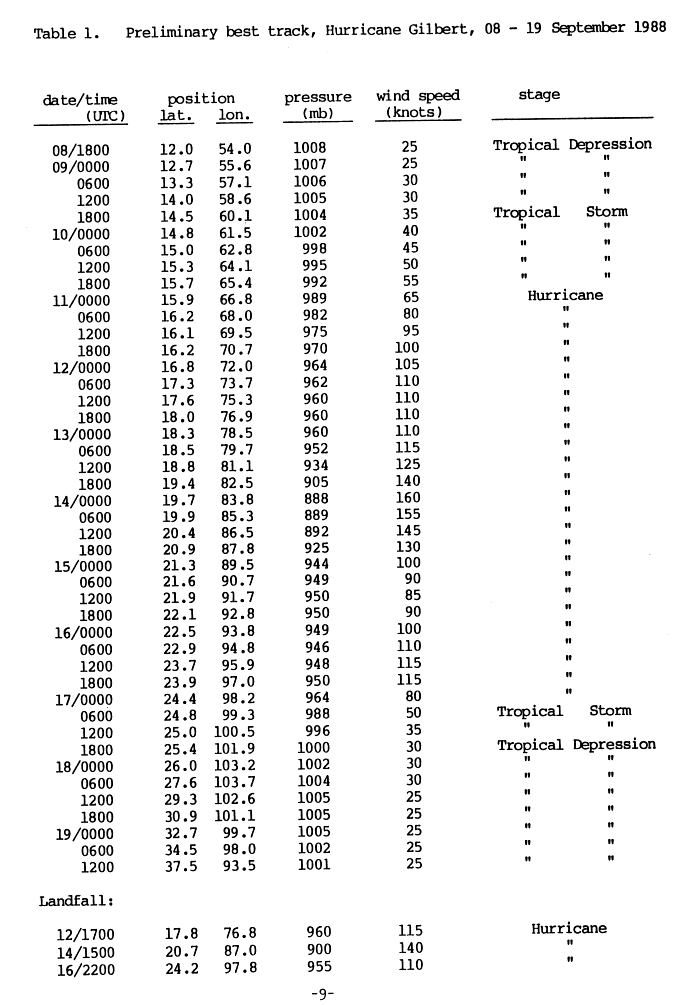
On September 3, 1988, a tropical wave emerged off the African Coast. Over the next several days, a low pressure area slowly developed from this wave, going onto develop an organized circulation center on September 8. Early on September 9 the storm was designated Tropical Depression Twelve, near the Windward Islands about 400 miles (640 km) east of Barbados. It quickly strengthened into Tropical Storm Gilbert that afternoon, becoming the seventh named storm of the season while crossing the Lesser Antilles.[1]

With no inhibiting factors to strengthening, Gilbert quickly became a hurricane late on September 10 and then a major (Category 3) hurricane on the 11th.[2] It moved consistently west-northwest influenced by a strong high pressure system to its north. This movement led to the hurricane's first landfall in Jamaica. The eye passed completely over Jamaica on September 12 with 125 mph (205 km/h) winds and a central pressure of 960 mb (28.35 inHg), making it a Category 3 hurricane on the Saffir-Simpson Hurricane Scale.[1]
| Rank | Hurricane | Season | Min. pressure |
|---|---|---|---|
| 1 | Wilma | 2005 | 882 mbar (hPa) |
| 2 | Gilbert | 1988 | 888 mbar (hPa) |
| 3 | "Labor Day" | 1935 | 892 mbar (hPa) |
| 4 | Rita | 2005 | 895 mbar (hPa) |
| 5 | Allen | 1980 | 899 mbar (hPa) |
| 6 | Katrina | 2005 | 902 mbar (hPa) |
| 7 | Camille | 1969 | 905 mbar (hPa) |
| Mitch | 1998 | 905 mbar (hPa) | |
| Dean | 2007 | 905 mbar (hPa) | |
| 10 | Ivan | 2004 | 910 mbar (hPa) |
| Source: U.S. Department of Commerce | |||

Gilbert strengthened rapidly after emerging from the coast of Jamaica. As the hurricane brushed the Cayman Islands a reporting station on Grand Cayman recorded a wind gust of 156 mph (252 km/h) while the storm passed just to the southeast on September 13. Extreme intensification continued until Gilbert reached a minimum pressure of 888 mb (26.22 inHg) with sustained flight-level winds of 185 mph (295 km/h), having intensified by 72 mbar in a space of 24 hours.[1] This pressure was the lowest ever observed in the western hemisphere and made Gilbert the most intense Atlantic hurricane on record, until it was surpassed by Hurricane Wilma in the 2005 season.
Gilbert made landfall for a second time on the island of Cozumel and then in Mexico's Yucatán Peninsula on September 14 as a Category 5 hurricane,[1][3] making it the first Category 5 to make landfall in the Atlantic basin since Hurricane David hit Hispanola nine years earlier in 1979; the minimum pressure at landfall in Cozumel was estimated to be 900 mb (26.6 inHg).[3] The storm weakened quickly while crossing land before emerging into the Gulf of Mexico as a Category 2 hurricane.[2] Gilbert restrengthened rapidly, however, and made landfall for a final time as a Category 3 hurricane near La Pesca, Tamaulipas, on September 16.
On September 17 Gilbert brushed the inland city of Monterrey, Nuevo León before taking a sharp turn to the north. The storm spawned 29 tornadoes in Texas on September 18 before moving across Oklahoma and being absorbed by a low-pressure system over Missouri on the 19th.[1]
[edit] Impact
| Country | Deaths |
|---|---|
| Mexico | 225[4] |
| Jamaica | 45[3] |
| Haiti | 30[3] |
| Guatemala | 12[3] |
| Honduras | 12[3] |
| Dominican Republic | 5[3] |
| Venezuela | 5[3] |
| United States | 3[3] |
| Costa Rica | 2[3] |
| Nicaragua | 2[3] |
| Total | 341 |
Gilbert claimed 341 lives, mostly in Mexico. Exact monetary damage figures are not available, but the total for all areas affected by Gilbert is estimated to be near $5.5 billion (1988 USD).
American journalist Jules Siegel was living in Puerto Morelos, Quintana Roo, (near Cancún) with his family. The hurricane hit Puerto Morelos dead-on, but the entire town population was evacuated to Cancún. Siegel's account of this experience was published in a local newspaper in Spanish and is available in English on his website.
[edit] Venezuela
Outflow bands from Gilbert produced flash floods in northern Venezuela, which killed five people.[5]
[edit] Jamaica
Hurricane Gilbert produced over 700 mm (27 inches) of rain in the mountainous areas of Jamaica, causing inland flash flooding.[6] About 45 people died.[7] Gilbert was the most severe hurricane to hit Jamaica since Hurricane Charlie in 1951.[8] The storm left $4 billion (1988 USD) in damage. Gilbert also destroyed crops, buildings, houses and roads and even turned small aircraft into shambles.[8]
[edit] Cayman Islands
Gilbert passed 30 miles (48 km) to the south of the Cayman Islands, with a gust of 157 mph (253 km/h) reported early on September 13. However, the islands largely escaped the hurricane's wrath due to Gilbert's rather quick forward motion, and the deepness of the water surrounding the islands limited the height of the storm surge to 5 ft (1.5 m) Nevertheless, there was very severe damage to crops, trees and pastures, and many private homes were ruined.[9]
[edit] Mexico

35,000 people were left homeless and 83 ships sank when Gilbert struck the Yucatán Peninsula. 60,000 homes were destroyed, and damage was estimated at between $1 and 2 billion (1989 USD).[10] In the Cancún region, a further loss of $87 million (1989 USD) due to a decline in tourism was estimated for the months October, November and December in 1988.[11] Rainfall in the Yucatán Peninsula peaked at 13.78 inches in Progreso, Yucatán.[12]
| Rank | Hurricane | Season | Landfall pressure |
|---|---|---|---|
| 1 | "Labor Day" | 1935 | 892 mbar (hPa) |
| 2 | Gilbert | 1988 | 900 mbar (hPa) |
| 3 | Dean | 2007 | 905 mbar (hPa) |
| Source: National Hurricane Center | |||
In northeastern Mexico, heavy rains in and around Monterrey caused tremendous flooding. More than 100 persons died when five buses carrying evacuees were overturned in the raging floodwaters.[10] Rainfall in northeastern Mexico peaked at over 10 inches (250 mm) in localized areas of inland Tamaulipas.[12]
[edit] United States
Despite concerns that Texas might suffer a direct hit, there was only minor damage reported in southern Texas from Gilbert's landfall, 60 miles (97 km) to the south. Winds gusted to hurricane force in a few places, but the main impact felt in the state was beach erosion from a 3-5-foot storm surge, and tornadoes, which mainly affected the San Antonio area.[13]
Oklahoma recorded the highest measurement of rainfall in the United States, 8.6 inches, in Wichita Mountain Wildlife Refuge. Isolated locations in Texas and Oklahoma reported over 7 inches (180 mm), while moderate rainfall of up to 3 inches (76 mm) fell in central Michigan.[12]
[edit] Aftermath
[edit] Jamaica
The hurricane severely damaged all but two medical facilities and 50% of the water supply.[8] In addition, many of the supplies brought to the needed remained in the warehouses and were sometimes stolen.[8]
[edit] Mexico
In Quintana Roo, the Category 5 hurricane defoliated the jungle. The debris fueled a fire that started in 1989, burning 460 square miles.[14]
[edit] Retirement
- See also: List of retired Atlantic hurricane names
Due to its extreme intensity and path of destruction, the name Gilbert was retired in the spring of 1989, and will never be used for another Atlantic hurricane. It was replaced by Gordon in the 1994 Atlantic hurricane season.
[edit] See also

[edit] References
- ^ a b c d e NHC TCR page 1
- ^ a b NHC TCR page 9
- ^ a b c d e f g h i j k NHC TCR page 2
- ^ Reseña del Impacto de los Principales Desastres. Retrieved on 2007-02-11.
- ^ National Weather Service (1988). 1988 Monthly Weather Review. Retrieved on 2006-07-21.
- ^ Preliminary Report: Hurricane Erin 31 July - 6 August 1995
- ^ Annual Summaries: Atlantic Hurricane Season of 1988 Monthly Weather Review, Vol. 117, p. 2248
- ^ a b c d The Hurricane and its Effects: Hurricane Gilbert - Jamaica undated
- ^ Hurricanecity. Grand Cayman's history with tropical systems. Hurricanecity. Retrieved on September 29, 2006.
- ^ a b E. Jáuregui. Climatology of landfalling hurricanes and tropical storms in Mexico. Centro de Ciencias de la Atmósfera, Universidad Nacional Autónoma de México June 11, 2003. Retrieved on October 1, 2006.
- ^ Benigono Aguirre. CANCUN UNDER GILBERT: PRELIMENARY OBSERVATIONS. International Journal of Mass Emergencies and Disasters March 1989, Vol. 7, No.1, pp. 69-82. Retrieved on October 1, 2006.
- ^ a b c David Roth (2006). Rainfall data for Hurricane Gilbert. Retrieved on 2006-10-16.
- ^ Then & Now: The tornadoes of 1988 July 31, 2005
- ^ (July 1998) Natural Hazards of North America (map), National Geographic Society.
[edit] External links
- TPC NHC Hurricane Gilbert (NOAA)
- Hurricane Gilbert Overview (NOAA)
- Hurricanes in the Yucatan (Yucatan Today)
|
||||||||||||||||||||