Hurricane Alicia
From Wikipedia, the free encyclopedia
| Category 3 hurricane (SSHS) | ||
|---|---|---|
 Hurricane Alicia shortly after landfall |
||
| Formed | August 15, 1983 | |
| Dissipated | August 21, 1983 | |
| Highest winds |
|
|
| Lowest pressure | 963 mbar (hPa; 28.45 inHg) | |
| Fatalities | 21 direct | |
| Damage | $2.6 billion (1983 USD) $5.6 billion (2008 USD) |
|
| Areas affected |
Eastern Texas (particularly around Houston) and Louisiana | |
| Part of the 1983 Atlantic hurricane season |
||
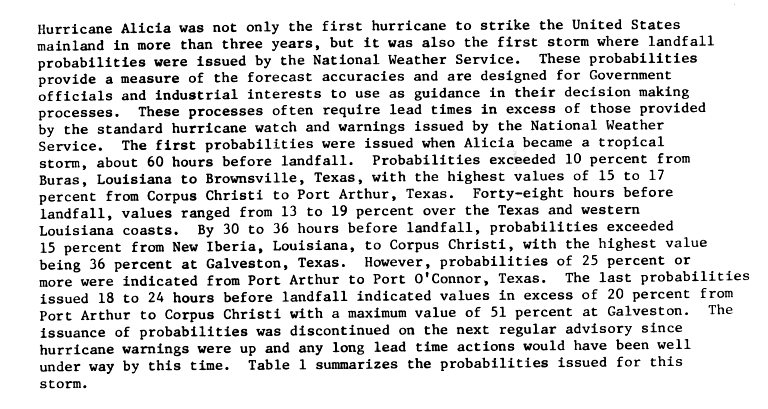
Hurricane Alicia was the third depression, first storm, and the only major hurricane of the inactive 1983 Atlantic hurricane season. It was the first hurricane to strike the United States mainland since Hurricane Allen of the 1980 season. It struck Galveston and Houston, Texas directly, causing $2.6 billion USD ($5.27 billion 2006 USD) in damage and killing 21 people, making it the worst Texas hurricane since Hurricane Carla (1961 season).[1] Hurricane Alicia became the last major hurricane (Category 3 or higher) to strike Texas until the stronger Hurricane Bret in 1999 made landfall. Alicia was the first storm for which the National Hurricane Center issued landfall probabilities.[2] Alicia became Texas' first billion-dollar storm.[3] Hurricane Alicia was notable for the delayed evacuation of Galveston Island (since the eye of the storm traveled the evacuation route up I-45 from Galveston to Houston) and was notable for the new skyscrapers with loose rooftop gravel/objects that shattered many windows in downtown Houston, prompting changes to rooftop construction codes.
Hurricane Alicia hit southeast Texas, becoming the first hurricane to hit the U.S. mainland since Hurricane Allen in September 1980. The time between the two storms totaled out to three years and eight days (998 days). The streak was the longest since a period of almost three years occurred from September 1929 to August 1932.[1]
Contents |
[edit] Storm history


.JPG/125px-Hurricane_Alicia_(1983).JPG)
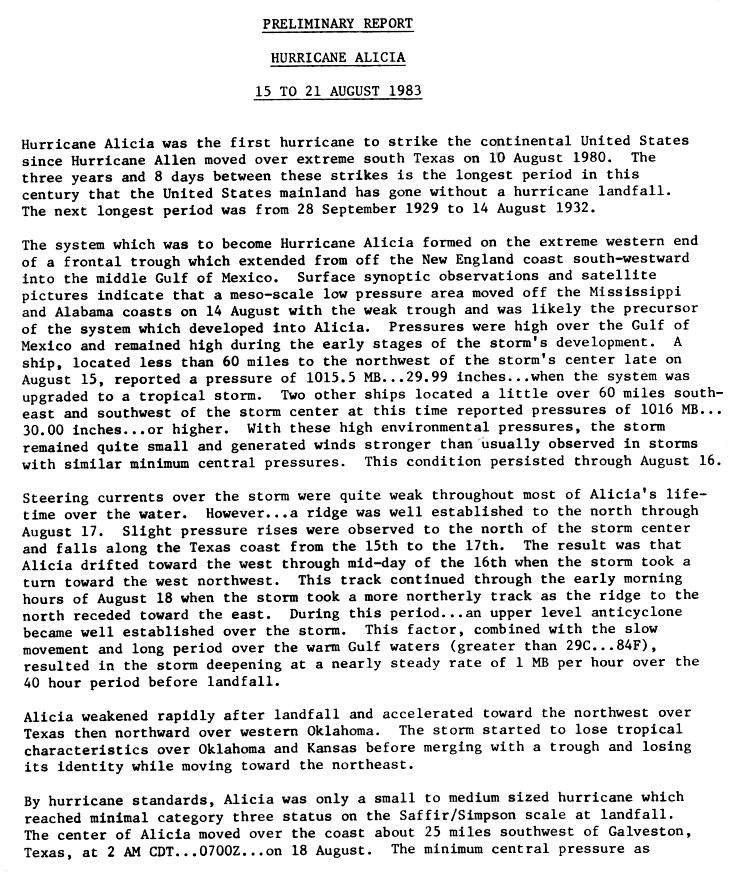
A mesoscale low formed off the Alabama and Mississippi coasts on August 14 with a weak frontal trough that had formed off New England. Pressures were high in the Gulf of Mexico, but the low strengthened into Tropical Depression Three on August 15. A ship located within 60 miles (97 km) of the depression reported a pressure of 1015.5 millibars, and the storm was upgraded to Tropical Storm Alicia late on August 15. With the high Gulf pressures, Alicia was unable to gain size, staying very small, but generated faster winds, and became a Category 1 hurricane on August 16. Steering currents were weak during Alicia's lifetime over water. A new frontal ridge had formed on August 17 which caused the storm to drift in a westerly direction.[1] Alicia continued west until the frontal ridge had subsided to the east.[4] Alicia turned to a more northerly direction on August 18, towards Port Arthur, Texas. During that time, the hurricane began to gain strength at about 1 mbar an hour, peaking at 963 mbar with winds of 115 mph (185 km/h) on the morning of the 18th. Just before landfall, Alicia exhibited a rare "double eye" feature for several hours.[5] The storm made landfall near Galveston, Texas as a category 3 hurricane at about 1:45 a.m. CDT on Thursday, August 18.[1] Alicia weakened rapidly after landfall, losing tropical characteristics and accelerated to the northwest, finally losing its identity in the southeast tip of Nebraska on August 21.[1]
[edit] Preparations
- See also: Tropical cyclone warnings and watches
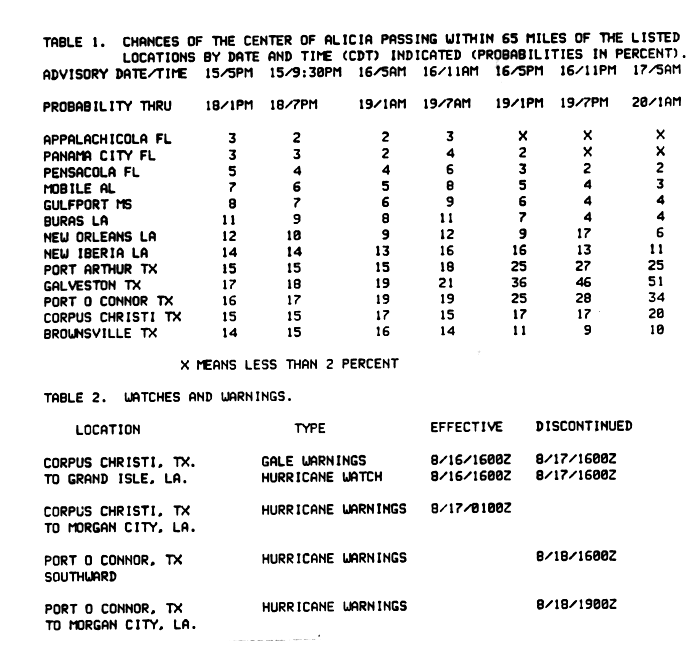
Several watches and warnings were issued in association with Alicia. The first ones were a gale warning and a hurricane watch for the area of Corpus Christi, Texas to Grand Isle, Louisiana issued on August 16. On August 17, a hurricane warning was issued for Corpus Christi to Morgan City, Louisiana and later for Port Arthur, Texas southward.[2] Initially, however, residents did not take the warnings seriously. Galveston Mayor E. Gus Manuel, against the advice of Texas Governor Mark White, ordered the evacuation of only low-lying areas.[6] (About 30 percent of Galveston's population evacuated the island when Hurricane Allen threatened the eastern Texas coastline in 1980; only 10 percent of the population living behind the seawall chose to leave when Alicia came ashore.)[7] Throughout the day, however, as the increasing winds began to cause damage in Galveston, people grew more concerned. The mayor finally ordered a widespread evacuation of the island after midnight on August 18, but by then, the bridges to the mainland were uncrossable.[6]
[edit] Impact
[edit] Texas

Galveston reported 7¾ inches (197 mm) of rain, Liberty reported 9½ inches (241 mm), Greens Bayou reported almost 10 inches (254 mm) of rain. Centerville reported over 8 inches (203 mm), with Normangee and Noxia reporting over 7 inches (178 mm).[8] Maximum rainfall in the Houston area in Harris County was about 10-11 inches (254-279 mm), while 8 inches (200 mm) of rain was reported in Leon County and 9 inches (229 mm) in the Sabine River area. High gusts were reported throughout Texas, with a maximum gust of 125 mph (201 km/h) reported on the Coast Guard cutter Buttonwood (WLB-306) stationed at the northeastern tip of Galveston Island.[5] Pleasure Pier reported tides of 8.67 feet (2.6 m), with Pier 21 reporting a little over 5.5 feet (1.7 m). Baytown, Texas reported 10-12 ft tides, and 12.1 ft (3.7 m) at Morgan City, the highest recorded by Alicia.[8] The storm also caused extensive disruption of power services. At one point Houston Lighting and Power reported about 750,000 homes were without electricity.
Twenty-three tornadoes were reported in association with Alicia, fourteen of those were located in the Galveston and Hobby Airport area. The other nine were concentrated around Tyler to Houston, Texas, ranging around F2 on the Fujita scale.[9] A major oil spill occurred around Texas City, with over sixty gallons having to be cleaned up by the National Weather Service, and an ocean-going tugboat capsized 50 miles (80 km) off the Sabine Pass coast.[10] The Coast Guard Air Station Houston (AIRSTA) weathered Alicia with minimal damage, and afterwards AIRSTA's helicopters assisted residents with evacuation, supply, and survey flights.[11]
The Galveston NWS office (temporarily) lost its radar.[12] Houston suffered billions of dollars in damage. Thousands of glass panes in downtown skyscrapers were shattered by gravel blown off rooftops.[7]

In Galveston, the western beach had its public beach boundary shifted back about 150 feet (46 m).[13] About 5 feet (1.5 m) of sand was scoured, leaving beachfront homes in a natural vegetation state. The beachfront homes after Alicia were in violation of the Texas Open Beaches Act and the Attorney General's office forebade the repair or rebuilding of those homes.[13] The Corps of Engineers stated that if the Galveston Sea Wall had not been there, that another $100 million dollars in damage could have occurred.[13] Also, if Alicia had been the size of Hurricane Carla from 1961, damage could have easily doubled or possibly tripled.[13] Alicia also did damage to chemical and petrochemical plants in Houston.[14]
[edit] Other states
Heavy amounts of rainfall were recorded with 8-14 centimeters in the south-central part of the state, from a curved swath. Rain reached up to 5 inches (127 mm) in the same area, however rainfall was limited to that area. Kansas only got 1-3 inches (25-76 mm), which were recorded in the eastern to central parts of the state. The southeast tip of Nebraska received one inch (25 mm) of rain from Alicia's remnants. Michigan, Iowa, Minnesota, Louisiana and Wisconsin all received one inch of rainfall. [15]
Alicia brought beneficial rains to the Southern Plains, which had been suffering from a drought for much of the Summer of 1983. In the end, Alicia killed 21 people and caused $2 billion in damage ($5.27 billion in 2006 USD).
[edit] Aftermath
The Red Cross had to provide food and shelter to 63,000 people in the hurricane's wake, costing about 166 million dollars.[9][13] FEMA gave out $32 million (1983 USD) to Alicia's victims and local governments. $23 million of that was for picking up debris spread after Alicia.[16] More than 16,000 people sought help from FEMA's disaster service centers. The Small Business Administration, aided with 56 volunteers, interviewed over 16,000 victims, and it was predicted that about 7000 loan applications would be submitted. The Federal Insurance Agency had closed over 1318 flood insurance cases from Alicia's aftermath, however only 782 received final payment.[16]
On September 23 and September 24, 1983, in the wake of Alicia, two subcommittees of the U.S. House of Representatives held hearings in Houston. The hearing on September 23 were to examine the primary issues of the National Weather Service during Alicia, the effectiveness of the N.W.S in current procedures, and the use of the National Weather Service. The second hearing, which occurred on September 24, was to discuss the damage and recovery efforts during Alicia.[16]
During the September 23 hearing, witnesses agreed that the National Weather Service (NWS) did well before and during the emergency caused by Alicia. NWS forecasters also testified in which they said they gratified themselves that their predictions were well "on target" and that the local emergency plans had worked so well, which saved many lives. Mayor Gus Manuel on Galveston claimed that the NWS did an excellent job during Alicia. He was also very impressed about their landfall predictions on August 17, before Alicia made landfall.[16]
During the September 24 hearing, evidence was presented which demonstrated the need for improving readiness to cope with disasters, such as Alicia. Mayor Manuel mentioned that his town needed stronger building codes, which were under review.[16]
[edit] Retirement
- See also: List of retired Atlantic hurricane names
The name "Alicia" was retired in the spring of 1984, becoming the 30th storm name to be retired and will never again be used for an Atlantic hurricane. It was replaced with "Allison" in the 1989 season. The name "Allison" was retired after Tropical Storm Allison caused major flood damage in June 2001, with much of the flooding affecting the same areas damaged by Alicia.
[edit] See also

[edit] References
- ^ a b c d e National Hurricane Center (NHC) (1983). Hurricane Alicia Preliminary Report: Page 1-Storm History. NHC. Retrieved on 2007-04-02.
- ^ a b National Hurricane Center (NHC) (1983). Hurricane Alicia Preliminary Report - Page 4 - Strike Probs - Watches/Warnings. NHC. Retrieved on 2007-04-02.
- ^ Texas State Library (2007). Texas Governors. Texas State Library. Retrieved on 2007-04-02.
- ^ Robert Case and Harold Gerrish (1984). 1983 Monthly Weather Review. National Hurricane Center. Retrieved on 2007-04-02.
- ^ a b U.S. Army (2007). STORM DEVELOPMENT AND HISTORY. US Army. Retrieved on 2007-04-02.
- ^ a b Isaacson, Walter (1983-08-29), “Coping with Nature”, TIME, <http://www.time.com/time/magazine/article/0,9171,949758,00.html>
- ^ a b U.S.A. Today (2007). Hurricane Alicia, 1983. U.S.A. Today. Retrieved on 2007-04-02.
- ^ a b "Hurricane Alicia Preliminary Report: Page 5" (NHC), 1983, accessed 2007-04-02.
- ^ a b National Hurricane Center (NHC) (1983). Hurricane Alicia Prelimary Report - Page 2 - Impact I. NHC. Retrieved on 2007-04-02.
- ^ National Weather Office - Lake Charles, LA (2007). Texas Hurricane History: Late 20th Century. NOAA. Retrieved on 2007-04-02.
- ^ U.S. Military (2007). Houston Coast Guard. U.S. Military. Retrieved on 2007-04-02.
- ^ U.S. Army (2007). Warnings. U.S. Army. Retrieved on 2007-04-02.
- ^ a b c d e National Weather Office - Houston-Galveston (2007). Upper Texas Coast Tropical Cyclones in the 1980s. NOAA. Retrieved on 2007-04-02.
- ^ Mark Levitan (2007). Are Chemical Plants Really Safe?. Louisiana State University. Retrieved on 2007-04-02.
- ^ David Roth (2007). Tropical Cyclone Rainfall: Hurricane Alicia. Hydrometeorogical Prediction Center. Retrieved on 2007-04-02.
- ^ a b c d e Subcommittee on Natural Resources, Agriculture Research and Environment (1983). Hurricane Alicia: Prediction, Damage & Recovery Efforts. (same). Retrieved on 2007-04-02.
[edit] External links
|
||||||||||||||||||||
|
|
|||||||||||||||||||||