Talk:X-ray
From Wikipedia, the free encyclopedia


[edit] inconsistent information
The following figures "10 to 0.01 nanometers, corresponding to frequencies in the range 30 PHz to 30 EHz." seem to not be consistent, since frequency is the inverse of wavelength. 69.117.88.126 (talk) 19:07, 8 June 2008 (UTC)
[edit] X-rays are not defined by their energy !
I speak from a radiation oncology background... x-rays are electromagnetic radtion defined by their source, not their energy. They have typical energies, but theoretically, they can be produced at any energy. In diagnostic radiology, x-rays are produced with low energies, in the kilo-electron-voltage range. In radiotherapy, however, x-rays can be produced by linacs, in the MEGA-electron-volatage range. If a 6 MeV beam is produced by a linear accelerator, x-rays of energies from 0 to 6 MeV is produced, with an average energy of 2 MeV.
A gamma ray comes from the nucleus of an atom. An x-ray comes from outside an atom, eg characteristic radiation, bremmstrahlung radiation, pair production. Some people think gamma rays have higher energies that x-rays. This is not true. They have higher energies than x-rays which are TYPICALLY USED IN DIAGNOSTIC RADIOLOGY. —Preceding unsigned comment added by 203.43.146.219 (talk) 01:06, 11 January 2008 (UTC)
[edit] Old
The third line on the physics paragraph refers to gamma rays as "low energy" when they are instead the highest energy region of the spectrum. I just wanted to bring up this point and let someone with better writing skills modify that paragraph.
A previous entry claimed to quote from Tesla's speech and gave him precedence in discovering x-rays. The actual speech found online says: "The taking of these photographic impressions by means of Crooks bulbs brought freshly to my mind the experiments of Lenard, some features of which, particularly the action on a sensitive plate..."
"...which made me temporarily forget my projects. I had hardly finished the work of reconstruction and resumed the course of my ideas when the news of Roentgen's achievement reached me. Instantly the truth flashed upon my mind. I hurried to repeat his incompletely reported experiments, and there I beheld the wonder myself. Then — too late — I realized that my guiding spirit had again prompted me and that I had failed to comprehend his mysterious signs. . . .But while I have failed to see what others in my place might have perceived..."
So he first claims that Lenard did it before him and then admits he didn't understand it. Rmhermen 04:59, 4 Aug 2003 (UTC)
- I believe he's referring to Lenard's finding that electrons produced by a cathode ray tube can penetrate through thin glass and extend out into the air, causing a glow. This resembles x-ray effects, and in hindsight we can see that they have a different cause.
Ivan Pulyui experimented with X-rays years before Tesla and Roentgen. It is hard to claim who invented the X-ray tubes, as the technology was there throughout Europe. However, there is evidence that Pulyui's work was technically superior to Roentgen's at the same time, in terms of equipment as well as the quality of images produced. Coincidentally, Roentgen was introduced to the work by Pulyui himself, who had demonstrated the photographic images of a broken arm and other objects and introduced the term X-ray in his manuscripts.
http://en.wikipedia.org/wiki/Ivan_Pulyuy
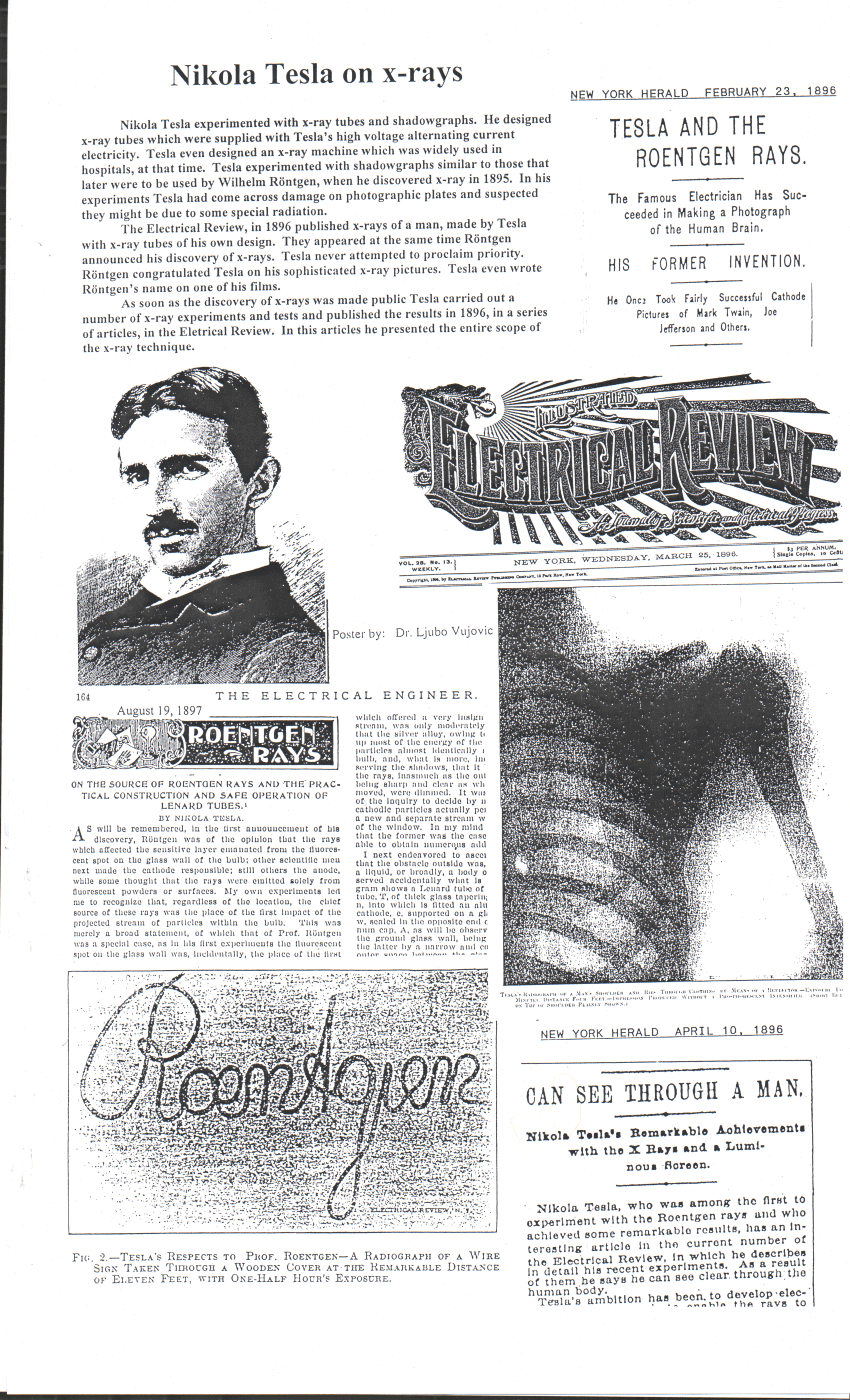
Some quotes on Tesla's priority over Roentgen ...
1892 Tesla discovers x-ray radiation while experimenting with HV and evacuated tubes
Tesla opened a new laboratory. By 1897, he had carried out investigations in the field of X-ray
In April 1887, he established his own laboratory, where he experimented with shadowgraphs similar to those involved in the discovery of x-rays
The Electrical Review in 1896 published X-rays of a man, made by Tesla, with X-ray tubes of his own design. They appeared at the same time as when Roentgen announced his discovery of X-rays. Tesla never attempted to proclaim priority. Roentgen congratulated Tesla on his sophisticated X-ray pictures, and Tesla even wrote Roentgen's name on one of his films. He experimented with shadowgraphs similar to those that later were to be used by Wilhelm Rontgen when he discovered X-rays in 1895.
After a difficult period, during which Tesla invented but lost his rights to an arc-lighting system, he established his own laboratory in New York City in 1887, where his inventive mind could be given free rein. He experimented with shadowgraphs similar to those that later were to be used by Wilhelm Röntgen when he discovered X-rays in 1895.
There are plenty of other sources on tesla and his work on x-rays before Roentgen - reddi 22:38, 4 Aug 2003 (UTC)
- Yes he and several others worked on x-rays. However it was Roentgen who figured it out. He "discovered" it. Rmhermen 00:08, 5 Aug 2003 (UTC)
-
- Just some links ...
- He also took the first x-ray photographs. - http://www.pbs.org/tesla/ll/ll_hifreq.html
-
- The Electrical Review in 1896 published X-rays of a man, made by Tesla, with X-ray tubes of his own design. They appeared at the same time as when Roentgen announced his discovery of X-rays. - http://www.teslasociety.com/biography.htm
- Photos of Tesla's image and news articles - http://www.teslasociety.com/xray.gif
- Lecture. Tesla's independent discovery of X-Ray - http://www.tfcbooks.com/mall/more/351ntl.htm
- He experimented with shadowgraphs similar to those that later were to be used by Wilhelm Röntgen - http://chem.ch.huji.ac.il/~eugeniik/history/tesla.htm and http://www.qsl.net/dominiondx/tesla.htm
Tesla was not aware of certain characteristics of x-rays. X-rays were not discovered yet. He was just working on unknown effect of phosphorescent light and admits in the article we both quote that he did not understand it. Also you have presented no evidence that Tesla took any human photographs before Roentgen or that he ever sent any photograph to him, much less before the publication of Roentgen's work. Also "1896 in the Electrical Review" is after 1895 when Roentgen published. Rmhermen 13:32, Aug 7, 2003 (UTC)
- Tesla's human x-ray photos before Roentgen: In "Tesla: Master of Lightning" by Cheney and Uth there is a very clear x-ray shadowgraph of a high-laced shoe containing a human foot, with visible bones, nails in the sole, etc. The authors state that this photo was made by Tesla accidentally. They also state that it was one of the few things recovered from the rubble of Tesla's 5th Ave laboratory fire. That fire took place many months before Roentgen's first public announcement. So, at the very least, Tesla made an accidental shadowgraph of a human body part. Perhaps at the time of the fire he hadn't yet determined how it happened? --Wjbeaty 01:51, 30 September 2006 (UTC)
The discussion on cathode rays is pretty confusingly written and even seems to imply that cathode rays were X-rays. It needs writing clearly explaining that Cathode rays (which perhaps merit their own page) were originally thought to be rays and were only later found to be streams of electrons. High energy cathode rays can create X rays when they hit something. BozMo(talk)
Are there no articles on X-ray optics; parabolic/hyperbolic kirkpatrick baez /wolter telescopes and the like on wikipedia? :o( --Deglr6328 03:01, 14 Aug 2004 (UTC)
[edit] Röntgen or Roentgen
In 2003, the German language was formally changed to use oe in preference to ö. This change hasn't yet eprcolated through society, and newspapers are still printing Schröder rather than Schroeder, but oe is being taught in schools in preference to ö. Since the wiki entry is Willhelm Röntgen, and the majority of the references in the article were Röntgen, I have changed oe to ö in this article. However, I believe that considering that the official norm in German is now to prefer oe to ö, the wiki should move over to the English spelling of German names. This is, after all, an English wiki, and ö is not an English character. PhilHibbs 13:45, 26 Aug 2004 (UTC)
"In 2003, the German language was formally changed to use oe in preference to ö."
Never heard of that and indeed it doesn't look like it's being followed. Liked to read about it. The ministers of education, who decide what's taught in schools, continue to use it. http://www.kmk.org/index1.shtml
I don't believe that any such change was made in the neue deutsche Rechtschreibung. It also seems somewhat unlikely that the spelling of names would be altered. Hence it remains, as before, Goethe but Schröder. The question of whether names should be Anglicised is a more complex issue. In that sense, certainly, "oe" is at least preferable to just "o" (no umlaut).144.213.253.14 04:59, 26 August 2005 (UTC)
"This is, after all, an English wiki, and ö is not an English character."
You are free to write "oe" instead of "ö", but would it not be better to stick with the original name? It is likly that most people who understand "oe" also understand "ö". The others will not care anyway. —Preceding unsigned comment added by 91.17.177.112 (talk) 14:54, 16 November 2007 (UTC)
The characters are offered when editing, probably to encourage their use in names that have them. --217.230.123.70 10:47, 9 Feb 2005 (UTC)
Hi! I am an Austrian user, and nobody (in Austria, Germany or Switzerland) is using oe instead of ö - except for describing those "Umlaut"s in other language. Since you guys don't have an "ö" on your keyboard, I believe it's ok to use "oe" instead in the title. In the article, though, i would stick with the correct german version... -- Mnolf 07:40, 9 Jun 2005 (UTC)
In addition, please don't translate first names into english, will you? Eugen Goldstein is NOT called Eugene. snottily 11.09.2005
Hi, I am German and have to say (as others stated before): PhilHibbs is perfectly wrong. In the past two days, there were edits which proposed Röentgen, this is even worse than Roentgen or Rontgen. (If you are able to type an ö, why misspell the name?) I reverted them. I think, you should stick to Röntgen, see the article about Wilhelm Conrad Röntgen. --GrGr 07:30, 8 September 2006 (UTC)
[edit] Visible x-rays?
In my opinion, the 'visible' x-rays represent phosphorescence of structures within the eye-ball, rather than truly visible x-rays. I have requested peer review. Axl 14:53, 23 Nov 2004 (UTC)
- If I recall correctly I'm the one who added the majority of the information on X-rays being visible. I am confident that the information I provided in the paragraph at the end of the "Detectors" section is factually and historically accurate (see here:[1]) however, I share your uncertainty about the actual mechanism which makes them visible. The question being, are the X-rays inducing phosphorescence in the retina or aqueous humor itself or are the X-rays directly exciting neurons in the retina OR are they exciting (and destroying?) rhodopsin molecules in the retina conventionally and causing visual signals to be sent? I would guess that because no one is going to be repeating these crazy experiments with X-ray beams on thier eyeballs anytime soon we probably have no real way of knowing for sure so we might just add a mention of this controversy on in the article. X-rays are indeed visible, but HOW and what is our definition of "visible"?--Deglr6328 22:20, 23 Nov 2004 (UTC)
- Okay, that's a sensible solution. Axl 11:51, 24 Nov 2004 (UTC)
[edit] bragg
how about mentioning all the x-ray stuff the braggs http://en.wikipedia.org/wiki/William_Henry_Bragg did on crystals. --ssam
[edit] Propose move to "X-rays"
The article is currently under the name "X-ray", I would like to propose it be moved to "X-rays" instead. The term "X-ray" most often refers to the image taken of an object using X-rays. Thoughts?--Deglr6328 02:06, 6 Feb 2005 (UTC)
- No - first, given that X-ray photographs (i.e. X-rays) are taken using X-rays, I can't see why the page title needs to change. But anyway, pages are generally listed in the singular, unless the plural is the predominant usage. -- ALoan (Talk) 23:01, 6 Feb 2005 (UTC)
-
- Right, this is why I think it should be moved. The article is firstly about the portion of the electromagnetic spectrum not the medical imaging technique and the term "X-rays" is the plural, predominant usage. Just like Gamma rays, cosmic rays etc.--Deglr6328 00:22, 7 Feb 2005 (UTC)
-
-
- But gamma ray, cosmic ray are both at the singular. There is already a separate article on radiography. -- ALoan (Talk) 12:30, 7 Feb 2005 (UTC)
-
[edit] Propose spelling change to "x-ray"
Why is this being spelled with uppercase X in the article??? DIV 128.250.204.118 05:47, 13 January 2007 (UTC)
- In astrophysics the capital X is the preferred form for X-ray/X-rays. Although I can't tell you why that form is used, I would say the article should retain the uses of capital X. Strickdk 15:00, 23 January 2007 (UTC)
[edit] Medical Affects/Early History
Does anyone have better information about the adverse health affects of x-rays, especially during the early evolution of the technology? Several scientists have developed x-ray burns or cancer, sometimes leading to death. Also, according to the History Channel, some scientists early on believed that they could use x-rays to change the skin tone of black people. In short, I think there could be better information about the early experimentation associated with the technology. Tkessler 00:33, Feb 18, 2005 (UTC)
- Yes, I'd like to see a section on health effects too. When were the hazards of x-rays realized and radiographers first start to take precautions? The photo of early x-ray experimenters shows them using no protection at all. Did doctors in the early 1900s who took hundreds of x-rays without shielding die of cancer? What was the dosage of early x-ray radiographs, and particularly fluoroscopy procedures? What are the current national and international dosage limits? --ChetvornoTALK 13:32, 18 January 2008 (UTC)
[edit] Generation of x-rays
I question the phrase: "The basic production of X-rays is by accelerating electrons in order to collide with a metal target (tungsten usually)", specifically the "usually tungsten" part. In my experience, it is rather "usually copper", although this is largely useless information, since the target varies with the application. Therefore, I propose the removal of the remark, or introduction of a list of common targets in its place. However, I must admit I have never encountered a tungsten target. Therefore I ask is this a historical fact, or a target in common use for a particular, specialised application? 144.213.253.14 01:05, 25 August 2005 (UTC)
?? X-ray TUBES virtually always use tungsten targets because of its high Z and high melting point and heat capacity. --Deglr6328 01:16, 11 September 2005 (UTC)
Thanks for your comment, which seems reasonable. Perhaps I should clarify my position. In the course of my work on x-ray crystallography, I have overwhelmingly encountered (in both personal experience and the literature) the use of Cu and Co targets, with occasional mentions of Mo. Maybe you could mention in which field W is commonly used, since it is certainly not in (modern) diffractometers... In my field, the material is chosen according to the characteristic wavelengths of x-ray it produces, rather than the properties you mention. Indeed, as you can see in the table of common x-ray wavelengths (which admittedly I introduced to the article), W is not even present. You also highlight a further deficiency of the phrase by emphasising that it applies only to x-ray TUBES, ignoring, for example, synchrotron x-ray production.210.235.63.243 23:55, 19 September 2005 (UTC)
- Perhaps it should only then be said that MEDICAL X-ray tubes use W anodes. Here [2] is an example of a device using W-Rh anode connected to a Mo-C rotor (Mo-C for its high heat tolerance but low thermal conductivity. Here [3] is another site saying "usually W", and another [http://64.233.161.104/search?q=cache:h6Hz1pV9ppwJ:hsc.csu.edu.au/physics/options/medical/3017/PHY962netdraft.html+x-ray+tube+%22usually+tungsten%22&hl=en[.....--Deglr6328 02:41, 20 September 2005 (UTC)
- Yes, I agree with the crystallography comment. From what I gathered, copper is often used in power/single crystal diffraction studies, and the copper K-alpha peak always seems to be referenced in all the crystallography texts I've read. Perhaps the article could read "...collide with different metal targets, such as copper, in the crystallographic/physics fields, and tungsten, in medical applications." (O.K., that's perhaps a little awkward, but something like that.) Also, if tungsten is used quite often, shouldn't its characteristic spectra be listed in the table to the right? perardi 02:10, 17 December 2005 (UTC)
[edit] Synchrotrons
The article says nothing about using synchrotrons to produce high intensity flows of X-rays. David.Monniaux 09:58, 18 October 2005 (UTC)
[edit] Angstroms to nanometers
can the article be switch to the convention of nanometers (SI) than the out of date angstroms.
[edit] Characteristic X-Ray
This article states, "each element had a characteristic X-ray." What does this mean? Can someone who knows please edit the article to clarify? David 19:35, 14 April 2006 (UTC)
- Characteristic x-rays are x-rays produced by electronic transitions in atoms. They're called "characteristic" because they can often be used to uniquely identify materials. I think this topic is important enough that it deserves to have its own entry; it is a process that is at least as important as bremsstrahlung and should be covered separately. When that article is posted, rather than describe what they are here it can simply be linked to from this page. I haven't changed the entry here since I don't know anything about the discovery of characteristic x-rays. Wilson 6500 04:17, 25 January 2007 (UTC)
[edit] Visibility to the Human Eye
Moved question from the article to here. Perhaps someone can answer it for 24.22.58.165. --BillC 20:51, 5 May 2006 (UTC)
It is commonly thought that X-rays are invisible to the human eye, and for almost all everyday uses of X-rays this may seem true; however, very strictly speaking, it is actually false. In special circumstances, X-rays are in fact visible to the "naked eye". An effect first discovered by Brandes in experimentation a short time after Röntgen's landmark 1895 paper; he reported, after dark adaptation and placing his eye close to an X-ray tube, seeing a faint "blue-gray" glow which seemed to originate within the eye itself.[1] Upon hearing this, Röntgen reviewed his record books and found he in fact, also saw the effect. When placing an X-ray tube on the opposite side of a wooden door Röntgen saw the same blue glow seeming to emanate from the eye itself, but thought his observations were spurious due to the fact that he only saw the effect when he used one type of tube. Later he realized that the tube which created the effect was the only one which produced X-rays powerful enough to make the glow plainly visible and the experiment was thereafter repeated readily. The fact that X-rays are actually faintly visible to the dark-adapted naked eye has largely been forgotten today is probably due to the lack of desire to repeat what we would now see as a recklessly dangerous and harmful experiment with ionizing radiation. It is not known what the exact mechanism in the eye is which produces the visibility and it could be due to either conventional detection (excitation of rhodopsin molecules in the retina), direct excitation of retinal nerve cells, or secondary detection via, for instance, X-ray induction of phosphorescence in the eyeball and then conventional retinal detection of the secondarily produced visible light.
(Query: Is this not the same thing as Cherenkov radiation?) —Preceding unsigned comment added by 24.22.58.165 (talk • contribs)
- No, x-rays are not charged particles. they can not produce cherenkov radiation except possibly through the production of high energy electrons via compton scattering. this mechanism is not intense enough to be relevant in conventional x-ray sources.--Deglr6328 06:34, 17 July 2006 (UTC)
[edit] Photographic plate detector
As far as I can tell, this is nonsense:
"For some procedures, the contrast can have a syrupy consistency, which can be thinned by warming, and is introduced with a power injector, such as the Nemoto Injector."
I left it for now because it seems like it might be saying that contrast can be improved by warming the plate. If that's true, that's what it should say. The rest simply doesn't make sense to me (what is introduced?), and the syrup metaphor is carried unscientifically far ("thinned"), making me think the whole statement is a ruse. If there's no dissent, I (or someone else) will delete it. -- 131.111.100.48 08:56, 3 October 2006 (UTC)
I don't know if it is nonsense or not, either way I was of the opinion that this line was either out of context, badly explained or possibly incorrect. In an effort to improve the readability of the article i have erased it 129.78.208.4 08:05, 7 December 2006 (UTC)
[edit] Reading x-rays an art.
Well, we have just built a state of the art hospital, the year 2006, and new equipment.
I have already heard of two people whose x-rays were incorrectly read, in the negative fashion.
Continued problems led these people to have x-rays taken again, with older equipment, and perhaps more skilled technicians who were able to diagnose a breakage in bones.
So it should be mentioned to people that x-rays, MUST BE READ, by a skilled person, to ensure that they are interperted correctly.
A very, very important element to x-rays; the human element of reading them.
I might suggest a column to emphasis that x-rays must be read, and that the conclusions are not definite as in some other tests.
--Son of Maryann Rosso and Arthur Natale Squitti 21:19, 16 December 2006 (UTC)
- It's proberbly quite universal. One needs to do the homework enough such that one understand the task at hand. Or else failure will happen. I hope people doesn't need it explicitly pointed out that X-Ray diagnosis from a person without a medical degree in radiology + experience is highly doubtful. Electron9 18:13, 21 January 2007 (UTC)
- I agree. Squitti's comment is important, but more relevant to the radiology or radiography articles. --ChetvornoTALK 13:43, 18 January 2008 (UTC)
[edit] This article or section may be confusing or unclear for some readers.
Can someone explain what is so hard to understand in the article? Else the tag should be removed. Electron9 18:15, 21 January 2007 (UTC)
I agree, the article seems perfectly clear to me. - Anon reader, Indiana.
[edit] Why is there 69696969... right below Cu on the table?
I think this should be removed —The preceding unsigned comment was added by 67.190.27.127 (talk) 00:19, 31 January 2007 (UTC).
While on the subject of corrections, the table of targets needs attention. The last line is 'Me', this needs correction but I don't know which element you intended. —Preceding unsigned comment added by 189.182.23.10 (talk) 02:27, 8 November 2007 (UTC)
[edit] The First X-Ray
Nikola Tesla has X-ray shadowgraphs of a foot in a shoe that pre-date Roteogen's supposed first X-rays of a human body part. The Electrical Review in 1896 published X-rays of a man, made by Tesla, with X-ray tubes of his own design. They appeared at the same time as when Roentgen announced his discovery of X-rays. Tesla never attempted to proclaim priority. Roentgen congratulated Tesla on his sophisticated X-ray pictures, and Tesla even wrote Roentgen's name on one of his films. He experimented with shadowgraphs similar to those that later were to be used by Wilhelm Rontgen when he discovered X-rays in 1895. —Preceding unsigned comment added by 98.163.69.213 (talk) 01:51, 18 May 2008 (UTC)
The first x-ray was not taken of Albert von Kölliker's hand, but of Wilhelm Röntgen's wife (Anna Bertha), hence the great big wedding ring!! the x-ray also as appears as his wife's on the article Wilhelm Conrad Röntgen and later in the same article!!!
... I think I will change it......
Update! I have changed the text but donot know how to rename the image philb 18:56, 26 March 2007 (UTC)
- Wedding rings can be used also by men. And the famous image of his wife's hand was much worse. [4]. It was also surprising to me. Miraceti 16:54, 27 April 2007 (UTC)
[edit] is the a separate article for x-rays relating to medicine?
Wondering if there is a separate article for x-rays relating to medicine. Tkjazzer 03:48, 16 June 2007 (UTC)
[edit] Diamonds
Can typical medical X-rays pass through small diamonds? Will they show up on an X-ray? Skittle 20:58, 28 June 2007 (UTC)
[edit] Incredibly sexist.
The name "Curie" does not appear a single time in this article. :( —Preceding unsigned comment added by 81.182.171.118 (talk • contribs) 11:03, 18 August 2007
- Nor does X-ray appear in the Marie Curie article.... Perhaps because the two topics are not related - you may be confusing "X-ray" with "Radioactivity" (which is related). -- MarcoTolo 17:02, 18 August 2007 (UTC)
- There is a section in Marie Curie dealing with radiography, though. Possibly the point at issue is that, although she was preparing radioactive sources for use in radiography as part of the war effort, she did not make any contribution to the development of X-rays. It's not relevant to this article on X rays. --Old Moonraker 07:01, 19 August 2007 (UTC)
[edit] Detection by Photgraphic Plate
The article claims that photographic plates are, "not generally sensitive to X-rays". There are many holidaymakers who could provide an arguement to that statement when airport x-ray scanners used higher levels of x-rays than they do now. I have done industrial radiography, and after the film is extracted to process it, all you are left with is the opaque paper envelope and a thin lead image enhancement screen (bounces the x-rays back to pass through the film again, doubling the sensitivity). There is certainly no phosphorescent screen. Industrial x-ray material is generally the same as medical material - there being no requirement for any difference. —The preceding unsigned comment was added by 20.133.0.14 (talk) 09:26, August 20, 2007 (UTC)
[edit] Proseline tag on History section.
Reading Wikipedia:Proseline#How does one spot proseline?: the emphasis there seems to be on one-sentence paragraphs...bulleted lists [or] sentences within the same paragraph start with a date or year. The section complained of does not meet any of these criteria (although there is a slight tendency towards the last, albeit in separate paragraphs). I propose to revert the tag shortly. --Old Moonraker 13:39, 15 October 2007 (UTC)
- Done--Old Moonraker 11:49, 16 October 2007 (UTC)
[edit] Penetrative power of X-rays
Could someone please describe the penetrative power through matter of the different wavelengths of X-rays? Thank you. —Preceding unsigned comment added by 209.202.16.139 (talk) 20:44, 28 November 2007 (UTC)
[edit] Image
The X-ray article shows the first radiograph of Anna Bertha Ludwig's hand while the article of Wilhelm Conrad Röntgen shows the exact same picture entitled radiograph taken by Röntgen of Albert von Kölliker's hand. One radiograph was taken in November 1895 the other early 1896 but which one is shown in this image? The google search gives more blured images stating that they were taken of Anna Bertha Ludwig's hand. Can anybody help with this problem?--Stone (talk) 10:27, 29 November 2007 (UTC)
- This picture of the first x-ray (linked from Talk:X-ray#The First X-Ray above) shows a different image (larger ring) for Anna Bertha's hand. Most online sources show the picture at present adorning this article as Albert von Kölliker's hand, as indeed did its caption here until recently. To add to the confusion, the image on WP commons is entitled "Roentgen-x-ray-von-kollikers-hand" but described in the text as "the hand of [Röntgen's] wife". The picture should be changed for a copy of the real first image. This version is from NASA and probably copyright-free for WP use but, as Stone points out, it is a bit blurry. To avoid further confusion, the von Kölliker image should be kept as well. I propose doing this in due course, after leaving a period for other editors' observations. Old Moonraker (talk) 14:15, 29 November 2007 (UTC)
I agree with Old Moonraker, and also with Miraceti in the section The First X-Ray earlier on this talk page. The blurry picture looks more like his first effort with Frau Roentgen's hand, especially since it doesn't even include her thumb. Two months later when he gave a public lecture and made an image of Professor Kolliker's hand, he would have had time to improve his technique. And it is certainly logical that he would have published the image of better quality rather than the first one.
The argument over the correct identification of the sharper photo has however been going on for a long time and pre-dates Wikipedia. See for example the (second) letter Whose Hand? in this January 2002 issue of American Physical Society News. Since both images are historically important, I agree with Old Moonraker that both should appear in Wikipedia, at least in the Roentgen article which is more historical. The X-ray article which is more general could have only one, correctly identified of course. Dirac66 (talk) 03:24, 30 November 2007 (UTC)
- Image changed, with citation. I will consider having both on Roentgen's page, to minimise confusion. Old Moonraker 17:31, 3 December 2007 (UTC)
- Also done. --Old Moonraker 18:19, 3 December 2007 (UTC)
[edit] Ivan Pulyui working independently
Yesterday I placed a {{who}} tag on Pulyui's "reputed" donation of his x-ray lamp to Roentgen, admitting that I hadn't been able to find any references to this in English. Thanks, than, to Silin2005 who has just posted this link on Talk:Ivan Pulyui, which throws a little light on the question. He/she also recommends the version on German Wikipedia. --Old Moonraker (talk) 09:03, 5 April 2008 (UTC)
[edit] Astrophysics
If x-ray is spelled upper case only in astrophysics, a general article on x-rays should be lower cased. Can someone elaborate with references on this spelling? I've studied some astrophysics, but don't recall a capital x. I'm wondering if it's British or something? Anyone know more? it's awkward having to capitalize. --Blechnic (talk) 04:05, 17 April 2008 (UTC)
[edit] Physics content isnt so scientific...
A lot of the content in the physics section sounds like it should be in the radiography article, not in an area that would logically describe the physical properties of x-rays. I thought it would be prudent to discuss this first before deleted/moved a good portion of that section. Thoughts? cisco_teen (talk) 08:43, 27 April 2008 (UTC)
[edit] "X-Rays are a hoax"
I'm not sharing Kelvin's "humorous case of hindsight" here. Could someone please explain?--Old Moonraker (talk) 17:44, 29 April 2008 (UTC)
- OK, I'm deleting this impenetrable joke. Please put it into context, with a reference, if you bring it back. --Old Moonraker (talk) 22:16, 5 June 2008 (UTC)
[edit] "Fourth finger"
Pressed "save" before I was ready, sorry. What I would have written was that the "third finger" caption was correct: the ring finger is surely the "fourth digit". Having said that, do we actually need the finger described at all? It can be seen perfectly easily: nobody needs to be told where to look. Again, apologies to User:Britney901 for the "fat finger edit". --Old Moonraker (talk) 21:21, 10 May 2008 (UTC)
[edit] keeping information accessible to non-physicists
Hello. I'd love it someone could include info on the frequency and wavelength of X-rays in the intro section in units that the lay person can more readily understand. I tried to fix this but the edit was reverted by Gail Wilson. Who this person is, and why she wants to keep the article confusing, I do not know. —Preceding unsigned comment added by 69.117.88.126 (talk) 20:36, 5 June 2008 (UTC)
- Indeed an excellent idea, particularly since exa is an uncommon prefix and "P" is non-standard for pico. Anonymous IPs get routinely reverted even when their edits are correct or excellent ideas. Hopefully someone will come along and fix this for you, as you raised an appropriate and excellent point for the quality and accessibility of this article. --Blechnic (talk) 21:41, 5 June 2008 (UTC)
Hi 69.117.88.126! I apologize if you were offended by my reversion of your edit. Here are my reasons:
- Your last edit left the article in a state which did not make sense. Take a look at [5]. The text in parentheses reads "(wavelengths range between 10 mn and )". I assume this was a mistake on your part, which you intended to correct afterwards. However, I would recommend you to use the Preview button before saving in order to catch these mistakes beforehand.
- Although you left an edit summary for your first edit, you did not do so for subsequent edits. It would be better if you leave a short edit summary for each edit you make.
- The wavelengths you were trying to add were already given at the beginning of the sentence. I don't understand why you felt that they should be repeated.
- By changing "P" to "pico", you introduced a factual error. As Blechnic noted, "P" does not stand for "pico", but for "peta", which is completely different.
If you have any further clarifications you would like me to make, please don't hesitate to drop me a note on my talk page. Have a nice day! Gail Wilson (talk) 15:09, 9 June 2008 (UTC)
- I changed the abbreviated units (PHz/EHz) to the full word, and added the scientific notation form in parentheses. I don't know if that's much more helpful, but at least you can read the units now without looking up the high prefixes, I guess? --tiny plastic Grey Knight ⊖ 14:14, 13 June 2008 (UTC)