University of Idaho
From Wikipedia, the free encyclopedia
| University of Idaho | |
|---|---|
 |
|
|
|
|
| Motto: | A Legacy of Leading |
| Established: | January 30, 1889 |
| Type: | Public Land Grant University |
| President: | Timothy P. White, Ph.D. |
| Students: | 11,251 |
| Location: | Moscow, ID, USA |
| Campus: | Rural, 1,585 acres (6.4 km²) |
| Sports: |  Vandals Vandals |
| Colors: | Silver and Gold |
| Mascot: | Joe Vandal |
| Website: | www.uidaho.edu |
 |
|
The University of Idaho is Idaho's oldest public university, located in the rural city of Moscow in Latah County, Idaho. It is the state's land-grant and primary research university. [1] The University of Idaho was the state's only university until 1963, [2] and hosts the state's only law school, which was established in 1909 and accredited by the ABA in 1925. The university's official abbreviation is UI, but is commonly referred to by students and alumni as U of I.
The university was formed by the territorial legislature of Idaho on January 30, 1889, and opened its doors on October 3, 1892 with an initial class of 40 students. The first graduating class in 1896 contained two men and two women. Today, the university has an enrollment exceeding 11,000. The university offers 54 degree programs, from agribusiness to zoology, including bachelor's, master's, doctoral, and specialists' degrees. Certificates of completion are offered in 6 areas of study.
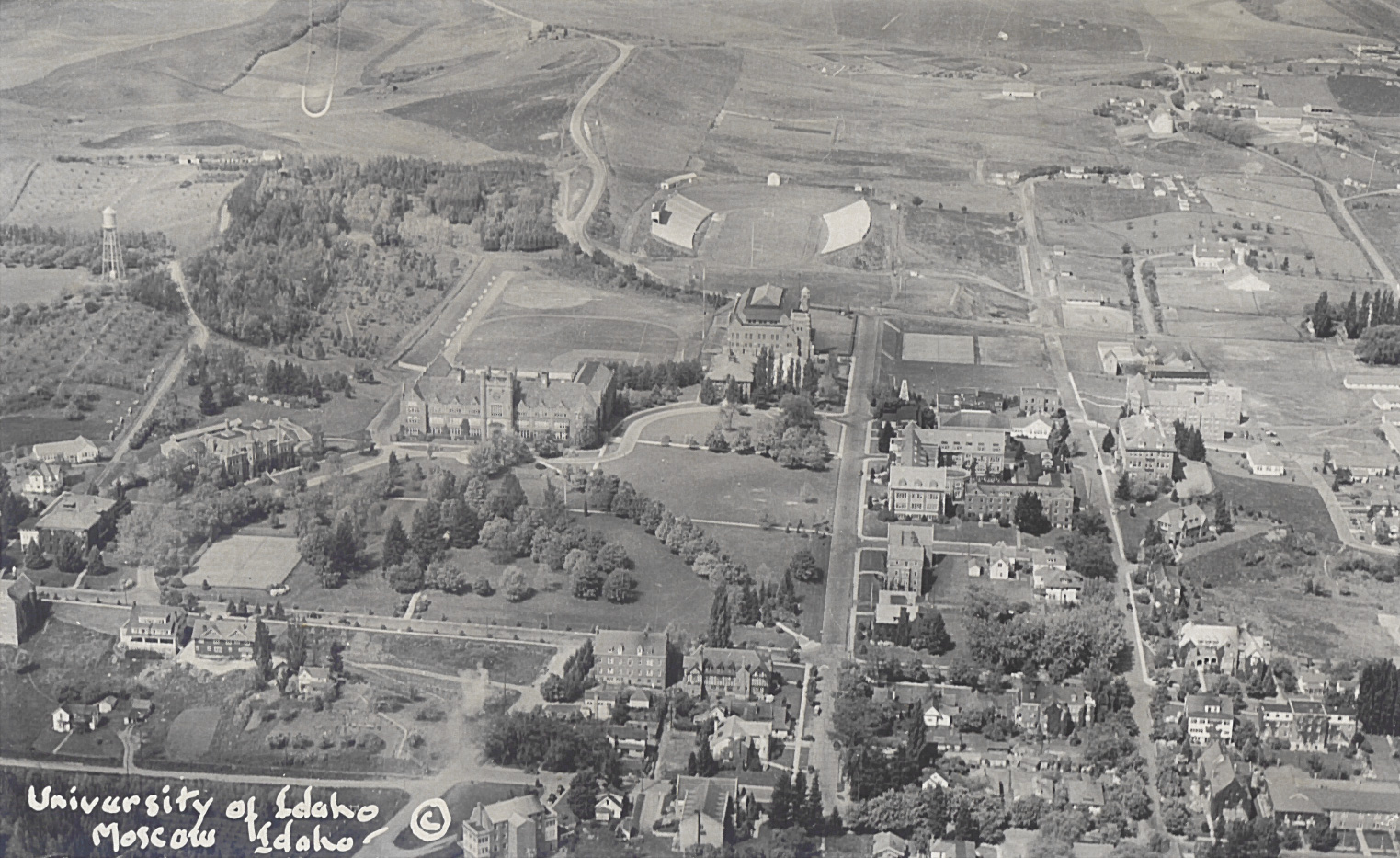
The University of Idaho has one of the most scenic campuses in the western U.S. The Palouse region has hills with rivers and lakes, with mountains nearby, offering a wide variety of recreational opportunities. The master plan for the UI campus was originally designed in 1908 by the Olmstead Brothers, the sons of Frederick Law Olmsted; the same landscape architecture firm from Massachusetts that designed the U.S. Capitol grounds and Central Park in New York City. Other notable campuses designed by the firm include Stanford, California, Washington, and Notre Dame. [3]
As a rural land-grant institution, UI has the largest campus area in the state, located in the rolling hills of the Palouse region at an elevation of 2600 feet (792 m) above sea level. [4] Washington's land-grant institution, Washington State University, is located eight miles (13 km) west in Pullman.
Contents |
[edit] History
 |
To meet Wikipedia's quality standards, this article or section may require cleanup because it is in a list format that may be better presented using prose. You can help by converting this section to prose, if appropriate. Editing help is available. (April 2008) |

On January 30, 1889, Governor Edward Stevenson of the Idaho Territory signed the territorial legislature's Council Bill No. 20, which officially established the UI as the upcoming state's land-grant institution. Nearly four years later, the university opened for classes on October 3, 1892.
- 1896 - first four undergraduate degrees awarded
- 1898 - first graduate degree awarded
- - UI Alumni Association established
- 1899 - UI opens first summer school in Northwest - June 21st
- 1901 - College of Agriculture established
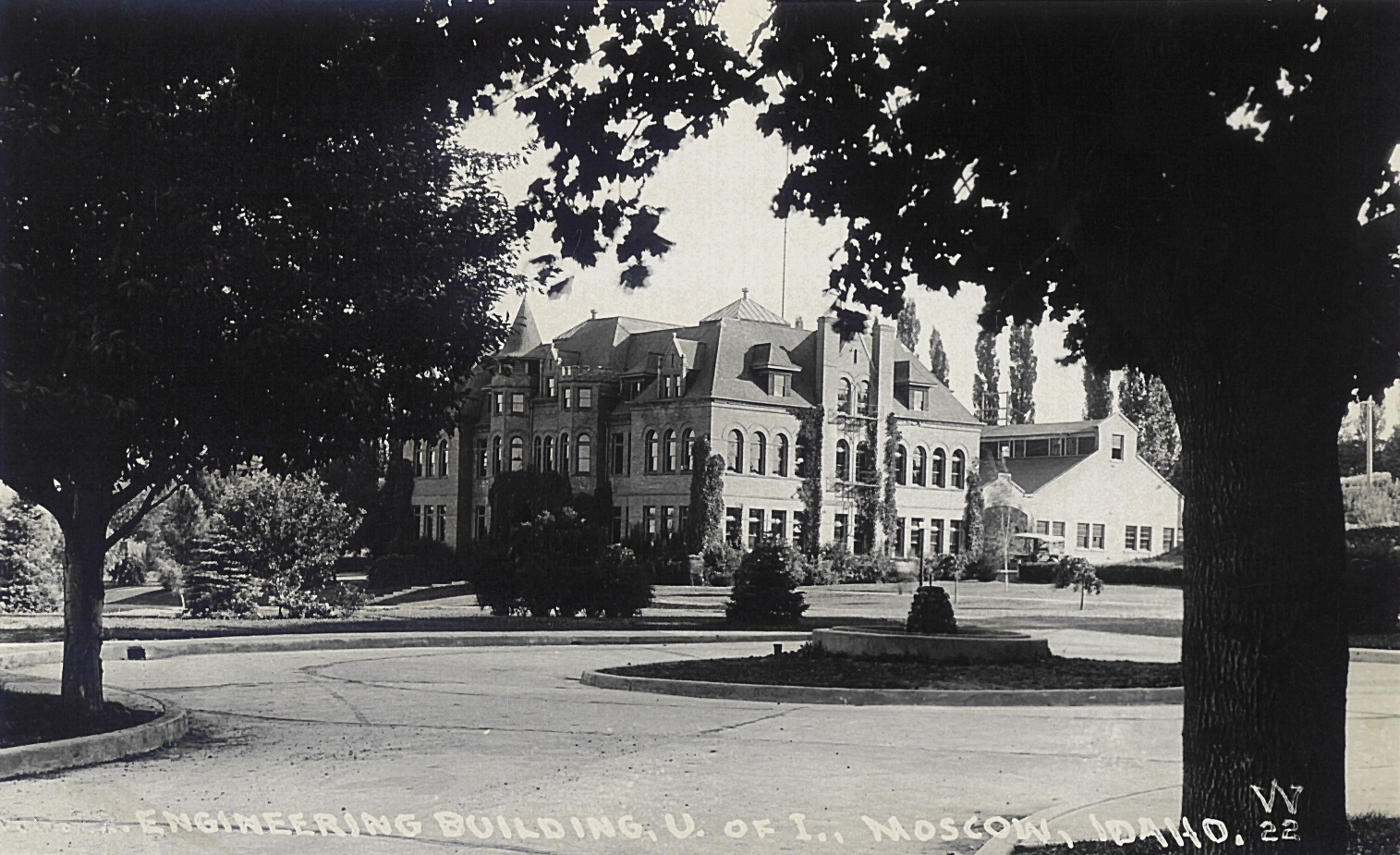
- - original Engineering Building opens (originally Applied Science, then Mines, then Engineering) photo (demolished 1951, unsafe), on site of present Niccolls Building (Home Economics, opened 1952)
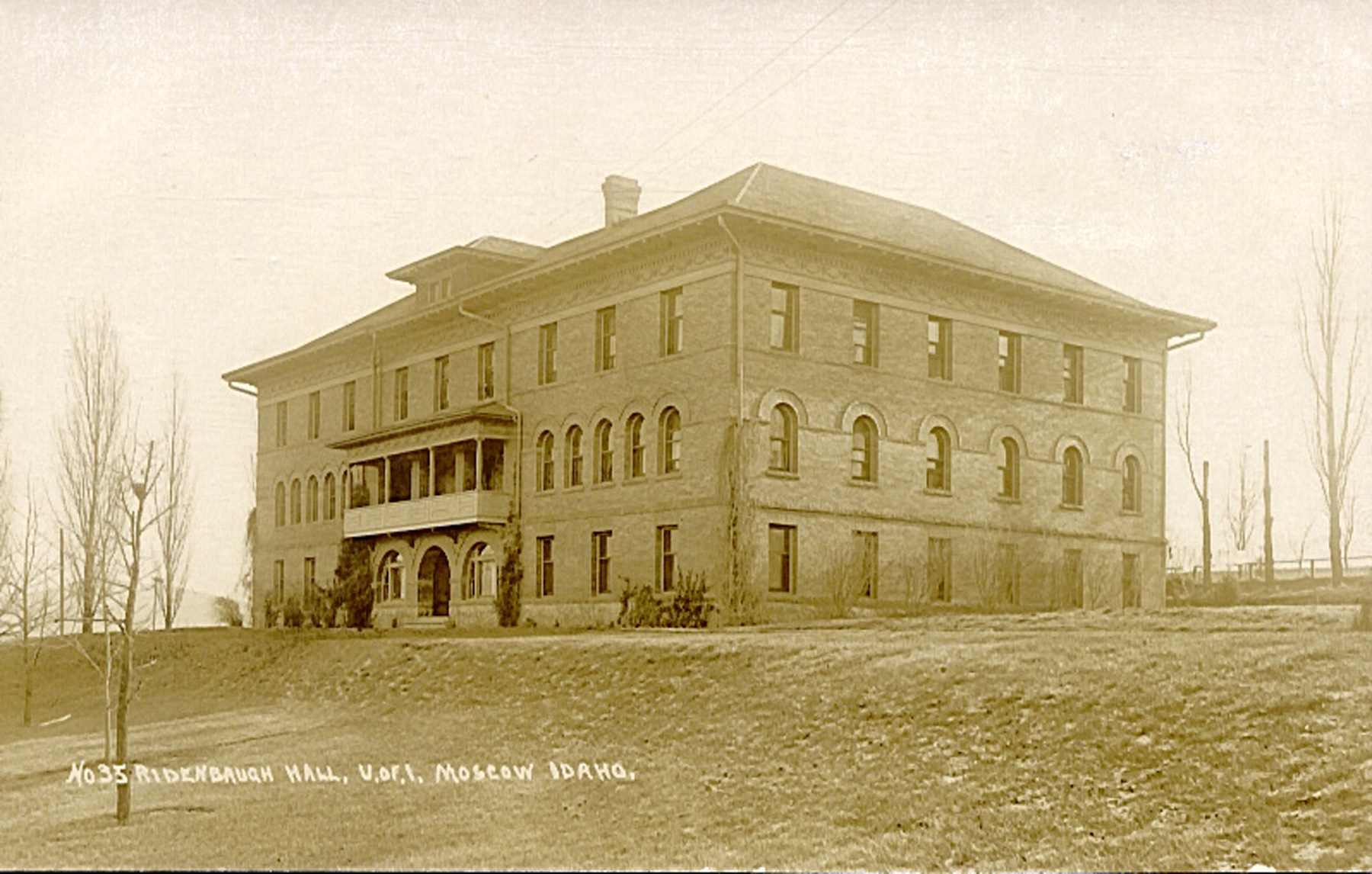
- 1902 - Ridenbaugh Hall completed (photo)
- Department of Domestic Science (later Home Economics) established; first in Pacific Northwest - June 11th
- 1904 - present Art & Architecture South building completed; originally a gymnasium & armory, became Women's Gym in 1928, remodeled for A&A in 1976
- 1906 - original Admin. Building burns down - March 30th - remains dynamited (photo)
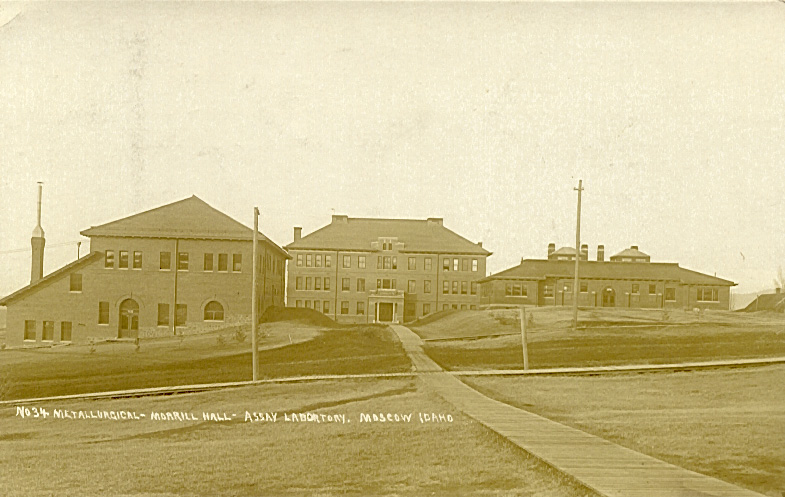
- - Metallurgical Lab completed, became Mines (1950), Psychology (1961), A&A (2001) - Pine St.
- - Assay Building completed - (later Geology), 1955-84 gallery & museum, demolished in 1984 for Life Sciences North (Gibb Hall)
- 1907 - Morrill Hall completed (photo) - using insurance funds from destroyed Admin bldg. - (originally for Agriculture, then Forestry in 1950) - Idaho Ave @ Pine St.
- - College of Engineering established in cooperation with the College of Mines [5]
- - construction of new Administration Building begins
- 1908 - Olmstead Brothers develop master plan for UI campus
- - greenhouses established at current site - 6th St. & Stadium Dr.
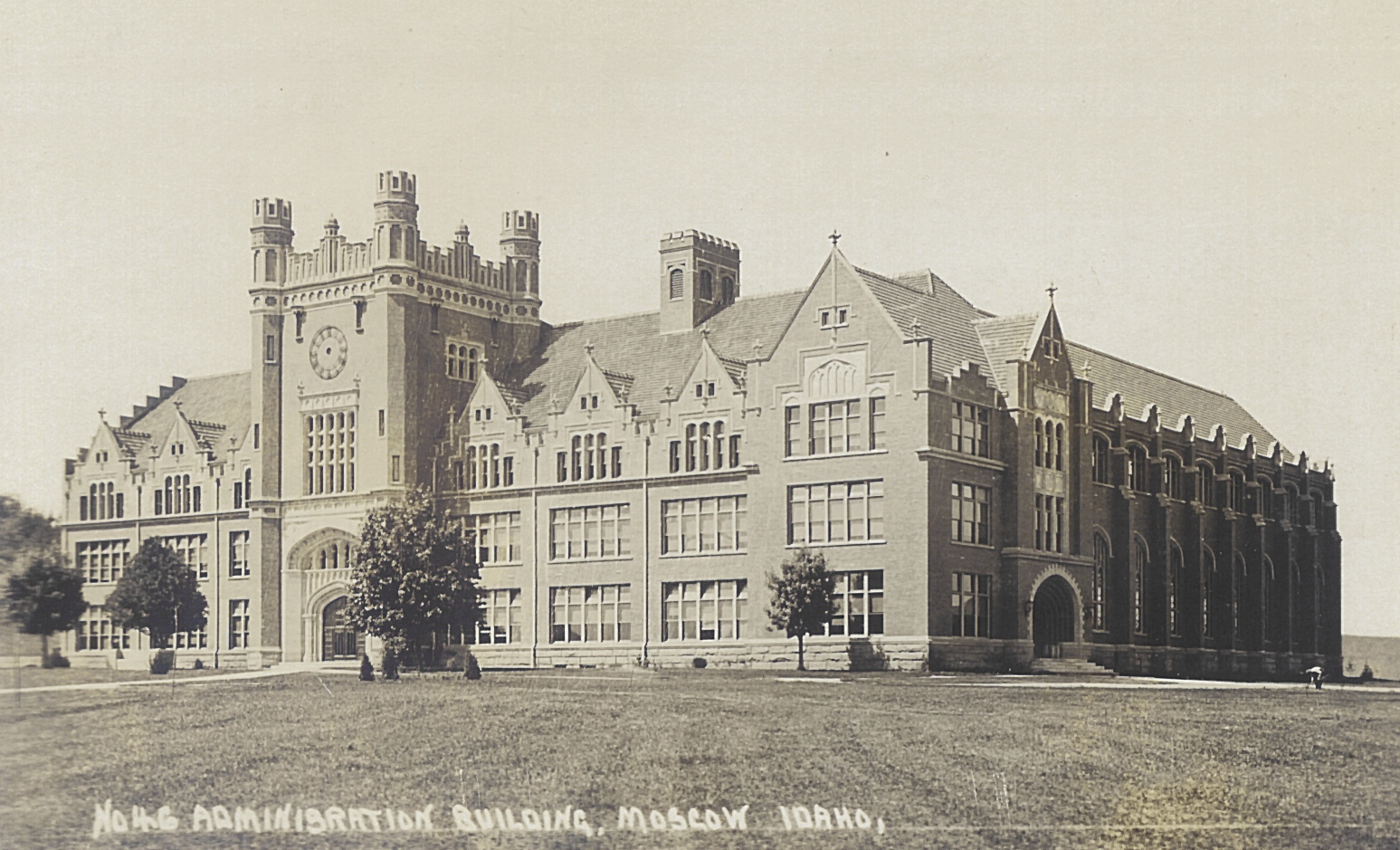
- 1909 - new Administration Building opens (Tudor Gothic)
- 1910 - Arboretum begun by Charles H. Shattuck, head of forestry
- 1911 - Theodore Roosevelt is first U.S. President (former) to visit campus - April 9th - speaker's platform is constructed of bags of wheat (photo)
- - College of Engineering formally established - October 27th [6]
- 1912 - North wing of Administration Building completed (photo)
- 1916 - South wing of Administration Building completed
- 1920 - School of Education established - June 7th
- 1922 - UI joins Pacific Coast Conference - member until mid-1959 when PCC disbands
- 1923 - current Continuing Education Bldg completed; originally Forney Hall (women's dorm)
- 1924 - current Life Sciences South building completed, originally Science Building
- 1927 - current Alumni Center completed, originally Hays Hall (women's dorm)
- - current steam plant bldg completed - NE corner of 6th & Line St.
- 1928 - Memorial Gymnasium completed - honors World War I service
- 1930 - fourth floor added to Morrill Hall
- 1933 - golf course opens (9 holes)
- - second 9 holes added in 1968 (5 holes at NW, 4 at E)
- 1936 - Student Union Building established at former Blue Bucket Inn
- - Student Health Center completed, originally Infirmary
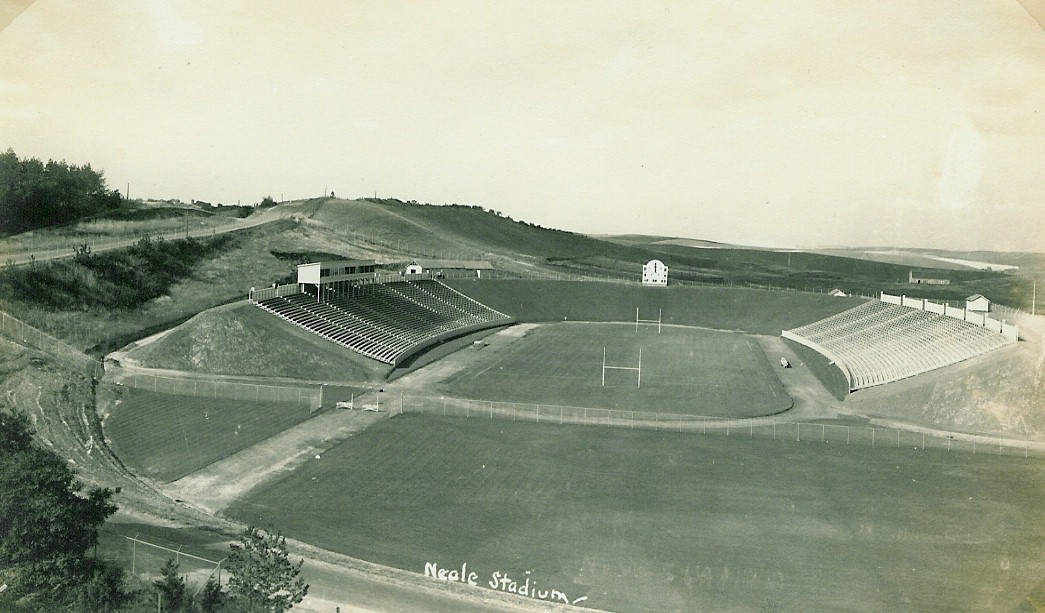
- - Neale Stadium completed (earthen horseshoe - wood bleachers), current site of Kibbie Dome
- - Brink Hall opened - (recent photo) - originally Willis Sweet Hall (men's dorm), then Faculty Office Complex (FOC) East, until renamed in 1982.
- 1938 - Eleanor Roosevelt speaks at Memorial Gym - March 26th
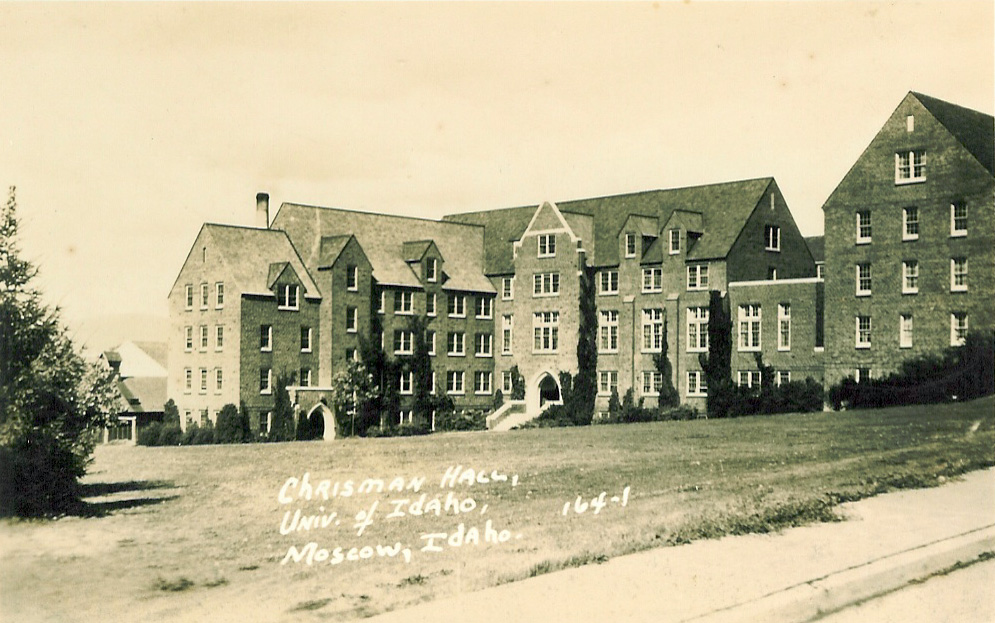
- - Phinney Hall completed (photo) - originally Chrisman Hall (men's dorm); FOC West until 1982.
- 1942 - Gauss ME Laboratory completed - (orig. Kirtley Lab #1: Charles Kirtley was first engineering graduate, class of 1896) - SE corner of 6th & Line St.
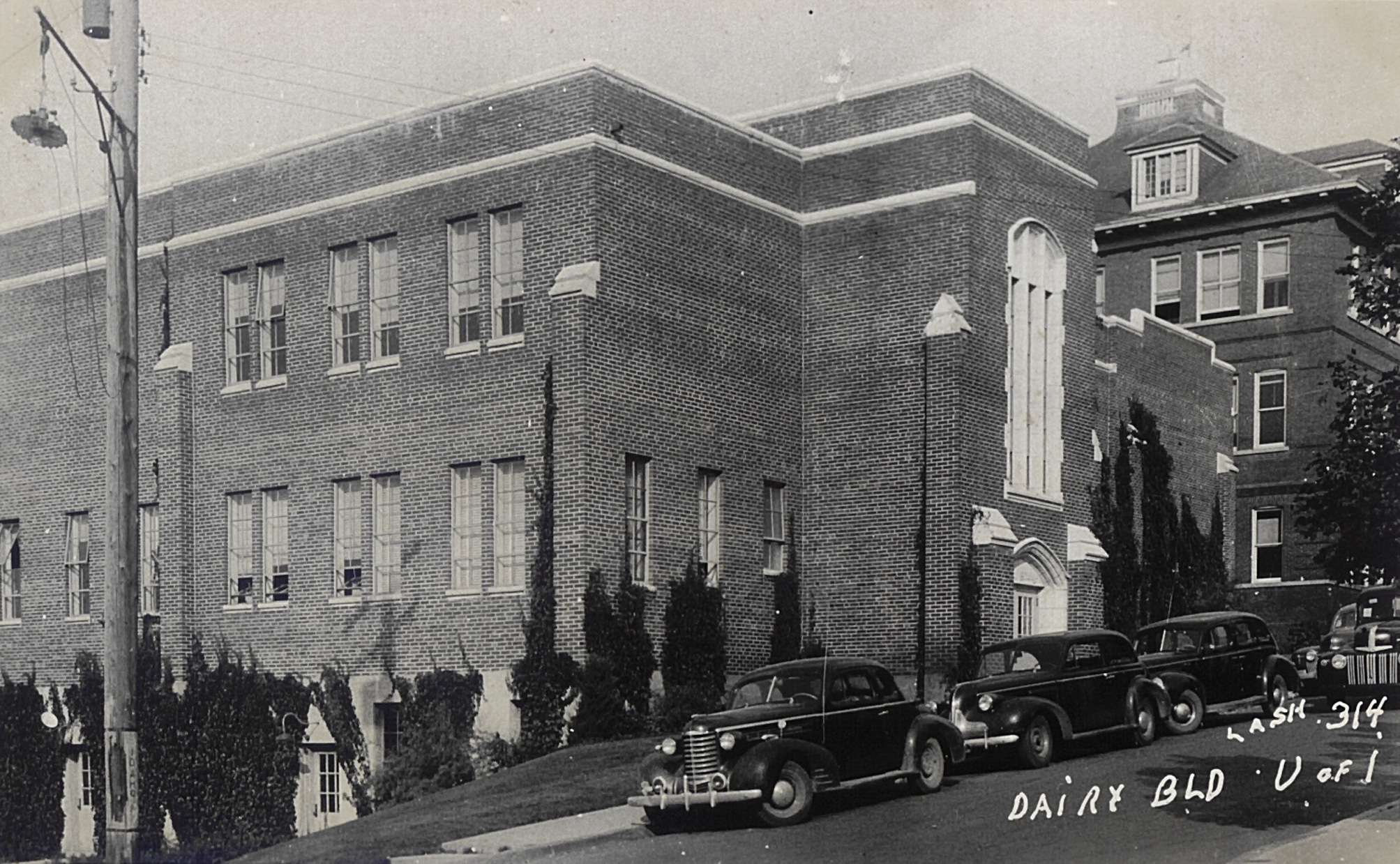
- - Food Research Bldg completed - (orig. Dairy bldg), west side of Morrill Hall (photo) - NE corner Line St. & Idaho Ave.
- 1945 - student radio KUOI-FM (89.3 MHz) goes on the air - November
- 1948 - inaugural Borah Symposium [7] on foreign policy
- 1949 - Engineering Building (classrooms) completed - renamed for Dean of Engineering Alan Janssen in 1951 [8]
- 1950 - Agricultural Science building completed
- - Johnson EE Laboratory completed - (orig. Kirtley Lab #2)
- 1951 - Music building completed (1987 - Lionel Hampton)
- 1952 - new "I" water tower installed - 500,000 gallons - old tower (1916, 60,000 gal.) to UI farm
- - Home Economics building completed - (now Niccolls), on site of old Engineering Bldg (photo), (1901-51, unsafe, demolished)
- 1954 - boxing dropped as a varsity sport - (national co-champs with Gonzaga in 1950)
- 1955 - Gault-Upham Halls (men's dorms) dedicated - October 15th
- 1956 - Gault Hall arson - 3 fatalities, 4th floor - October 19th
- - Arsonist was reporter for UI student newspaper Argonaut, responsible for other campus fires: convicted, paroled in 1968, & died in 1980.
- 1957 - UI Library dedicated - November 2nd (formerly housed in Admin. Bldg), built on former site of tennis courts
- - Park Village Apts. completed (married & graduate) - 3rd & Home St. - demolished 2002
- 1958 - Two Vandals selected in top 50 of 1958 NFL Draft: Jerry Kramer (39th) & Wayne Walker (45th)
- 1959 - Pacific Coast Conference disbands in spring; UI independent for 4 years
- 1961 - College of Mines building completed - north of Morrill Hall
- 1963 - Wallace Complex dormitories (two S.wings, 4 floors each) & cafeteria completed
- - UI joins the new Big Sky Conference as a charter member, but keeps university (Division I) status with non-conference schedule through 1977.
- - campus radio station KUID-FM (91.7 MHz) goes on the air
- 1964 - Physical Sciences building completed - (Renfrew Hall - 1985)
- 1965 - University Classroom Center (UCC) completed, east of library - closed 2003 - reconfigured as Teaching & Learning Center, reopened 2005
- - Third wing (NE, 6 floors) of Wallace Complex dorm completed
- - campus KUID-TV (Ch.12) goes on the air - Idaho Public Television takes over station in 1982
- - current police substation (originally visitor information center) opens - 3rd & Line St.
- 1966 - Art & Architecture (North) building completed
- 1967 - President's Residence (S. side of Shattuck Arboretum) completed
- - Wallace Complex dorm's final wing (NW, 6 floors) completed
- - St. Augustine's Catholic Center opens - February - east of SUB
- 1968 - Buchanan Engineering Laboratory (BEL) completed - (CE, ChE, AgE, EE)
- - inaugural annual UI jazz festival - February - (1985 - renamed Lionel Hampton Jazz Festival)
- - second nine holes at ASUI Golf Course added [9] (5 holes @ NW, 4 @ E)
- 1969 - College of Education building completed
- - built on infield of MacLean baseball field - new baseball field, Guy Wicks Field, built NW of Wallace dorms.
- - Theophilus Tower (12-floor dormitory) completed (twin tower cancelled)
- - golf course's new clubhouse completed
- - Neale Stadium is condemned; destroyed by arson after the season in November, UI football played its two Palouse home games at WSU's Rogers Field
- - UI Wilderness Research Center established at Taylor Ranch field station, located in the Idaho Primitive Area (now the Frank Church-River of No Return Wilderness)
- 1970 - Swim Center & Women's Gymnasium (P.E. Building) completed
- - fire destroys south grandstand of WSU's Rogers Field in April, WSU's plays all its home football games at Spokane's Joe Albi Stadium on new astroturf, UI remains at Rogers Field with reduced capacity.
- - South Hill Apts (married) opens - first phase
- 1971 - College of Forestry Building (Natural Resources - 2000) completed - SW corner of 6th & Line St.
- - Agricultural Science Building addition completed
- - new concrete football stadium opens October 9th with natural grass field.
- 1972 - Tartan Turf installed in completed outdoor football stadium
- - skiing dropped as a varsity sport
- 1973 - College of Law Building completed - (Menard - 1984)
- 1974 - Hartung Theater opens - April - originally the "Performing Arts Center"
- 1975 - football stadium enclosed; becomes the Kibbie Dome - September
- - arched roof and vertical end-walls completed for football home opener - September 27th
- - first basketball games in Kibbie Dome - December
- 1978 - UI descends to Division I-AA (with Big Sky Conference moving up to I-AA from Division II.
- - Don Monson hired as basketball coach
- 1980 - baseball dropped as a varsity sport, after 80+ years
- 1982 - men's basketball team advances to NCAA Sweet 16 in March, finishes 27-3.
- - Dennis Erickson begins head coaching career at UI.
- - Kibbie Dome: East End Addition & composite roof project completed.
- - Idaho Public Television takes over operation of KUID-TV
- 1983 - Agricultural Engineering building completed - (JW Martin - 1990s) - 6th St. & Perimeter Rd.
- 1984 - KUID-FM (91.7 MHz) funding is cut by the state legislature
- - KWSU acquires & renames it KRFA [10]
- - Lionel Hampton's first appearance at the UI Jazz Festival - February
- 1985 - women's swimming dropped as a varsity sport
- - Jazz Festival renamed for Hampton
- 1986 - Life Sciences North building completed - (Gibb - 1993)
- - men's swimming dropped as a varsity sport
- 1987 - School of Music named for Lionel Hampton
- 1989 - Elisabeth Zinser becomes UI's 14th president; first female university president in state history
- - new UI Bookstore completed (in parking lot east of SUB)
- 1990 - Kibbie Dome's original astroturf replaced after 18 years
- - Business Technology Incubator building completed - March - Sweet Ave. & S. Main St.
- - campus post office station moved from library to new UI Bookstore
- 1992 - UI receives its own zip code: 83844 - November
- 1993 - Library's expansion (by 50%) completed in fall - dedicated April 1994
- 1995 - College of Mines & Earth Resources' McClure Hall dedicated - September
- 1996 - UI joins Big West, returns to Division I-A after 18 years - July
- - outdoor track stadium named for new Olympic champion Dan O'Brien - September
- - Engineering/Physics building dedicated - October 4th
- 1998 - Vandal football team wins first Division I-A conference title and bowl game
- - women's soccer added as a varsity sport - fall
- 1999 - renovation of Gauss-Johnson engineering labs completed - November
- 2000 - Idaho Commons opens January 10th, dedicated April 7th - east of UCC (now TLC)
- - College of Forestry, Wildlife, & Range Sciences (FWR) is renamed - becomes College of Natural Resources (CNR)
- 2001 - Cowan Spectrum debuts - February
- - enclosed configuration for basketball in Kibbie Dome.
- - Big West drops football after 2000 - UI becomes a "football only" member in Sun Belt for four seasons (2001-04).
- - Agriculture Biotechnology Laboratory dedicated - October 28th
- - East entrance to campus completed - Sweet Ave. @ S. Main Street
- 2002 - Student Recreation Center - opens in April - north of Theophilus Tower dorm.
- - Budget crisis forces reorganization of colleges - July 1st
- - Letters & Science splits into College of Science and College of Letters, Arts, & Social Science (CLASS).
- - College of Mines & Earth Resources is eliminated, programs to either Science or Engineering
- - J.A. Albertson building (College of Business & Economics) - dedicated October 24th
- - Budget crisis forces reorganization of colleges - July 1st
- 2003 - Living Learning Community - first 5 of 8 dormitories completed on Line Street, east of Theophilus Tower.
- - Gault-Upham dorms demolished
- 2004 - Vandal Athletic Center - opens March 19th - dedicated April 30th
- - enhancement of the Kibbie Dome's 1982 East End Addition.
- - women's swimming reintroduced - fall - (orig. 1972-85)
- - final three dorms of Living Learning Center completed
- 2005 - UI joins the WAC for all sports - July 1st
- - SprinTurf installed on varsity practice fields east of Kibbie Dome - August
- - replaced limited-use natural grass; two fields, each 75 yards (69 m) in length with a goal post, lighting, & fencing; now available for intramurals, misc.
- - Teaching & Learning Center opens (former UCC (1965-2003))
- - SprinTurf installed on varsity practice fields east of Kibbie Dome - August
- 2007 - Kibbie Dome installs "Real Grass Pro" - August
[edit] Campus


According to the UI Facts Books, the Moscow campus is an 1,585 acres (16.4 km²) including 253 buildings with a replacement value of $812 million, 10 miles (16 km) of streets, 49 acres (200,000 m²) of parking lots, 1.22 miles (2 km) of bike paths, 22 computer labs, 150 acre (610,000 m²) golf course with 18 holes, 80 acres (320,000 m²) of arboreta, and 860 acres (3.5 km²) of farms.
There are several distinctive areas on campus.
[edit] Administration Building
The east-facing Administration Building (1909), with its 80-foot (24 m) clock tower, is a UI icon. In addition to numerous classrooms, the offices of the President and Provost are located in the Tudor Gothic-style structure. Theodore Roosevelt spoke at the clock tower's base in April 1911 on a platform built of Palouse wheat (photo); the north wing was completed in 1912, the south wing in 1916.
The original building, with a single tall spire, was constructed through the decade of the 1890s and ultimately finished in 1899, but was reduced to embers in late March 1906. Arson was suspected, but never proven. After the fire there was debate whether to rebuild from the remains or start from scratch; the remaining structure was eventually deemed infeasible to recover and was demolished with dynamite. (photo) (The original building's steps were recovered; they currently climb the small hill immediately southeast of the south wing.)
In the meantime, classes were held at various sites in Moscow; the Carnegie Library, the Methodist church, and local lodge halls. Insurance policies paid $135,000, but the new building cost twice that. To appease the state legislature, the UI Regents decided to build Morrill Hall first, use it for classrooms, and finance the new administration building over three years.
The new Administration building was designed by prominent Boise architect John E. Tourtellotte. He designed the state's Roman Revival capitol building in Boise and other buildings, both public and private. He modeled the new structure after the venerable Hampton Court Palace in England; construction began in 1907. [11]
The 1909 Administration Building was added to the National Register of Historic Places in 1978. [12]
[edit] Idaho Commons
The Idaho Commons is the heart of the campus, with study space, wireless connectivity to the Internet, free laptops, and many other services. Opened on January 10, 2000, the building contains a food court, bookstore, copy center, coffee shop, Credit Union, and convenience store. The offices of the Associated Students of the University of Idaho (ASUI), Academics Assistance, and Student Support are all located here.
[edit] Student Union Building
The Student Union Building houses Financial Aid, Admissions, New Student Services, the Registrar's Office, the office of the Graduate & Professional Student Association(GPSA) and student meeting rooms. There is also wireless access, laptops available for check-out, and a student computer lab. The UI Bookstore is located directly across the street.
[edit] ASUI-Kibbie Activity Center

UI's multi-purpose "Kibbie Dome", home to Vandal athletics, is best appreciated from all angles. Both football and basketball are played here, as well as tennis and indoor track & field. Its Trus-Dek roof system uses wood arches to span 400 feet (122 m) at a height of 150 feet (45 m). The concrete grandstands were completed in 1971 and the arched roof and end walls were completed in 1975, enclosing the former outdoor venue, built on the site of the original Neale Stadium. (photo).
Neale Stadium opened in 1936 as an earthen horseshoe with wooden sideline grandstands. After 32 seasons, it was condemned for structural inadequacies in the summer of 1969. After an idle 1969 season, it was destroyed (by suspected arson) on November 22, 1969. After two years away at nearby Rogers Field in Pullman, the new "Idaho Stadium" opened on October 9, 1971, with new concrete grandstands; the Vandals responded with a victory over Idaho State, an 8-3 season and the Big Sky title.
Tartan Turf, similar to Astroturf, was installed in 1972; the arched roof and vertical end-walls were completed in time for the 1975 football home opener on September 27th, enclosing the stadium to become the Kibbie Dome. Its innovative roof won the Outstanding Structural Engineering Achievement award from the ASCE in 1976.
- - 16,000 bench seating for football
- - 7,000 basketball seating (called the Cowan Spectrum since 2001)
- - 7,500 concert seating
The original Tartan Turf was replaced in 1990 and lasted until 2007, when it was replaced with Real Grass Pro, an infilled synthetic turf (similar to FieldTurf).
[edit] Arboretum and Botanical Garden

Referred to as "Tree City" or "The Arb" by UI students, this 65 acre (26 hectare) site features display gardens, ponds and a variety of trees and plants from Asia, Europe, and North America.
The original Shattuck Arboretum was begun by head of forestry Charles H. Shattuck in 1910, a year after his arrival on campus. His tireless efforts gradually turned a treeless slope southwest of the Administration Building into a dense forest grove. Until the late 1960s this area provided the background for left & center field of the MacLean baseball field (circa 1940 photo), whose infield was displaced by the construction of the Education buildings in 1968). The aboretum was named for Shattuck in 1933, two years after his death.
The newer portion of the arboretum complex is south of the Shattuck area, in the valley below the president's residence (1967), along the eastern edge of the campus' 18-hole golf course. [13]
[edit] Student Recreation Center
Opened in April 2002, the 85,000-square-foot (7,900 m²) Student Recreation Center boasts a 55 foot (17 m) freestanding climbing wall, as well as a weight training area, cardio, 6,000 square feet (557 m²) of climbing area, jogging track, and two full-size gyms.
[edit] UI Library
The UI Library is the state's largest, with more than 1.4 million books, periodicals, government documents, maps, videorecordings, and special collections. Included are those for Sir Walter Scott, and famous Idahoans like Ezra Pound, Vardis Fisher, Frank Bruce Robinson, and Carol Ryrie Brink.
Originally opened in 1957, relocating from the Administration Building, the UI Library was expanded and rededicated in 1994.
University of Idaho Library

[edit] Hello Walk
UI's "Hello Walk" on the Administration Lawn perpetuates a tradition of friendliness that dates from the 1920s. Students today still greet each other with a "hello" on this walkway across the "Ad Lawn."

[edit] Memorial Gymnasium
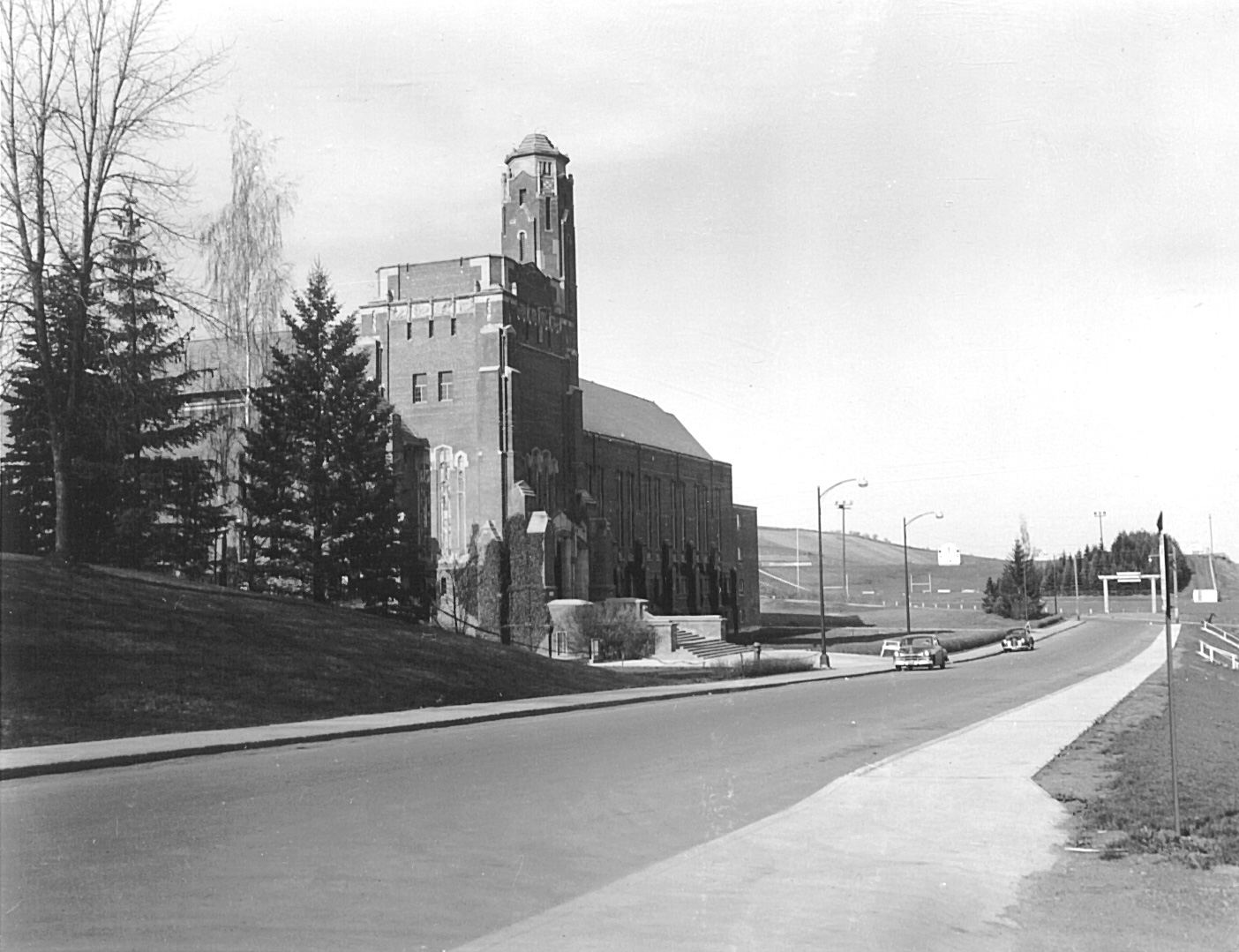
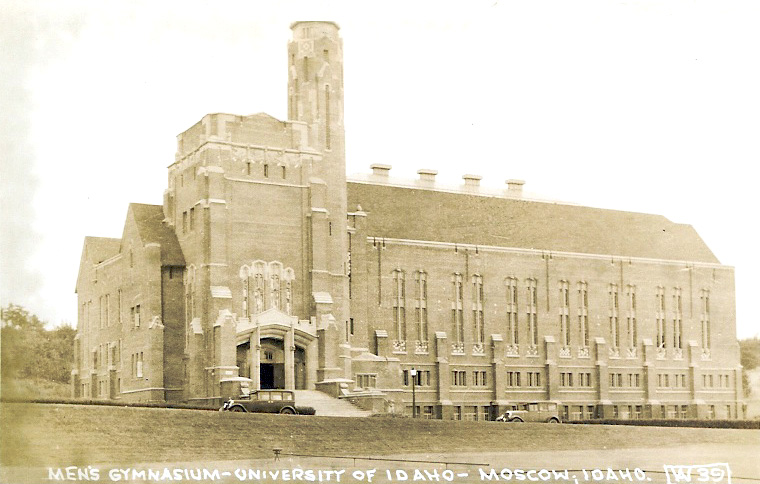
Memorial Gym is another UI icon known for its athletic gargoyles perched along the brick building's ledges. The 1,500 seat multi-purpose arena, which opened in 1928, was built as a memorial to the UI students and alumni who died in World War I (1917-18). [14] (photo 1) (photo 2)
The Memorial Gym was the primary venue for men's basketball until the Kibbie Dome was enclosed in September 1975. The women's team hosted its home games in the gym until 2001, when the Cowan Spectrum (inside the Kibbie Dome) was completed. The "Mem Gym" is still in active use today as the home court for the women's volleyball team, and several early season basketball games. It is also used extensively for intramurals and open recreation, as well as for ROTC. The swim center and physical education (ex-"Women's Gym") buildings (both opened in 1970) are adjacent to the south. The MacLean baseball field was formerly located directly south of the Memorial Gym, its infield was displaced by the construction of the College of Education building in the late 1960s. (photo - circa 1940)
At the young age of just 49 years, the Memorial Gymnasium was added to the National Register of Historic Places in 1977. [15]
[edit] Under the Elms
Rare Camperdown elms line the walkway between the Music building, Child Development Center and Administration Building. These "upside-down" trees have been on campus for over 80 years and are among few of their kind in the Northwest. The Camperdown elm stands out because of its unusual voice. The weeping branches and knotty trunk are formed by being grafted upwards.
[edit] Student life
The University of Idaho is a rural, residential campus, with a number of residence hall communities to choose from on campus as well as fraternities and sororities. Residence halls available for students include Wallace Residence Center, Theophilus Tower, Living Learning Communities, as well as the McConnell Community.
Living on campus is not required at the University of Idaho, but 90 percent of first-year students choose to live on campus.
There are also apartments on campus for families, married couples, graduate students, law students and non-traditional students. The law cluster, is a group of apartments reserved for law students, allowing for a community close to campus for law students, facilitating study groups.
[edit] Transportation

All students are permitted to have cars on campus. Public transportation also serves the campus. The nearest airports are in Pullman 5 miles (8 km) away, Lewiston 34 miles (55 km) away and Spokane 90 miles (145 km) away. The nearest passenger train station is in Spokane, and the nearest bus station is in Moscow.
[edit] Student employment
School employment is available, with approximately 35% of undergraduates working on campus during the 2003-04 academic year. The average amount undergraduates may expect to earn per year from part-time on-campus work is $2,340.
[edit] Student Organizations
Many students participate in a wide variety of clubs and organizations. Clubs range anywhere from the Economics Club to the community service and action club UI Circle K.
[edit] Campus events
The most popular cultural and campus events are the Lionel Hampton Jazz Festival, Palousafest, and NCAA Division I-A football and basketball in the Kibbie Dome, which is transformed into the Cowan Spectrum for basketball.
[edit] Moscow
Moscow is a college town of about 23,000 residents. It is located in the rolling hills of the Palouse region of North Central Idaho. The UI campus is adjacent to the southwest side of town; most stores, restaurants, and taverns are within easy walking distance, with some exceptions.
[edit] Degrees & Colleges
Since 1894, the University of Idaho has granted 66,348 bachelor's degrees, 17,120 master's degrees, 224 honorary degrees, 774 specialist degrees, 2,865 law degrees, and 1,983 doctorate degrees.
The university is organized into ten colleges, two of which are exclusively for graduate students (Law & Graduate Studies).
In 2000, the College of Forestry, Wildlife, and Range Sciences (FWR) changed its name to the College of Natural Resources (CNR).
In July 2002, the College of Letters & Science was split into two separate colleges: the College of Science and the College of Letters, Arts, and Social Sciences (CLASS). Concurrently, the College of Mines was discontinued; its programs were split between the College of Science and the College of Engineering.
- College of Agricultural and Life Sciences
- College of Art and Architecture
- College of Business and Economics
- College of Education
- College of Engineering
- College of Graduate Studies
- College of Law
- College of Letters, Arts, and Social Sciences - formed after split of L&S - 2002
- College of Natural Resources - formerly Forestry, Wildlife, & Range Sciences
- College of Science - formed after split of L&S - 2002
[edit] Degrees
154 undergraduate majors are offered, with a variety of emphases in many. UI also offers 71 master's programs and 25 doctoral degrees, and is home to the state of Idaho's only law school. A complete list of majors can be found at UI's Major Finder.
[edit] Demographics
Moscow enrollment
- Undergraduate - 8,723
- Graduate - 1,836
- Law - 302
- Resident - 8,040
- Non-resident - 3,401
Enrollment by college
- Agricultural and Life Sciences - 1,011
- Business and Economics - 1,205
- Education - 2,096
- Engineering - 1,789
- Law - 302
- Letters, Arts and Social Sciences - 3,862
- Natural Resources - 751
- Science - 773
Student demographics
- Students enrolled from all 44 Idaho counties, 50 states and 92 countries
- 645 international students
- Student population is 54.2 percent male and 45.8 percent female
- 69% In-state students
- 31% Out-of-state students
- 2% American Indian/Alaskan Native
- 3% Asian/Pacific Islander
- 1% African American/Non-Hispanic
- 5% Hispanic
- 84% White/Non-Hispanic
- 1% Non-Resident Alien
- 4% Race/ethnicity unreported
- 80% had high school GPA of 3.0 and higher
- 20% had high school GPA of 2.0 - 2.99
[edit] Athletics
 |
It has been suggested that this section be split into a new article entitled Idaho Vandals. (Discuss) |

The university's official colors are silver & gold (although black & gold are the prevalent colors for the athletic teams). Its teams, the Vandals, participate in the NCAA's Division I-A in the Western Athletic Conference (WAC). In addition to football, the intercollegiate athletic program fields two teams (men's & women's) in the following sports: basketball, cross-country, golf, track (indoor & outdoor), and tennis. Volleyball, soccer, and swimming are sports offered only for women.
[edit] Conference affiliations
UI joined the WAC in July 2005, moving from the Big West Conference, which it had joined in 1996, moving back to Division I-A after 18 years in I-AA. Because the Big West discontinued football after the 2000 season, the UI was a "football-only" member of the Sun Belt Conference for four seasons (2001-04).
Prior to July 1996, UI competed in the Big Sky Conference for 33 years; it was a charter member in 1963. The Big Sky has been a Division I-AA conference since I-AA's formation in 1978, but from 1963-77, the conference was a "college division" (later Division II) for football. Although a charter member of the Big Sky, Idaho maintained its "university division" (Division I) status, with its additional football scholarships, by playing a non-conference schedule of Division I teams. Idaho moved down to the new I-AA division in 1978 as the Big Sky moved up from Division II.
From 1922-58, Idaho competed with eight of the present Pac-10 schools as a member of the Pacific Coast Conference. The PCC disbanded in the spring of 1959; Idaho then competed as an independent for four years until the Big Sky was launched in 1963. [16]
[edit] Facilities
The University of Idaho has numerous on-campus facilities for the athletic program. [17] The Kibbie Dome indoor stadium also houses the athletic department offices, locker rooms, weight room, and training facilities. The 16,000 seat arena, enclosed in 1975, is the venue for football and basketball. Since 2001, massive black curtains have been hung around the basketball seating configuration and the arena is called the "Cowan Spectrum." The Kibbie Dome's indoor facilities offer track & field and tennis a place to practice and compete with the five-lane, 290 meter track and nine tennis courts.
The historic Memorial Gymnasium (1928) is the home for women's volleyball, and also hosts early season basketball games. South of the "Mem Gym" is the Swim Center and the P.E. Building (formerly the new "Women's Gym"), which houses practice gymnasiums. These facilities were completed in 1970.
Outdoor facilities include the 18-hole championship golf course, directly south of the Kibbie Dome. The first nine holes opened in 1933 and nine more were added in 1968 [18]; the original clubhouse was replaced in 1969. West of the Kibbie Dome is the 400-meter outdoor track & field stadium, opened in the early 1970s and named for newly-crowned Olympic champion decathlete Dan O'Brien in September 1996.
In addition, there are athletic practice fields east of the Kibbie Dome, as well as numerous tennis courts. The Guy Wicks baseball field, soccer field, and intramural fields are located at the spacious northwest corner of campus.
[edit] Rivalries
[edit] Washington State
Since returning to Division I-A status for football in 1996, Idaho has rekindled its rivalry with Washington State, eight miles (13 km) to the west in Pullman. The annual game, usually played at Martin Stadium in Pullman, was renewed in 1998 after just two meetings in two decades, and is referred to as the "Battle of the Palouse." The Cougars hold an immense advantage in the series, but the Vandals did win back-to-back meetings in 1999-2000. The last time this game was played was on the Idaho side of the border in this series was in 1966. [19] Some of these games played on Washington State's Pullman stadium have been designated as Idaho home games to assist Idaho's endeavor to reach NCAA minimum attendance requirements. [20]
At the request of Vandals head coach Robb Akey, a former WSU assistant, the game will be played every few years rather than annually; the game will not be played in 2008.
[edit] Boise State
Idaho has had a major in-state rivalry with Boise State since 1971, after BSU joined the Big Sky in 1970. Both schools are currently members of the WAC. BSU began competing as a four-year school in 1968 as a Division II independent, moving up from the junior college ranks. BSU & UI moved to Division I-AA in 1978 and to Division I-A in 1996, joining the Big West. Boise is 300 highway miles (480 km) south of Moscow, and many UI students are from the Treasure Valley (greater Boise area), the major population area of the state.
Since 2000, the Vandals' football and basketball teams have not been competitive against BSU, losing 9 straight football games and 14 straight men's basketball games. The one-sidedness of this rivaly has been cyclical, as the Vandal football team won 12 consecutive games over BSU from 1982-93, after the Broncos had dominated the previous decade. [21]
[edit] Montana
For most of its history, Idaho had an intense interstate rivalry with the University of Montana in Missoula. The teams have met for football 84 times (second only to the 91 games with Washington State). UI and Montana first played in 1903, and played every year from 1914-95 (except during the war years of 1918 and 1943-44 when neither school had a team). Montana was also a member of the Pacific Coast Conference until 1950, and a fellow charter member of the Big Sky in 1963. Idaho leads the overall series 55-27-2 (.667), but Montana has dominated the rivalry since 1991. [22]
The teams have played just five times since Idaho moved up to Division I-A in 1996, with the I-AA Montana Grizzlies winning the last four, the most recent meeting being in 2003. The winner of the Idaho-Montana game claims the Little Brown Stein. Since the departure of Idaho, Boise State, and Nevada from the Big Sky, Montana has been the dominant football program in the conference and a perennial national power in Division I-AA.
[edit] Noted track athletes
Joachim Olsen of Denmark, the 2004 Olympic bronze medalist in the shot put, competed for the Vandals from 1999-2003, winning the NCAA outdoor championship in 2000.
Dan O'Brien, a former hurdler on the UI track team in the late 1980s, won the gold medal in the decathlon at the 1996 Summer Olympics in Atlanta, as well as multiple World Championships. He received his bachelor's degree in 1993, and the outdoor track & field stadium where O'Brien trained for these world titles was named for him in September 1996.
[edit] 2007 UI Football Season Results
| Opponent | Result | Score | Record |
|---|---|---|---|
| @ USC | Loss | 10-38 | 0-1 |
| Cal Poly | Win | 20-13 | 1-1 |
| @ WSU | Loss | 28-45 | 1-2 |
| N. Ill. | Loss | 35-42 | 1-3 |
| Hawai'i | Loss | 20-48 | 1-4 |
| @ San José St. | Loss | 20-28 | 1-5 |
| Fresno St. | Loss | 24-37 | 1-6 |
| @ N.Mex. St. | Loss | 31-45 | 1-7 |
| @ Nevada | Loss | 21-37 | 1-8 |
| La. Tech | Loss | 16-28 | 1-9 |
| @ Boise St. | Loss | 14-58 | 1-10 |
| Utah St. | Loss | 19-24 | 1-11 |
|
|||||
[edit] Activities
- Associated Students University of Idaho (ASUI) Student Government website
- ASUI Center for Volunteerism and Social Action
- Choral groups
- Concert band
- Dance
- Drama
- Environmental Club
- Film
- Fraternities & Sororities
- Graduate & Professional Student Association (GPSA) website
- Jazz band
- Literary Magazine
- Marching band
- Music ensembles
- Musical theater
- Opera
- Radio Station (KUOI 89.3 FM)
- Student Activities, Leadership, and Volunteer Programs
- Student Newspaper
- Symphony orchestra
- Technology
- Television station
- Vandal Friday
- W7UQ Amateur Radio Club
[edit] Recognition
- Idaho Gem, the world's first cloned mule, was created by researchers at the University of Idaho and Utah State University.
- Yahoo! Internet Life magazine listed UI as among the top 13 of 200 most wired universities in the country.
- Kiplinger magazine ranks the University of Idaho among the top 50 best values in public universities.
- UI is consistently listed in such publications as How to Get an Ivy League Education at a State University and in America's 100 Best College Buys.
- One of the 77 Best Value Colleges in the United States according to the Princeton Review. The ranking is based on data about academics, college costs and financial aid and includes information from both college administrators and students.
- U.S. World & News Report magazine ranks UI in its top category of national universities having the widest range of undergraduate and graduate majors.
- Intel ranked UI 33rd on its list of the 100 "Most Unwired College Campuses." An advanced campus network provides the freedom to wirelessly connect to the Internet in all academic buildings on campus.
- Consumers Digest magazine ranked UI 24th on its list of "Top 50 Best Values for Public Colleges and Universities." UI was the only Idaho university to be ranked in the survey.
- Outside magazine listed UI 29th on its list of Top 40 colleges offering the best in heroic outdoor adventure.
[edit] Presidents
The following individuals have held the office of President of the University of Idaho.
| James H. Forney, (Acting) | 1891–1892 |
| Franklin B. Gault | 1892–1898 |
| Joseph P. Blanton | 1898–1900 |
| James Alexander MacLean | 1900–1913 |
| Melvin A. Brannon | 1914–1917 |
| Ernest H. Lindley | 1917–1920 |
| Alfred H. Upham | 1920–1928 |
| Frederick J. Kelly | 1928–1930 |
| Mervin G. Neale | 1930–1937 |
| Harrison C. Dale | 1937–1946 |
| Jesse E. Buchanan | 1946–1954 |
| Donald R. Theophilus | 1954–1965 |
| Ernest W. Hartung | 1965–1977 |
| Richard D. Gibb | 1977–1989 |
| Elisabeth A. Zinser | 1989–1995 |
| Thomas O. Bell, (Acting) | 1995–1996 |
| Robert A. Hoover | 1996–2003 |
| Gary G. Michael, (Interim) | 2003–2004 |
| Timothy P. White | 2004– |
[edit] Notable alumni
UI Alumni Association - Hall of Fame index
[edit] Athletics
- Bob Dillinger - MLB third baseman; 3-time AL stolen base champion. Class of '40.
- Hec Edmundson - basketball & track coach at UI & Washington. Class of '10.
- Spencer Folau - NFL guard (1997-2004). Class of '97.
- John Friesz - NFL quarterback (1990-2000), 2006 College Football Hall of Fame inductee, 1989 Walter Payton Award winner. Class of '90.
- Mike Hollis - NFL placekicker (1995-2002). Class of '94.
- Gus Johnson - NBA star (power forward) - (1963-73). Played for Vandals during 1962-63 season. Class of '66.
- Jerry Kramer - NFL all-star guard, Green Bay Packers (1958-68), and author. Class of '58.
- Scott Linehan - NFL head coach - St. Louis Rams (2006- ), former Vandal QB. Class of '87.
- Ray McDonald - NFL running back (1967-69), Washington Redskins' first round draft pick, 13th overall. Led nation in rushing in 1966. Class of '67.
- Sam Merriman - NFL linebacker (1983-87) - Seattle Seahawks. Class of '83.
- Dan Monson - basketball coach at Long Beach State, formerly at Gonzaga & Minnesota. Class of '85.
- Don Monson - basketball coach at UI & Oregon, father of Dan Monson. Class of '55.
- Yo Murphy - former NFL and CFL wide receiver. Class of '92.
- Doug Nussmeier - NFL quarterback (1994-97), 1993 Walter Payton Award winner. Class of '94.
- Jim Norton - AFL all-star safety and punter, Houston Oilers (1960-68). Class of '60.
- Dan O'Brien - 1996 Olympic gold medalist (decathlon), 3-time world champion. Class of '93.
- Joachim Olsen - 2004 Olympic bronze medalist (shot put) for Denmark. NCAA champion. Class of '02.
- Jim Prestel - NFL defensive tackle (1960-67). Class of '59.
- Jeff Robinson - NFL tight end & long snapper (1993-2005, 2007). Class of '93.
- Mark Schlereth - NFL guard (1989-2000) and ESPN commentator. Member of three Super Bowl championship teams. Class of '89.
- Ken Schrom - MLB pitcher (1980-87), former Vandal QB. Class of '76.
- Jake Scott - NFL guard - Indianapolis Colts (2004 - ). Class of '03.
- Bill Stoneman - MLB pitcher (1967-74). GM of L.A. Angels (1999 -2007). Class of '66.
- Chris Tormey - former football coach at UI & Nevada, assistant at Washington. Class of '78.
- Wayne Walker - NFL all-star linebacker, Detroit Lions (1958-72), and sportscaster. Class of '58.
- Marvin Washington - NFL defensive end (1989-99). Class of '88.
- John Yarno - NFL center, Seattle Seahawks (1977-82). Div-I AP first team All-American in 1976. Class of '77.
[edit] Business
- William Agee - controversial business executive. Class of '60.
- Jack Lemley - Construction manager for Europe’s Channel Tunnel or "Chunnel," the undersea rail tube linking England and France. Class of '60.
- Gary G. Michael - chairman and CEO of Albertsons (1991-2001), interim UI president (2003-04). Class of '62.
- Frank A. Shrontz - former chairman and CEO (1986-96) of Boeing. Class of '54.
- Dean D. Thornton - former Boeing executive. Class of '52.
Sharon Allen, Chairman of the Board, Delloit and Touche USA
[edit] Government
- Jeff Ashby - astronaut, naval aviator, and test pilot; veteran of three space shuttle missions. Class of '76.
- Terrell Bell - Secretary of Education (1981-85) (under President Reagan. M.A. '54.
- Mary (Thomas) Brooks - Director of the U.S. Mint - (1969-77). Class of '29. [23]
- Dale N. Bosworth - Chief Forester, U.S. Forest Service - (2001-07). Class of '66.
- Larry Craig - U.S. Senator from Idaho. Class of '69.
- W. Mark Felt - former top official of the FBI, Watergate informer "Deep Throat,". Class of '35.
- Philip Habib - Diplomat, special envoy to the Middle East under President Reagan. Class of '42.
- Dirk Kempthorne - Secretary of the Interior; Former Governor of Idaho, U.S. Senator, and Mayor of Boise. Class of '75.
- Gus Kohntopp - Colonel in the Idaho Air National Guard and identified as one of two 190th Fighter Squadron pilots involved in the 190th Fighter Squadron, Blues and Royals friendly fire incident - March 28, 2003.[1][2]
- Jim McClure - former U.S. Senator from Idaho. J.D. '50.
- Sarah (Heath) Palin - Governor of Alaska - (2006 - ). Class of '87.
- Jim Risch - Lieutenant Governor and former Governor of Idaho. Class of '65, J.D. '68.
- Steve Symms - former U.S. Senator from Idaho. Class of '60.
- Linda Copple Trout - Idaho Supreme Court Justice (1992- ). Former state chief justice (1997-2004). Class of '73, J.D. '77.
[edit] Other
- Ali Abdelghany - prominent Egyptian academic and marine biologist. Ph.D. '86.
- Carol Ryrie Brink - Author; winner of the John Newbery Medal in 1936 for her book Caddie Woodlawn, Moscow native, attended UI 1914-17.
- Lawrence H. Chamberlain - Dean of Columbia University in 1950. V.P. of Columbia in 1962. Class of '30.
- Bill Fagerbakke - American actor, notably of Coach; Class of '81.
- E.E. "Doc" Smith - Science fiction author who wrote the Lensman series and the Skylark series, among others. Class of '14.
[edit] References
[edit] External links
- University of Idaho - official site
- Go Vandals.com - official athletics site
- Terraserver.microsoft.com - USGS topo map (& aerial photo) of UI campus
|
|||||
|
|||||