Gus Johnson (basketball)
From Wikipedia, the free encyclopedia
Gus Johnson (December 13, 1938–April 29, 1987) was a professional basketball player who spent nine seasons with the NBA's Baltimore Bullets and part of one season with the Phoenix Suns and the ABA's Indiana Pacers. One of the first prototype power forwards to play consistently above the rim, the 6'6", 235-pounder possessed an extraordinary blend of strength and athleticism. The man known as "Honeycomb" also was one of the first personalities and dunk artists in the game, as evidenced by the trademark gold star drilled into one of his front teeth and the three backboards he shattered in his career.[1][2]
As a member of the Bullets, Johnson was named to 1964 All-Rookie Team, played in five NBA All-Star Games, was named to four All-NBA Second Teams and was twice named to the All-NBA Defense First Team. His No. 25 jersey was retired by the Bullets organization. With the Pacers, he was a member of the 1972-73 ABA championship team.
Contents |
[edit] College career
Johnson attended Akron Central Hower High School, where he was an all-Ohio prep star. Among his teammates was Nate Thurmond, a future Hall of Fame center. Despite his obvious talent and athletic ability, Johnson had few college scholarship opportunities, fairly common for African Americans of his era.
Johnson chose to attend college in the Northwest, first for a year at Boise Junior College then for his final college season at the University of Idaho. It was at Idaho where Johnson became known as "Honeycomb," a nickname that Vandals head coach Joe Cipriano gave him because of his sweet play.
Gus Johnson averaged 19 points and 20 rebounds per game during the 1962-63 season, leading Idaho to a 20-6 record. Johnson and the Vandals were at their best against main rivals -- 4-0 versus Oregon, 4-1 versus Washington State and 1-1 versus Washington. The Vandals' primary nemesis that season was Seattle U., who won all three games. (Idaho also lost its only meeting with Oregon State.)
Johnson and Creighton center Paul Silas waged a season-long duel for the NCAA rebounding title, which Silas claimed by averaging 20.6 per game, 0.3 more than Johnson. Johnson set the school record for rebounds in one game with 31 versus Oregon.
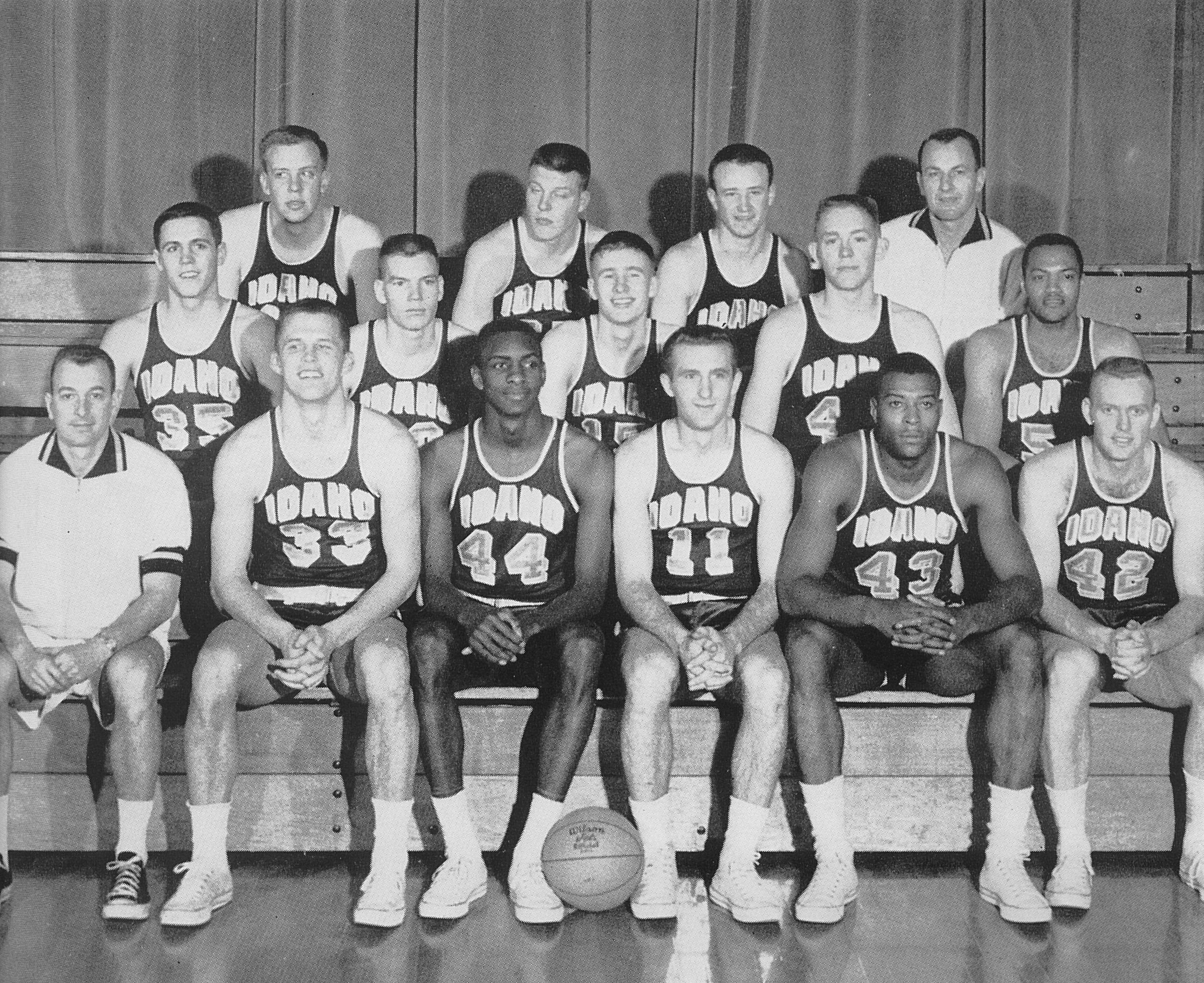
team photo of 1962-63 Idaho Vandals - Gus Johnson #43
[edit] Professional career
At 24, Gus Johnson got a late start in the professional ranks. He was selected in the second round of the 1963 NBA Draft by the Baltimore Bullets. He was an immediate sensation and averaged 17.3 points and 13.6 rebounds per game. Johnson was the runner-up for Rookie of the Year honors to Jerry Lucas, his former Ohio prep rival, and he joined Lucas and former prep teammate Thurmond on the NBA All-Rookie Team. In college, Johnson had been dwarfed by Lucas in terms of national recognition, a snub that served as no small source of motivation for him. Early in his NBA career, Johnson went so far as to stare at photos of the former Ohio State star in his hotel room in preparation for their showdowns on the road.
A lethal inside scorer and an exciting open-court performer, Johnson was among the most effective two-way players of his time. His moves around the basket were comparable to those of peers Elgin Baylor and Connie Hawkins, then Julius Erving in later years. Yet as effective as Johnson was a post-up and mid-range threat, he was even more dominant as a physical defender and rebounder throughout his career. Indeed, he was one of the select few players who was quick enough to be paired against backcourt great Oscar Robertson yet strong enough to hold his own against the much taller Wilt Chamberlain in the middle.
Despite chronic knee problems, Johnson was a perennial All-Star. In his NBA career, Johnson averaged 17.4 points and 12.7 rebounds per game. He scored 25 points in 25 minutes in the 1965 All-Star Game.
Gus Johnson experienced his best years with the Bullets from 1968-71, during which he received All-League consideration. As the team was more successful, he received more recognition for his stellar play. In the 1968-69 campaign, the Bullets turned in the best regular-season record but faded in the playoffs, largely because Johnson was sidelined because of an injury. After a third-place finish in 1970 to the eventual league champion New York, Johnson and the Bullets upset them in seven games then advanced to the NBA Finals in 1971. Injuries had decimated the team, and the Bullets quickly fell to Lew Alcindor and the Milwaukee Bucks in a four-game sweep.
Injuries relegated Johnson to the bench in 1972, his last with the team. The next season, the Bullets traded for Elvin Hayes and drafted Kevin Porter, making Johnson expendable. Johnson was signed by the Phoenix Suns for the 1972-73 season, but wound up playing only 21 games for them before being released. The Indiana Pacers, then of the ABA, picked him up, and he became a steadying veteran influence on the team as they went on to win the ABA championship that season.
Injuries limited Johnson's career to 10 seasons and no doubt prevented post-career honors such as Hall of Fame induction and inclusion on the NBA 50 Greatest Players Ever list.
In late April 1987, Gus Johnson died of inoperable brain cancer at age 48 at Akron City Hospital. Less than four months before his death, he was honored in Boise by both Boise State and Idaho during a conference game between the two schools on January 17th. The Saturday night crowd exceeded 12,000 at the BSU Pavilion, setting a Big Sky Conference attendance record for a regular season game (won by Idaho 60-50).
[edit] The Nail
When Johnson played at Idaho in 1963, he already had a reputation as a leaper of the highest order. One evening at the Corner Club, a local tavern on Main Street in Moscow, Johnson was requested by owner Herm Goetz to display his rare ability to the patrons. The Corner Club was a very modest establishment, converted from a white-stuccoed small chapel in the 1940s with hardwood floors and a beamed ceiling. From a standing start near the bar, Johnson touched a spot on a beam 11'6" (3.505 m) above the floor. This spot was ceremoniously marked with a nail by Goetz, who then proudly proclaimed that anyone who could duplicate the feat could drink for free. A 40-inch (1.016 m) diameter circle was painted on the floor, and both feet had to start inside the circle to ensure a standing start. A full 23 years went by with many attempts at Gus Johnson's Nail, including Bill Walton in the summer of 1984, but there were no successes.
That was until 1986, when the College of Southern Idaho basketball team from Twin Falls stopped in town in January on their way to a game against NIC in Coeur d'Alene. Joey Johnson, a younger brother of then NBA star Dennis Johnson, was brought into the Corner Club for a try. The 6'3" (1.905 m) guard had a 48" (1.219 m) vertical leap and could put his chin on a basketball rim (10 feet (3.048 m)) with a running start.
Johnson laced up his shoes and touched the nail on his first try but was disqualified because he did not start with both feet inside the 40-inch circle. The next attempt came from a legal static start but was just a bit short. On his third try, Johnson grabbed and bent the legendary nail, a landmark event in Palouse sports history. Goetz pulled the nail out of the beam and pounded it back in, a half inch (13 mm) higher.
[edit] External links
- TheDraftReview.com - Gus Johnson's NBA Draft History Page
- Basketball-Reference.com - Gus Johnson stats
- Database Basketball.com - stats for Gus Johnson
- Idaho.Scout.com - "How great was Gus Johnson?" reprinted from 1997 article
[edit] References
- ^ Goldaper, Sam (April 30, 1987), “Gus Johnson, Ex-N.B.A. Star with Baltimore, is Dead at 48”, The New York Times, <http://query.nytimes.com/gst/fullpage.html?res=9B0DE6D6153FF933A05757C0A961948260>
- ^ Smith, Marlin (December 31, 1997). How Great Was Gus Johnson?.
- "S.Idaho's Little JJ almost brings down the house," The Seattle Times, 04-May-1986, p. C-10
- "A Case of Vandalism in Big Sky Country," Sports Illustrated, 25-Jan-1982, p.20-21