Stickney (crater)
From Wikipedia, the free encyclopedia


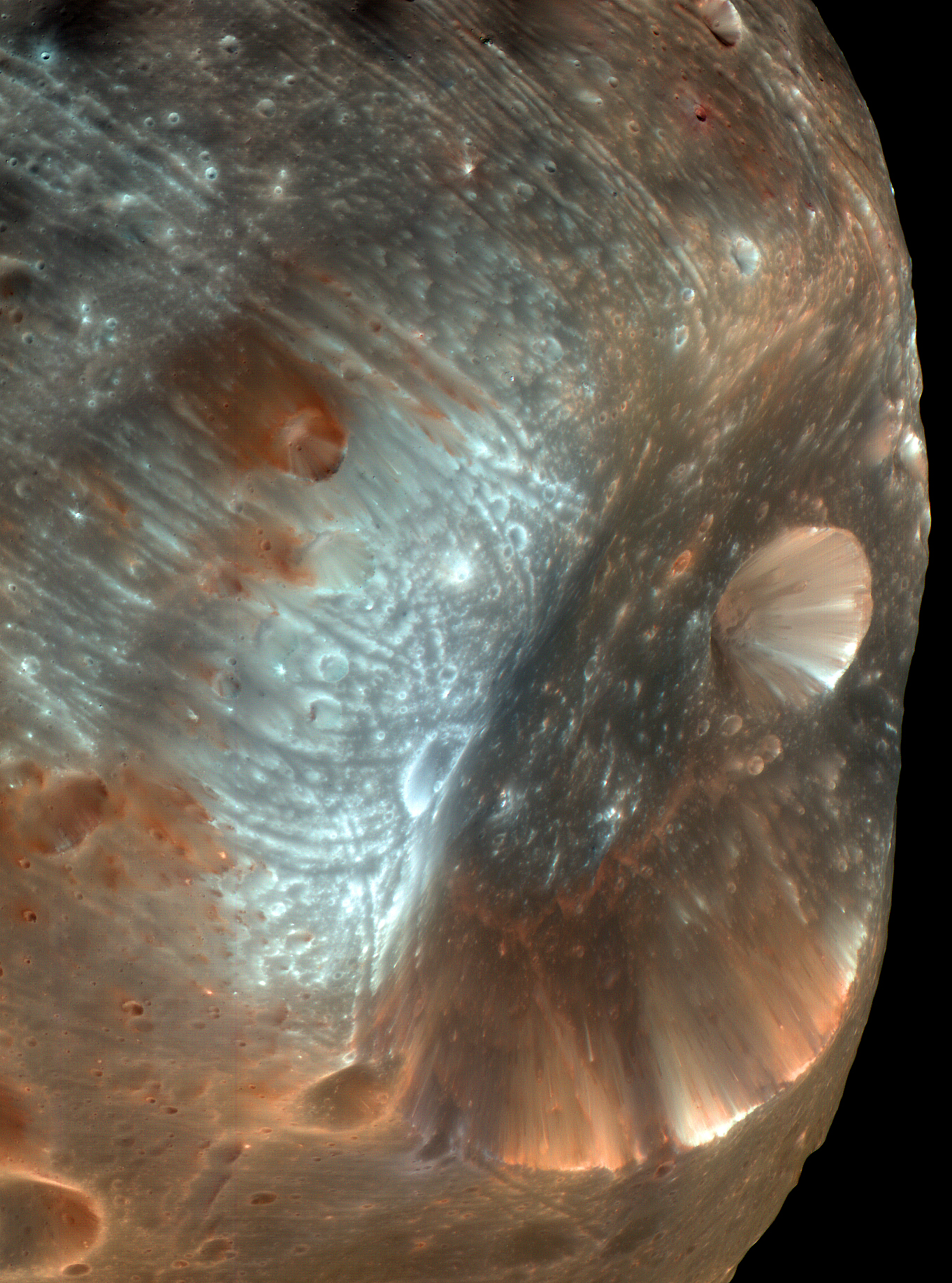
Stickney crater is the largest crater on Phobos, which is a satellite of Mars. It is located at 5°S 55°W on Phobos and is 9 km in diameter, taking up a substantial proportion of the moon's surface. It is named after Chloe Angeline Stickney Hall, wife of Phobos's discoverer, Asaph Hall.[1] It has a smaller, unnamed crater within it, resulting from a later impact.
Grooves and crater chains appear to radiate from Stickney, and had led to theories that the impact that formed it nearly destroyed the moon. However, evidence from the Mars Express orbiter indicate that they are unrelated to Stickney and may have been formed by material ejected from impacts on Mars. The crater has a noticeable lineated texture on its interior walls, caused by landslides from materials falling into the crater.[2]
It is possible that Stickney is large enough to be seen with the naked eye from the surface of Mars.[3] It is located at the middle of the left edge of Phobos's face, on the Mars-facing side.
Stickney appears in Kim Stanley Robinson's novel Red Mars in which the crater is the site of a city.
Contents |
[edit] Gallery
 Stickney crater (at left), with radiating grooves |
 Stickney at top in sunlight, imaged by Mars Global Surveyor |
 A montage of three separate images taken by Viking 1 on October 19, 1978. |
[edit] References
- ^ Blue, Jennifer. Phobos Nomenclature: Crater. Gazetteer of Planetary Nomenclature. Retrieved on 2007-11-12.
- ^ Phobos from 6,800 Kilometers (Color). NASA/JPL-Caltech/University of Arizona (2008-04-09). Retrieved on 2008-04-09.
- ^ Angular Size: With a diameter of 9km and a distance of 9250km, we get 9/9250*206265 = 200". An object needs to 60" to be resolved by the naked eye.
[edit] See also
[edit] External links
- Flight around Phobos (animated movie)
- Stickney in High Resolution
|
||||||||||||||||||||||||||||||||||||||||||||


 |
This article, which relates to the planet Mars or its moons, is a stub. You can help Wikipedia by expanding it. |
 |
This article about an extraterrestrial geological feature is a stub. You can help Wikipedia by expanding it. |