Serbia (1941-1944)
From Wikipedia, the free encyclopedia
 |
This article needs additional citations for verification. Please help improve this article by adding reliable references. Unsourced material may be challenged and removed. (August 2007) |
 |
This article requires authentication or verification by an expert. Please assist in recruiting an expert or improve this article yourself. See the talk page for details. This article has been tagged since September 2007. |
|
|||||||||||||||||||||||||||||||||||||||||||||||
.svg/30px-Flag_of_the_Kingdom_of_Yugoslavia_(civil).svg.png)


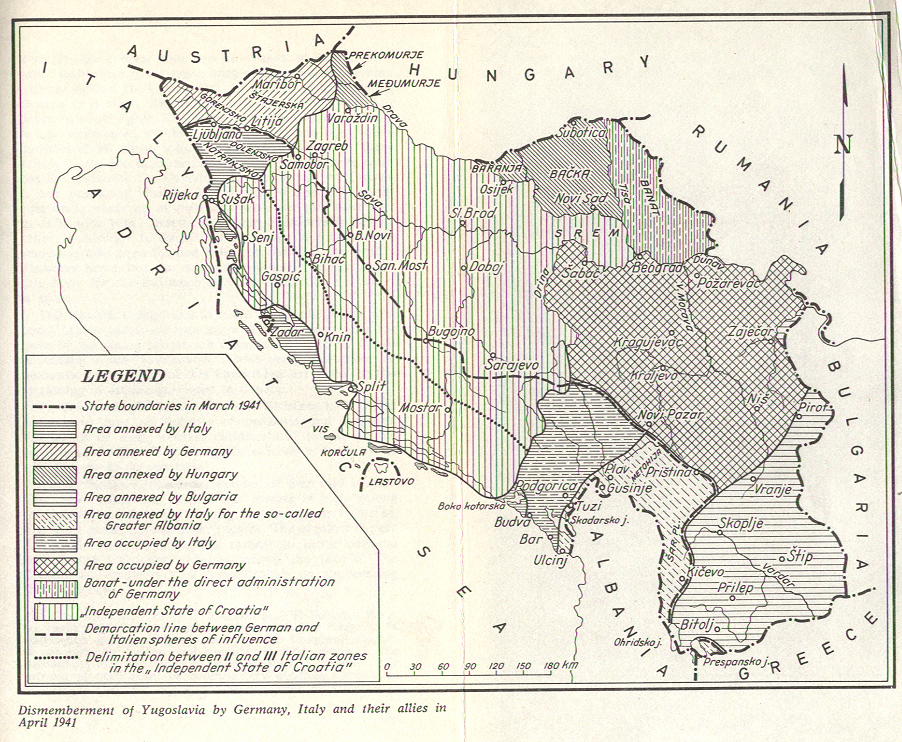
Several months after the occupation and division of the Kingdom of Yugoslavia by the Axis Powers in World War II, the territory of Serbia became known as Militärverwaltung in Serbien or Military Administration in Serbia, by Nazi Germany in 1941 .[1] [2] [[3]] The Serbian civil administration preferred to call the entity the Government of National Salvation (Serbian Cyrillic: Влада Националног Спаса, Serbian Latin: Vlada Nacionalnog Spasa) and claimed it was an independent state, though its affairs were dictated by German authorities which did not recognize its sovereignty. Its territories included present-day Central Serbia, northern part of Kosovo (around Kosovska Mitrovica), and region of Banat, composed the territories of Serbia[3] Officially, the affairs of Serbs were to be represented by their own government, led by Milan Nedić, who was their official leader from 1941 to 1944.[4] and was backed by Dimitrije Ljotić with his fascist ZBOR party supporters. But Nedić held little real power while most power resided in the administration's de facto governors, which were simply called a Military Commander (Militärbefehlshaber): The Military Commanders of the administration were Franz Böhme in 1941, Harold Turner (1941-1942), Walter Uppenkamp (1942), Egon Bönner (1942-1943), and Franz Neuhausen (1943-1944).[5] Böhme was given emergency powers to govern the territory since July 1941 and served as a defacto governor of the region even before the administration was solidified in August. Böhme was relieved of the position later in 1941. Staatsrat (privy councillor) Harold Turner and SS Untersturmfuhrer Fritz Stracke handled most of the affairs of the administration while Nedić served as a nominal local leader and as a symbol of legitimization of the German presence there.[4] The regime was unsuccessful in detracting Serbs from rebelling against the occupiers of Yugoslavia and had little support amongst Serbs. This was due to acts of extreme violence and ethnic persecution of Serbs by the German occupiers and Ustashe extreme nationalists in Croatia, most Serbs associated with opposition forces who fought against both the German occupation forces and the Ustashe regime of Croatia. The regime attempted to reduce the large Serbian resistance against the German military occupation of Yugoslavia, but continued atrocities by German occupation authorities made such attempts futile. Real power resided with the German occupiers rather than under Nedić's government.[6]
Contents |
[edit] Geopolitical situation
After the quick defeat and carving up of the Kingdom of Yugoslavia, the territory that was not given to the surrounding Axis neighbours, including the new Independent State of Croatia in the west, Italian-occupied territories in the south, Hungarian-occupied territories in the north-west, and Bulgarian-occupied territories in the south-east, became part of a German and collaborationist military administration. As they usually did in occupied territories, the Germans installed a puppet government, which was to be a partner in providing security and to implement laws and policies amenable to the Germans.

[edit] Currency
After the collapse of the Kingdom of Yugoslavia, the Serbian civil government had the National bank of Kingdom of Yugoslavia was transformed into the Serbian National Bank. It introduced Serbian Dinar as the only legal currency and disabled the circulation of other currencies on the territories of Serbia occupied by neighboring countries.[7] The traditional Obrenović coat of arms was found on bills and coins minus the royal crown.[8][9][10]
[edit] Culture
[edit] Media
With the dissolution of the Kingdom of Yugoslavia, many newspapers went out of print while new papers were formed. On May 16, 1941 the first new daily, Novo vreme (New Times), was formed.[11] The weekly Naša borba (Our Struggle) was formed by the fascist ZBOR party in 1941, its title echoing Hitler's Mein Kampf (My Struggle).[11] The regime itself released the Službene novine (Official Gazette) which attempted to continue the tradition of the official paper of the same name which was released in the Kingdom of Yugoslavia.[11][12]
[edit] Film
The state of film in Serbia was somewhat improved over the situation in the Kingdom of Yugoslavia. During this time, the number of cinemas in Belgrade was increased to 21, with a daily attendance of between 12,000 and 15,000 people.[13] The two most popular films were 1943's Nevinost bez zaštite and Golden City which had viewership of 62,000 and 108,000 patrons respectively.[14]
[edit] Sport
With the dissolution of the Yugoslav First League in the spring of 1940, Serbia had its own national football competition. Competing teams included BSK Belgrade, SK 1913 (SK Jugoslavija), and FK Obilić.[15]
[edit] Internal affairs


The internal affairs of Serbia were affected by Nazi racial laws. These were introduced in all occupied territories with immediate effects on Jews and Roma people, as well as causing the imprisonment of those opposed to Nazism. The region of Banat was ruled by its local minority German population. Despite domination by the German occupiers across the military administration, it maintained its own currency, the Serbian dinar which replaced the Yugoslav dinar which existed until 1945, when the Germans and the collaboratists were defeated and replaced by the Yugoslav communist state, which scrapped the Serbian dinar and other currencies of the Independent State of Croatia and Montenegro in 1945.[16]
The administration's first Serbian government leader was Milan Aćimović[17] In late August Aćimović stepped down and was replaced by Milan Nedić, who hoped that his collaboration would save what was left of Serbia and avoid total destruction by Nazi reprisals, he personally kept in contact with Yugoslavia's exiled King Peter, assuring the King that he was not another Pavelic (the Croatian Ustashe leader), and Nedić's defenders claimed he was like Philippe Pétain of Vichy France (who was claimed to have defended the French people while accepting the occupation), and denied that he was leading a weak Quisling regime.[18] The Serbian collaboratist government failed to win the favour of Serbs, who largely associated with the two key opposition groups, the Serb nationalist Chetniks and the communist Yugoslav Partisans.
The real power rested with the administration's Military Commanders, who controlled both the German armed forces and Serb collaborationist forces in the administration. In 1941, the administration's Military Commander, Franz Böhme, responded to Serb attacks on German forces by ordering reprisal attacks in which 100 Serbs would be killed for each German killed and 50 Serbs killed for each wounded German. The first set of reprisals were the massacres in Kragujevac and in Kraljevo by the Wehrmacht. These proved to be counterproductive to the German forces in the aftermath, as it ruined any possibility of gaining any substantial numbers of Serbs to support the collaborationist regime of Nedić. Additionally, it was discovered that in Kraljevo, a Serbian workforce group which was building airplanes for the Axis forces had been among the victims.[19] The massacres caused Nedić to urge that the arbitrary shooting of Serbs be stopped, Böhme agreed and ordered a halt to the executions until further notice.[20] Approximately 14,500 Serbian Jews - 90 percent of Serbia's Jewish population of 16,000 - were murdered in World War II.[21]

By late 1941, with each attack by Chetniks and Partisans, brought more reprisal massacres being committed by the German armed forces against Serbs. The largest Chetnik opposition group led by Colonel Dragoljub "Draža" Mihailović decided that it was in the best interests of Serbs to temporarily shut down operations against the Germans until the possibility of decisively beating the German armed forces looked possible. Mihailović justified this by saying "When it is all over and, with God's help, I was preserved to continue the struggle, I resolved that I would never again bring such misery on the country unless it could result in total liberation".[22] Mihailović then reluctantly decided to allow some Chetniks to join Nedic's regime to launch attacks against Tito's Partisans,.[23] Mihailović saw as the main threat to Chetniks and, in his view, Serbs, as the Partisans[24] who refused to back down fighting, which would almost certainly result in more German reprisal massacres of Serbs. With arms provided by the Germans, those Chetniks who joined Nedic's collaborationist armed forces, so they could pursue their civil war against the partisans without fear of attack by the Germans, whom they intended to later turn against. This resulted in an increase of recruits to the regime's armed forces.[25] One of Mihailović's closest friends, Djuishić joined Nedic's collaboratist forces, and later planned in 1943, under the auspices of the collaboratists to exterminate the Muslims, Croats, and Partisans of the Sanjak region in revenge for Croatian Ustashe and Muslim massacres of Serbs in the Independent State of Croatia in 1941 and to inflict serious damage to the Partisans, but this was never put through.[26]
[edit] Collaborationist armed forces

Aside from German armed forces which were the dominant Axis military in the territory, there were two Serbian collaborationist military forces, the Serbian State Guards (Srpska Državna Straža) and the Serbian Volunteer Command both formed in 1941. In 1943, the Serbian Volunteer Command was renamed the Serbian Volunteer Corps (Srpski Dobrovoljački Korpus).[27]
Initially, the recruits were largely paramilitaries and supporters of the fascist Yugoslav National Movement "Zbor" (Jugoslovenski narodni pokret "Zbor" , or ZBOR) party of Dimitrije Ljotić. Nedić's forces fought Communist Partisans as well as Royalist Chetniks who were not willing to sign an agreement of cooperation.
Recruits to the collaborationist forces increased in numbers following groups of Chetniks loyal to Kosta Pećanac joining. By their own postwar account, these Chetniks joined with the intention to destroy Tito's Partisans, rather than supporting Nedić and the German occupation forces, whom they later intended to turn against.[28]
The Serbian Volunteer Corps were formed in the spring of 1943. At the end of 1944, the Corps and its German liaison staff were transferred to the Waffen-SS as the Serbian SS Corps and comprised a staff from four regiments each with three batalions and a training battalion.
[edit] Concentration camps
[edit] Key Politicians
- Milan Nedić
- Dimitrije Ljotić
- Velibor Jonić
- Dr. Milorad Nedeljković
- Dragomir Jovanović
- Milan Aćimović
- Tanasije-Tasa Dinić
- Čedomir Marjanović
- Bogoljub Kujundžić
- Đura Dokić
- Ljubiša Mikić
- Dušan Letica
- Dušan Đorđević
- Boško Pavlović
- Vladimir Velmar-Janković
[edit] Military and special forces
[edit] References
[edit] General references
- Bailey, Ronald H. 1980 (original edition from 1978). Partisans and guerrillas (World War II; v. 12). Chicago, Illinois, USA: Time-Life Books.
- Browning, Christopher H. 2004. The Origins of the Final Solution: The Evolution of Nazi Jewish Policy, September 1939-March 1942 (Comprehensive History of the Holocaust). Jerusalem, Israel: Yad Vashem, the Holocaust Martyrs' and Heroes' Remembrance Authority.
- Dobrich, Momcilo. 2001. Belgrade's Best: The Serbian Volunteer Corps, 1941-1945, Axis Europa Books. ISBN 1-891227-38-6
- Kostić, Boško N. Za istoriju naših dana, Lille, France, 1949.
- Kostić, Lazo M. Armijski đeneral Milan Nedić, Novi Sad, 2000.
- Wolff, Robert Lee. 1956. Balkans in Our Time. Cambridge, Massachusetts, USA: Harvard University Press.
- History of Serbian Volunteer Corps
- Serbia at WorldStatesmen.org
[edit] Footnotes
- ^ Wolff, Robert Lee, (1956). Balkans in Our Time Cambridge, Massachusetts, USA: Harvard University Press. P. 203
- ^ Tomasević, Jozo. (2001). War and Revolution in Yugoslavia, 1941-1945: Occupation and Collaboration. Stanford University Press.
- ^ Wolff, Robert Lee, (1956). Balkans in Our Time Cambridge, Massachusetts, USA: Harvard University Press. P. 204
- ^ Bailey, Ronald H. 1980 (original edition from 1978). Partisans and guerrillas (World War II; v. 12). Chicago, Illinois, USA: Time-Life Books. P. 81
- ^ Tomasević, Jozo. (2001). War and Revolution in Yugoslavia, 1941-1945: Occupation and Collaboration. Stanford University Press.
- ^ War and Revolution in Yugoslavia, 1941-1945: Occupation and Collaboration by Jozo Tomasevich, published 2001 Stanford University Press pg 182 Quote: "Nedic thus headed a government whose powers were strictly limited, one that had no international standing even with the Axis powers. Like its predecessor, it was no more than a subsidiary organ of the German occupation authorities, doing part of the work of administering the country and helping to keep it pacified so that the Germans could exploit it with a minimum of effort, and bearing some of the blame for the harshness of the rule."
- ^ Pavlovic International Bank
- ^ http://www.atsnotes.com/catalog/serbia/serbia-22.JPG
- ^ http://www.atsnotes.com/catalog/serbia/serbia-28.JPG
- ^ Worldcoingallery.com
- ^ a b c Olivera Milosavljević - POTISNUTA ISTINA
- ^ Paragraf Co
- ^ Miroslav Savković, Kinematografija u Srbiji tokom Drugog svetskog rata 1941-1945., Ibis, Belgrade 1994 (pg. 59)
- ^ Miroslav Savković, Kinematografija u Srbiji tokom Drugog svetskog rata 1941-1945., Ibis, Belgrade 1994 (pg. 46)
- ^ History of FC Obilić
- ^ Wolff, Robert Lee, (1956). Balkans in Our Time Cambridge, Massachusetts, USA: Harvard University Press. P. 324
- ^ Dobrich, Momcilo. 2001. Belgrade's Best: The Serbian Volunteer Corps, 1941-1945, Axis Europa Books. P. 21
- ^ Wolff, Robert Lee, (1956). Balkans in Our Time Cambridge, Massachusetts, USA: Harvard University Press. P. 204
- ^ Browning, Christopher H. 2004. The Origins of the Final Solution: The Evolution of Nazi Jewish Policy, September 1939-March 1942 (Comprehensive History of the Holocaust) Jerusalem, Israel: Yad Vashem, the Holocaust Martyrs' and Heros' Remembrance Authority. P. 344
- ^ Browning, Christopher H. 2004. The Origins of the Final Solution: The Evolution of Nazi Jewish Policy, September 1939-March 1942 (Comprehensive History of the Holocaust) Jerusalem, Israel: Yad Vashem, the Holocaust Martyrs' and Heros' Remembrance Authority. P. 344
- ^ Encyclopedia of the Holocaust, Macmillan Publishing Company New York 1990
- ^ Bailey, Ronald H. 1980 (original edition from 1978). Partisans and guerrillas (World War II; v. 12). Chicago, Illinois, USA: Time-Life Books. P. 80
- ^ Bailey, Ronald H. 1980 (original edition from 1978). Partisans and guerrillas (World War II; v. 12). Chicago, Illinois, USA: Time-Life Books. P. 81
- ^ Wolff, Robert Lee, (1956). Balkans in Our Time Cambridge, Massachusetts, USA: Harvard University Press. P. 213
- ^ Bailey, Ronald H. 1980 (original edition from 1978). Partisans and guerrillas (World War II; v. 12). Chicago, Illinois, USA: Time-Life Books. P. 81
- ^ Wolff, Robert Lee, (1956). Balkans in Our Time Cambridge, Massachusetts, USA: Harvard University Press. P. 213
- ^ Dobrich, Momcilo. 2001. Belgrade's Best: The Serbian Volunteer Corps, 1941-1945, Axis Europa Books. P. 21
- ^ Bailey, Ronald H. 1980 (original edition from 1978). Partisans and guerrillas (World War II; v. 12). Chicago, Illinois, USA: Time-Life Books. P. 81
[edit] See also
- Banat (1941–1944)
- Republic of Užice
- Kingdom of Montenegro (1941-1944)
- Independent State of Croatia
- Military history of Hungary during World War II
- Military history of Bulgaria during World War II
- Military history of Albania during World War II
- World War II
- Anti-Freemason Exhibition
- Balkans Campaign
- People's Liberation War
- Quisling