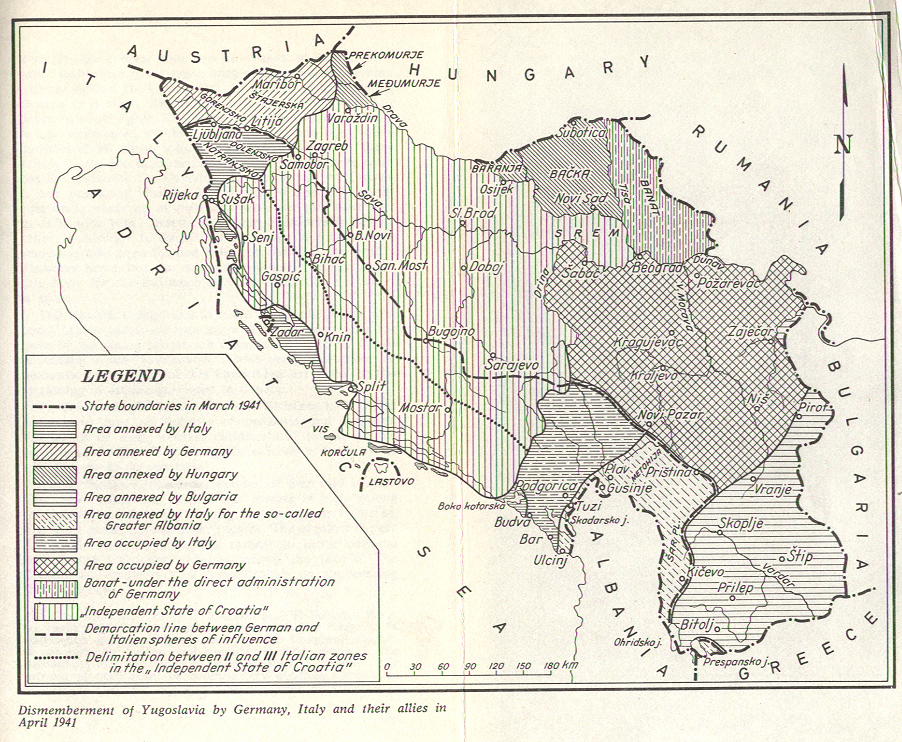
Banat (1941–1944)
From Wikipedia, the free encyclopedia
 |
The factual accuracy of this article is disputed. Please see the relevant discussion on the talk page. (March 2008) |


The Banat was a political entity established after occupation and partition of Kingdom of Yugoslavia by the Axis Powers. It existed from 1941 to 1944. Banat was formally part of Axis protectorate of Serbia, but all power within region was in the hands of local ethnic German minority. Regional civilian commissioner was Josef-Sepp Lapp. [1] Following the defeat of Axis Powers in 1944, this German-ruled region was revoked and most of its territory was included into Vojvodina, one of the two autonomous provinces of Serbia within the new SFR Yugoslavia.
Contents |
[edit] History
Although the region was formally a part of Axis protectorate of Serbia, it was ruled by its German minority. The aim of the Germans was to transform Banat into a separate state of Danube Swabians connected to the Third Reich. Therefore, the local German authorities started to persecute Serbs (who were largest ethnic group in the area), as well as Jews and Roma.
The Germans instituted anti-Jewish measures immediately after the German invasion and occupation of Yugoslavia. The Jewish population of the city of Zrenjanin was rounded up and sent to the Tašmajdan concentration camp near Belgrade where they were executed. In September, 1941, there was a mass hanging of Serbian and Jewish civilians. Jews were also forced into labor battalions to do forced work for the German occupation authorities. In August, 1942, German officials announced that the area was judenrein, or cleansed of Jews. During the war, on a location named Stratište near the village of Jabuka, German army killed about 20,000 people who mostly were brought from Sajmište concentration camp near Belgrade. [2] At the same place, German army operated a furnace for burning. [3] The largest number of Banatian Jews was also killed at this place.
The German government sought to use the German minority in Serbia and the Balkans as part of the Waffen SS. Therefore, the "Prinz Eugen Nazi SS Division" was formed. The backbone of the division was made up of ethnic Germans from the Banat, many of whom had been former officers and NCOs in the Yugoslav Army. The core of the Division was made up of the SS controlled Protection Force or Selbstschutz consisting of Volksdeutsche from Serbia. In 1943, Himmler would introduce compulsory military service for the Volksdeutsche of Serbia. Approximately 21,500 ethnic Germans from Serbia would serve in the Waffen SS.
The staff of the "7th SS Volunteer Mountain Division Prinz Eugen" was located in the city of Pančevo in Banat. The division was formed between April and October, 1942 and was commanded by Romanian Volksdeutsche SS Gruppenfuehrer and Generalleutnant of the Waffen SS, Artur Phleps. By December 31, 1941, the division would be made up of 21,102 men. The officers and NCOs were primarily Reichsdeutsche, Germans from Germany proper, while the enlisted men were Volksdeutsche, ethnic Germans from Serbia and the Balkan countries.
The Prinz Eugen SS Division was deployed throughout the former Yugoslavia to combat guerrilla forces. The division was accused of committing the worst atrocities against POWs and civilians during World War II at the Nuremberg War Crimes Trials.
[edit] Population
[edit] Ethnic groups
According to the 1931 census, the population of the region numbered 585,579 people, including: [4]
- Serbs = 261,123 (44.59%)
- Germans = 120,541 (20.58%)
- Hungarians = 95,867 (16.37%)
- Romanians = 62,365 (10.65%)
- Slovaks = 17,900 (3.06%)
- Croats = 12,546 (2.14%)
- others.
[edit] Religion
By religion, the population included (1931 data): [5]
- Orthodox Christians = 321,262 (56.71%)
- Roman Catholics = 196,087 (34.62%)
- Protestants = 37,179 (6.56%)
- others = 11,932 (2.11%)
[edit] War crimes
During the war, German Axis troops killed 7,513 inhabitants of Banat, including: [1]
- 2,211 people who were killed directly
- 1,294 people who were sent to concentration camps and killed there
- 1,498 people who were sent to forced labour and killed there
- 152 people who were mobilized and later killed
- 2,358 killed members of the resistance movement
Of the total number of the victims (excluding the killed members of the resistance movement), 4,010 were men, 631 were women, 243 were old people, and 271 were children.
[edit] References
- Jelena Popov, Vojvodina i Srbija, Veternik, 2001.
- Dimitrije Boarov, Politička istorija Vojvodine, Novi Sad, 2001.
- Slobodan Ćurčić, Broj stanovnika Vojvodine, Novi Sad, 1996.
- History of Europe, The Times, London, 2001.
- Richard Overy, History of the 20th century, The Times, London, 2003.
[edit] Notes
- ^ Slobodan Ćurčić, Broj stanovnika Vojvodine, Novi Sad, 1996. (pages 42, 43)
[edit] See also
- Occupation of Vojvodina, 1941-1944
- 7th SS Volunteer Mountain Division Prinz Eugen
- History of Vojvodina
- History of Serbia
- Banat
[edit] External links
- "Prinz Eugen" SS Division, 1941-1945
- 1941: Mass Murder
- Jewish history of Yugoslavia - Serbia and the Banat
- Partition of Yugoslavia in 1941 - Quotes from Encyclopedia Britannica, edition 1971, Volume 23, pages 921,922 entry: Yugoslavia, 6. WWII
- Cinematography in Serbia during the Second World War 1941-1945
- Map
- Map
- Map