Kingdom of Montenegro (1941-1944)
From Wikipedia, the free encyclopedia
|
|||||||||||||||||||||||||||||||||||||||||||||||||||||||||
.svg/30px-Flag_of_the_Kingdom_of_Yugoslavia_(civil).svg.png)


.png/250px-Kingdom_of_Montenegro_(1941-1944).png)
Montenegro existed as a puppet protectorate of the Fascist Italy as a component of the Italian Empire (1941 - 1943) and later a puppet state under Nazi Germany (1943 - 1944). The Italian Fascist regime saw Montenegro as a future part of a Greater Italy that would span across the Adriatic coast to northern Greece where the local populations would be assimilated as Italians and colonization by Italians would be promoted by the Italian Fascists as it was in Italian-held Albania to eventually displace the non-Italian population. In 1943, the Fascist regime in Italy was ousted and German military forces took over Montenegro. With no territorial aims on Montenegro, the German authorities made it a puppet state for the remainder of the war.
Contents |
[edit] History
After the invasion of Yugoslavia by Nazi Germany and Fascist Italy on April 6, 1941 and subsequent Royal Yugoslav Army surrender on April 17, 1941, Sekula Drljević, leader of the Montenegrin Federalists in the Kingdom of Yugoslavia, established the Provisional Administrative Committee of Montenegro, which operated as the collaborationist organ of Fascist Italy. The Committee was disbanded on 5 May 1941 and a Montenegrin Council was formed to oversee the Italian occupation create a semi-independent protectorate of Montenegro. The Fascist regime intended to make Montenegro part of a Greater Italy which would span down along the Adriatic coast to Albania, with the intention of assimilating the people into Italians.
King Victor Emmanuel III of Italy (influenced by his wife Queen Elena, daughter of the former King of Montenegro) imposed on Mussolini the creation of an independent Montenegro against the wishes of the fascist Croatians of Ante Pavelic and the Albanians (who wanted to divide Montenegro between themselves). The Kingdom of Montenegro was created under fascist control when Krsto Zrnov Popović returned from his exile in Rome in 1941 to attempt to lead the Zelenaši ("Green" party), who supported the reinstatement of the independent Montenegrin monarchy. This militia were called the Lovćen Brigade.
Montenegro was nominally a Kingdom, but the last King's grandson Prince Michael Petrović-Njegoš refused the crown, declaring loyalty to his nephew, young King Peter II of Yugoslavia. Instead, Italian governors ran Montenegro.


On July 12, 1941, the rule of Sekula Drljević was inaugurated, but the country at the beginning of 1942 broke into an all out civil war as initially the Partisans and Chetniks (Yugoslav Army in the Fatherland) on one side fought against Montenegrin separatists and Axis forces on the other. As the World War II progressed, the conflict within Montenegro became extremely chaotic and vicious as virtually every combination of alliances were made and broken between the warring sides and factions.
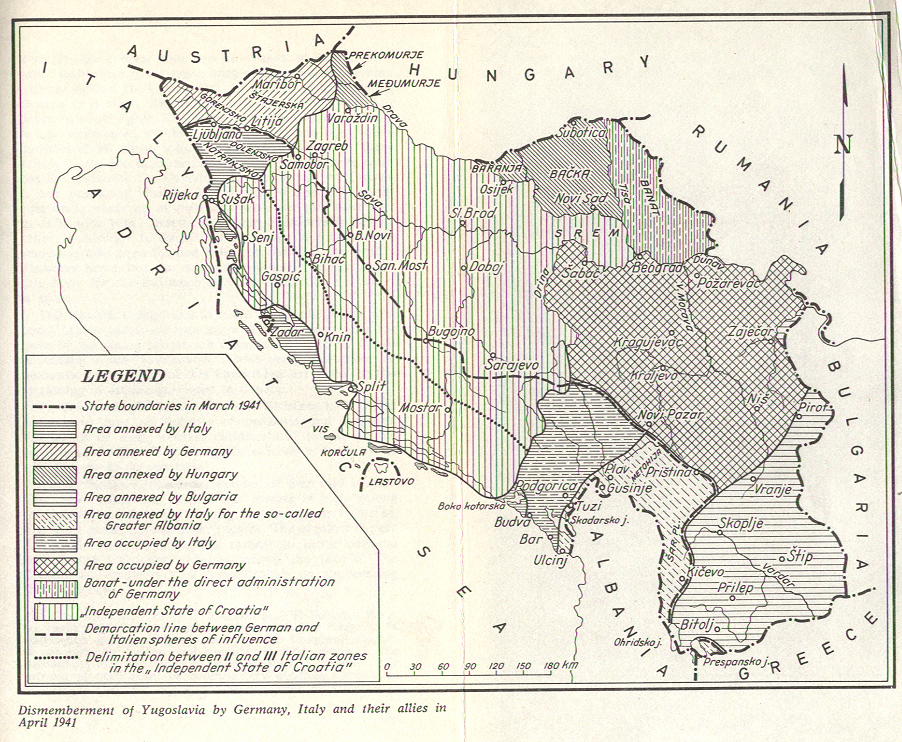
In regards to the nation's borders, much of the Sandžak region was included in the Independent State of Montenegro, that essentially existed only on paper as some of its proclaimed territory, mainly after the spring of 1942, was never actually controlled by its proclaimed government . The area of the Bay of Kotor (the venetian Cattaro) was annexed to the Dalmatian province of the Kingdom of Italy until September 1943.
Also active within Montenegro were the Second Serbian Volunteer Corps.
By October of 1943, Drljević was exiled from Montenegro. He eventually formed the Montenegrin State Council from the Independent State of Croatia in 1944, which attempted to act as a government in exile.
Meanwhile, at the end of September 1943, the fascist Croatia of Ante Pavelić officially annexed the the Italian Province of Kotor (Provincia di Cattaro; Bay of Kotor)[citation needed]. Montenegro remained under the direct control of German troops, with a terrible and bloody guerrilla war ravaging the area.
The Montenegrin People's Army was later forcedly formed by Ante Pavelić and Drljević out of defeated Pavle Đurišić-led Chetnik forces.
In December 1944 the German troops withdrew from Montenegro and Tito's partisans started to control the full area, ending the existence of the Kingdom of Montenegro.
In the period from 1941 to 1944 tens of thousands of innocent civilians have been killed by the Nazis.
[edit] Governors
- Mihajlo Ivanović (nominal) (17 May 1941 - 23 July 1941)
- Conte Serafino Mazzolini 19 April 1941 - 23 July 1941)
- Principe Alessandro Pirzio Biroli (23 July 1941 - 13 July 1943)
- Conte Curio Barbasetti di Prun (13 July 1943 - 10 September 1943)
- Theodor Geib (10 September 1943 - 1 June 1944)
- Wilhelm Keiper (1 June 1944 - 15 December 1944)

[edit] Religion
The main religion in Montenegro was Serbian Orthodox, while there was also a significant Muslim population and a smaller Catholic one. The Serbian Orthodox Church was divided into the Metropolitanate of Montenegro and the Littoral and the Eparchy of Budimlje-Nikšić both led by Joanikije Lipovac. Lipovac was killed in the aftermath of the war by Yugoslav communist after trying to flee the country in 1945.[1] The Catholic church was divided into two dioceses, the Roman Catholic Archdiocese of Bar and the Roman Catholic Diocese of Skopje.