Talk:Royal coat of arms of the United Kingdom
From Wikipedia, the free encyclopedia


[edit] Precedence: France v. England
Could it be that France takes precedence over England in the quartering because France is a more ancient kingdom that England? --Daniel C. Boyer 21:11, 13 Dec 2003 (UTC)
Actually it was more a case of the English monarch wanting to emphasise his claim to France as much (and as much to the annoyance of the French) as possible.
[edit] New version of the arms
Please help me. I've seen new version Great Britain coat of arms. Is this version official? Darius-poland-viki 19:08, 18 Mar 2004 (UTC)
- I'm not sure what you mean by "official". I don't know if the Wikipedia image is an exact copy of the design used by Buckingham Palace, but the image here is a correct rendering of the arms; however, any other drawing with the same arrangement of design elements and colours is also correct. However, it should be noted that the Government of the U.K. generally uses a version without the helmet and mantling, with the crest resting on the top of the shield. The version with the helmet seems to be reserved for use by the Queen herself.--Indefatigable 19:54, 19 Mar 2004 (UTC)
- One black & white version used on used by the government on acts of parliament doesn't seem to have a mound various printed items, another version is more artistic, so the supporters feet are lower,but of course its not the picture that matters but the description. Have you seen blazon under heraldry?
- In The Government's version the crown rests directly on the shield. The version with the helmet crest and mantling is used only by the Queen herself - the only woman in the UK allowed by the laws of heraldry to display such items
garryq 10:57, 29 Apr 2004 (UTC) garryq 07:38, 1 Jun 2004 (UTC)
[edit] Versions since Victoria
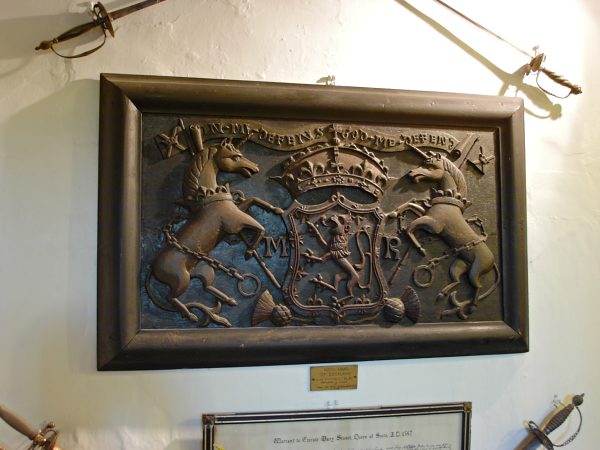
The Tower of London has a room with all the Coats of Arms of UK monarchs. In Victoria's the supporters are "lying down" (don't know the proper heraldic term), while QEII has them "standing up". Should this be mentioned? Astrotrain 20:10, Dec 27, 2004 (UTC)
[edit] King of Ireland
- Ireland (which had been ruled by the Sovereign of England since 1541).
- Surly the Sovereign of England had ruled Ireland for may years before 1541 but as Lord of Ireland instead of King of Ireland. The change being made to emphasise the Henry VIII was second to none in Ireland. --Philip Baird Shearer 08:47, 5 March 2006 (UTC)
- This depends how loosely one interprets "ruled". As stated in the first of the the above, "nominally all-island Irish state" is an apt description; the de facto situation doesn't change for some time after 1541, either. But yes, it should be made clearer that this is a change in title, rather than a change in "facts on the ground". Alai 15:09, 11 April 2006 (UTC)
[edit] Joint Reigns
Where are Mary and Philip's arms, or Mary and William's arms--both impaled side-by-side? IP Address 08:52, 27 April 2006 (UTC)
[edit] Crest in Northern Ireland
Does anyone have an image of the crest used in Northern Irland?--Hun2 12:02, 29 April 2006 (UTC)
- Unless I am mistaken, the Royal Crest of Ireland (on a torse Azure and Or, a castle triple-towered of the second, from the portal thereof a hart springing Argent attired and hooved Or) has never been used in Northern Ireland. Instead the same arms with the same Royal Crest as used in England and Wales is used in Northern Ireland as the Royal Arms.
- But, I may be wrong.
- --Bill Du Talk 19:42, 30 April 2006 (UTC)
[edit] language
I'm not happy with Sakhuluv's recent changes in language, but hesitate to undo them wholesale. —Tamfang 00:06, 1 April 2007 (UTC)
[edit] The title
The article starts with 'The Royal Coat of Arms of the United Kingdom.....' in capitals presumably because starts by describing the principal version. Normally subject of the first sentence matches the title of the article. However the article is called 'Royal coat of arms of the United Kingdom'. This seems inconsistent and my first thought was to add more capital letters. However there is another royal coat of arms for the Scots. Perhaps the article should be called 'Royal coats of arms of the United Kingdom', pluralised like courts-martial. JMcC 18:26, 18 May 2007 (UTC)
[edit] Fair use rationale for Image:QuAn Arms.png

Image:QuAn Arms.png is being used on this article. I notice the image page specifies that the image is being used under fair use but there is no explanation or rationale as to why its use in this Wikipedia article constitutes fair use. In addition to the boilerplate fair use template, you must also write out on the image description page a specific explanation or rationale for why using this image in each article is consistent with fair use.
Please go to the image description page and edit it to include a fair use rationale. Using one of the templates at Wikipedia:Fair use rationale guideline is an easy way to insure that your image is in compliance with Wikipedia policy, but remember that you must complete the template. Do not simply insert a blank template on an image page.
If there is other fair use media, consider checking that you have specified the fair use rationale on the other images used on this page. Note that any fair use images uploaded after 4 May, 2006, and lacking such an explanation will be deleted one week after they have been uploaded, as described on criteria for speedy deletion. If you have any questions please ask them at the Media copyright questions page. Thank you.
BetacommandBot 23:15, 13 September 2007 (UTC)
- I've added a fair use rationale for this article's usage to the image's description page. Others are welcome to improve upon it. —Adavidb 13:24, 14 September 2007 (UTC)
[edit] "Royal" coat of arms
I took the initiative of moving this page to "Coat of Arms of the United Kingdom", dropping the initial royal. My reasoning is thus: every other country that has a coat of arms page in the Wikipedia is called "Coat of arms of _____", including other Commonwealth nations. (Canada, Australia, etc.). Furthermore, since there is no need to disambiguate between the "Coat of arms of the United Kingdom" and the "Royal coat of arms of the United Kingdom", then I suggest we keep the title as concise as possible. After all, if we really wanted to spell out the full title, it should read "The Royal coat of arms of the United Kingdom of Great Britain and Northern Ireland". This is why I moved the page. Thanks, and happy editing. Lovelac7 13:05, 23 November 2007 (UTC)
- Agree with the move because it's redundant. It's called a "United Kingdom", so the coat of arms is royal as a matter of course. For any article, if we can have a shorter title that means exactly the same thing, I'm all for it. -- I. Pankonin (t/c) 23:32, 24 November 2007 (UTC)
- This page has been moved to Coat of arms of the United Kingdom as the result of a move proposal listed at Wikipedia:Requested moves. Dekimasuよ! 10:05, 28 November 2007 (UTC)
[edit] Fair use rationale for Image:Arms Scot Exec.jpg
Image:Arms Scot Exec.jpg is being used on this article. I notice the image page specifies that the image is being used under fair use but there is no explanation or rationale as to why its use in this Wikipedia article constitutes fair use. In addition to the boilerplate fair use template, you must also write out on the image description page a specific explanation or rationale for why using this image in each article is consistent with fair use.
Please go to the image description page and edit it to include a fair use rationale. Using one of the templates at Wikipedia:Fair use rationale guideline is an easy way to insure that your image is in compliance with Wikipedia policy, but remember that you must complete the template. Do not simply insert a blank template on an image page.
If there is other fair use media, consider checking that you have specified the fair use rationale on the other images used on this page. Note that any fair use images lacking such an explanation can be deleted one week after being tagged, as described on criteria for speedy deletion. If you have any questions please ask them at the Media copyright questions page. Thank you.
BetacommandBot (talk) 06:55, 2 January 2008 (UTC)
[edit] No Welsh Quarter?
I am curious to know why instead of a Welsh quarter on the shield, there are two English quarters. Could somebody either enlighten me or point me in the direction of another page which holds the information I seek? --Thexeber (talk) 19:48, 27 January 2008 (UTC)
- Sorry, I just read the rest of the article. Oops, I should have read the article more thoroughly. --Thexeber (talk) 19:50, 27 January 2008 (UTC)
- No, it's fine — you wouldn't believe the number of times I was asked the same thing when I worked at Buckingham Palace! † DBD 23:59, 27 January 2008 (UTC)
- So for Wales to get on the coat of arms, it has to break away from the UK, set up its own kingship, and then rejoin the UK? That's silly and too much work, just add them to the shield, England doesn't need two sections. --130.15.164.98 (talk) 16:32, 26 February 2008 (UTC)
- No, it's fine — you wouldn't believe the number of times I was asked the same thing when I worked at Buckingham Palace! † DBD 23:59, 27 January 2008 (UTC)
- If the Queen strips Charles of his "Prince of Wales" title and invests it in herself, the Welsh arms could be added. Astrotrain (talk) 17:08, 26 February 2008 (UTC)
The arms of Wales are represented on the arms of Charles, Prince of Wales. That is the appropriate place for them. -- I. Pankonin (t·c) 23:25, 26 February 2008 (UTC)
[edit] Arms of Francis
King consort was chalk and cheese in that period to how it is in modern times. His standing was equal to, if not greater than, the Queen herself - these were chauvinistic times you must remember. (Particularly if the King consort was an heir to a throne or indeed already a King in his own right). One of the reasons Elizabeth I of England never married was because of this exact situation - she did not want to play second-fiddle to a man! The only reason Francis doesn't figure greatly in Scots history was that he only lived as King consort of Scots for two years, otherwise the issue over the inclusion of his arms would not require discussion. Rab-k (talk) 00:09, 18 March 2008 (UTC)
- Having looked at the issue of English monarchs and Kings consort, the only equivalent to Francis which I can see in the table is Philip of Spain, (King consort of Mary I of England), whose arms do not appear in the table. Philip was King consort of England for two years prior to becoming King of Spain, much in the way Francis was King consort of Scots for one year prior to becoming King of France, however, I can find no example of Philip's arms prior to his becoming King of Spain which include an English element. For that reason I will remove the Franco-Scots arms of Francis for the sake of balance. I have however included the three Franco-Scots styles of Mary's arms, given that the table displays styles of arms rather than simply a list of monarchs I trust this to be in order.Rab-k (talk) 04:27, 18 March 2008 (UTC)
[edit] Alternative quartering
I know that various organs of government use variations of the arms. As I understand it, these differ in what elements surround the shield, but leave the quartering intact. I also realize that now as at times in the past, the quartering has depended on whether or not the royal arms are used in respect of Scotland.
I was watching the John Adams miniseries on HBO, and the royal arms on the wall behind the judge during the Boston Massacre trial caught my eye. It was clearly meant to be a post-Union representation because the supporters were the lion and the unicorn. It was the royal arms because the garter encircled the shield and a crown topped the shield. However, the quartering seemed wrong. The second quarter was clearly the three fleurs-de-lis of France, and the third quarter was clearly the Irish harp. The first and fourth were harder to make out. Given the other elements, the 1st and 4th quarters should be the English arms impaled with the Scots arms or those impaled arms in the first and the Hanoverian arms in the fourth. At first it appeared to me that both quarters in the TV version were the three lions of England alone. When watching the 1st episode recap at HBO.com, it appeared that the fourth quarter might be the Scottish lion. Then again, it might have been a glare, it's just hard to tell.
Assuming I saw the arms right on the internet, would there have been a variation of the arms in which the English arms were in the 1st quarter and the Scottish arms in the fourth? If so, that should be mentioned. Also, can anyone with HBO and an HDTV confirm what I saw? Rrius (talk) 23:24, 24 March 2008 (UTC)
- Can't say I've ever seen such a version. Could be the guy in the 'props' section just threw something together as best he could, without too much attention to detail? Or perhaps a copyright issue resulted in the use of a fictional design? Rab-k (talk) 01:53, 26 March 2008 (UTC)
- Anachronisms in the royal arms are easy to spot. That's not as bad as one movie I saw recently where the doors of a British courtroom were decorated with the shield of Norway! —Tamfang (talk) 18:35, 3 April 2008 (UTC)
[edit] use of the Royal Arms and Royal motto in courts
This is my 1st Article about; Wikipedia articles on: The use of the Royal Arms and Royal motto in courts. In all courts throughout England and Wales, all Judges and Magistrates sit beneath the Royal Coat of Arms with the motto; “DIEU ET MON DROIT - GOD AND MY RIGHT” In the Queens Coronation oath, she makes her solemn oath in the sight of all the people by “laying her right hand upon the Bible saying: So help me God.” This oath is in accordance with Magna Carta Statutes: “John, by the grace of God King of England,” “Know that before God.” [61] “We give public and free permission to take the oath …we will compel any of our subjects who are unwilling to take it to swear it at our command.” This oath is compelled to be sworn by jurors, witnesses and the accused, in all law courts. The Court Usher compels the subject to place their left hand upon the Bible [representing God] and to raise their right hand. They then state the oath; “I swear by almighty God.....” Accordingly I/we all swear on oath by “God (h)and my right” - before and using - "God and my right". The Court’s use of DIEU - GOD, is not to British Monarchs, as this originates from the pledge of allegiance to English Kings/Queens; “In the name of God, King and Country.” Pledges of allegiance to all Germanic British Kings/Queens since the 1701 Act of Union, replaced this pledge with; “In the name of the King/Queen, his/her heirs and successors.” Stephen2nd (talk) 14:29, 16 April 2008 (UTC) Any comments ? [References]: [Coquetdale Magistrates Court]: Road Traffic Act: GH/GH/0033022. 3/01 to 21/09/1995. Chief Constable of Northumbria Police: John Stevens v. Stephen Mowbray McDermott. G Hogg [re Lord Chancellor]: Royal Arms displayed in all courts in England and Wales. [NB: not in all courts throughout the country]Stephen2nd (talk) 14:29, 16 April 2008 (UTC)
[Wikepedia]: Royal Coat of Arms: Motto: Magna Carta: Coronation and Judicial Oaths.Stephen2nd (talk) 14:57, 16 April 2008 (UTC)
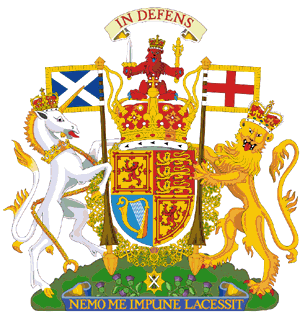
[edit] Is that a small lion or a bear sitting on top of the crown on the scottish emblem?
Also, why is it holding a sword in one hand and a spoon in the other? (78.149.8.182 (talk) 16:04, 20 April 2008 (UTC))
- The answers to your questions are in the article Royal coat of arms of Scotland, third paragraph. Indefatigable (talk) 18:08, 22 April 2008 (UTC)
-
- For a slightly more detailed (but not free image) see here: http://www.flags.net/images/largeflags/UNKG1029.GIF . Also, for an example of the motto In Defens, in full, see here: http://www.dorothydunnett.co.uk/2006AGM/mqos-arms-600.jpg . See also Honours of Scotland. 80.41.213.40 (talk) 16:09, 28 April 2008 (UTC)