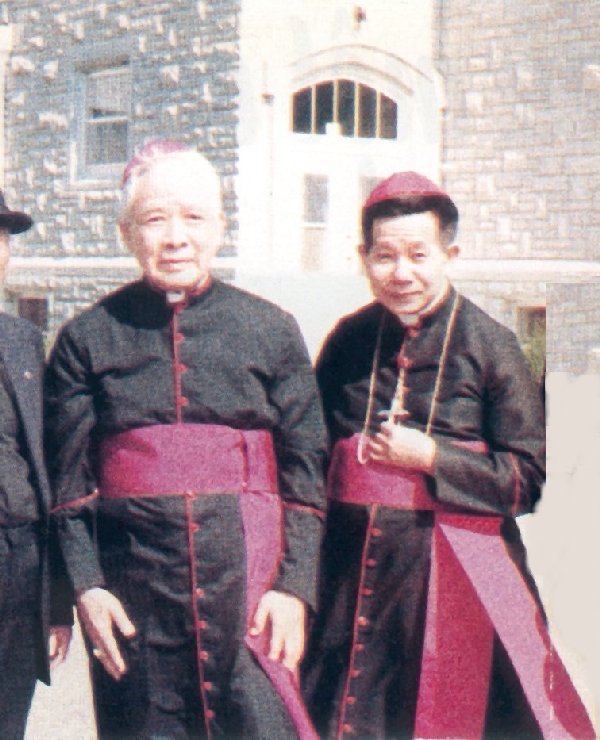
Pierre Martin Ngô Đình Thục
From Wikipedia, the free encyclopedia
- This is a Vietnamese name; the family name is Ngô, but is often simplified as Ngo in English-language text. According to Vietnamese custom, this person properly should be referred to by the given name Thục.
Pierre Martin Ngô Đình Thục (approximately pronounced "Ngoh Din Took" ) (ŋo ɗìɲ tʰûk) (October 6, 1897–December 13, 1984), Roman Catholic Archbishop of Huế, Vietnam, was born in Huế, on October 6, 1897, of affluent Roman Catholic parents. His younger brother, Ngô Đình Diệm, was the first president of South Vietnam. Cardinal François Xavier Nguyễn Văn Thuận (1928 - 2002) was Thục's nephew. Thục was the principal consecrator of Bishops Antoine Nguyên Van Thien (born 1906) and Michel Nguyên Khác Ngu (born 1909), who are currently the oldest still living Roman Catholic bishops in Vietnam.[1]
Contents |
Early Ecclesiastical Career


His episcopal motto was: "Miles Christi", soldier of Christ.
Thục entered the minor seminary in An Ninh at the age of 12. He spent eight years there before going on to study philosophy at the major seminary in Huế. After his ordination to the priesthood on December 20, 1925, he taught at the Sorbonne in Paris, France. He was then selected to study theology in Rome and returned to Vietnam in 1927 after being awarded three doctorates from the Pontifical Gregorian University in Rome in philosophy, theology, and Canon law.[citation needed]

He then became a professor at the College of Vietnamese Brothers in Huế, a professor at the major seminary in Huế, and Dean of the College of Providence.
In 1938, at the age of 41, Father Thục was chosen by Rome to direct the Apostolic Vicariate at Vinh Long. He was consecrated bishop on May 4, 1938, being the third Vietnamese priest raised to the rank of bishop. In 1957, Bishop Thục founded the Dalat University. On November 24, 1960, Pope John XXIII named Bishop Thục Archbishop of Huế.
Thục's brother, Ngô Ðình Khôi, was buried alive because of his refusal to become a minister in the first communist government. Thục's three other brothers, Ngô Đình Diệm, president of South Vietnam, Ngô Đình Nhu and Ngô Đình Cẩn, his close collaborators, were all assassinated. President Diệm was assassinated on November 1, 1963. Of all his siblings, only Thục and Luyen escaped assassination. Luyen was serving as ambassador in London and Thục had been summoned to Rome for the Second Vatican Council. After the Council (1962-1965), for political reasons and, later on, to evade execution by the communist government of Vietnam, Archbishop Thục was not allowed to return to his duties at home and thus began his life in exile, initially in Rome, later on in Toulon, France.
Palmar de Troya
Palmar de Troya, Spain, a town just outside of Seville, was the site of supposed apparitions of the Virgin Mary in the late 1960s and the 1970s. The Virgin was said to have appeared to little girls and to one adult, male visionary. The visionary and founder of the Palmar movement, Clemente Domínguez y Gómez staged ecstasies and supposedly received the stigmata.[citation needed] Archbishop Thuc traveled to Spain due to the intervention of Roman Catholic Canon of Grand-Saint-Bernard Rev. Maurice Revaz, who until he had become convinced by the Palmar de Troya apparitions, had taught Canon Law at the Society of Saint Pius X (SSPX) seminary of Archbishop Marcel Lefebvre in Ecône, Switzerland. Revaz left the SSPX for the Palmar de Troya group. Archbishop Lefebvre himself did not believe in the apparitions of Palmar de Troya and often warned his faithful of the many recent apparitions being reported; even more after Professor Rev. Revaz had left Lefebvre's traditionalist Roman Catholic seminary for "this fraudulent group in Palmar".[citation needed]
Archbishop Thục initially believed the apparitions were genuine. He also decided that several men in the Palmar de Troya-based Carmelite Order of the Holy Face were worthy of receiving Holy Orders. On January 1, 1976, Archbishop Thục consecrated Dominguez Gomez and four others to the episcopate, after having earlier ordained two of them to the priesthood on December 31, 1975. Three of the men consecrated by Thục had already been Roman Catholic priests for a long time: among them two diocesan priests and a Benedictine father. Since the consecrations were not done with the Pope's approval, Pope Paul VI excommunicated Archbishop Thục.[citation needed]
Archbishop Thục quickly severed his ties with Palmar de Troya - not directly because of Paul VI's objections, but rather because he came to conclude that the Palmarian movement was deviant and illegitimate, and that the apparitions were in fact fraudulent. He asked for the excommunication to be lifted and to receive absolution of all ecclesial penalties, to which Pope Paul VI immediately agreed.
Dominguez Gomez and his followers however proceeded to say Mass, ordain their own priests and consecrate bishops for their initially vagant religious Congregation of supposed Carmelites, however in the end (towards the end of 1977) effectively setting up a parallel church in opposition to the dioceses of the Roman Catholic Church by usurping ordinary ecclesiastical jurisdiction. Upon the death of Pope Paul VI in mid 1978, Dominguez Gomez claimed to have been mystically crowned pope in a jail, only hours after the death news reached him, founding the Palmarian Catholic Church.
Sedevacantism
Archbishop Thục then moved to Toulon in southern France, where he was assigned a confessional in the cathedral and at least once concelebrated the vernacular Mass of Paul VI (the New rite of Mass promulgated by Pope Paul VI in 1969), until about 1981. One author says that Thục also served at the Mass of Paul VI as an acolyte several times.[2] Thục lived in a poorly maintained apartment in relative poverty. Convinced of a crisis devastating the Roman Catholic Church and coming under increasing influence of sedevacantist activists, Archbishop Thục proceeded to consecrate several bishops without a mandate from the Holy See because he believed he was morally obliged to secure apostolic succession in the Latin Church, considering the reformed rites for Holy Orders of Paul VI to be of doubtful validity. Thục consecrated a Dominican priest, an expert on the dogma of the Assumption, advisor to Pope Pius XII,[3] and former professor at the Pontifical Lateran University, Guérard des Lauriers. On October 17, 1981, he consecrated two Mexican priests and former seminary professors, Moises Carmona of Acapulco and Adolfo Zamora. Both of these priests were convinced that the Papal See of Rome was vacant and the successors of Pope Pius XII were all heretical usurpers of papal office and power (see Sedevacantism). In February 1982, in Munich's Sankt Michael church, Archbishop Thục issued a declaration that the Holy See in Rome was vacant. In his declaration, he intimated that he desired a restoration of the hierarchy to end the vacancy. However, his newly consecrated bishops became a fragmented group. Nevertheless, many of them limited themselves essentially to sacramental ministry and only consecrated a few other bishops.

On September 25, 1982, Thục conditionally consecrated the former Old Catholic bishop, Christian Datessen. It is alleged that during this period, Archbishop Thục consecrated various individuals of dubious character and of independent Catholic and Old Catholic tendency, allegations which were never substantiated. Many of these dubious persons claimed to have "collected" multiple lines of apostolic succession, from several churches and sects, Catholic, Jacobite and Eastern Orthodox. The claims of these supposedly consecrated individuals were refuted by sources close to Archbishop Thục, going as far as to say the questionable persons claiming to have been consecrated by Thục, especially a certain "Bishop Roux", falsely claimed having been consecrated by Archbishop Thục.[4] Other persons close to Thục say that on the dates of the supposed consecrations, Thục had been with them in a different country and not where the alleged consecration by Thục supposedly had taken place. It should be noted that these claims were made after Thục's death.
Apart from the bishops consecrated by Thục with papal mandates in Vietnam, Thục consecrated five bishops at Palmar de Troya, three sedevacantists in 1981, and provided an episcopal ordination sub conditione to three clerics, who presented themselves to Thục as former Old Catholics intent on joining the traditionalist faction of the Roman Catholic Church. These eleven bishops consecrated by Thục proceeded to consecrate other bishops for various Catholic splinter groups, many of them Sedevacantists.

Shortly after the Datessen consecration, Archbishop Thục departed for the United States at the invitation of Bishop Louis Vezelis O.F.M., a Franciscan former missionary priest who had agreed to receive Episcopal Consecration by the Thục line Bishop George J. Musey, assisted by Co-Consecrators, Bishop Moisés Carmona y Rivera of Acapulco, Mexico and Bishop Adolfo Zamora y Roberto Martinez of Mexico City, Mexico in order to provide Bishops for an "imperfect Council" which was to take place later in Mexico in order to elect a legitimate Pope from among themselves. Archbishop Thuc took up residence in Bishop Vezelis' New York State friary for a short time after this photo was taken.
End of life
It is alleged (by the Vezelis group in particular) that Archbishop Thục was "abducted" by a group of Vietnamese priests while he was in New York and was taken to a Vietnamese Roman Catholic monastery in Missouri, where he was kept from contact with sedevacantists. A range of wild conspiracy theories exist about Thục's disappearance from the sedevacantist movement. It is equally possible that Thục joined his Vietnamese confrères after coming to the conclusion that his involvement in sedevacantism was not proper, or possibly just for nostalgic reasons. It is known that Thục posed in clerical garb with more conservative Vietnamese "Novus Ordo" clerics (priests and one bishop) during this period (1982 - 1984).[5] His Vietnamese Roman Catholic countrymen in exile continued, despite the illicit episcopal consecrations and despite his (formerly) open sedevacantism, to view Thục with the greatest respect. This veneration might be linked to the assassination of his brother-president in 1963. An ethnically Vietnamese website exists honouring Thục, but mentions nothing about the illicit episcopal consecrations.[6]
It is possible he returned to union with Pope John Paul II and abjured his former position of Sedevacantism, although this can neither be confirmed nor denied with certainty. Under these uncertain circumstances, Archbishop Thục died at the monastery of the Vietnamese American religious Congregation of the Mother Co-Redemptrix on December 13, 1984, at Carthage, Missouri, United States.
Controversy
Validity controversy
Some opponents of Thục and even some sedevacantists claim that the Thục-line episcopal consecrations might be invalid because they allege Archbishop Thục was no longer in possession of his mental capacities. This has been disputed by several authors; Bishop Gilles Barthe of the Diocese of Toulon - and thus himself involved in the controversies and opposed to traditionalist movements - claimed Thuc was not, without adducing proof though.[7] Pio Cardinal Laghi, Vatican diplomat and papal nuncio to the United States said that the episcopal consecrations and subsequent ordinations and consecrations are "valid but illicit". The Holy See itself has recognized and regularized a Thục-line priest who was ordained in the earlier ordinations of Palmar, bishop Alfred Seiwert-Fleige, and was reconciled to John Paul II. Seiwert-Fleige was allowed to function publicly as a priest, though was probably ordered to lay down his episcopal dignity. His Holy Orders were recognized as entirely valid. Seiwert-Fleige publicly concelebrated at a papal Mass of John Paul II at St. Peter's Square (Vatican City) in 2001. Ngo Dinh Thục according to all present at the consecrations and those who associated with him beforehand and afterwards was in full mental capacity during his 1981 consecrations. Furthermore, Thục wrote an official note in Latin confirming that he consecrated Carmona and Zamora. Other sources have alleged that the Vatican curial dicasteries have kept registries of all the Thuc-line bishops as valid episcopi vagantes. This is a logical procedure of the Vatican, as Roman Catholic doctrine requires only a valid bishop, a valid Catholic rite (Thuc used the old form of the Latin Roman Pontifical for episcopal consecrations), and imposition of hands. If these three conditions are met, a sacrament is to be considered as valid, unless the celebrant himself openly claimed an intention contrary to what the Church intends the rite to confer. Some opponents of Thuc allege that episcopal consecrations require two co-consecrators to ensure validity. While canonically this is true, one consecrating bishop without co-consecrators consecrates validly, as proven from the fact that the episcopal consecrations and priestly ordinations of the Old Catholic Church, which descend to one episcopal consecration conferred by only one bishop, Marie-Dominique Varlet, were always recognized as valid by the Holy See in numerous declarations of the Holy Office.
Other possible consecrations
In addition to the consecrations above, Archbishop Thục conditionally re-consecrated the following bishops who formerly belonged to the Old Catholic Church; Jean Laborie on February 8, 1977, and Christian Datessen on September 25, 1982. Laborie and Datessen founded their own missions. Reportedly, Archbishop Thục conditionally re-consecrated Michel Fernandez and Jean-Marie Roger Kozik, both formerly of the Palmarian Catholic Church (they left when the Palmarian leader declared himself "pope"), on October 19, 1978 and who returned to more or less traditionalist Roman Catholicism as episcopi vagantes. Kozik and Fernandez had been ordained to the Roman Catholic priesthood by Thục at Palmar in 1975.
It has been reported, but remains unconfirmed, that Archbishop Thục also consecrated Labat d'Arnoux on July 10, 1976, Claude Nanta de Torrini on March 19, 1977. These consecrations probably did not take place.
This makes a total of eleven bishops consecrated by Thục without the pontifical mandate required for licitness though not for validity. These bishops are: five Palmarian bishops (1976), Laborie (1977), Datessen (1982), Kozik, Fernandez (1978), Guérard des Lauriers (1981) and Zamora and Carmona-Rivera (1981).
Roux controversy
Finally, there is the case of the episcopus vagans Jean Gerard Roux. Roux alleges that he was consecrated by Archbishop Thuc on April 18, 1982. However, it is reported that he was consecrated earlier and later by other vagant bishops. There remains doubt concerning the circumstances of Roux's ordination and consecration. As a vagus who is known for having fraudulently asserted titles and honours, Roux should be considered as not consecrated, especially given the reports that Thuc was not with Roux on the date given by Roux as his supposed consecration. Archbishop Thuc was in Munich on the given date (April 18) and therefore could not have consecrated a Roux in Nice.[8]
Fraudulent claims
Besides the Roux controversy, because of Thuc ordained several bishops without papal mandate, and because he was a well-known, doubtlessly valid, Roman Catholic bishop, some vagant bishops and others posing as Independent Catholic clergy claim succession from him as well as from other Roman Catholic bishops, without in reality having been ordained in their apostolic succession.[citation needed]
References
- ^ Van Thien - Roman Catholic Hierarchy; Khac Ngu - Roman Catholic Hierarchy
- ^ Rev. Fr. Noël Barbara, Fortes in fide, Nr 12.
- ^ M.L. Guérard des Lauriers, Dimensions de la Foi, Paris: Cerf, 1952.
- ^ Anthony Chadwick on Jean-Gérard Roux: 'A pathological Liar'
- ^ Photo of Thục with Vietnamese clerics I; Photo of Thục with Vietnamese clerics II
- ^ Website in Vietnamese on Archbishop Ngô dinh Thuc
- ^ On the validity of the Ngô Dinh Thuc consecrations. By Rev. Anthony Cekada.
- ^ Einsicht - Röm.-Kath. Zeitschrift, Dr. E. Heller, December 1993, page 95. "Da sich der Erzbischof, den ich am 29. Januar 1982 in Nizza mit dem Flugzeug abgeholt hatte, zu diesem Zeitpunkt in München befand- er flog erst am 1. Mai 1982 wieder von München nach Nizza (Abflug: 15 Uhr 35, Ankunft: 17 Uhr 05), wo er von Herrn Norrant mit dem Auto abgeholt wurde -, kann eine Weihe zu diesem Zeitpunkt nicht erfolgt sein."
"An episcopal consecration on April 18, 1982 cannot have taken place in Loano, as the Archbishop Thuc, whom I had taken with me from Nice on January 29, 1982, by plane, at that date was with me and my family in Munich—he would fly back to Nice only on May 1, 1982 (Departure 3.35 pm), where he was picked up by Mr Norrant by car. Testimony of Dr. Eberhard Heller, Munich, Germany.
External links
- Roman Catholic Hierarchy: Archbishop Ngô dinh Thuc.
- "Misericordias Domini in æternum cantabo": Autobiography by Mgr. Ngô Dinh Thuc, written ca. 1978-1980. Published in: Einsicht - röm.-kath. Zeitschrift
- In Memoriam Monseigneur Peter Martin Ngo-Dinh-Thuc by Most Rev. M.L. Guerard des Lauriers, O.P.
- Sedevacantist Declaration of Archbishop Thuc
- PDF Document of Einsicht, 1982 - Includes Photographic Documentation of most of Archbishop Thuc's consecrations
- A critical evaluation of the validity of the episcopal consecrations conferred by Archbishop Ngo Dinh Thuc, according to Roman Catholic standards.
- http://www.tboyle.net/Catholicism/The-Athanasian.html - about the mental state of the Archbishop.
- "Archbishop Thuc: a brief defense by sedevacantist bishop Daniel Dolan.
| Episcopal Lineage | |
| Consecrated by: | Antonin Drapier |
| Date of consecration: | May 4, 1938 |
| Consecrator of | |
|---|---|
| Bishop | Date of consecration |
| Philippe Nguyên-Kim-Diên | January 22, 1961 |
| Michel Nguyên Khác Ngu | January 22, 1961 |
| Antoine Nguyên Van Thien | January 22, 1961 |
| Clemente Dominguez | January 11, 1976 |
| Manuel Corral | January 11, 1976 |
| Camilo Estevez | January 11, 1976 |
| Michael Donnelly | January 11, 1976 |
| Francis Sandler O.S.B. | January 11, 1976 |
| Michel Louis Guerard des Lauriers O.P. | May 7, 1981 |
| Moises Carmona | October 17, 1981 |
| Adolfo Zamora | October 17, 1981 |
|
|||||||||||||||||||


]]