Nehalem (microarchitecture)
From Wikipedia, the free encyclopedia
 |
This article contains information about scheduled or expected future computer chips. It may contain preliminary or speculative information, and may not reflect the final specification of the product. |
 |
Nehalem is a codename for both a processor microarchitecture and a processor. Nehalem will be released in late 2008 for high-end chips and early 2009 for mainstream chips. Volume production for LGA 1366 Nehalems is scheduled for the second half of 2008.[1] The microarchitecture is being developed by Intel and is the planned successor to the Core microarchitecture.
Intel is already well into the development process for Nehalem. Nehalem uses the 45 nm manufacturing methods from Penryn and applies it to the new Nehalem microarchitecture. This processor will debut in the second half of 2008 according to Intel;[2] a working system with two Nehalem processors was shown at Intel Developer Forum Fall 2007[3] and a large number of Nehalem systems were shown at Computex in June 2008. The processor is named after the Nehalem River in Northwest Oregon, which is in turn named after the Nehalem Native American tribe in Oregon.
Contents |
[edit] The codename
The codenames "Bloomfield" (desktop chip), "Gainestown" (server chip), "Gilo" (mobile chip),[4] and "Beckton" (or "Becton") (server chip)[5] have been associated with Nehalem, but with very few details.
The code name itself had been seen on the end of several roadmaps starting in 2000. At that stage it was supposed to be the latest evolution of the NetBurst architecture.


Since the abandonment of NetBurst, the codename has been recycled and refers to a completely different project.
[edit] Technology

As of its current description (at Spring IDF 2008), Nehalem appears to incorporate the most significant new architectural changes to the x86 microarchitecture since the Pentium Pro debuted in 1995. Nehalem is highly scalable[6] with different components for different tasks. Various sources have stated that Nehalem's specifications will be as follows.
- 2 through 8 (or more) cores.
- Integrated memory controllers supporting DDR3 SDRAM and between 1 and 4 memory channels.
- Manufactured using the same 45 nm manufacturing process as its predecessor, Penryn.
- Some variants will have an integrated graphics processor (IGP) located off-die, but in the same CPU package.[7]
- Uses the new point-to-point processor interconnect, the Intel QuickPath Interconnect, replacing the legacy front side bus.
- Hyper-threading, which has not been present on a consumer Intel processor since 2006 with the Pentium 4 and Pentium EE.
- Native (monolithic, i.e. all processor cores on a single die) quad and octo (8) core processors.[8]
- 731 million transistors for the quad core variant.
- 32 KB L1 instruction and 32 KB L1 data cache per core.
- 256 KB L2 cache per core.
- 8 MB (in the quad core version) L3 cache shared by all CPU cores.
- 33% more in-flight micro-ops than Core.[9]
- 2nd level branch predictor and 2nd level Translation Lookaside Buffer.[9]
- Modular blocks of components such as cores that can be added and subtracted for varying market segments.[10]
There have been reports about the demonstration of a Nehalem CPU (1st stepping) with 4 cores (8 threads) running at a speed of 2.133 GHz with a multiplier of 16x. This processor has 32 KB data and 32 KB inst of L1 cache, 256 KB L2 cache per core (1 MB total), and 8 MB of shared L3 cache.[11]
It is suggested that dual- and octo-core Nehalems will launch earlier in 2009 rather than later that year.[12]
[edit] Performance and power improvements
It has been reported that Nehalem will have a focus on performance, which accounts for the increased core size.[13] Compared to Penryn, Nehalem will have:
- 1.1x to 1.25x the single-threaded performance or 1.2x to 2x the multithreaded performance at the same power level
- 30% lower power usage for the same performance
- According to a preview from AnandTech "expect a 20 - 30% overall advantage over Penryn with only a 10% increase in power usage. It looks like Intel is on track to delivering just that in Q4." [14]
Compared to a 3.0 GHz Core-based "Clovertown" microprocessor, the Nehalem-EP "Gainestown" processor will have 1.6x the SPECint_rate2006 integer performance and 2.4x the SPECfp_rate_2006 floating-point performance.[13]
Bloomfield systems will have a theoretical memory bandwidth of up to 38.4 GB/s using triple-channel 1600 MHz DDR3.[15] In experiments with a pre-release 2.93 GHz Bloomfield, AnandTech measured 12.0 GB/s copy bandwidth using triple-channel 1066 MHz DDR3, against 6.9 GB/s using dual-channel 1066 MHz DDR3 on a 3.0 GHz Core 2 Quad system.[16]
Overclocking Nehalem processors will only be possible with the X58 chipset. The mainstream PCH will not be capable of overclocking unless a hardware mod is found.[17][18]
[edit] Variants
Nehalem will come in variants for servers, desktops, and notebooks. The processor for four-socket servers is codenamed Beckton, the chip for two-socket servers Gainestown, and the chip for single-socket desktops is Bloomfield.[19]
According to DailyTech, all models of the desktop chip Bloomfield will have three DDR3 channels. The quad core models will have 8 MB of shared L3 cache (Penryn has 12 MB of shared L2 cache), and the high-end models will have a 130 W TDP, compared to 136 W for high-end Penryns.[20] Server processors will support registered DDR3.[21]
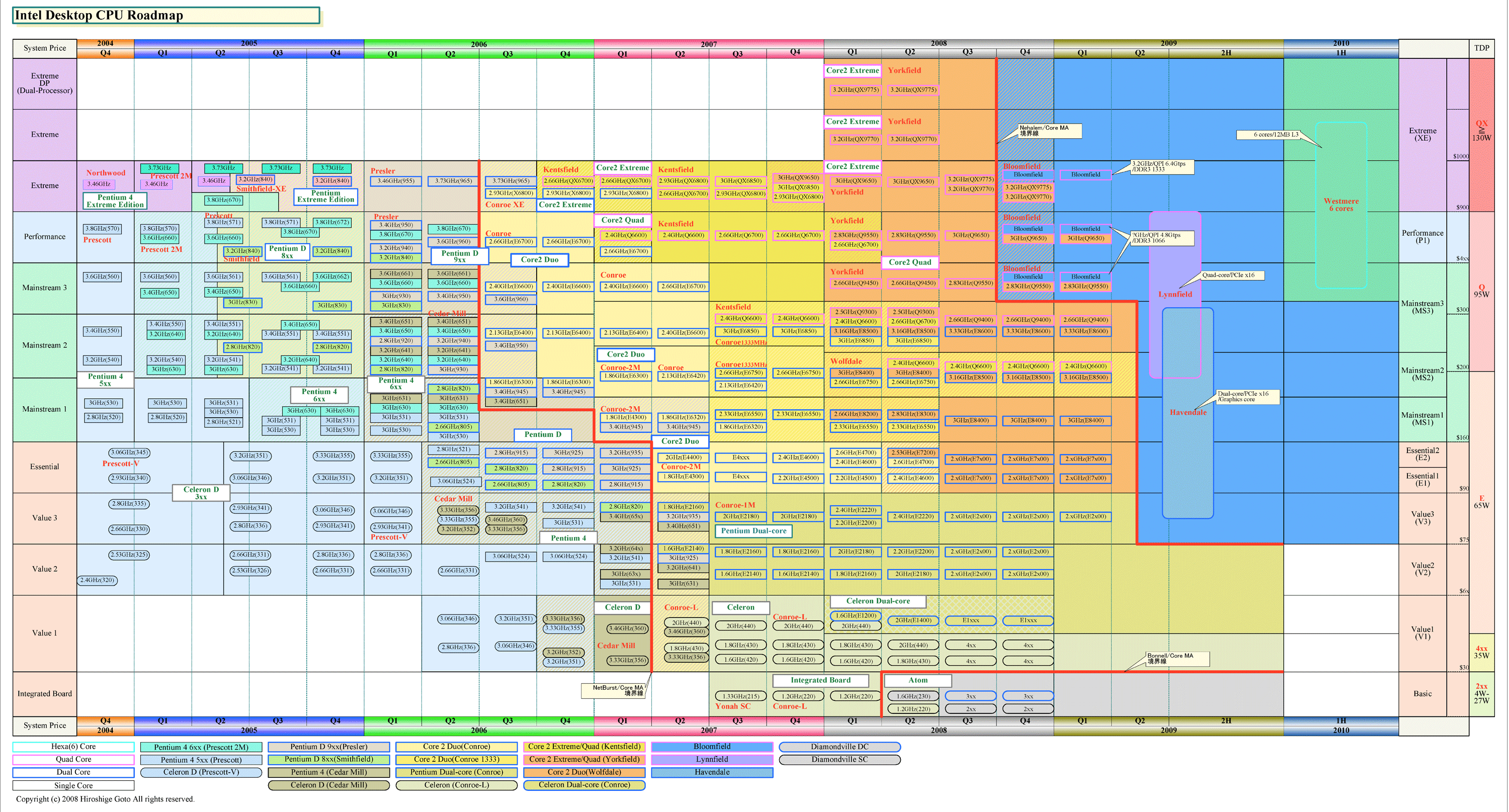
Seven codenames have been associated with the Nehalem microarchitecture in a PC Watch article[22]. These include two server processors, three desktop processors, and two mobile processors. The server processor, Beckton, will have 44 bits of physical memory address and 48 bits of virtual memory address.
| Codename | Market Segment | Process | Cores (Threads) | Speed | Cache | Memory Controller | Bus Interface | GPU Core | TDP | Socket | Timeframe |
|---|---|---|---|---|---|---|---|---|---|---|---|
| Westmere [23] | Nehalem refresh | 32 nm | 6 (12) | 256 KB L2/core 12 MB shared L3 |
Triple channel DDR3 | 2x QuickPath | No | Unknown | LGA1366 | H1 2010 | |
| Beckton[22] | MP server | 45 nm | 8 (16) | 256 KB L2/core 24 MB shared L3 |
Quad channel FB-DIMM2 | 4x QuickPath | 90/105/130 W | LGA1567 | Q4 2009 | ||
| Gainestown[22] | DP server | 4 (8) | 256 KB L2/core 8 MB shared L3 |
Triple channel DDR3 800/1066/1333 MHz | 2x QuickPath | 60/80/130 W | LGA1366 | Q4 2008[24] | |||
| Bloomfield[22] | Extreme desktop | 3.2 GHz[25] | Dual and Triple channel DDR3 800/1066/1333/1600 MHz[26] |
1x 6.4 GT/s QuickPath[26] | 130 W | Q4 2008[24] | |||||
| 1x 4.8 GT/s QuickPath[26] | |||||||||||
| Performance desktop[27] | |||||||||||
| Lynnfield[22] | Mainstream desktop | Dual channel DDR3 800/1066/1333 MHz[28] | DMI x4/x2 PCI Express 2.0 |
95 W | LGA1160[22] | Q2 2009[29] | |||||
| Clarksfield[22] | Mainstream mobile | 45/55 W | mPGA 989[22] | Q2 2009 | |||||||
| Havendale[22] | Value desktop | 2 (4) | 256 KB L2/core 4 MB shared L3 |
DMI x4/x2 PCI Express 2.0 |
Yes | 75 W[26] | LGA1160[22] | H2 2009[29] | |||
| Auburndale[22] | Value mobile | 35/45 W | mPGA 989[22] | H2 2009 |
[edit] The successor
Westmere (formerly Nehalem-C) is the name given to the 32 nm shrink of Nehalem. Westmere should be ready for a 2009 release provided that Intel stays on target with its roadmap. Westmere will, according to Intel's Pat Gelsinger, have a new set of instructions called AES-NI, that gives over 3x the encryption and decryption rate of AES processes compared to before.[30] AES-NI may be included in the integrated graphics of Westmere. It is also suggested that Westmere, unlike Nehalem, will have the integrated graphics released at the same time as the processor.
AES-NI will deliver six new instructions that will use the Advanced Encryption Standard (AES) algorithm and also an instruction that will perform carry-less multiplication (PCLMULQDQ). Those instructions allow the processor to perform hardware accelerated encryption not only providing a faster execution but also protects against software targeted attacks.
The successor to Westmere will be Sandy Bridge, scheduled for release in 2010.
[edit] See also
[edit] References
- ^ Intel says Nehalem chips on track for '08 2nd half
- ^ Intel: More Details on Penryn and Nehalem, AnandTech.com.
- ^ IDF 2007 - Day 1: Nehalem, Intel's GPUs, 32nm and More, AnandTech.com.
- ^ A Field Guide to Intel's Nehalem revealed. The INQUIRER (7 July 2005). Retrieved on 2008-03-20.
- ^ The road from Aliceton leads to. The INQUIRER (11 September 2006). Retrieved on 2008-03-20.
- ^ Intel Nehalem microarchitecture details
- ^ Jeremy Laird (September 19, 2007). IDF: Not all Intel Nehalem CPUs single-die. Tech.co.uk.
- ^ IDF: Intel reveals eight-core PC processor, Tech.co.uk.
- ^ a b Anand Lal Shimpi (March 17, 2008). Opening the Kimono: Intel Details Nehalem and Tempts with Larrabee. AnandTech.
- ^ Gelsinger, Patrick P (2008-03-17). Intel Architecture Press Briefing (pdf). Intel.
- ^ Intel Nehalem cpuz, Xtreview.
- ^ What chips may come: Intel lifts curtain on upcoming CPUs. Ars Technica (March 18, 2008). Retrieved on 2008-03-20.
- ^ a b Intel's dual teamed approached to micro-architecture development (Japanese). PC Watch (2008-01-29).
- ^ AnandTech - The Nehalem Preview: Intel Does It Again
- ^ Fudzilla - More Nehalem details emerge
- ^ "Intel does it again", AnandTech, June 5, 2008.
- ^ "No Overclocking for Mainstream Nehalems", Softpedia, April 22, 2008.
- ^ "Next Generation: Platform Controller Hub", HKEPC, January 3, 2008.
- ^ Intel roadmaps next-gen Extreme 'Nehalem' chips, Register Hardware.
- ^ Kristopher Kubicki (October 26, 2007). Intel Slates "Nehalem" for Q4 2008. DailyTech.
- ^ Kristopher Kubicki (November 28, 2007). Gearing Up for "Nehalem" Sockets. DailyTech.
- ^ a b c d e f g h i j k l (Japanese)Hiroshige Goto (November 28, 2007). What GPU integration CPU of Intel "Havendale/Auburndale"? (translated title). PC Watch.
- ^ Hiroshi Goto (March 26, 2008). 32nm process "Westmere" is a 6 2009-2010 (translated). PC Watch.
- ^ a b Intel says Nehalem chips on track for '08 2nd half
- ^ http://pc.watch.impress.co.jp/docs/2008/0326/kaigai02l.gif
- ^ a b c d Deconstructing Intel's 2009 desktop platforms (Chinese). HKEPC Hardware (2008-01-03).
- ^ Fudzilla - Nehalem to launch in three SKUs
- ^ Gabriel Ikram & Kristopher Kubicki (March 17, 2008). Intel Discusses GPU, Hybrid CPUs. DailyTech.
- ^ a b Hiroshige Goto (2008-06-02). ソケット数の制約から脱却する Nehalem世代のIntel CPU. PC Watch. Retrieved on 2008-06-05.
- ^ Tim Smalley (September 19, 2007). Westmere is Nehalem's successor. bit-tech.net.
- Intel Showcases Dunnington, Nehalem and Larrabee Processors HotHardware, 17 March 2008
- Intel Slides and Nehalem architecture information PC Perspective, 28 March 2007
- Intel drops a Nehalem bomb on AMD's Fusion: integrated graphics, on-die memory controller, SMT ArsTechnica, 28 March 2007
- Nehalem: Single die, 8-cores, 731M transistors AnandTech, 18 September 2007
- IDF 2007: Intel debuts Nehalem ITPro, 19 September 2007
- Intel takes the silicon out of chips Jerusalem Post, 13 November 2007
- Bloomfield will cost less than 400 dollars Xtreview, 2008-02-03
- What you need to know about Intel's Nehalem CPU Ars Technia, 2008-04-09
- Details on the Forthcoming Intel Nehalem Processor
|
|||||||||||||||||