Talk:My Lai Massacre
From Wikipedia, the free encyclopedia


 Archives |
| 1 |
[edit] American support
I removed the following from the article
- Some Americans were almost proud of what there soldiers did. Most of them family members of killed soldiers wanting revenge on Vietcong.
since it seemed to use weasel words ("almost proud"), and may be giving undue weight to a minority (per WP:NPOV). Citations for this might be useful in gauging the magnitude and meaning of this claim. --TeaDrinker 02:38, 5 January 2007 (UTC)
[edit] Crime of obedience
I think this sentence is rather inappropriate: "Enraged because fellow platoon soldiers were killed on previous occasions, they gave little thought to the consequences of their actions that day."
This massacre has been used as an example of a “crime of obedience” (e.g in “Crimes of obedience”, Kelman and Hamilton, 1989), and there is an ongoing debate concerning why ordinary human beings (that is, not sadist or anything) commit such horrible acts. This is a large field within social psychology, and it is way too easy to say that these soldiers comittede these acts because they were enraged as a consequence of fellow platoon soldiers being killed on previous occasions.
Also I think it would be appropriate to write a section in this article concerning the massacre as a crime of obedience (e.g what makes people do this sort of thing). ..but this is only a suggestion.
--Galeandra 09:26, 7 February 2007 (UTC)
- I agree entirely with your point about the sentence you've quoted. For one thing, it removes the institutional, systemic culpability that was one of the issues examined in the courts martial. I imagine your suggestion re; crimes of obedience could reasonably be integrated into the discussion of why the Massacre occurred. Pinkville 16:51, 6 February 2007 (UTC)
I removed the sentence. --Galeandra 10:06, 7 February 2007 (UTC)
But does the fact that it could have been a crime of obdience remove the possibility that they also acted like they did, because they were enraged over the death of their fellow soldiers? Does one exclude the other?
[edit] Globalize/Northern
This article is tagged with "Globalize/Northern" because the following phrase is used within the article:
- In the spring of 1972
The use of seasons as time references is deprecated because seasons in different parts of the world occur at different times of the year. To remove this ambiguity, this ambiguous seasonal reference should be replaced by a more precise and less ambiguous time reference, such as month names. --B.d.mills 04:28, 16 March 2007 (UTC)
- Although I sympathise with the motivation for this tag, I think the context of the line quoted above is quite clear: we're talking about Spring locally, i.e. in Vietnam, not in Tierra del Fuego, and not "worldwide". Pinkville 11:43, 23 March 2007 (UTC)
- Except that Vietnam's a tropical climate. There is no Spring as such. It's talking about the American Spring. Anyhow, Spring is a very imprecise term, and therefore B.d.mills is right
Furius 08:50, 4 December 2007 (UTC)
[edit] A moment of semi-protection please?
This page is getting vandalised repeatedly from various similar anon IPs at this time (17:12, 17 April 2007 (UTC)). I point the finger at a bunch of school kids messing around. A few hours of semi-protection would stop the little blighters. Bob f it 17:12, 17 April 2007 (UTC)
- All is quiet now, they took the hint. Bob f it 17:43, 17 April 2007 (UTC)
[edit] Cleanup
I did a lot, but now:
- the "Massacre" section must be rewritten, expanded
- the helicopter rescue in its own section (now its more than killings), and so the discovery (whistleblowing stories)
- maybe also "Scandal" section, on the popular outrage and the effects
- the responsiblity of the other platoons and the command (and beyond Medina) should be discussed, and also the fact the village was first hit by the artillery
Don't be afraid of the grizzly details. We already have pictures, so gruesome I standard-thumbnailed them. BBC wrote: "Soldiers went berserk, gunning down unarmed men, women, children and babies. Families which huddled together for safety in huts or bunkers were shown no mercy. Those who emerged with hands held high were murdered. (...) Women were gang raped; Vietnamese who had bowed to greet the Americans were beaten with fists and tortured, clubbed with rifle butts and stabbed with bayonets. Some victims were mutilated with the signature "C Company" carved into the chest."[1] The extreme brutality of the incident is quite important, I think. --HanzoHattori 13:45, 15 July 2007 (UTC)
-
- I agree with all of your suggestions. Bleh999 17:43, 16 July 2007 (UTC)
-
-
- Yeah. But the problem with Wikipedia is it's always "do it yourself (and the others will destroy your work anyway)"... and the related problem is it's not my job, and I spend too much time anyway. --HanzoHattori 02:07, 18 July 2007 (UTC)
-
[edit] Phoenix Program
The Phoenix Program article needs some fact-checking and source-checking. The article has been recently rewritten. Much was deleted. The new material seems questionable. Just like the old material.
Someone claimed also that some of the new material was copied verbatim from elsewhere without using quotes. So if it is true then that is probably a violation of WP:COPYVIO. Unless the material was in the public domain.
The new references need to be detailed with titles, authors, dates, etc.. It would be nice if some quotes from the referenced material was used. Sometimes I don't trust paraphrasing. Especially for controversial articles. And the editor who did much of the rewriting and paraphrasing has been accused of POV-pushing in other articles. --Timeshifter 15:29, 10 August 2007 (UTC)
[edit] The other soldiers
Anyone has information on the other soldiers of the Charlie Company? --HanzoHattori 23:21, 19 August 2007 (UTC)
I've got a list of key personas from the investigation:
'CID Statements, 1st Platoon, C Company'. File of photocopies of statements collected by US Army Criminal Investigation Division (CID) from members of 1st Platoon, C Company, 1st Bn 20th Inf, US Army, who were witnesses to events at My Lai, 16 Mar 1968, when Vietnamese civilians were massacred by US forces. Includes statements from William Calvin Lloyd, Lenny Battallones Lagunuy (Aquilino), Sidney Kye, Dennis Irving Conti, Allen Joseph Boyce, Robert James Bergthold, Robert Martin Mauro, Robert E Maples, Robert James Lee, James Joseph Dursi, Isaiah Cowan, Bruce Umber Cox, Harry Stanley, Charles Wayne Hall, Elmer Glen Haywood, Roy Lee Augustus Wood, Herbert Louis Carter, David Mitchell, Paul David Meadlo, Charles Sledge, Gregory Thomas Olsen, Daniel Simone, and Ronald David Grezik.
'CID Statements, 2nd Platoon, C Company' File of photocopies of statements collected by US Army Criminal Investigation Division (CID) from members of 2nd Platoon, C Company, 1st Bn 20th Inf, US Army, who were witnesses to events at My Lai, 16 Mar 1968, when Vietnamese civilians were massacred by US forces. Includes statements from Floyde Dale Wright, Richard Wayne Wyatt, Roy Fred Trevino, Fernando R Trevino, Varnado Simpson, Kenneth Schiel, Thomas Richard Partsch, Dean Fields Jr, James Michael McBreen Jr, Tommy Lee Moss, Tom Calvin Makey, John Richard Mower, Dennis Martin Bunning, Jay Allan Buchanon, Salvador LaMartina, Max Dean Hutson, Leonard Robert Gonzalez, George Arsenio Garza, Charles Edward Hutto, and Kenneth Larry Hodges.
'CID Statements, 3rd Platoon, C Company' File of photocopies of statements collected by US Army Criminal Investigation Division (CID) from members of 3rd Platoon, C Company, 1st Bn /20th Inf, US Army, who were witnesses to events at My Lai, 16 Mar 1968, when Vietnamese civilians were massacred by US forces. Includes statements from Richard Wayne Pendleton, Stephen Tandall Glimpse, Charles Dean Gruver, Gary Michael Garfolo, Joe Grimes, Jeffrey Urban LaCross, Everette Lee Cayot, Fred William Dustin, Abel Flores Jr, Rickey C Neria, Gener Ralph Oliver Jr, Larry Owen Polston, Raymond McDonald, John Henry Smail, Robert William T'Souvas, and Charles Anthony West.
'CID Statements, Medina's Command Group and non-C Company personnel'. File of photocopies of statements collected by US Army Criminal Investigation Division (CID) from members of Capt Ernest L Medina's Command Group, 16 Mar 1968, relating to reports of a massacre of Vietnamese civilians at My Lai on that day. Includes statements from Nels August Parson Jr, Chief of Staff, American Division; Patrick M Trinkle, and William Clifton Riggs, variously Commanding Officers of A Company, 3rd Bn, 1st Inf; William Earl Watson Sr, member of Mortar Platoon, C Company, 1st Bn, 20th Inf; Michael Crouch Adcock, Hq Co, 3rd Inf, 1st Bn,11th Bde, Radio Telephone Operator to Col Henderson; James T Cooney, 174th Aviation Company, Col Henderson's helicopter pilot on 16 Mar 1968; Randolph Emil Sabre, James Allen Reutner, Jerry R Culverhouse, Henry Dalo Mott, Dan Richard Millians, Charles Hersley Mansell, Brian William Livingston, Jerry F Lesher, Daniel Eugene Hill, and Calvin Dale Hodde, pilots and crew of US Army helicopters; Cecil David Hall, Bde Communication Chief, 11th Light Inf Bde; John L Halliday, Commanding Officer, 123 Aviation Bn, Americal Division; Lenny Barrallones Lagunoy (Aquilino),Thomas John Kinch, Michael Arnold Bernhardt, Sgt Duong Minh, Sgt Nguyen Dinh Phu, Dennis Harvey Johnson, Nicholas Capezza, William R Kern, Roger Delano Murray, James Harold Flynn, John Hobart Paul, and Frederick Joseph Widmer, members of Capt Medina's command group within C Company, 1st Bn, 20th Inf, 11th Bde on 16 Mar 1968; Jerry LeMar Heming, and Calvin Louis Hakwins C Company, 26th Engineer Bn, demolition experts, Jay Alfred Roberts, Senior Correspondent, 31st Public Information Detachment, Louis Bernard Martin, Radio Telephone Operator, Roger Louis Alaux, Artillery Officer, all assigned to 1st Bn, 20th Inf, 11th Bde; Dale Manford Arcoren, Martin Edward Fagan, John Lewis Oliphent, Larry Edwin Waterstreet, Thomas John Kinch, David Benjamin Hein, Mortar Platoon, 1st Bn, 20th Inf, 11th Bde.
--HanzoHattori 01:45, 8 September 2007 (UTC)
One can google through their names for more if needed. --HanzoHattori 01:47, 8 September 2007 (UTC)
[edit] Patriots
People who defend their homeland againnst invaders and aggressors are called patriots. Nobody should call them insurgents. —Preceding unsigned comment added by 212.114.166.220 (talk) 16:59, August 25, 2007 (UTC)
- I found one instance of the word "insurgents" in the article. I changed it to "fighters". --Timeshifter 17:34, 26 August 2007 (UTC)
- Technically, South Vietnamese "patriots" would rather support their country against North Vietnam. --HanzoHattori 11:47, 31 August 2007 (UTC)
- And those on both sides considered themselves "patriots" - those who supported the RVN against North Vietnam, and those who supported a united Vietnam and considered the RVN government a Quisling regime. The same is the case in every civil war in which a foreign military presence is involved. It's one of those POV-loaded words. --Davecampbell 22:00, 9 September 2007 (UTC)
[edit] Context?
I fully understand the nature of a guerilla war includes women and children as combatants, and that anyone who picks up a gun to join the fight makes themselves a threat. (A kid with a grenade or machine gun who is trying to kill an adult can change one's ethics quite quickly). (I agree with that notion! -Jack Battle 7:14 10/15/07)
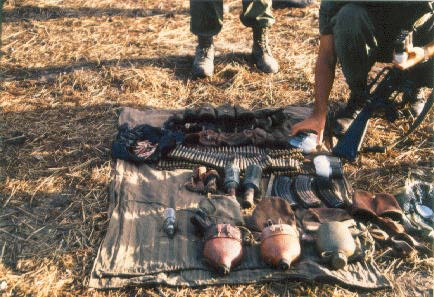
The section on context seems inappropriate here because the soldiers and pictures clearly showed people who were unarmed. Rounding up and murdering anyone a unit comes across in a guerrilla war and citing that as a reason actually does a disservice to those forced to actually return fire at armed women and children who are shooting at them. Combatants all have one thing in common, military equipment like the round, drum magazine near the top left. If they did find guns and such in My Lai they did a crappy job pointing that out, because usually pictures like this would be taken documenting any weapons found. Anynobody 07:11, 31 August 2007 (UTC)
- Actually 3 (three) weapons were found (there would be probably more, but they were burning buildings and blowing up tunnels and not searching). But it's not the point, as according to all real evidence no shots were fired at the American soldiers in the village (VC all fled to the jungle and returned only when the Anericans left). --HanzoHattori 11:41, 31 August 2007 (UTC)
Related:
"The GIs were in the belief that every person in that village were either Viet Cong or Viet Cong sympathizers," Latimer said. Troops had been prepared for an unflinching enemy, Staff Sgt. L.G. Bacon testified, a Dec. 15, 1970, Globe-Times report said. "They told us that old women and children strapped grenades on them, poisoned Cokes, and put grenades down our gas tank." Capt. George C. White took the stand to describe the heavy fire his platoon had endured in February 1968, when casualties reduced his company from 172 to 50 men, the story said. "My impression was that any one (sic) remaining in the village, regardless (of) whether they were men, women and children, were to be killed," Staff Sgt. Martin Fagan testified. "(Medina) said we were going to where the 48th Viet Cong battalion was and we were to kill all Viet Cong, all Viet Cong suspects, all NVA (North Vietmase Army) and all NVA suspects, destroy all food sources, kill all animals and burn the village," Bacon said. "To me that meant women and children and everything else. Viet Cong sympathizers can be any of these ... my impression was they were all to be killed," another solder, Elmer Haywood, said.[2]
If anything, what happened was partailly the effect of the stories they "were told". --HanzoHattori 12:19, 31 August 2007 (UTC)
- I'm not saying those things didn't happen (kids with bombs, poisoned cokes, etc.) during the conflict. The VC were masters of guerilla war, but I am saying they weren't happening in that village on March 16, 1968. Even if the troops had reason to believe they might happen, after a little time it should have been obvious that the children weren't carrying grenades, and their Cokes were safe within a few minutes.
- I'll use the US casualty figures and your data; 3 weapons were found, with possibly more, for a body count of 347. What kind of weapons were they Ak-47s or hunting rifles? Also I'd have to say the idea of simply burning explosives and weapons in huts is pretty unlikely unless the soldiers were stupid; does this look like a man concerned the weapons cache inside is about to explode? You do understand that these pictures were taken by the soldiers, not some anti war reporter ignoring a huge pile of weapons somewhere.
- Calley and Meadlo were firing at the people. They were firing into the hole. I saw Meadlo firing into the hole.
- Q: Well, tell me, what was so remarkable about Meadlo that made you remember him?
- A: He was firing and crying.
- Q: He was pointing his weapon away from you and then you saw tears in his eyes?
- A: Yes.
- This type of report is not typical of an actual battle. Anynobody 01:53, 1 September 2007 (UTC)
- Even the Army accepts what happened was a massacre, explained but not excused by the nature of war the VC were pursuing. (Those soldiers not only murdered innocent people, but they actually helped the VC cause by doing it by giving them a propaganda victory.) This wasn't the first time a massacre happened, nor the last, and most militaries are guilty of similar behavior. Anynobody 02:18, 1 September 2007 (UTC)
I never suggested it was anything like "a battle" (there would be, but the real VC decided to not fight and flee). I'm just saying the stories (none of them interviewd there said they actually witnessed this) would explain (not excuse) the mindset of the soldiers and officers which led to the tragedy. Read again what I wrote first. --HanzoHattori 06:29, 3 September 2007 (UTC)
- I totally understand what you are saying, and if the situation was more like I described below (jumpy GI shoots a kid) it'd probably be exactly what made him so jumpy in the first place. My point is this thing went on for hours. Plus in an accidental situation, one generally doesn't keep shooting villagers once they notice no return fire. Rounding them up in a hole for easier execution also indicates a general lack of accidental nature here. Anynobody 06:40, 3 September 2007 (UTC)
I'm not saying it was accident. I'm saying what helped to turn the normal American kids into basically a bunch of Nazis. They took numerous casualties from mines and traps (VC there avoided any direct contact), and heard stories how they're "all VC". They went to kill the VC and "suspects". They didn't find the armed rebels, so they killed what they thought was "suspects" (everyone). --HanzoHattori 06:49, 3 September 2007 (UTC)
--
The point of adding context to this article, is that Vietnamese women and children were regularly used as combatants, and did not wear a uniform. The entire article fails to provide this highly relevant context. So what may appear to be an "innocent civilian," may actually be a combatant. My additions did not state the people were armed at the moment the madness began in the village. Also, providing a photo of a Vietnamese child combatant, which was also continually deleted, helps illustrate the usage of what people normally view as "civilians" in the role of combatant.
Also, regarding citations -- how can citations to Noam Chomsky fall within NPOV? Additionally, the hyperbolic quote featured at the top of the article (about shooting a baby and laughing), is cited with a reference to a 32 Volume document -- thousands and thousands of pages -- so no one can possible learn who said it, in what context it was said, and if they had an agenda in making it up (e.g., an anti-war activist soldier).
WilliamSpencer 21:13, 2 September 2007 (UTC)
- In the interest of clarity I should point out that my concern is about the context paragraph. The baby shooting quote and the kid with the grenade launcher are not what I was talking about when I set up this thread. Noam Chomsky quotes can go too because I agree he is not exactly NPOV.
- The context trying to be presented in the paragraph would be appropriate if we were talking about an incident where a jumpy GI blew away a kid he thought was carrying a grenade. In this case soldiers directed by their superiors engaged in the systematic killing of everyone they encountered over a period of hours.
- Also, maybe I'm misunderstanding you but I took My additions did not state the people were armed at the moment the madness began in the village. to mean that because they weren't armed at the time they still must've been VC? Anynobody 01:13, 3 September 2007 (UTC)
On a sidenote, I'm against any Chomsky quotes anywhere near there. This man disqaulified himself on the Khmer Rouge issue enough to ignore him on anything related to the extended Vietnam war (I actually just ignore him whole). --HanzoHattori 01:38, 8 September 2007 (UTC)
OK, this resolved already? --HanzoHattori 01:51, 8 September 2007 (UTC)
- As long as the context section in this archive isn't added again, I'm good. Anynobody 03:27, 8 September 2007 (UTC)
[edit] Photographs

[edit] Chomsky quoting
On a sidenote, I'm against any Chomsky quotes anywhere near there. This man disqaulified himself on the Khmer Rouge issue enough to ignore him on anything related to the extended Vietnam war (I actually just ignore him whole). --HanzoHattori 01:38, 8 September 2007 (UTC)
- Chomsky has expressed opinions on dozens of different subjects and written books packed with "information", only twice has he been proved wrong (I've forgotten the other one, it's significantly less memorable than this one).
- Chomsky seems to have carried on defending Pol Pot/Khmer Rouge for about 2 years after it should have been clear what was happening in the Killing Fields. However, the US carried on recognising Pol Pot as the leader of Kampuchea for 12 years, so it's hardly a big fault on his part. (Did people realise it was the newly victorious Vietnamese who overthrew the Khmer Rouge, and it's the only really successful "regime change" in history?). PRtalk 18:55, 1 October 2007 (UTC)
- Wow, HanzoHattori, your opinion of Chomsky is quite apparent. At first, I was perhaps thinking you might have a point, but since you found it important to let us know that you chose to ignore Chomsky altogether, it is apparent you have something against the man, so why should his views be taken any less seriously than yours? Also, read what PalestineRemembered wrote above about the Rouge. Chomsky has proven himself to be a well-informed intellectual, but all I get from you is that you don't like what he says. Any comments?153.26.176.34 01:57, 2 October 2007 (UTC)
- Chomsky seems to have carried on defending Pol Pot/Khmer Rouge for about 2 years after it should have been clear what was happening in the Killing Fields. However, the US carried on recognising Pol Pot as the leader of Kampuchea for 12 years, so it's hardly a big fault on his part. (Did people realise it was the newly victorious Vietnamese who overthrew the Khmer Rouge, and it's the only really successful "regime change" in history?). PRtalk 18:55, 1 October 2007 (UTC)
- There aren't any "Chomsky quotes" in this article. In the Further Reading section, links are provided to one work by Chomsky that specifically relates to this event, and the other to a co-authored work on related issues. There is no basis for an objection to the inclusion of these two items. As for Chomsky and Cambodia... those who claim that he ever supported the Khmer Rouge or was "wrong" about Cambodia should actually read what he (and Edward Herman) wrote on the subject*. He has always been an opponent of the Khmer Rouge (unlike the US administration of Ronald Reagan, for instance) and the point that he (and Herman) made back in the 1970s (and subsequently) was that mainstream accounts of Cambodia under the Khmer Rouge attributed all deaths to the Khmer Rouge without ever mentioning US responsibility for Cambodian deaths due to their earlier massive bombardment of the country (which contributed greatly to the rise of the Khmer Rouge in the first place) nor US support for the murderous Lon Nol regime that preceded the Khmer Rouge. Furthermore, Chomsky (and Herman) were contrasting the massive mainstream reporting of the Killing Fields with the (literally) total absence of mainstream reporting on the contemporaneous Indonesian invasion of East Timor that resulted in 200,000-300,000 deaths. While the US had virtually no influence on the Khmer Rouge (while they were in power) to stop the killings in Cambodia, the US had great influence on Indonesia to stop the invasion and near genocidal massacre, but did nothing (except to increase military aide to the invader). With no media coverage of the latter events, no pressure was brought to bear on the US government to change policy. [And, in fact, when news reports finally started hitting the mainstream media (nearly 20 years later) following the Dili Massacre, the US government did withdraw its support for the invasion and occupation, forcing Indonesia to abandon its military campaign in East Timor… 20 years too late.] That was what Chomsky and Herman had to say about Cambodia, etc. Pinkville 12:06, 16 October 2007 (UTC)
- My side note to HanzoHattori: If you wish to refute Chomsky (or anyone else) you're going to have to read him, otherwise your objections are without foundation and dismissable.
- And to PR, you refer to two occasions on which Chomsky has been "proved wrong"; if you are referring to his writings on Cambodia and, presumably, to the Faurisson affair, you are mistaken. The substantive points that he and Herman made in their comparison of the mainstream media's treatment of Cambodia versus East Timor have rarely been addressed by their critics, let alone proved wrong. Instead, critics have merely flung terms like "Khmer Rouge-supporter" and other snarl words without substantiation or have misrepresented his arguments. Again, Chomsky and Herman were not evaluating the Khmer Rouge, nor themselves making estimates of how many Cambodians were killed by the Khmer Rouge or any other group (they did provide all such figures compiled by other sources), but rather, were comparing media coverage of deaths in Khmer Rouge Cambodia with deaths in East Timor caused by the US-backed Indonesian invaders. And your comment, Chomsky seems to have carried on defending Pol Pot/Khmer Rouge... refers to something that never happened. It's maybe worth noting that Chomsky is an anarchist, and the type of authoritarian regime that Pol Pot ran couldn't be more at odds with his politics. As for the Faurisson affair, Chomsky's involvement with Faurisson consisted entirely and exclusively in defending the Holocaust-denier's right to free speech; Chomsky's views are diametrically opposed to those of Faurisson.
- * Read Chomsky's recent comment on this issue. And for a deeper understanding of the historical issues involved, The Political Economy of Human Rights and Manufacturing Consent: The Political Economy of the Mass Media are the best places to start. Pinkville 14:35, 16 October 2007 (UTC)
[edit] Nicholas Capezza
At the moment under "other soldiers" the article says "Nicholas Capezza - chief medic in Charlie Company, insisted he saw nothing unusual."
Then just under where it says that, it's got a photo of him burning down someone's dwelling!
Should we add that to his bit under "other soldiers"? Or was burning down dwellings a totally legitimate thing? (I'm not trying to be a smartass, I really don't know much about Vietnam)
Great article by the way, can't believe it isn't featured! Ryan4314 (talk) 12:16, 9 December 2007 (UTC)
[edit] Thanks
Thank you so much for this great article. (Lhenslee (talk) 05:17, 12 December 2007 (UTC))
[edit] Graphic and Disturbing
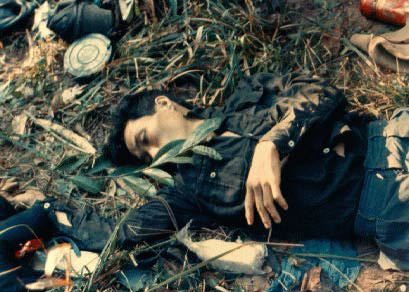
The pictures in this article are incredibly graphic and disturbing. Now, I am rarely in favour of any kind of censorship, and I don't think that the pictures should be removed. However, I think in the case of this article a warning at the beginning would be appropriate, that way a reader does not have to unwittingly stumble upon the image of the bloodied corpse of a child with half of it's face blown off. As I said, the pictures should in no way be removed (after all, they show the reality of the massacre), but If I knew how to properly add a warning to this artice I definitley would. 142.150.48.149 (talk) 06:48, 12 February 2008 (UTC)S.B, Feb 11 2008
The truth hurts, but it's the truth. Too bad. 66.99.254.5 (talk) 22:41, 15 March 2008 (UTC)
It's not called a massacre for nothing buddy. Wikipedia DOESN'T censor to cater to any special interest groups or people it might offend. I mean what the hell did you expect to see? There's pictures far more shocking and grotequese on Wikipedia and still their not censored. That's ridiculous, why would you get rid of the very symbolic images that made this event world history?
Gamer112 (talk) 07:55, 28 April 2008 (UTC)
[edit] New Public Directive 525-3 information
Someone needs to follow up to integrate information from the now public Directive 525-3, which controdicts information given by the Peers investigation. See http://www.antiwar.com/porter/?articleid=12531. —Preceding unsigned comment added by 204.4.13.72 (talk) 00:38, 17 March 2008 (UTC)
[edit] Should be linked to earlier massacres
There should be a link between U.S. troops behavior in Vietnam with earlier activities. This was no a random incident. It represents a pattern that has been hushed up instead of being dealt with and corrected. The exxernal links sections should at least link to
No doubt some of the Vietnamese from My Lai ended up as gruesome souvenirs, perhaps someone can write an article on that. I see a link between the poor Japanese conscript who ended up on display as picture of the week in Life magazine May 1944 [3] and the poor Vietnamese [4], [5]. --Stor stark7 Talk 19:34, 24 March 2008 (UTC)
- Good links, I think the article on mutilation of Japanese war dead is relevant to this article because mutilation of the dead during this massacre is widely documented in interviews with soldiers and the investigation into the massacre, I'm not so sure about the links you posted about vietnamese skulls confiscated from U.S soldiers, unless it has a direct relevance to this incident. Should be included in the Vietnam War casualties page. Thisglad (talk) 03:08, 25 March 2008 (UTC)
Don't forget the Hue Massacre —Preceding unsigned comment added by 70.129.187.194 (talk) 11:04, 19 May 2008 (UTC)
The Hue massacre took place by the NVA during the NVA occupation of Hue, which was discovered after the fighting to retake the city by Americans. Also, in regaurd to the actions in the pacific, what happened there was a hatred so deep, and so powerful caused by the horrors of war suffered by the soldiers in the theater. The Pacific war was a brutal campaign. The death rates for Amaericans at the hands of the japanese after they surrender was far higher. You must also take into consideration that few japanese surrendered. —Preceding unsigned comment added by 97.92.71.237 (talk) 07:40, 15 June 2008 (UTC)
[edit] Soldiers involved
The entire article cites that it was men of Charlie company, but this article says Baker company was also involved:
http://news.bbc.co.uk/1/hi/world/asia-pacific/7298533.stm
I'm not sure how much other evidence of this there is, but thought you guys might know. Ambulnick (talk) 23:49, 25 March 2008 (UTC)
Add stuff if you want. --84.234.60.154 (talk) 17:39, 4 April 2008 (UTC)
[edit] Significance of the Robert Maple quote
Hi, I'm not sure if this is an appropriate medium in which to pose this question. I do not understand the significance about the quote "he was crying and shooting" and then the cross-examining. I don't understand it's relation, whether it was saying the witnesses were liars or he was an emotional fella. Can anyone clarify this?--Rypoll (talk) 18:26, 24 May 2008 (UTC)
The transcript shows how emotional the soldiers were during the massacre and that they were aware what they were doing was wrong. —Preceding unsigned comment added by 60.242.171.22 (talk) 04:59, 14 June 2008 (UTC)