Khan Yunis
From Wikipedia, the free encyclopedia
| Khan Yunis | |
| Arabic | خان يونس |
| Name Meaning | "Jonah's Inn" |
| Government | City |
| Governorate | Khan Yunis |
| Population | 179,900 (2006) |
| Jurisdiction | dunams |
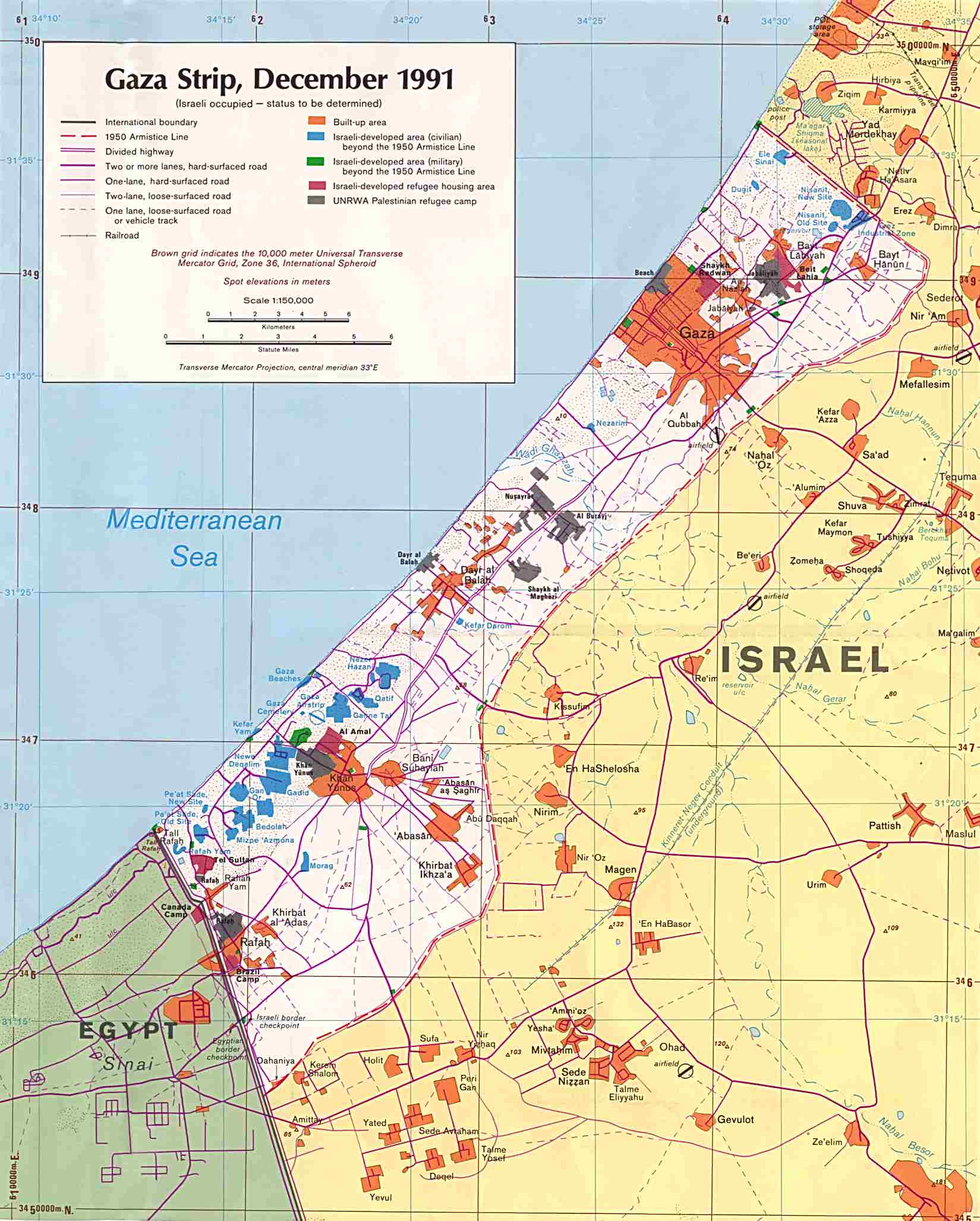
Khan Yunis (Arabic: خان يونس; literally Jonah's Inn) is a city and adjacent refugee camp in the southern part of the Gaza Strip. According to the Palestinian Central Bureau of Statistics the city, its refugee camp, and its immediate surroundings had a total population of 180,000 in 2006.[1]
Contents |
[edit] History
Khan Yunis was established during the 14th century century. It was named after its builder Yunis Ibn Abdallah an-Nawruzi ad-Dawadar. He was the executive Secretary and one of the high ranking officials of Sultan Barquq, the first Circassian Mamluk Sultan. The Khan was built in 789 Hijri/ 1387CE according to the inscription located on the main entrance. Its purpose was to protect the caravans, pilgrims and travelers. Later it became an important center for trade, the weekly market in the town was on Thursday, and used to attract traders from neighboring regions.[2]
Khan Yunis refugee camp was founded in 1948 initially held 35,000 Palestinian Arabs. The number of refugees and their descendants registered with UNRWA in mid-2002 was 60,662.
In November 3rd 1956 , during the Suez war Israel launched an invasion into Egypt; at that time Khan Yunis was controlled by Egypt. Khan Yunis was occupied for the first time and suffered terrible human casualties from indiscriminate aerial bombing. In 1967, during the Six Day war, Israel captured Khan Yunis.
In 2006 Hamas, recognized as a terrorist organization by Israel, the U.S. Department of State, E.U. and United nations, was voted to power in the Gaza Strip. Since Israel's 2005 Gaza Disengagement, over 2,000 Kassam rockets have been launched from Khan Yunis into Israel, mostly to the Southern Israeli city of Sderot.
[edit] Khan Yunis in the al-Aqsa Intifada
Khan Yunis was an early stronghold of the militant Islamist group Hamas. [3] Skirmishes with Hamas fighters resulted in Israeil Defense Forces helicopter attacks in August 2001 and October 2002. The attacks did kill dozens of millitants but also resulted in the deaths of civilian bystanders.
The northern part of Khan Yunis overlooks the Kissufim junction — formerly one of the main roads for Israeli traffic to Gush Katif settlement. Buildings there had often been used by militants as sniping posts and mortar bases to shoot at the settlements and soldiers.
From Khan Yunis' northern buildings, two militants killed Tali Hatuel on May 2, 2004, forcing her and her four daughters off the road and shooting them at close range. The next week, her memorial service was attacked at the same site. One building was also used as cover for an explosive-laden tunnel, which blew up an Israeli(IDF) outpost on June 27. After each attack, the Israeli defense forces bulldozed some of the structures used by the militant terrorists.
From September, 29 2004 till October 15 2004, the Israeli Defense Forces killed more than 142 Palestinians, 100 of whom were miliants including many Hamas in Jabalya Refugee camp.
On December 16, 2004, the Israeli occupation forces raided the town with armoured bulldozers and tanks in order to stop mortar shelling of Israeli illegal settlements. In the six weeks before the operation about 80 mortar shells and Qassam rockets had hit Gush Katifsettlement which had been built on land forcibly taken from the local inhabitants, killing one Thai worker and wounding a dozen civilians and 11 soldiers.[4] As a result, Khan Yunis have been the target of frequent raids by the Israeli defense forces, and heavy battles ensued in the area, leaving some Palestinians killed, a small number of whom were civilians,with the overwhelming majority being armed militants.
[edit] Israeli pullout
In 2005, Israel unilaterally pulled out of Khan Yunis and the rest of the Gaza Strip in its unilateral disengagement plan. Palestinians hailed this as a victory over the 38 year old occupation of the Gaza strip, although the airspace and sea remain blockaded and under Israeli control.
[edit] See also
[edit] References
Pierre Rehov's " From the river to the sea "
[edit] External links
|
|||||||||||||


|
|||||
| Palestinian exodus · Palestinian refugees1 · UNRWA | ||||||||||
|---|---|---|---|---|---|---|---|---|---|---|
|
||||||||||
| 1The UNRWA definition of a "Palestinian refugee" is a person "whose normal place of residence was Palestine between June 1946 and May 1948, who lost both their homes and means of livelihood as a result of the 1948 Arab-Israeli conflict." "UNRWA's definition of a refugee also covers the descendants of persons who became refugees in 1948." (UNRWA) |