Talk:James Cook
From Wikipedia, the free encyclopedia


.jpg/37px-Napoleon(1850).jpg)


 |
James Cook was the Wikisource Collaboration of the Week starting 2007-08-20. |
[edit] First Voyage
I have made two changes to the first voyage section and thought I'd explain as one of them was changing a quote. Also I don't know how to put in a ref so could somebody please do that for me (and maybe explain it as I tried to mimic another ref and it ended up wrong).
[edit] Contact vs Observation
I changed "first recorded contact" to "first recorded direct observation" as I think contact gives an impression of something more than just sighting. I also put in 'direct' rather than "first recorded observation" as I think they had seen evidence of inhabitants prior to this - I have reservations about this though as it seems a bit ungainly (rather than "first recorded observation"). I don't know if people agree with the contact/observation difference, if you don't revert it.
[edit] Quote
The quote that was used before was, "four or five ... Indians ... naked and very black." I have no idea where this came from and so I have copied the relevant part of Captain Cook's journal for the day (namely, "...and were so near the Shore as to distinguish several people upon the Sea beach they appear'd to be of a very dark or black Colour but whether this was the real colour of their skins or the C[l]othes they might have on I know not.") I took from here: http://southseas.nla.gov.au/journals/cook/17700422.html - please also add this as a reference.
Thanks Jgillett (talk) 13:19, 25 February 2008 (UTC)
- Done --Old Moonraker (talk) 13:31, 25 February 2008 (UTC)
[edit] Map request
I'd really like to see maps detailing the routes of his three voyages. --zandperl 22:26, 19 Feb 2004 (UTC)
- That sounds like a good idea. I could draw such a map (I have more than one book in which they appear, and redrawing should be under the "information is not copyrightable" idea), if someone can give me a "naked map" to draw it upon. Andre Engels 10:20, 20 Feb 2004 (UTC)
- I now uploaded a map, however this one is only good for showing the first voyage. Andre Engels 19:58, 22 Feb 2004 (UTC)
I wonder if the article should say he discovered hawaii and australia. He just let the Europeans know about it. The australian people already knew of it. Shouldn't the article come from a NPOV. just a question. BrokenSegue
- I agree. I like the approach the Hawaii article took saying, "Vague reports by various European explorers suggest that Hawai‘i was visited by foreigners well before the 1778 arrival of British explorer Captain James Cook. Cook was credited for the discovery after having been the first to plot and publish the geographical coordinates of the Hawaiian Islands. Cook named his discovery the Sandwich Islands in honor of one of his sponsors, John Montagu, 4th Earl of Sandwich." I guess information along those lines should be appropriate for this article. --Gerald Farinas 02:29, 12 Sep 2004 (UTC)
[edit] VD and Cook's death
I have read that Cook had allowed, um, fraternization, between his crew members and the beautiful, friendly, willing Hawaian women. But that between his penultimate and ultimate visits Cook's vessels had visited Alaska, where he had allowed fraternization between his crew members and the friendly, willing Aleutians. I read that theRussian explorers had inoculated the Aleutian community with VD, and that had left an epidemic of VD behind. Consequently many of Cook's crew had VD. So, on his final visit, Cook forbid his crew from contacting the Hawaiians.
The Hawaiians were very upset by this decision. The sailors had a habit of giving gifts to their girlfriends. Even a purloine nail held great value for them. And the unexpected cutting off of this source of wealth was disruptive to the economy and political stability of the Hawaiian society.
I think Cook's attempt to prevent an epidemic of VD in Hawaii was commendable.
Anyhow, I think this belongs in the article. I'd add it myself, if I could find an authoritative source to back up my recollection...
Geo Swan 23:38, 15 Nov 2004 (UTC)
Actually, Cook discouraged relations with native women on each of his voyages. Astragal 14:49, 14 October 2006 (UTC)
[edit] Transit of Venus difficulties
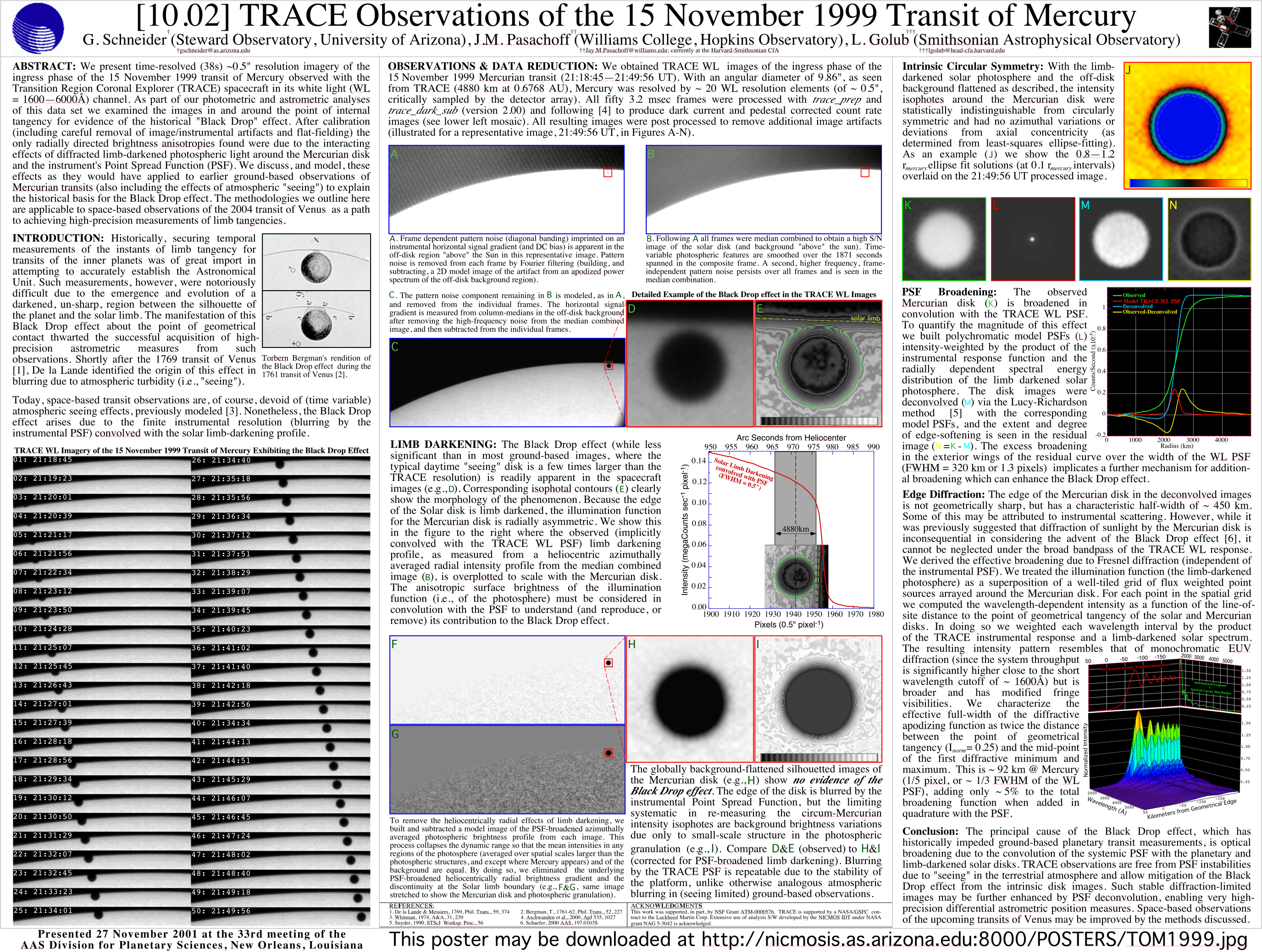
The article describes that Cook's failure to measure the transit of Venus was a result of imprecise scientific instruments. This is untrue. Cook had timepieces and telescopes. Cook's major difficulty was the "Black Drop" effect, which he documented. Observed many times since then, this effect makes precise determination of the two interior contacts a matter of estimation.
-RPellessier 03:59, 23 Jan 2005 (UTC)
- I'd like to throw in with RPellessier on this. Cook posessed good scientific instruments and I don't believe any sources I've seen relate that he was dissatisfied with their quality or quantity. His diaries clearly indicate that he had enough instruments to distribute to other passengers and crew and disperse them to nearby islands as a hedge against cloudiness. Cook and his other observers were indeed frustrated by the black drop effect. However, even with the "primitive" (by today's standards) scientific instruments and the hindrance of the black drop, Cook and his contemporaries elsewhere in the world took sufficiently accurate measurements of the transit that the distance between Earth and Sun was calculated by Encke, using their data, to be 95 million miles (152,888,000 km), which is within about two percent of the currently accepted value. In short, the story that Cook failed in his astronomical goals is a myth. If no-one else is more qualified to correct this portion of the article, I'll dig up my references and do it when I have a chance. Jeff Medkeff 10:21, Jan 24, 2005 (UTC)
This article from the 1911 Encyclopedia Britannica describes how Encke used the transits of 1761 and 1769 to determine the solar parallax. But this article does not specifically mention Cook. http://encyclopedia.jrank.org/EMS_EUD/ENCKE_JOHANN_FRANZ_17911865_.html RPellessier 03:07, 25 Jan 2005 (UTC)
[edit] Junior officers
Is there a reason "junior officers" is linked to the page listing Russian military ranks?
24.14.153.215 18:44, 18 Jan 2005 (UTC)
[edit] "the sandwich man"
i have read a great deal about cook and NEVER read him referred to as the sandwich man. i'd like to see a source on that....
- You happened to view the article in a vandalized state, unfortunately. I've fixed it now. Adam Bishop 05:44, 19 Jan 2005 (UTC)
oh haha i thought it was a weird reference to the earl of... -astragal
[edit] Discovery of Christmas Island
The Selected anniversaries (24 December) listing claims that Christmas Island was discovered by Captain James Cook. Nowhere in the article do I see a mention of this discovery. Kember 23:27, 24 December 2005 (UTC)
[edit] James Cook University
Just added a little bit in the 'legacy' section about how James Cook Uni in North Qld was named after him, obviously. Dunno if it is the right section though, so feel free to put it wherever you like or do anything. Anyway, see ya. DarkSideOfTheSpoon 13:19, 27 December 2005 (UTC)
[edit] Vandalism
If anyone reads this before I get to a better computer, this page needs reverting back to Scohurst's edit of 13:18, 29 March 2006. Adam Bishop 07:10, 30 March 2006 (UTC)
- Done. I see why. Well spotted. Cheers. Moriori 08:14, 30 March 2006 (UTC)
-
- Ahem. NOW it is correct. Shucks. Moriori 08:19, 30 March 2006 (UTC)
-
-
- Thanks! Adam Bishop 08:59, 30 March 2006 (UTC)
-
- Finally got round to listing the page at WP:MOSTVANDALIZED as am getting fed up with Aussie schoolkids (predominantly) attacking the article on an almost daily basis. To all those who continue to keep watch on the page, cheers Dick G 04:01, 22 August 2007 (UTC)
[edit] RN
Can somebody explain what does it means (RN)? Thanks. 195.150.224.238 17:01, 31 March 2006 (UTC)
- RN = (British) Royal Navy.--cjllw | TALK 14:35, 2 April 2006 (UTC)
[edit] Legacy
The revision dated "15:29, 12 October 2005" changed this: 'So, by calculating the time difference from one's starting point at noon, when the sun is exactly on the meridian, one can calculate the longitude.' to this: 'Cook figured that by calculating the time difference from one's starting point at noon, using the position of the sun, one can calculate longitude.'
As much as I admire Cook, it was not Cook himself who came up with the idea. John Harrison (John_Harrison) is the man who invented the marine timepiece that Cook used (and I doubt that even he was the first to realise the link between relative time and longitude).
It seems to me that the original paragraph was intended as an introduction to the following paragraph stating that Cook was the first to use a chronometer in a long distance voyage in order to measure latitude.
I think that both paragraphs should be re-written. Replace the unneeded detail of the 'longitude difficulty' with a short comment containing a reference and a link to both John Harrison and longitude. Then follow up with a statement that Cook used the K1 choronometer to make very accurate charts of the South Pacific. This should remove any ambiguity.
What do you think?—The preceding unsigned comment was added by Special:Contributions/Pelirrojo (talk) 06:50, 16 April 2006 (UTC).
[edit] Secret Instructions to Cook
I found some "Secret Instructions to Lieutenant Cook 30 July 1768 (UK)" on foundingdocs.gov.au - which seems to be a national library initiative. They basically tell Cook that if he so happened to find any unclaimed land out there that he should take possession of it, and try to get any natives' blessings to set up a colony there. It seems to be extremely important, but I'm not sure how to fit it into the article - help??
- http://www.foundingdocs.gov.au/item.asp?sdID=67 - explanation of its significance
- http://www.foundingdocs.gov.au/resources/transcripts/nsw1_doc_1768.pdf - transcript
- 220.237.30.150 01:25, 19 April 2006 (UTC)
-
- This possibly refers to the instructions given to Cook by the Admirality on his first voyage to observe the transit of Venus. He was only to open these instructions once the first stage of the mission had been completed. As I recall from various texts the instructions were to head south and then along a specified latitude to ascertain whether the fabled Terra Australis (AKA the Great Southern Continent) existed and to claim it for the King. I suspect the Admirality would have included the wording you have described in any such instructions. Would suggest looking back at source texts re the above. Dick G 09:41, 19 April 2006 (UTC)
-
-
- Well yes 220.237.30.150, the instructions were secret, then, but not now. And they don't reveal any conspiracies or whatever. Just the admiralty wallahs keeping things close to their chests, just as govts and corporations do today.
-
It doesn't seem to be in the article, though. I mean, an Aussie might know about these instructions as general knowledge, but it's another thing entirely to read the actual documents for yourself. Even if all of the 'conspiracies' related to the letter are gone (although some would say native title is slightly related...), and even if everyone at the time knew that there was a 'colonising race' going on between the European countries, I think it's still important. - 220.237.30.150 21:40, 19 April 2006 (UTC)
- Fair enough. But we shouldn't infer that Cook's voyage, commissioned for astronomy/discovery purposes, was simply a subterfuge to hide ulterior colonisation intentions. Cook wrote "I was ordered, therefore, to proceed directly to Otaheite; and, after the astronomical observations should be completed, to prosecute the design of making discoveries in the South Pacific Ocean by proceeding to the South as far as the latitude of 40 degrees: then, if I found no land, to proceed to the west between 40 and 35 degrees till I fell in with New Zealand, which I was to explore, and thence return to England by such route as I should think proper." Go to http://www.culturelanguage.com.au/ and find the section headed "CREW WELL SATISFIED". It too mentions secret, but it would be hard to take from that any more than the Admiralty not disclosing information which no-one else needed to know. The use of the word "secret" would be grist to the mill for the conspiracy theorists who lurk hereabouts. Moriori 00:15, 20 April 2006 (UTC)
"Secondary", then? - 220.237.30.150 00:27, 20 April 2006 (UTC)
And even if we do have it as secondary, for various purposes, I'm just not sure how to add it in. "Once the observations were completed, Cook then departed in order to execute the secondary purpose of his voyage: namely, to search the south Pacific for signs of the postulated southern continent of Terra Australis, acting on (link to PDF) additional instructions from the Commissioners of the Lord High Admiral of Great Britain." ?? - 220.237.30.150 00:35, 20 April 2006 (UTC)
- No, not truly secondary, because he says his orders were two-part, to make observations at Tahiti and to sail south to make discoveries. It wasn't primary and secondary, but firstly and secondly. . Moriori 01:39, 20 April 2006 (UTC)
[edit] Kū
There is a reference in the 3rd voyage section to the Hawaiian time of war as 'Kū'. Since Kū is the Hawaiian god of war, I have removed the link to Tūmatauenga, the Māori god of war - the connection is too tenuous and I have replaced it with an in-text clarification which works better I think. Kahuroa 08:23, 20 April 2006 (UTC)
[edit] Lost info
Various vandals have necessitated a number of reverts that have seemingly disruptred the article and, certain sections (from Third Voyage onwards) appear to have been lost (at least in my browser (Mac Safari 2.0.3)). Can someone with more Wiki expertise please rectify? Dick G 15:28, 30 April 2006 (UTC)
-
-
- I fixed it - it wasn't a vandal, it was you my friend! You didn't close the <ref> tags properly - you just had /ref> instead of </ref> and the code you added in the Notes section was wrong too, should have been <references/>. This caused the problemo. Kahuroa 19:27, 30 April 2006 (UTC)
-
That makes sense. Was totally confused there. Will teach me to make edits before I have had my first coffee of the day! Thanks again Dick G 07:49, 2 May 2006 (UTC)
[edit] New Zealand
Currently Cook's time in New Zealand is summarized as
- Cook managed to reach New Zealand, becoming only the second European in history to do so (after Abel Tasman over a century earlier, in 1642). Cook mapped the complete New Zealand coastline, making only some minor errors (such as calling Banks Peninsula an island, and thinking Stewart Island/Rakiura was part of the South Island). He also discovered Cook Strait, which separates the North Island from the South Island, and which Tasman had not seen.
Not much info. Can I request an expansion on this point? --Midnighttonight 01:01, 11 June 2006 (UTC)
- Have split the first voyage off into First voyage of James Cook. This will give more room for expansion. --Astrokey44 03:31, 16 May 2007 (UTC)
[edit] Lono Contradiction
The text includes these two statements:
"...Cook's arrival on what is now the 'Big Island' of Hawaii coincided by quirk of fate with a season of worship for the Polynesian god Lono."
and
"It is thought that Cook's return to Hawaii outside the season of worship for Lono (Makahiki)..."
It seems to me that both these statements cannot be true.
I beleive the deal is that yes, his visit coincided with the annual visit of the god Lono, some believe causing Cook to be mistaken for the god. But then not long after Cook and his ships had departed a mast snapped, and they were forced to return to Kealekua Bay for repairs. It was during this unplanned and subsequent visit that Cook's agenda was in direct conflict with the Hawaiian ritual schedule. Some believe this was a factor in the escalation of tensions that lead to Cook's death. -Astragal 13:22, 9 August 2006 (UTC)
-
- That's correct. I wrote both elements into the article originally but can see that there is a confusion. I'll take a look and see if it can be made clearer that it was the return to the island that sparked the confusion/unrest Dick G 15:46, 9 August 2006 (UTC)
Have now clarified timing of Cook's visits in recent amends. Hope that helps Dick G 12:03, 11 August 2006 (UTC)
[edit] Possession Island
Why doesn't the article mention that on 22 August Cook named and landed on Possession Island where we claimed the east coast of Australia for King George III? —The preceding unsigned comment was added by 58.168.59.32 (talk • contribs) .
- Because, User:58.168.59.32, you haven't added that info to the article. Make sure you provide a reference if you do. Moriori 06:42, 23 August 2006 (UTC)
- As Moriori suggested you could always WP:Be Bold and make the change yourself. You may want to check the article's existing references, some may already mention Possession Island, and could be used as a basis for a sentence or two in the article about it. Also, it's good practice to sign your posts on talk pages by typing ~~~~ after your comment (there's a shortcut below the "Save Page" button that will insert it). -- Mako 07:26, 23 August 2006 (UTC)
[edit] British spellings?
I'm a bit unsure whether British spellings (harbour, favourite) are preferred over American ones (harbor, favorite) in article text (aside from direct quotes). Anyone know? This article is rife with British spellings. Dan 13:07, 27 September 2006 (UTC)
- Of course it is, he was British. Why should American spellings be used? Adam Bishop 13:42, 27 September 2006 (UTC)
-
- There's some corner of a foreign web site that is for ever England! Can the non-American English-speakers have some part of the Web to ourselves?--Iacobus 03:30, 28 September 2006 (UTC)
- No. William Wallace
 05:48, 24 August 2007 (UTC)
- No. William Wallace
- There's some corner of a foreign web site that is for ever England! Can the non-American English-speakers have some part of the Web to ourselves?--Iacobus 03:30, 28 September 2006 (UTC)
It is my understanding the language the article was first written in, i.e. British English, also determines the continuity of the spelling within a Wikipeida article. (Wikipedia:MOS#National varieties of English) Stephenjh 22:32, 8 November 2006 (UTC)
[edit] Notable achievements
Whilst it is accepted Cook did not "discover" Australia (ref: European exploration of Australia), it is fair to say that he sighted and charted much of the Eastern coastline for the first time for a European and made the first significant (and recorded?) contact with the aboriginal population. He also claimed the lands for the British Crown and identified Botany Bay to an extent that the First Fleet followed shortly after and established the first meaningful settlement on the basis of the voyage's discoveries. Similarly this exercise in charting the Eastern coastline finally put paid to the myth of Terra Australis. This surely must list as an achievement at least equal to the first circumnavigation of Newfoundland?! Hence edits reverted Dick G 09:36, 30 October 2006 (UTC)
[edit] Revisionist...
James Cook was not born in North Yorkshire, he was born in YORKSHIRE!
[edit] Descendents
Does anyone know the names of Cook's siblings, and if they have any descendants, as I understand that all of Cook's children died without issue. Fergananim 20:11, 21 November 2006 (UTC)
- James had a number of siblings - John Cook (died at 23 without issue), Christiana COOK (died at 65 without issue), Mary Cook(died aged 5), Jane Cook (died aged 5), Mary COOK (born 1740 and died less than a year later), Margaret Cook (married James Fleck, and had eight children), and William Cook (died aged 3). The James Cook family tree has been compliled by a group of American genealogists and can be found on this link [1] although the sources of the data are a little unclear. Query whether a link to this URL is worthwhile on the main James Cook page Dick G 17:36, 22 November 2006 (UTC)
[edit] Birth place
I removed "born in Hartlepool" which was addeed (22:05, 26 December 2006) by User:Loryn67 because it says further donw the page that he was born in Marton, North Yorkshire. Belovedfreak 22:36, 26 December 2006 (UTC)
[edit] Captain Hook
Any connection between J. M. Barrie's character Captain James Hook in Peter Pan and the aforementioned Captain James Cook?
--1000Faces 21:41, 3 February 2007 (UTC)
yes. also check out "blue latitudes" by tony horowitz for interesting parallels with Star Trek. No joke.
Maunakea 21:28, 28 February 2007 (UTC)
[edit] flags
pictures of flags in the middle that he sailed for in order he sailed. —Preceding unsigned comment added by 72.152.60.47 (talk • contribs)
[edit] "far as I think it possible for man to go"
"... farther than any man has been before me, but as far as I think it is possible for a man to go."
quote is a bit out of place where it stands; it comes from his second voyage in the pacific. Putting this before either of his voyages makes it seem if his aspirations towards a place in history predate his voyaging. Read Beaglehole, Nicholas Thomas, etc. and find that this is not true. —The preceding unsigned comment was added by Maunakea (talk • contribs) 21:30, 28 February 2007 (UTC).
[edit] Captain James Cook
He made an exstordanary finding which happened to be Australia. Everone things he was a freak but he was a good and loyal person to poeple didnt know what was beyond their island or land. With captain james cook, he made the world so different that no one could not believe him because they thought he was just telling the truth. —The preceding unsigned comment was added by 203.208.124.176 (talk) 08:47, 13 March 2007 (UTC).
[edit] Circumnavigation?
The wording of the opening of the article suggests that Cook circumnavigated Newfoundland:
"...achieving the first European contact with the eastern coastline of Australia, the European discovery of the Hawaiian Islands, and the first recorded circumnavigation and mapping of Newfoundland and New Zealand."
--Wormholio 16:41, 25 May 2007 (UTC)
- OK. So what is the issue you'd like to discuss? JackofOz 03:58, 28 May 2007 (UTC)
-
- He was the first to map Newfoundland and circumnavigate New Zealand (not the entire world, as a recent edit claimed), but maybe he was the first to circumnavigate Newfoundland as well? That seems unlikely considering how many people had been there in the previous 300 years before Cook, but maybe no one ever went all the way around it, I don't know. Adam Bishop 17:52, 30 May 2007 (UTC)
[edit] Lost in space?
The page is supposed to be about him, & he was a prominent (!) RN officer, so howcum his early ships aren't mentioned? Like Soleday, Pembroke, & Grenville, which I got from Dean & Kemp, but which WP seems not to be connecting to the right ships, if to any at all... D&K say he mastered Solebay first, Pembroke next (when he went to Louisbourg, Grenville next (his first solo act), & had Tobias Furneaux' Adventure in company in March 1773. Montgomery LaForge 05:57, 24 August 2007 (UTC)
-
- Hi. Thanks for your contribution. I think the issue is that Cook is more widely known (for obvious reasons) for his later exploits in the Pacific. The early navy years are often overlooked given what came later. Having said that, there is clearly scope for their inclusion in this article and thanks for putting them in. I would hope that with the work being done at Wikisource this week, the main page could benefit from a bit more interest from editors (I count myself in that!) and a better set of references. Hopefully you'll stay around to help out! Dick G 06:11, 24 August 2007 (UTC)
[edit] Map of voyages
I can see how he got to the South Pacific on his second voyages but what was his route home? Also did he travel west to east on his 3rd voyage? Arrows would helpXtrump (talk) 20:07, 24 December 2007 (UTC) he was killed in hawii in a knife fight he was stabed in the chest 8 times —Preceding unsigned comment added by 68.51.21.60 (talk) 01:51, 11 March 2008 (UTC)
Returning to the matter of the map. It has some features which make it quite difficult to understand:
- There are no arrows to indicate directions
- The lines move off the map at various points with no indication of where the voyages went
- The lines are too thick, and obliterate parts of the map, especially at points of conjunction
- Only parts of his voyages are shown. In particular, no one could gather from the map that Cook crossed the Antarctic Circle on his second voyage, nor that he completed a circumnavigation of the earth at a high latitude. These were surely the high points of the second voyage.
I don't know what can be done with the map. Perhaps a clever cartographer could improve it, and more explanatory text could be added?
There is also an error in the text relating to the second voyage. It says that on 17 January 1773 Cook reached 71°10'S. In fact, on that date he crossed the Antarctic circle, but retreated almost immediately, at around 67°S. It was a year later, on 31 January 1774, that he reached the 71°10'S mark. Brianboulton (talk) 00:51, 12 March 2008 (UTC)
-
- Specifically, Cook reached latitude 67°15'S on 17 January 1773 in longitude 39°35'E,
and latitude 71°10'S on 30 January 1774 in longitude 106°54'W. Brianboulton (talk) 17:09, 12 March 2008 (UTC)
- I'll try working on some new maps over the next couple days. I'll be back here with updates, and I'll post the new map(s?) at my sandbox when they're finished, plus a link here to my sandbox. AlexiusHoratius (talk) 18:43, 12 March 2008 (UTC)
- OK, I've hit a few snags, primarily due to the lack of accurate maps on the internet, but the maps are coming along, and should be ready by Monday or Tuesday (at the latest). AlexiusHoratius (talk) 17:40, 14 March 2008 (UTC)
- Good luck with that. Will you also change the text regarding Cook's latitudes? Brianboulton (talk) 18:08, 14 March 2008 (UTC)
-
-
- I'll look at those things as well, as it's all tied in with the maps in a way. You're right about the dates and the latitudes, the 71°10'S 106°54'W would have been much later in his second voyage. AlexiusHoratius (talk) 20:29, 14 March 2008 (UTC)
-
[edit] Great Southern Land
The greatest legacy from Cook, at least at the time, was that he showed that the "great southern continent" did not exist. It had been believed for centuries that there was a large continent in the south to "balance" the Eurasian continent in the north (and which might have had untold wealth). Tasman before him had shown that Australia was not part of it but had then found part of New Zealand which could have been part of it. To possibly find and claim it was really the main purpose of Cook's first and second voyages. His first voyage showed that NZ was not part of it and his second greatly reduced the possible size of any southern continent(s).
Australian's would also say another great legacy is the discovery (and charting) of the east coast of Australia. —Preceding unsigned comment added by 124.168.189.185 (talk) 12:21, 22 March 2008 (UTC)
[edit] Consequences with Native Peoples
I find the article lacks info or at least links to several extinct tribes of people from various islands he visited. Many died from disease, clothing, and impact of contact with Europeans. I can excuse the lack of info in relation to the eventual deaths caused by other later Europeans, but there are at least 2 entire groups who became extinct as a direct result. Can such info be applied to this section as a contrast to his achievements? Or is it merely a subject reserved for other data and historical research? <V Guyver>
[edit] Complaint
Why did my addition to the article removed? James Cook DID come up with the theory that Polynesians originated in Asia and I DID cite my source.67.165.136.53 (talk) 00:45, 9 May 2008 (UTC)
- I'm assuming that this is the edit you're talking about. Another editor removed it as unsourced because you didn't cite where you found the information. Take a look at WP:CITE for more information about doing this, or feel free to ask me on my talk page if you have more questions. About the addition itself, it would probably be fine to add provided it has a proper citation, but I don't think it needs its own section. Incorporating the information into an already existing section may be the way to go; as it was, the new section was a bit too small. AlexiusHoratius (talk) 01:03, 9 May 2008 (UTC)
- The first attempt was removed because you didn't cite a source. The second attempt was integrated into the article by me. That is, I moved it from its own tiny section into the larger section called legacy. I did not alter the text, but I linked to the article on Bryan Sykes, and I moved the source from the "References" section to become an inline reference, because the source covers this specific fact, not the life of Cook in general. In short, your second attempt was successful, and I made a minor change to it.
- Your third attempt was obviously because you didn't see the change I'd made, and you added material which was already in the article. I have removed the attempt to add the reference again, because it's already in the notes section.
- Please read the "history" link for the article; you'll see that experienced editors add a brief edit summary which explains their edits.-gadfium 02:21, 10 May 2008 (UTC)
[edit] Map still not fixed
Cming back to this page after a couple of months, I'm a bit disappointed to see no progress on the map. Is there any chance of this? I have now corrected the text with regard to the date of Cook's furthest south (see discussion above). Brianboulton (talk) 11:24, 13 May 2008 (UTC)
- Sorry, being the WikiSloth that I am, I made the maps nearly two months ago, then spent the rest of the time saying "I'll upload them in a couple of days". Anyway, they're here, and available for viewing either at my sandbox or at my illustrations page. I made four in all, three for each specific voyage, and one showing all three. AlexiusHoratius (talk) 17:17, 13 May 2008 (UTC)
-
- They're excellent. No idea how you made them but super job. I vote for the composite map of all voyages to be used on the main JC page. The others should be used on the articles that accompany each voyage (in the case of the 2nd and 3rd voyages, as and when they are completed). Many thanks for doing those. Dick G (talk) 01:48, 14 May 2008 (UTC)
-
-
- OK, I went ahead and put in the new map. For size, I went with 600px, which is somewhat large, but it is still a bit smaller than the old one, and the larger it is, the easier to read. I agree with Dick G that the composite is probably best for now. Although the three seperate maps are probably easier to follow, especially for the second voyage, the article is already a bit heavy on illustrations and light on prose. In the future, if the information on the specific voyages is expanded, it may be better to move to the seperate maps, but for now, I think the composite works a bit better. AlexiusHoratius (talk) 05:33, 16 May 2008 (UTC)
-
[edit] Could someone add this information? (Garunteed to double the size and quality of the article)
I've come across CaptainCookSociety.com and found the information there to be of high quantity and quality. See for yourself:
An extremely specific chronological timeline of everything that happened on James Cook's voyage. This includes the number of people the ship was supposed to hold, how many it departed with, specific dates for each sailor's death, specific dates for every island he visited, and more:
http://www.captaincooksociety.com/ccsu61.htm
Another chronological timeline, except holding some information that's not found in the previous link. This one specializes for the discovery of New Zealand:
http://www.captaincooksociety.com/ccsu68.htm
I have several complaints about this article, for example, neither the James Cook article or the First Voyage of James Cook says anything about him claiming New Zealand for Britain. Also, none of those articles say where he landed on New Zealand (Poverty Bay) or the person who coincidentially arrived at New Zealand at the same time he did (Jean François Marie ).
Mikister (talk) 04:08, 25 May 2008 (UTC)
- The Captain Cook Society is certainly a useful resource and one that is already linked from the main article page (see External Links). I would argue the quality of the James Cook article is not defined purely by the quantity of the information it contains. The article should be a comprehensive but not overwhelming encyclopedic treatment. Statistics of the kind referred to in your comment certainly have their place but really they are limited to where they add to the reader's understanding of James Cook. By all means add that kind of information to the article on his first voyage but again, it doesn't need an almanac-style list - better to link to the relevant Captain Cook Society page where they've already done the work extrapolating it from the primary source journals and only where it really adds to our understanding of that voyage. Additional details about his charting of New Zealand, landing points and the J. F. Marie coincidence can be incorporated into the relevant sub articles. There is nothing to stop you adding this yourself and indeed you are encouraged to do so, but please make sure you cite the relevant sources for any new content you add. This article has a number of faults and could do with a concerted effort by a number of editors but I don't think the absence of the content you describe is one of them, though please comment further if you disagree. Thanks for stopping by. Dick G (talk) 03:48, 26 May 2008 (UTC)