Interstate 110 and State Route 110 (California)
From Wikipedia, the free encyclopedia
.svg/84px-I-110_(CA).svg.png)  |
|||||||||||||||||
| Interstate 110, State Route 110 |
|||||||||||||||||
| Harbor Freeway, Pasadena Freeway Defined by S&HC § 410, maintained by Caltrans |
|||||||||||||||||
 |
|||||||||||||||||
| Length: | 31.819 mi[1] (51.208 km) | ||||||||||||||||
|---|---|---|---|---|---|---|---|---|---|---|---|---|---|---|---|---|---|
| Formed: | December 1978 by FHWA 1981 (from SR 11) by Caltrans[2] |
||||||||||||||||
| South end: | San Pedro | ||||||||||||||||
| Major junctions: |
.svg/24px-I-405_(CA).svg.png) I-405 in Carson I-405 in Carson.svg/20px-I-10_(CA).svg.png) I-10 in Los Angeles I-10 in Los Angeles |
||||||||||||||||
| North end: | Pasadena | ||||||||||||||||
|
|||||||||||||||||


Route 110, consisting of two segments of State Route 110 (SR 110) joined by Interstate 110 (I-110), is a state highway in the Los Angeles area of the U.S. state of California, mostly built to freeway standards. The entire length of I-110 (which ends at I-10), as well as SR 110 south of the Four Level Interchange with US 101, is the Harbor Freeway[3], and SR 110 north from US 101 to Pasadena is the historic Pasadena Freeway, the first freeway in California. At the south end of I-110, SR 110 continues south on Gaffey Street in the Los Angeles neighborhood of San Pedro.
This route is part of the California Freeway and Expressway System[4].
Contents |
[edit] Route description


| Major cities Bolded cities are officially-designated control cities for signs |
|---|
|
The Harbor Freeway begins at Gaffey Street in San Pedro, where it then travels mostly due north to the Santa Monica Freeway (Interstate 10) at a point south of downtown Los Angeles, where it becomes signed as State Route 110. I-110 is primarily within the city limits of Los Angeles, running through the Harbor Gateway, a two-mile wide north-south corridor that was annexed by the city of Los Angeles specifically to connect San Pedro, Wilmington and the Port of Los Angeles with the rest the city.

In addition, the Harbor Transitway, a grade-separated bus and high-occupancy vehicle corridor in the median of the 110, runs between State Route 91 (Gardena Freeway) and the south side of Downtown Los Angeles.
The Harbor Freeway, along with the Long Beach Freeway, are the principal means for freight to get from the port of Los Angeles to rail yards and warehouses further inland. Its interchange with the Santa Monica Freeway is notoriously busy and congested, and the portions bordering Bunker Hill in northwest Downtown Los Angeles are choked with traffic at peak travel times.
Notable landmarks and attractions near the Harbor Freeway include the California State University, Dominguez Hills; Watts Towers; Exposition Park (including the Los Angeles Memorial Coliseum); the University of Southern California; Staples Center; and the Los Angeles Convention Center.
SR 110 continues north on the Pasadena Freeway to Pasadena.
[edit] Notable features

The Harbor Freeway is noted for its elaborate high-occupancy vehicle lane infrastructure, with HOV lanes elevated above the rest of traffic in many areas. Of particular note is the 7-story ramp that connects the eastbound Century Freeway to its northbound carpool lanes, offering splendid views of the entire Los Angeles Basin and the San Gabriel Mountains.
[edit] History
In the 1924 Major Street Traffic Plan for Los Angeles, a widening of Figueroa Street to San Pedro as a good road to the Port of Los Angeles was proposed.[5] Progress was slow,[6] and in 1933 the state legislature added the entire length to the state highway system as Route 165, an unsigned designation. This route not only extended from San Pedro north to Los Angeles, but continued through the city-built Figueroa Street Tunnels and along the northern extension of Figueroa Street to Eagle Rock, and then followed Linda Vista Avenue (via an overlap on Route 161 (SR 134) over the Colorado Street Bridge) to Route 9 (now I-210) at the Devil's Gate Reservoir.[7][8][9] The entire length of Route 165 became Sign Route 11 in 1934.[10] U.S. Route 6 was also assigned to the portion between SR 1 and Avenue 26 in 1937,[11] and at about the same time US 66 was moved from Eagle Rock Boulevard to Figueroa Street, overlapping SR 11 between Sunset Boulevard (US 101) and Colorado Street (SR 134).[12][13]
- See also: Arroyo Seco Parkway
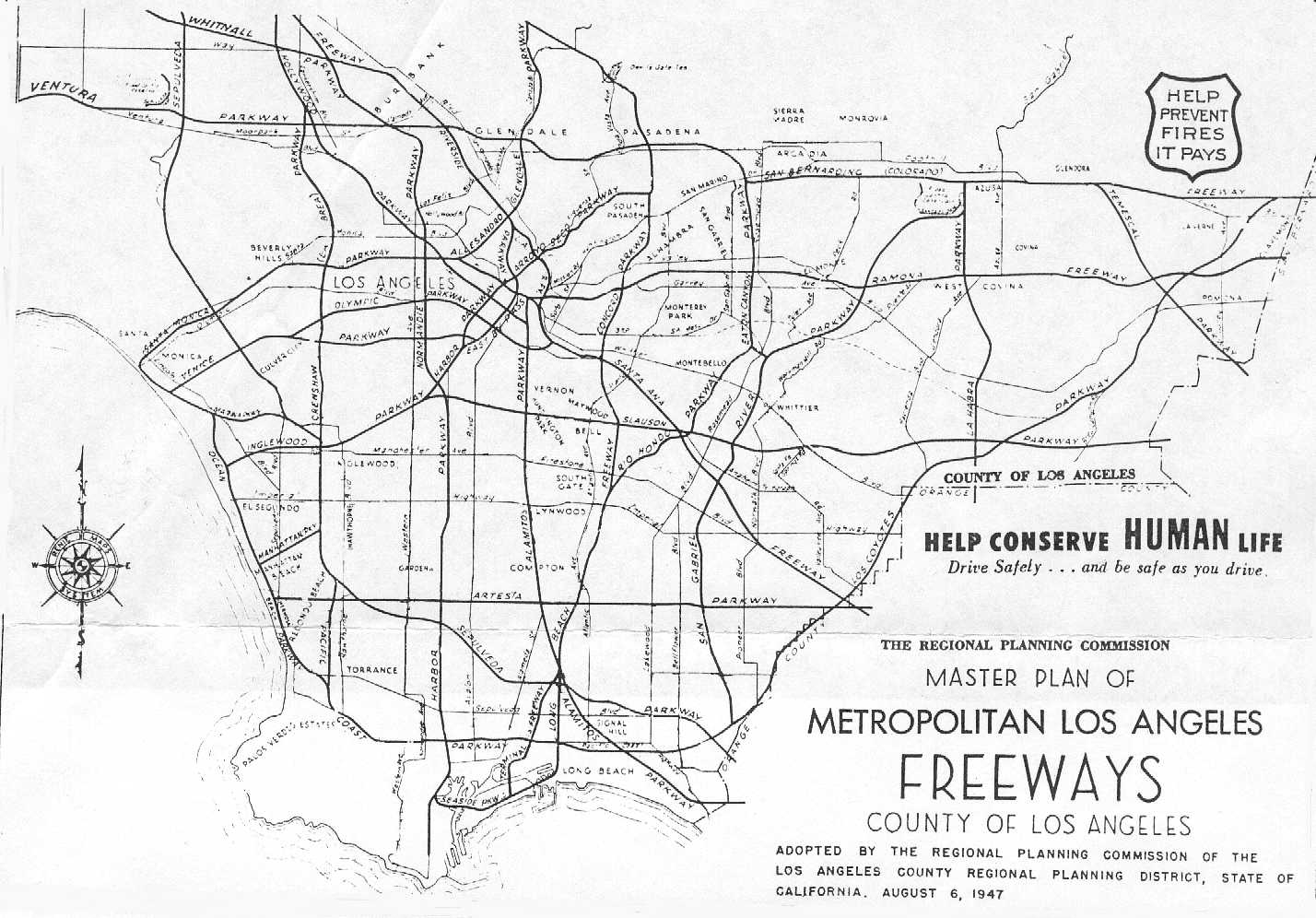
The state completed the Arroyo Seco Parkway, which had been added to the state highway system in 1935 as Route 205, in early 1941, providing a faster route between SR 11 at Avenue 26 and Pasadena.[14] US 66 was moved to the new route, while SR 11 remained on Figueroa Street and Linda Vista Avenue, the former also becoming a new U.S. Route 66 Alternate.[15] Construction of a freeway to San Pedro was much slower, despite having been in the earliest plans for an integrated system. Initially, the Harbor Parkway was to split at the merge with the Venice Parkway northeast of the University of Southern California, with the East By-Pass and West By-Pass straddling the Los Angeles Central Business District and rejoining at the split between the Arroyo Seco Parkway and Riverside Parkway south of Dodger Stadium.[16][17][18] The West By-Pass was soon incorporated into the Harbor Parkway,[19] and the first short piece, by then renamed the Harbor Freeway, opened on July 30, 1952 from the Four Level Interchange south to 3rd Street.[20] (The Arroyo Seco Parkway was completed to the Four Level Interchange on September 22, 1953, and renamed the Pasadena Freeway on November 16, 1954.[14])
The Harbor Freeway gradually pushed south, opening to Olympic Boulevard on March 23, 1954[21] and Washington Boulevard on May 14, 1954.[22] On March 27, 1956, the highway was extended to 42nd Street,[23] and on April 24, 1957 it reached temporary[24] ramps at 88th Place.[25] Further extensions were made to Century Boulevard on July 31, 1958,[26] 124th Street on September 24, 1958,[27] Alondra Boulevard (which the county widened to carry the load) on May 2, 1960,[28] 190th Street on July 15, 1960,[29] Torrance Boulevard on August 28, 1962,[30] and finally Pacific Coast Highway (SR 1) on September 26, 1962.[31] There it connected with a section that had been open since June 19, 1956, from Pacific Coast Highway south to Channel Street.[32] Along with the Vincent Thomas Bridge to Terminal Island, the final piece in San Pedro opened on July 9, 1970, completing the Harbor Freeway to its present length.[33][34][35]
In December 1978, the Harbor Freeway was approved as an Interstate Highways by FHWA. In 1981, the SR 11 designation was renumbered as Interstate 110 on the Harbor Freeway, and State Route 110 on the Pasadena Freeway.[36]
[edit] I-5 signage
In 2001, Richard Ankrom, a local artist, who got lost trying to get onto Interstate 5 North from the northbound 110 Freeway because there was no clear official signage labeling access to the 5 North, solved his frustration by covertly modifying one of the overhead signs on the freeway just before the tunnels. Using official government sign specifications, Ankrom fabricated two sign pieces, one being an Interstate marker shield with the number '5' on it, and one with the word "NORTH", and affixed them to the left side of the sign. He performed his modifications in broad daylight, disguised as a Caltrans worker. In that district Caltrans has 3 sign crews, each thinking one of the other two crews did the installation. After nine months, at Ankrom's request, the Los Angeles Downtown News broke the story.
Prior to Ankrom's work, the only signage directing motorists to the 5 North off-ramp came at a quarter-mile before the exit, thus forcing many to merge across multiple lanes in a very short distance. The unofficial modifications remain on the sign to this day, after having been inspected by Caltrans to ensure they would not fall off onto the road below. Caltrans is gradually upgrading all California freeway signs to a newer, more reflective form; when this happens on the 110, Ankrom's work may be lost, but the new sign will include "5 North" icons.
Ankrom was never charged, despite statements from officials that his actions were illegal.
It should be noted that an additional "5 North" sign has since been installed over the left lane of the northbound Pasadena Freeway at the entrance to the Figueroa Street Tunnels.
- See http://www.ankrom.org/freeway_signs.html for a picture of Ankrom's work.
[edit] Major intersections and exit list
- Note: Except where prefixed with a letter, postmiles were measured in 1964, based on the alignment as it existed at that time, and do not necessarily reflect current mileage. The numbers reset at county lines; the start and end postmiles in each county are given in the county column.
The entire route is in Los Angeles County.
| Location | Postmile [1][37][38] |
#[39] | Destinations | Notes |
|---|---|---|---|---|
| San Pedro | 0.00 | Ninth Street | ||
| R0.75 | Gaffey Street north | At-grade intersection | ||
| R0.93 | 1A |  SR 47 (Vincent Thomas Bridge) – Terminal Island, Long Beach SR 47 (Vincent Thomas Bridge) – Terminal Island, Long Beach |
South end of I-110 | |
| R1.23 | 1B | Channel Street, Pacific Avenue | No southbound entrance | |
| Wilmington | 2.77 | 3A | C Street | |
| 3.26 | 3B | Anaheim Street | ||
| 4.06 | 4 |  SR 1 (Pacific Coast Highway) SR 1 (Pacific Coast Highway) |
||
| Carson | 5.45 | 5 | Sepulveda Boulevard | |
| 6.52 | 7A | 223rd Street | Northbound exit is via exit 7 | |
| 7.02 | 7B | Carson Street | Signed as exit 7 northbound | |
| 7.74 | 8 | Torrance Boulevard | ||
| 8.78 | 9 | I-405 (San Diego Freeway) – Santa Monica, Long Beach |
||
| Los Angeles | 9.07 | 9 | 190th Street | Southbound exit and northbound entrance |
| 9.87 | 10 |  SR 91 (Gardena Freeway) SR 91 (Gardena Freeway) |
Signed as exits 10A (east) and 10B (west) northbound | |
| 11.24 | 11 | Redondo Beach Boulevard | ||
| 11.89 | 12 | Rosecrans Avenue | ||
| 12.90 | 13 | El Segundo Boulevard | ||
| 13.82 | 14A | .svg/24px-I-105_(CA).svg.png) I-105 (Century Freeway) – Norwalk, El Segundo I-105 (Century Freeway) – Norwalk, El Segundo |
Signed as exits 14A (east) and 14B (west) northbound | |
| 13.97 | 14B | Imperial Highway | ||
| 14.97 | 15 | Century Boulevard | Northbound exit is via exit 14B | |
| 15.98 | 16 | Manchester Avenue | Former SR 42 | |
| 16.98 | 17 | Florence Avenue | ||
| 17.51 | 18A | Gage Avenue | ||
| 17.98 | 18B | Slauson Avenue | ||
| 18.50 | 19A | 51st Street | Southbound exit and northbound entrance | |
| 19.00 | 19B | Vernon Avenue | Signed as exit 19 northbound | |
| 19.50 | 20A | Martin Luther King Jr. Boulevard – Exposition Park, Los Angeles Memorial Coliseum | ||
| 20.00 | 20B | 37th Street, Exposition Boulevard | ||
| 20.71 | 20C | Adams Boulevard | ||
| 21.44 | 21 | I-10 (Santa Monica Freeway) – Santa Monica, San Bernardino |
North end of I-110; south end of SR 110 | |
| 21.76- 22.12 |
22A | Pico Boulevard, Olympic Boulevard – Downtown Los Angeles | Northbound exit is part of exit 21 | |
| 22.36 | 22B | 9th Street, 8th Street – Downtown Los Angeles | Signed as exit 22 northbound | |
| 22.83 | 23A | 6th Street, Wilshire Boulevard | ||
| 23.04 | 23B | 4th Street | ||
| 23.04 | 23C | 3rd Street | ||
| 23.73 | 24A | .svg/23px-US_101_(CA).svg.png) .svg/20px-I-5_(CA).svg.png) US 101 north (Hollywood Freeway) to I-5 south (Santa Ana Freeway) / I-10 east (San Bernardino Freeway) – Hollywood, Santa Ana, San Bernardino US 101 north (Hollywood Freeway) to I-5 south (Santa Ana Freeway) / I-10 east (San Bernardino Freeway) – Hollywood, Santa Ana, San Bernardino |
Northbound exit and southbound entrance | |
| See Pasadena Freeway | ||||
| Pasadena | 31.91 | Glenarm Street | ||
[edit] References
- ^ a b California Department of Transportation, State Truck Route List (XLS file), accessed January 2008
- ^ California Highways: Interstate 110
- ^ 2007 Named Freeways, Highways, Structures and Other Appurtenances in California. Caltrans, 71. Retrieved on 2007-03-27.
- ^ CA Codes (shc:250-257)
- ^ Los Angeles Times, City Moves in Figueroa Plan, September 29, 1926, p. 13
- ^ Los Angeles Times, Haste Asked on Figueroa, March 2, 1936, p. A8
- ^ "An act...relating to...the addition of certain highways to the State system.", 1933 chapter 767, p. 2040: "San Pedro to State Highway Route 9 near La Canada via Figueroa Street."
- ^ "An act to establish a Streets and Highways Code...", 1935 chapter 29, p. 285: "Route 165 is from San Pedro to Route 9 near La Canada via Figueroa Street."
- ^ "An act...relating to State highways.", 1935 chapter 274, p. 959, 285: "Route 165 is from San Pedro to Route 9 near La Canada via Figueroa Street and Linda Vista Avenue."
- ^ California Highways and Public Works, State Routes will be Numbered and Marked with Distinctive Bear Signs, August 1934
- ^ Richard F. Weingroff, U.S. 6: The Grand Army of the Republic Highway
- ^ H.M. Gousha Company, Los Angeles and Vicinity, 1935
- ^ H.M. Gousha Company, Los Angeles and Vicinity, 1939
- ^ a b Historic American Engineering Record (J. Philip Gruen and Portia Lee), Arroyo Seco Parkway (HAER No. CA-265) written historical and descriptive data, August 1999, pp. 34, 57, 65, 67
- ^ Correspondence between the Division of Highways and American Association of State Highway Officials, transcribed at California Highways: State Route 66
- ^ Automobile Club of Southern California, map from Traffic Survey, Los Angeles Metropolitan Area, 1937, reproduced in Janet L. Abu-Lughod, New York, Chicago, Los Angeles: America's Global Cities, 1999, p. 256
- ^ Transportation Engineering Board, map from A Transit Program for the Los Angeles Metropolitan Region, 1939, reproduced in Gerrylynn K. Roberts, Philip Steadman, American Cities and Technology: Wilderness to Wired City, 1999, p. 79
- ^ Andrew Hamilton, New York Times, Los Angeles Roads Plan, February 25, 1940, p. 128
- ^ Los Angeles County Regional Planning District, Master Plan of Metropolitan Los Angeles Freeways, adopted August 6, 1947
- ^ Los Angeles Times, Official Ceremonies Open First Harbor Freeway Link, July 31, 1952, p. A1
- ^ Los Angeles Times, New Harbor Freeway Link to Open Today, March 23, 1954
- ^ Los Angeles Times, New Harbor Freeway Section to Open Today, May 14, 1954
- ^ Los Angeles Times, Brief Ceremonies Open Harbor Freeway Section, March 28, 1956, p. 2
- ^ Van Nuys News, Harbor Freeway Section Opened, August 5, 1958
- ^ Los Angeles Times, Ribbon Cut for New Four-Mile Extension to Harbor Freeway, April 25, 1957
- ^ Los Angeles Times, New Harbor Freeway Link Due Thursday, July 28, 1958, p. 5
- ^ Los Angeles Times, Harbor Freeway Sector Opens With Ceremony, September 25, 1958, p. B1
- ^ Los Angeles Times, Alondra Blvd. Readied for Freeway Exit Load, May 1, 1960, p. CS1
- ^ Los Angeles Times, Two-Mile Harbor Freeway Section Will Open Today, July 15, 1960
- ^ Los Angeles Times, Harbor Freeway Link to Be Opened Today, August 28, 1962, p. A1
- ^ Los Angeles Times, Final Harbor Freeway Link to Be Opened, September 24, 1962, p. 25
- ^ Van Nuys News, Harbor Freeway Two-Mile Sector Will Open Today, June 19, 1956
- ^ Lee Bastajian, Los Angeles Times, Vincent Thomas Bridge Link Scheduled to Open in July, May 31, 1970, p. CS1
- ^ Long Beach Independent, Dedication Set on Freeway Link to Bridge, July 8, 1970
- ^ Valley News (Van Nuys), Harbor Freeway Extension to Be Dedicated Today, July 9, 1970
- ^ California Highways (www.cahighways.org): Routes 105 through 112
- ^ California Department of Transportation, Log of Bridges on State Highways, July 2007
- ^ California Department of Transportation, All Traffic Volumes on CSHS, 2006
- ^ California Department of Transportation, California Numbered Exit Uniform System, I-110 Northbound and I-110 Southbound, accessed January 2008
[edit] External links
|
|||||||

|
||||||||||||||