California State Route 57
From Wikipedia, the free encyclopedia
 |
|||||||||||||||||
| State Route 57 |
|||||||||||||||||
| Orange Freeway Defined by S&HC § 357, maintained by Caltrans |
|||||||||||||||||
 |
|||||||||||||||||
| Length: | 23.936 mi[1] (38.521 km) (plus about 2 mi (3 km) on SR 60) |
||||||||||||||||
|---|---|---|---|---|---|---|---|---|---|---|---|---|---|---|---|---|---|
| History: | State highway in 1931; numbered in 1964 | ||||||||||||||||
| South end: | .svg/20px-I-5_(CA).svg.png)  I-5 / SR 22 in Santa Ana I-5 / SR 22 in Santa Ana |
||||||||||||||||
| Major junctions: |
 SR 91 in Anaheim SR 91 in Anaheim.svg/20px-I-10_(CA).svg.png)  I-10 / SR 71 in Pomona I-10 / SR 71 in Pomona |
||||||||||||||||
| North end: | .svg/24px-I-210_(CA).svg.png)  I-210 / SR 210 in Glendora I-210 / SR 210 in Glendora |
||||||||||||||||
|
|||||||||||||||||


State Route 57 (SR 57), also known as the Orange Freeway, is a major north-south state highway in the Greater Los Angeles Area of the U.S. state of California. It connects the interchange of I-5 and SR 22 near downtown Orange, locally known as the Orange Crush, with the Glendora Curve interchange with I-210 and SR 210 in Glendora. The highway provides a route across several spurs of the Peninsular Ranges, linking the Los Angeles Basin with the Pomona Valley and San Gabriel Valley. It is eligible for the State Scenic Highway System through Brea Canyon, between SR 90 and SR 60, and the entire route is in the California Freeway and Expressway System (and is a freeway where built). An unconstructed extension from Santa Ana south to Huntington Beach remains in the legal definition of Route 57, and has been studied, most recently as a toll road above the Santa Ana River.
Contents |
[edit] Route description

State Route 57 begins at the Orange Crush interchange near downtown Orange, where it meets the northwest-southeast Santa Ana Freeway (I-5) and the east-west Garden Grove Freeway (SR 22). The interchange, long considered a major bottleneck, was rebuilt in the 1990s and 2000s.[2][3] The freeway heads north from the junction and soon crosses to the west side of the Santa Ana River, continuing north through suburban portions of Anaheim, where it meets the Riverside Freeway (SR 91). As it crosses Imperial Highway (SR 90), SR 57 enters more rugged terrain, soon climbing through Brea Canyon, the gap between the Chino Hills and Puente Hills. Near its summit, the highway curves north out of the Brea Canyon, and descends slightly to a junction with the Pomona Freeway (SR 60) in Diamond Bar, right on the edge of the San Gabriel Valley.[4]
A short overlap carries SR 57 traffic on the outside of SR 60. The two routes head northeast through an arm of the San Gabriel Valley; after they split, SR 57 ascends slightly and then descends through the edge of the Puente Hills and into the west end of the Pomona Valley. Here it meets the San Bernardino Freeway (I-10) and Chino Valley Freeway (SR 71) at the four-level Kellogg Hill Interchange. In the north haly of that interchange, SR 57 enters the San Jose Hills, climbing to its highest elevation before descending back into the connected San Gabriel-Pomona Valleys and ending at the Glendora Curve interchange with the Foothill Freeway (I-210/SR 210) in Glendora.[4]
High-occupancy vehicle (HOV) lanes exist in the median of SR 57 south of SR 60 in Diamond Bar. Elevated ramps allow HOV traffic bound to or from Brea Canyon to connect with I-5 towards the southeast, SR 91 towards the west, or SR 60 towards the east without entering the main lanes.[4][5]
[edit] History

The road through Brea Canyon was oiled dirt by the late 1910s, providing a good connection across a spur of the Peninsular Ranges between the Los Angeles Basin and Pomona Valley. This road left the main coast highway (Harbor Boulevard) at Fullerton and followed the present Brea Boulevard and Brea Canyon Road, merging with the Valley Boulevard from Los Angeles near Walnut and continuing east to Pomona via Valley and Pomona Boulevards.[6] Los Angeles County paved the road in concrete in early 1923,[7] and in 1931 it was added to the state highway system as a branch of Route 19. Route 19 until then connected Route 9 near Claremont with Riverside, following Garey Avenue and Mission Boulevard through Pomona.[8][9]
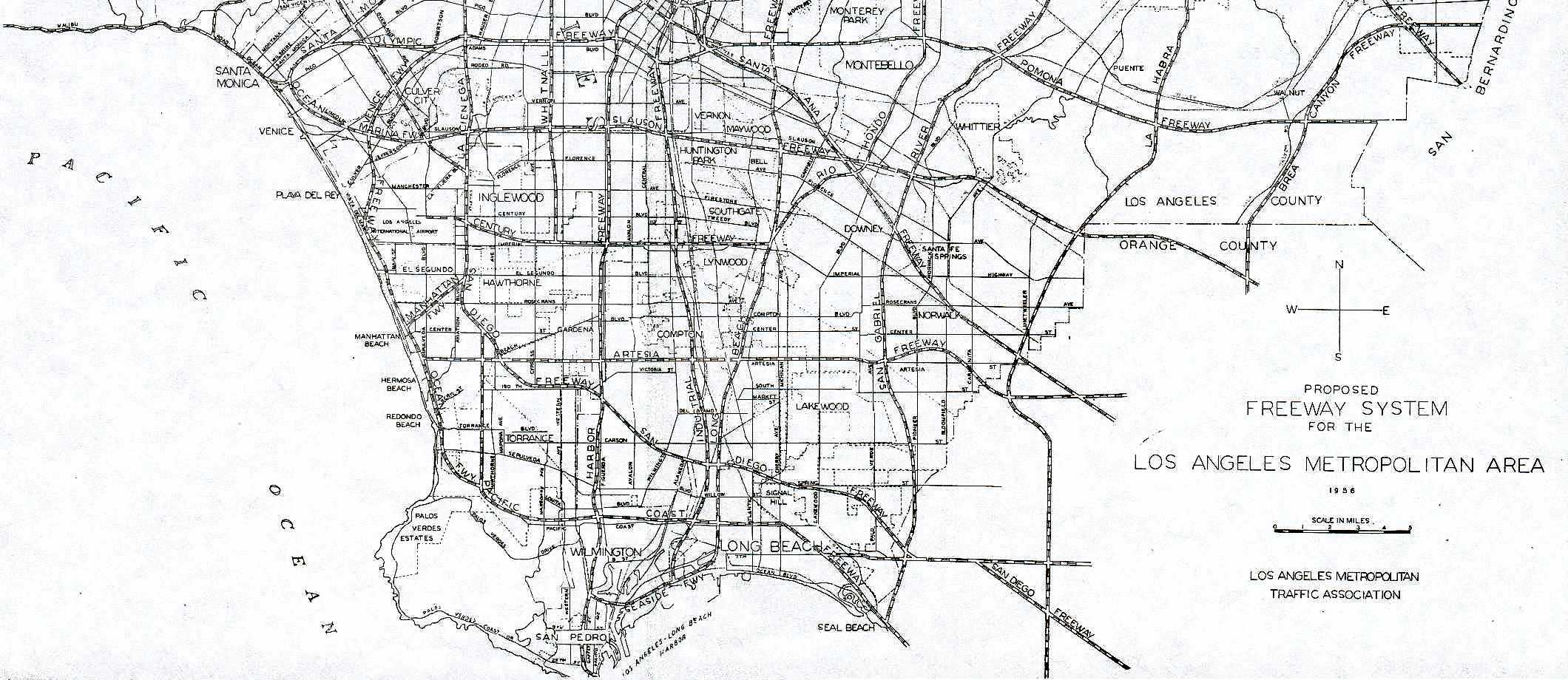
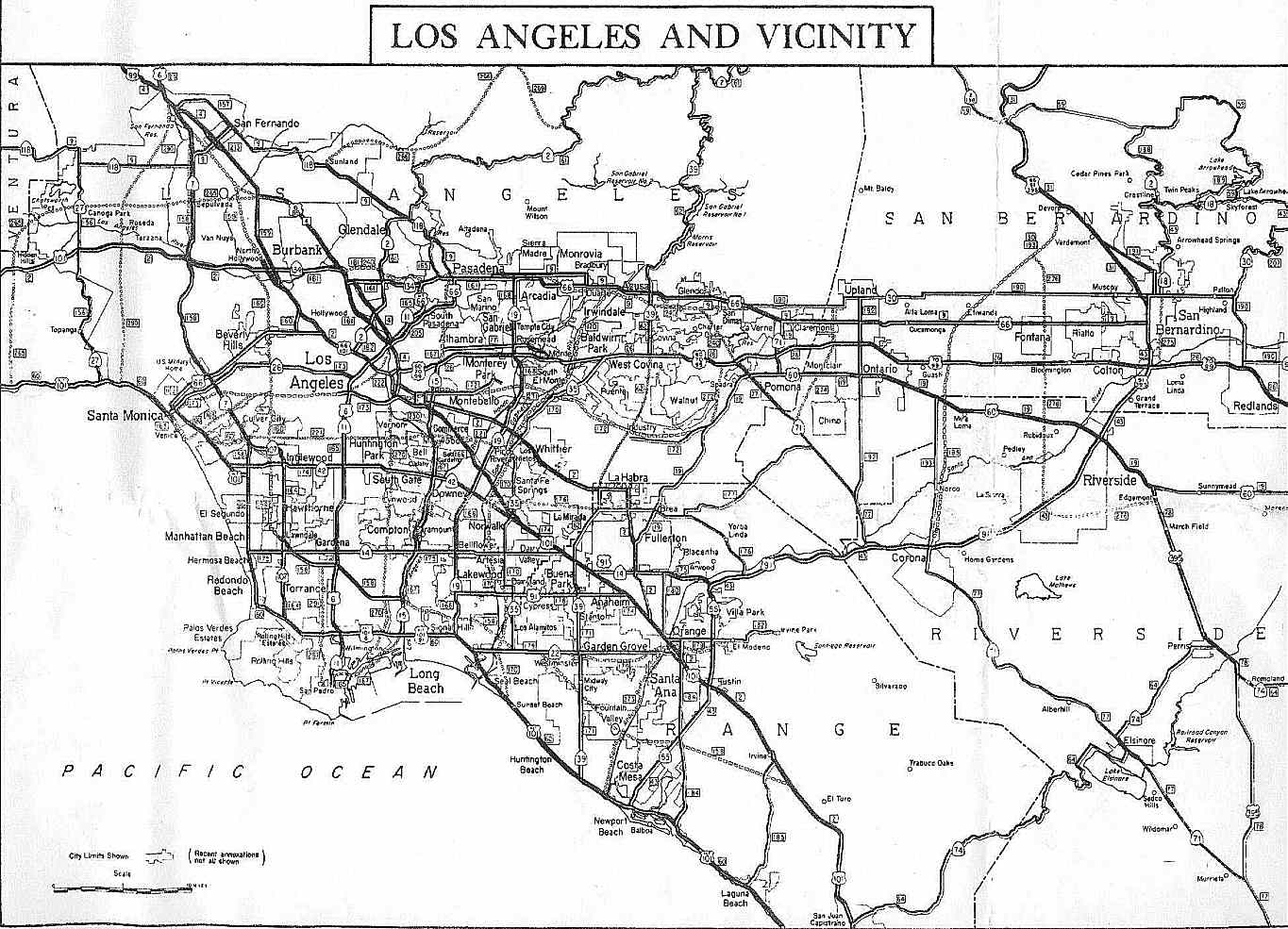
The state built a bypass of the Valley Boulevard portion of the route in the early-to-mid 1930s, leaving the old road near Diamond Bar and heading northeast through the foothills, along the present freeway alignment and Mission Boulevard.[10] To the south, the legislature added then-unrelated Route 180 along State College Boulevard in 1933, connecting Route 2 (I-5) near the Santa Ana River with Route 175 (Orangethorpe Avenue, later replaced by SR 91) near Placentia.[11][12] By 1955, a Brea Canyon Freeway was proposed to begin at the Santa Ana Freeway (I-5) near La Veta Avenue in Santa Ana and head north, paralleling Routes 180 and 19 to Pomona.[13][14][15] (The portion northeast of Diamond Bar into Pomona soon became part of the planned Pomona Freeway, and the name of the remainder was changed to Orange Freeway.[16]) The state legislature changed the definition of Route 19 to reflect this in 1957 by moving its south end to Santa Ana.[17]
Also in 1957, the northernmost part of present SR 57 was added to the state highway system as part of Route 240, which the legislature designated along the route planned for Interstate 210.[18] This became part of the proposed Temescal Freeway (later Corona Freeway); a southerly extension of the Orange Freeway[16] to Legislative Route 60 (SR 1) near Huntington Beach was added in 1959 as Route 273. Also in 1959, the legislature created Route 272, extending the line of the Orange Freeway north from the Pomona Freeway to the Temescal Freeway, completing the proposed freeway corridor that is now SR 57.[19] At the time of the 1964 renumbering, when the entire route (except Route 240, which was still part of I-210) was redesignated Route 57, none of these proposed freeways had been built; the only constructed portion was the old surface road from Fullerton towards Pomona.[20] (The portion of old Route 19 east of Route 272 became part of SR 60.) As part of the same renumbering, Route 180 on State College Boulevard became Route 250,[21] which was amended the next year to provide for its deletion once that portion of the SR 57 freeway was completed (between I-5 and SR 91).[22]


A groundbreaking ceremony was held in Placentia on January 30, 1967 to begin construction of the Orange Freeway.[23] The first portion was dedicated on May 16, 1969 and opened soon after, extending north from the Riverside Freeway (SR 91) to Nutwood Avenue.[24] Over the next few years, the freeway was completed from SR 91 north to I-10, and I-210 was built north to the present end of SR 57; the Pomona Freeway (SR 60), which overlaps it through Diamond Bar, was constructed at the same time.[25] The last pieces of that portion were through Brea Canyon, opened March 13, 1972,[26] and the four-level Kellogg Hill Interchange at I-10, dedicated May 1, 1972 and opened soon after.[27] Finally, the Orange Freeway was extended south from SR 91 to I-5 in the mid-1970s,[25] allowing Route 250 to be turned back to local governments (though the subsequent deletion from the Streets and Highways Code did not take place until 1981[28]). With the extension of Route 210 around San Bernardino in 1998, the former easternmost piece of I-210 to the Kellogg Hill Interchange instead became a northerly extension of SR 57,[29] though it remains officially part of the Interstate Highway System.[30]
The southerly extension to Huntington Beach remains unconstructed. The most recent plans were for a toll road elevated above the Santa Ana River rather than through existing neighborhoods, only extending south to the San Diego Freeway (I-405) in Costa Mesa with connections to the Corona del Mar Freeway (SR 73).[31][32] The extension was most recently considered as two 11.2-mile (18.0 km) two-lane viaducts, costing $950 million; the toll road franchise expired in January 2001.[33]
[edit] Exit list
- Note: Except where prefixed with a letter, postmiles were measured in 1964, based on the alignment as it existed at that time, and do not necessarily reflect current mileage. The numbers reset at county lines; the start and end postmiles in each county are given in the county column.
| County | Location | Postmile [1][25][34] |
#[35] | Destinations | Notes |
|---|---|---|---|---|---|
| Orange ORA 10.83-R22.55 |
Orange | 10.83 | 1A | I-5 south (Santa Ana Freeway) – San Diego |
Southbound exit and northbound entrance |
| 10.83 | 1 | SR 22 (Garden Grove Freeway) – Orange, Long Beach |
Southbound exit and northbound entrance; signed as exits 1B (east) and 1C (west) | ||
| 10.70 | 1C | La Veta Avenue | Southbound exit and northbound entrance | ||
| 11.24 | 1D | Chapman Avenue – Orange | Signed as exit 1A northbound; former SR 51 | ||
| 11.80 | 1E | Orangewood Avenue | Signed as exit 1B northbound | ||
| Bridge over the Santa Ana River | |||||
| Anaheim | 12.54 | 2 | Katella Avenue | ||
| 13.42 | 3 | Ball Road | |||
| 14.78 | 4 | Lincoln Avenue – Anaheim | Former US 91/SR 18 | ||
| 15.60 | 5A | SR 91 (Riverside Freeway) – Los Angeles, Riverside |
Signed as exits 5A (east) and 5B (west) | ||
| Placentia | 16.39 | 6A | Orangethorpe Avenue | Signed as exit 6 southbound; former SR 14 | |
| Fullerton | 17.30 | 6B | Chapman Avenue – Fullerton | Southbound exit is via exit 7 | |
| 17.57 | 7 | Nutwood Avenue | |||
| 18.34 | 8 | Yorba Linda Boulevard | |||
| 19.86 | 9 |  SR 90 (Imperial Highway) – Brea SR 90 (Imperial Highway) – Brea |
|||
| Brea | |||||
| 20.88 | 10 | Lambert Road | |||
| 21.78 | 11 | Tonner Canyon Road | Northbound exit and southbound entrance | ||
| Los Angeles LA R0.00-R12.21 |
R0.91 | 13 | Brea Canyon Road | Southbound exit and northbound entrance; former SR 57 | |
| Diamond Bar | R1.94 | 14 | Diamond Bar Boulevard | ||
| R3.17 | 15 | Pathfinder Road | |||
| Diamond Bar, Industry |
R4.52 60 R23.56 |
16 |  SR 60 west (Pomona Freeway) – Los Angeles SR 60 west (Pomona Freeway) – Los Angeles |
South end of SR 60 overlap; no exit number southbound | |
| 60 R24.45 | 24B | Grand Avenue – Diamond Bar | |||
| Diamond Bar | 60 R25.46 R4.52 |
SR 60 east (Pomona Freeway) – Pomona, Riverside |
North end of SR 60 overlap; southbound exit is via exit 18 | ||
| 4.98 | 18 | Sunset Crossing Road | No northbound exit | ||
| Pomona | 6.17 | 20 | Temple Avenue | ||
| R7.72 | 21 | I-10 (San Bernardino Freeway) – Los Angeles, San Bernardino |
Signed as exits 22A (west) and 22B (east) southbound | ||
| San Dimas | |||||
| R7.94 | 22C | SR 71 south (Chino Valley Freeway) – Corona |
Southbound exit and northbound entrance | ||
| R8.71 | 22D | Via Verde, Raging Waters Drive | Signed as exit 22 northbound | ||
| R10.27 | 24A | Covina Boulevard | |||
| R10.79 | 24B | Arrow Highway – San Dimas | |||
| Glendora | R11.57 | 25A | Auto Centre Drive | Northbound exit and southbound entrance | |
| R12.30 | 25B | SR 210 east (Foothill Freeway) – San Bernardino |
Northbound exit and southbound entrance | ||
| R12.21 | I-210 west (Foothill Freeway) – Pasadena |
Northbound exit and southbound entrance | |||
[edit] References
- ^ a b California Department of Transportation, State Truck Route List (XLS file), accessed February 2008
- ^ Los Angeles Times, 'Orange Crush' Gets Tighter, January 28, 1992, p. 1
- ^ Orange County Register, Orange Crush link to shut till Monday, November 18, 2006
- ^ a b c Google Maps street maps and USGS topographic maps, accessed February 2008 via ACME Mapper
- ^ California Department of Transportation, Interregional HOV System Status, 2005-06
- ^ Official Automobile Blue Book, Volume Eight, 1919, p. 530
- ^ Los Angeles Times, New Road Winds In and Out, February 25, 1923, p. VI8
- ^ "An act establishing certain additional state highways and classifying them as secondary highways.", 1931 chapter 82, p. 103: "Pomona to Fullerton via Brea canyon."
- ^ "An act to establish a Streets and Highways Code...", 1935 chapter 29, p. 276: "Route 19 is from: (a) Route 9 west of Claremont to Beaumont via Riverside. (b) Pomona to Fullerton via Brea Canyon."
- ^ Rand McNally & Company, Los Angeles & Vicinity, 1933
- ^ "An act...relating to...the addition of certain highways to the State system.", 1933 chapter 767, p. 2040: "State Highway Route 2 near Orange County Hospital northerly to Hermosa Beach-Santa Ana Canyon Road."
- ^ "An act to establish a Streets and Highways Code...", 1935 chapter 29, p. 286: "Route 180 is from Route 2 near Orange County Hospital northerly to Route 175."
- ^ Los Angeles Times, Brea Canyon Freeway Plan Pushed, July 16, 1955, p. 13
- ^ Valley News (Van Nuys), Propose Four New Routes for Freeways, November 2, 1955
- ^ Los Angeles Metropolitan Traffic Association, Proposed Freeway System for the Los Angeles Metropolitan Area, 1956
- ^ a b Metropolitan Transportation Engineering Board, Master Plan of Freeways and Expressways, adopted February 28, 1958
- ^ "An act...relating to state highway routes.", 1957 chapter 1911, p. 3342: "Route 19 is from:...(b) Pomona to Route 2 near Santa Ana."
- ^ "An act to add Section 560 to the Streets and Highways Code, relating to state highways, declaring the urgency thereof, to take effect immediately.", 1957 chapter 24, p. 578: "Route 240 is hereby added to the State Highway System, to extend from Route 4 near Glendale to Route 26 near the east boundary of Los Angeles County..."
- ^ "An act to amend...the Streets and Highways Code, relating to state highways, providing for a California Freeway and Expressway System...", 1959 chapter 1062, p. 3120: "Route 272 is from Route 19 near City of Industry to Route 26 near Pomona." "Route 273 is from Route 60 near Huntington Beach to Route 179 near Santa Ana."
- ^ Division of Highways, Los Angeles and Vicinity, 1963
- ^ "An act...relating to routes on the state highway system.", 1963 chapter 385, p. 1176, 1188: "Route 57 is from: (a) Route 1 near Huntington Beach to Route 22 near Santa Ana. (b) Route 5 near Santa Ana to Route 210 near Route 10 and Pomona, passing near Industry." "Route 250 is from Route 5 near Orange County Hospital northerly to Route 91."
- ^ "An act...relating to state highways.", 1965 chapter 1372, p. 3276: "This route shall cease to be a state highway when Route 57 freeway is completed from Route 5 to Route 91."
- ^ Los Angeles Times, Work Started on Orange Freeway, January 31, 1967, p. OC8
- ^ Independent Press-Telegram, Orange Freeway Section to Open, May 17, 1969
- ^ a b c California Department of Transportation, Log of Bridges on State Highways, July 2007
- ^ Los Angeles Times, Orange Freeway Through Canyon to Open Today, March 13, 1972, p. D1
- ^ Montclair Tribune, New Freeway Hub Dedicated, May 4, 1972
- ^ "An act to amend...the Streets and Highways Code, relating to state highways.", 1981 chapter 292, p. 1419
- ^ "An act to amend Sections 253.1, 263.3, 263.8, 357, and 510 of, and to repeal Section 330 of, the Streets and Highways Code, relating to highways.", 1998 chapter 221: "Route 57 is from:...(b) Route 5 near Santa Ana to Route 210 near San Dimas."
- ^ Federal Highway Administration, National Highway System: Los Angeles--Long Beach--Santa Ana CA, May 2003
- ^ Los Angeles Times, Interest Growing in 2 Traffic Proposals for Santa Ana Area, January 7, 1986, p. 1
- ^ Los Angeles Times, Hundreds Cheer as Panel Turns Down [Garden Grove] Freeway Extension, July 29, 1986, p. 1
- ^ California Department of Transportation, Private Investment / Public Infrastructure: Route 57 (Orange County), accessed February 2008
- ^ California Department of Transportation, All Traffic Volumes on CSHS, 2005 and 2006
- ^ California Department of Transportation, California Numbered Exit Uniform System, SR-57 Northbound and SR-57 Southbound, accessed February 2008
[edit] External links
|
||||||||||||||