Talk:Incorruptibility
From Wikipedia, the free encyclopedia


Contents |
[edit] Judaism
I am surprised that the Jewish aspect of this concept isn't mentioned. I looked up this article to find citations to sources. I had never heard a term for it, but it has traditionally been seen as so central to Judaism that it is considered a component of the Thirteen Princples by Orthodox Jews. The convergence of "bodily resurrection" and what is defined here as incorruptibility makes them almost indistinguishable in Orthodox Judaism. I really don't want to do the research to start the appropriate section correctly, but this article should be useful. http://www.jewishchronicle.org/issues/20030926/localnews7.htm. Pay particular attention to the part about cremation. Decomposition is seen as atonement for sins. The fewer sins a person commits, the less "chibut kever" (rattling of the grave) that person gets. Righteousness, at least to the Orthodox, is proven by the lack of decomposition. I have also seen this cited (I think in the Jewish Book of Why) as the reason why Jewish funerals/grave visits do not include flowers, but rather placing stones on the grave. 75.3.236.44 (talk) 07:31, 16 April 2008 (UTC)
[edit] Two questions
- Is it worthwhile to include an explanation of the difference between a body being incorruptible or well preserved?
-
- If there are useful things to say about it, sure!
- The article currently discusses incorruptibility in Christian cultures, but there are examples of it from other cultures - secularly, well preserved corpses could be seen as incorruptible, some Buddhist monks have their bodies preserved through a system of drying and coating in gold leaf, in another example a well preserved or incorruptible corpse of a monk was found and venerated, and some followers of Paramahansa Yogananda claimed his body was incorruptible. Would it be appropriate to expand the article in this way? MrTrev 04:06, 4 February 2006 (UTC)
-
- I think yes. That's why I added the subheading "Incorruptibility in Christianity", because the concept is wider than Christianity alone. Additional subheadings might be useful. As a Christian myself, I personally tend to give more credence to the Christian claims, but I'm also an NPOV fanatic and thus I think this article needs to be as complete as possible! Lawrence King 06:39, 4 February 2006 (UTC)
-
-
- Ok, I've added a couple of possible examples. I decided not to include the Buddhist monks, as they are deliberately preserved. You could argue the same for Paramahansa Yogananda, but his followers maintained otherwise. I felt it worthwhile to show there was disagreement over the cause, but this is a tricky area to get NPOV, so I'd appreciate you double checking. I'm not happy with the Incidence of Incorruptibility section but don't know how better to phrase what I'm trying to say here. MrTrev 19:25, 6 February 2006 (UTC)
-
[edit] Erm
Just a question, but should this article also deal with instances where a specific body part was found incorruptible? (Typically a heart, but other instances are also in folklore/religion) Sherurcij (talk) (Terrorist Wikiproject) 05:02, 20 February 2006 (UTC)
[edit] Appropriatness of tone
Given that incorruptability is mythic, I find it odd that the Wikipedia choses to discuss it as if it were real. The section on "causes of incorruptability" is hardly good writing. Its a bit as if we had an article on flat Earth mythology that discussed "why the Earth is flat" as if it truly was flat. sotonohito
- Is it really fair, or even true, to say that it's mythic? There are dozens of reports of holy people whose bodies remain incorrupt years, sometimes centuries, after their deaths. Do you have cites proving that all of those incidences are false? -RaCha'ar 01:42, 6 March 2006 (UTC)
- I'd disagree it is mythic. The explanations are mythic, but there are a number of cases where bodies have been found to be remarkably well preserved. Myself, I lean towards a physical explanation, probably related to the physical environment the corpse is in, but we have to acknowledge that others see it as metaphysical, spiritual, divine, or suchlike. MrTrev 13:52, 6 March 2006 (UTC)
- Certainly some distinction needs to be made. Some cases are more inexplicable than others. The body of St. Innocent of Irkutsk was the only incorrupt one found in the cemetery, or even in the same part of the cemetery, although it was treated no differently. On the other hand, no matter how much I venerate him it must be admitted that the relics of St. John (Maximovitch) of Shanghai and San Francisco occupied a metal casket inside an airtight sarcophagus in what must have been a completely anaerobic environment after a portion of the inner casket oxidized. Even a devout believer might be excused for thinking there was not much miraculous about incorruptibility in that case, although it is a blessing to have intact relics for veneration. TCC (talk) (contribs) 23:03, 31 May 2006 (UTC)
[edit] St Zita
We have a photo of her body, yet her name does not appear in the list of incorruptible people, or anywhere else in the article. Her own article makes no reference to her incorruptibility. Does she belong here or not? JackofOz 02:27, 8 February 2007 (UTC)
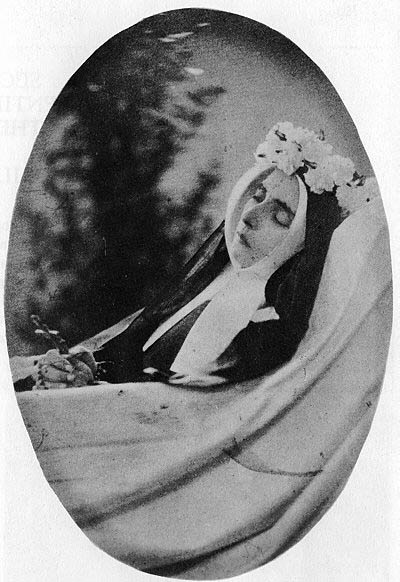
- It seems to me there should be a better picture anyway because her body does not look so incorrupted to me. St. Bernadette for example looks completly normal, Zita looks like a mummy?--JaymzRR 02:50, 18 March 2007 (UTC)
[edit] Saint Bernadette Soubirous died in 1879
A good example of a Saint included on the list, she left Her Body April 16th 1879.
Pictured here: http://wordbytes.org/saints/DailyPrayers/BernadetteLourdes.jpg
Pictured on the cover of this a thorough study of the Incorruption of the Bodies. The (1) Deliberately preserved, (2) Accidentally preserved and (3) The Incorruptibles (i.e. Saint Bernadette): http://www.amazon.com/gp/product/0895550660?tag2=sacreddestina-20
Here we have a picture of Saint Bernadette at the time of her Death in 1879: http://www.catholicpilgrims.com/lourdes/images/bernbw.jpg (photo quality from technology available at the time, in 1879;considerably very clear I think)
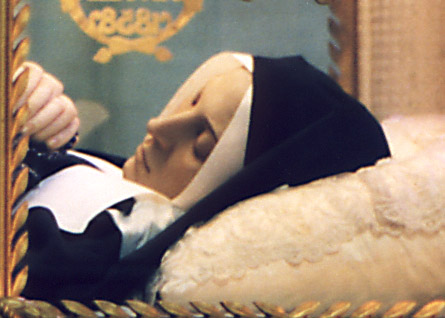
Here we have a picture of Saint Bernadette on June 6, 1997 (118 years later). http://www.catholicpilgrims.com/lourdes/images/bern97a.jpg http://www.catholicpilgrims.com/lourdes/ba_bernadette_intro.htm —The preceding unsigned comment was added by 70.54.4.102 (talk) 12:58, 4 March 2007 (UTC).
70.54.4.102 13:04, 4 March 2007 (UTC) a_kaldas@hotmail.com 70.54.4.102 13:04, 4 March 2007 (UTC)
[edit] List of saints
John Newman has not been canonized. He's only venerable. Lexo 21:05, 4 July 2007 (UTC)
[edit] Wax mask
Cabinet of Wonders posted on this subject, & included mention that the saint pictured in the article's lead has had her face "refurbished" with a wax mask. This is probably worthy of mention, but I don't have time to see if I can find a better cite than the article above. Anybody have anything? If not, I'll try to remember to come back later. --mordicai. 17:29, 30 August 2007 (UTC)
- Ha, especially because closer reading shows that Wikipedia is the source cited in the article...okay, well. Now to decide if the picture requires a caveat or similar...--mordicai. 21:06, 30 August 2007 (UTC)
- I've gone ahead & added mention; don't want the photos to be misleading. --mordicai. 20:52, 1 September 2007 (UTC)
- Hmmm, I just recently saw the incorrupt corpses of St. Vincent de Paul, St. Catherine Labouré and Saint Louise de Marillac in Paris. I'm afraid I couldn't help but notice how similar they looked to wax models I've seen in wax museums. I admit that I'm a skeptical person by nature, but I honestly believe that these incorruptables (at least the ones I saw) are nothing more than elaborate hoaxes. Of course, a fervent believer will always dismiss this as pure nonsense. Are there any references to independent (or dare I say the word, "scientific") verifications of these bodies? Ga2re2t 10:26, 11 October 2007 (UTC)
-
- I can tell you that in some cases, they just put a coat of wax over the hands and face of the saint. It supposedly helps protect it from damage. I know that in the case of Saint Bernadette Soubirous (of Lourdes fame) was exhumed several times, each time her body was found to be in a perfect state even though the Rosary in her hands was rusted and there were other signs of decay. Each time, they'd take her body, wash it, put a new habit on it, then bury it again. The last time they exhumed the body, it was for permanent display; they gave it the usual wash and change, but the body suffered water damage. So they coated it with wax, perhaps to hide the water damage, and to protect it. I don't know if there were scientific explorations into these incorruptible cases, but there wouldn't be anything wrong if there were. In fact, if anything, the Church greatly encourages scientists to try to find flaws in supposed-miracles, to protect the faithful from venerating a miracle that really isn't one. J.J. Bustamante 15:52, 11 October 2007 (UTC)
-
- There's a serious misunderstanding here. It is correct that in the Chapel of the Miraculous Medal in Paris, St. Catherine Labouré's incorrupt body is on display. However, the 'body' of St. Louise de Marillac is a wax statue/figure that contains her relics. I can see how this would be confusing, but it was very clear to me when I was there. I don't know where you saw the body of St. Vincent de Paul - his heart is preserved in a reliquary, but there is no image of his body (other that what is obviously a marble statue) as far as I know. Here is a link to the official website of the Shrine, which has information (although poorly translated from the French). Click on the picture of the chapel for the 'tour,' then the coffin on the far left for information about St. Louise de Marillac. St. Vincent de Paul's relics are on the right, and St. Catherine is in the coffin to the right of the center. SHarold (talk) 06:42, 8 June 2008 (UTC)
-
- There is a book called The Incorruptibles which can be found on Amazon.com but it seems to be written by someone who believes in all known cases of incorruptibility and who only poses the "right" questions. I'll try to do some more research on the area. Ga2re2t 10:22, 12 October 2007 (UTC)
-
- "each time her body was found to be in a perfect state" - there are major POV problems in this article. These are only claims, not facts, and pious fraud is very common so it would not be suprising to me if this were not true, or exaggerated. The water damage reason to use a mask sounds like an excuse to me. Does anyone know of any photos of well documented incorupts? Or any good evidence of fraud - wax passing for real bodies? Do people who see bernadette understand that they are just seeing wax? Liam1564 (talk) 15:50, 28 April 2008 (UTC)
[edit] Saint Frances Cabrini
This article lists Saint Cabrini to have been incorrupt, yet the main article for her explicitly says the opposite. Does anyone happen to know which version is true? I'd be happy to correct whichever article is inaccurate, but I just don't know which.J.J. Bustamante 03:06, 3 September 2007 (UTC)
[edit] Blessed Virgin Mary
Just a thought, should we include the Blessed Virgin Mary in this article? She's the only one whose incorrupt state is a matter of dogmatic fact. Any thoughts?J.J. Bustamante 03:11, 3 September 2007 (UTC)
- According to the Catholic Church, the Virgin Mary was assumed into Heaven. In contrast, the incorruptibles are the earthly remains of saints that never succombed to decomposition. Also, the Assumption of the Virgin Mary, as far as I am aware, is not a shared dogmatic fact amongst all Christian faiths. Ga2re2t 15:35, 15 October 2007 (UTC)
[edit] Buddhist Monk
The article makes reference to "a Buddhist monk." It does nto say whom this monk is. Yet there is a case of supposedly verified incorruptibility of Hambo Lama Itigelov, a Buddhist monk exhumed in 2002.
http://www.neplaneta.ru/hamba_lama.shtml
http://www.buddhistchannel.tv/index.php?id=3,3759,0,0,1,0
Can someone confirm this with another source? —Preceding unsigned comment added by 69.249.252.225 (talk) 23:31, 2 December 2007 (UTC)
[edit] Major POV problem here!
On the St. Bernadette photo, an editor has changed
She is shown here with a wax mask.
to
Her incorrupt state is evident here in this recent photo.
Well, which is it? Are we looking at a wax mask or an incorrupt face? I hardly think we can have an article about incorruptibles with an illustration of a face that might not be an incorrupt face at all. The article needs to be crystal clear what we're looking at. Facts, please, not faith. EverybodyLovesSomebody (talk) 00:37, 7 February 2008 (UTC)
- It's a wax mask. The photo caption has already been updated. Dgf32 (talk) 19:45, 15 February 2008 (UTC)