Darod
From Wikipedia, the free encyclopedia
| Darod
بني داوود |
||||||||||||
|---|---|---|---|---|---|---|---|---|---|---|---|---|
| Total population | ||||||||||||
|
5,000,000(est.)[citation needed] |
||||||||||||
| Regions with significant populations | ||||||||||||
|
||||||||||||
| Languages | ||||||||||||
| Somali and Arabic | ||||||||||||
| Religions | ||||||||||||
| Islam (Sunni) | ||||||||||||
| Related ethnic groups | ||||||||||||
Hawiye, Isaaq, other Somali clans groups. |


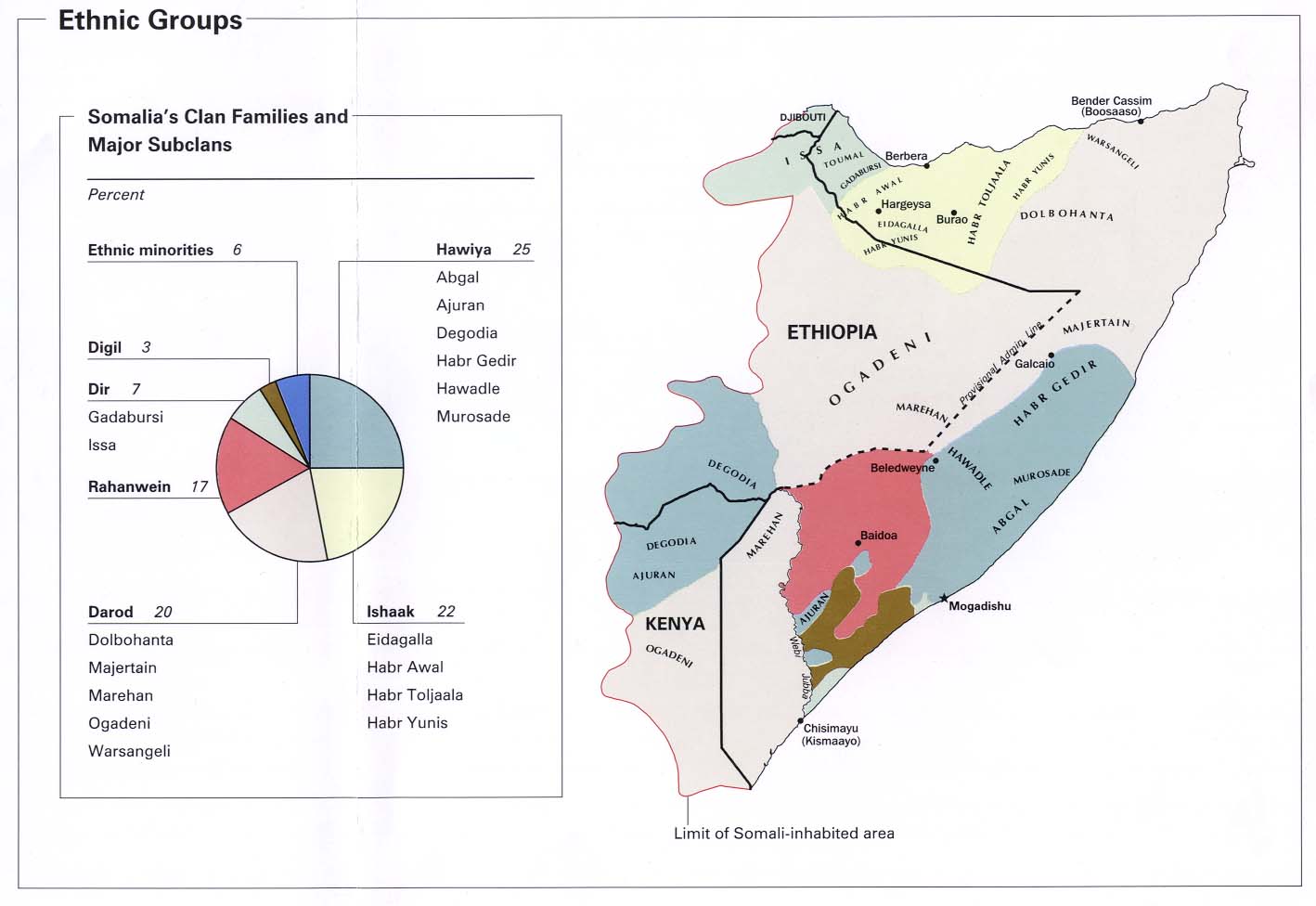
The Darod (Somali language: Darood, or Daarood) is a Somali clan. The Arabic name of the Darod clan is Banu Dawud (بني داوود). In the Somali language, the word Daarood means "an enclosed compound," a conflation of the two words daar (compound) and ood (place enclosed by wall, trees, woods, fence, etc). The Darod population in Somalia lives principally in the north, with a presence in the Mogadishu area as well as southwestern Somalia. Outside of Somalia, there are various Darod sub-clans in the Somali Region of Ethiopia (particularly the Ogaden area), Yemen, and the North Eastern Province of Kenya.
Contents |
[edit] History
Some Darod clan members claim to be descendants of Muhammad ibn Aqil, son of Aqeel ibn Abi Talib. Aqeel ibn Abu Talib was second of four sons of Abu Talib ibn ‘Abd al-Muttalib, who was the uncle and protector of the Islamic prophet, Muhammad who was head of the Banu Hashim. They have a strong tribal relationship with the other Hashemites. According to tradition, Muhammad ibn Aqil's descendant Abdirahman Isma'il Jabarti, a sheikh of the Qadiriyyah Order, arrived in northeastern Somalia in either the 10th or 11th centuries AD, where he took the daughter of a local Somali chief as his wife.[1]
The Darod were supporters of Imam Ahmad ibn Ibrihim al-Ghazi during his 16th century conquest of Ethiopia, especially the Harti and Marehan sub-clans, who fought at the Battle of Shimbra Kure.[2]
[edit] Demographics
Some sources, including the Canadian Report of the Somalia Commission of Inquiry, indicate that the Darod is the largest Somali clan.[3][4] The CIA and Human Rights Watch, however, indicate that Hawiye is the largest Somali clan.[5][6] The CIA indicates that the Darod make up 40% of the Somalis in Ethiopia and Kenya.[citation needed]
[edit] Partial sub-clan summary
- Geri
- Issak Hassan, Abayoonis Hassan, Omer Hassan and Ika Hume Geri
- Marehan (Somali: Mareexaan)
- Howrarsame
- Reer Kooshin
- Reer Shirwac
- Reer Khalaf
- Awrtable
- Ogaden
- maxamed subeer
- Abdalla
- abudwaaq
- Jidwaq
- ( Bartire))
- (Absguul))
- (Yabaree))
- Leelkase
- Harti
- Warsangali
- Dhulbahante
- Xuseen Saciid
- Muuse Saciid
- Axmed Saciid
- Dashiishe
- Reer Boqor
- Reer Ugaas
- Majeerteen
[edit] Notable Darod people
- Mohammed Sheikh Adden, Marehan, Somali intellectual, former head of Somali Technological Development, Minister of Information, Minister of Education, Marehan, Head of the Ideology Bureau SRRC
- Abdullahi Yusuf Ahmed, Majeerteen, President of Somalia's transitional government since 2004
- Abdulrahman Jama Barre, Marehan, Somali Foreign Minister and close relative of Siad Barre
- Siad Barre, Marehan, third President of Somalia, 1969–1991
- Fatimo Isaak Bihi, Marehan, First Somali female ambassador, Ambassador to Geneva, Director of the African Department of the Ministry of Foreign Affairs
- Abdi Bile, Dhulbahante, winner of the 1,500 metres at the "1987 World Championships in Athletics"
- Faarax Maxamed Jaamac Cawl, Warsangeli, writer
- Hassan Abshir Farah, Majeerteen, former Mogadishu mayor, Somali ambassador to Japan and later to Germany, interior minister of Puntland, prime minister of Transitional Federal Government from Arta, and current TFG minister of fishing and marine resources
- Nuruddin Farah, Ogaden, prominent writer and winner of the 1998 Neustadt International Prize for Literature
- Ali Khalif Galaid, Dhulbahante, former TNG Prime Minister of Somalia
- Ali Matan Hashi, Marehan, first Somali pilot, commander of Somali Airforce 1959-1978, Minister of Justice, Minister of Health, Somali Nationalist.
- Mohammed Abdullah Hassan (Maxamed Cabdulle Xasan), Ogaden, the Sayyid; called the Mad Mullah by the British
- Mohamud Muse Hersi, Majeerteen, President of Puntland
- Mohamed Abdi Hashi, Dulbahante, Former President of Puntland, Former Vice-president of Puntland, Former Chairman of USP (United Somali Party) Pan-Somali party. Known for his surpassing integrity, nationalism and fairness.
- Aden Ibrahim Aw Hirsi, Marehan, Author, Islamic Jurisprudence/Political Science scholar, governor of Gedo region 2007-
- Mohamud Hashi Abdi Hoosh, Marehan, Jubba Regional Army Command 1980-1991
- Abdirizak Haji Hussein, Majeerteen, Prime Minister of Somalia.
- Ahmed Farah Ali 'Idaja', Marehan, one of the first Somali language writers and 'father' of the Somali written folklore
- Warsame Indhoole, Marehan, Director of the Somali Developmental Crash Program, oversaw the successful Somali literacy campaign
- Hirsi Magan Isse, Majeerteen, scholar and one of the leaders of the Somalian revolution
- Osman Yuusuf Keenadiid, Majeerteen, inventor of the Osmanya writing script
- Yaasiin Cismaan Keenadiid, Majeerteen, author of the Somali Dictionary and founding member of the Somali Youth League
- Mohammed Awale Liban, Majeerteen, designed the flag of Somalia
- Mire Hagi Farah Mohamed, Majeerteen, Somali Finance Minister 2004-2006, and former Mayor Of Kismayo port City
- Mohammed Said Hersi Morgan, Majeerteen, defence minister beginning of 1990s
- Mohammed Jibril Muse, Majeerteen, former Chief of Somali Secret Service, General and later on Police chief of state of Puntland[7]
- Said Sheikh Samatar, Leelkase, professor at Rutgers University
- Abdirashid Ali Shermarke, Majeerteen, second President of Somalia, 1967–1969
- Mohamoud Ali Shire, Warsangeli, Sultan of former "British Somaliland" (1897–1960)
- Hussein Shuqul, Marehan, Head of "Jaalle Siyaad" National Military College
- Ahmed Warsame, Marehan, Head of the Somali Military
- Xasan Xayle, Warsangeli, Somali poet from Las Khorey
- Abdiqadir Hersi Yam-Yam, Marehan, prominent Somali poet and scholar
[edit] Notes
- ^ I.M. Lewis, A Modern History of the Somali, fourth edition (Oxford: James Currey, 2002), p. 22
- ^ Sihab ad-Din Ahmad bin 'Abd al-Qader, Futuh al-Habasa: The conquest of Ethiopia, translated by Paul Lester Stenhouse with annotations by Richard Pankhurst (Hollywood: Tsehai, 2003), pp. 50, 76
- ^ The Situation in Somalia. Report of the Somali Commission of Inquiry, Vol. 1. Retrieved on November 21, 2005.
- ^ Somalia Assesment 2001, Annex B: Somali Clan Structure, Country Information and Policy Unit, Home Office, Great Britain
- ^ Central Intelligence Agency (2002). Ethnic Groups. Somalia Summary Map. Retrieved on February 15, 2006.
- ^ Human Rights Watch (1990). Somalia: Human Rights Developments. Human Rights Watch World Report 1990. Retrieved on November 21, 2005.
- ^ Somalia Online
[edit] References
- Hunt, John A. (1951). "Chapter IX: Tribes and Their Stock". A General Survey of the Somaliland Protectorate 1944–1950. London: Crown Agent for the Colonies. Accessed on October 7, 2005 (from Civic Webs Virtual Library archive).
- The Somali Ethnic Group and Clan System. Civic Webs Virtual Library, from: Reunification of the Somali People by Jack L. Davies, Band 160 IEE Working Papers, Institute of Development Research and Development, Ruhr-Universität Bochum, Bochum, Germany 1996, ISBN 3-927276-46-4, ISSN 0934-6058. Retrieved on January 22, 2006.