Talk:Boiler
From Wikipedia, the free encyclopedia


[edit] Added "Applications" and some definitions
I added an applications section with a brief overview since the article seemed to jump right into types of boilers without really describing what they do. I also created some definitions and added a few boiler accessories. --johntindale (talk) 22:29, 9 May 2008 (UTC)
[edit] Counterintuitive Statement re Superheaters
In the section on superheaters, the article currently says:
- It is important to note that while the temperature of the steam in the superheater is raised, the pressure of the steam is not.
This doesn't make sense to me. If the temperature of the steam is raised, shouldn't the pressure in the system increase? Or is the case of an open system where the steam can freely exit the superheater as fast as it wants taken on premise? (I.e., you're increasing the V term in PV=nRT rather than the P term...) If this is the case, I think it should be clarified, because at first glance it just seems rather counterintuitive; if the temperature is increased, either the volume or the pressure is going to increase (and unless the outlet is just to the atmosphere with no flow resistance, increasing the volume is going to increase the pressure at least to some degree). I'm not saying the statement is necessarily wrong, but just that it's confusing, and perhaps someone with better background in the area could explain it more thoroughly. –Kadin2048 05:36, 15 November 2007 (UTC)
- I have just modified the paragraphs on the different types of boiler which were hopelessly confused. Went on to the superheated steam section, and quite frankly, not only do I find it "counterintuitive" as you do, but think it is drivel (and I am not in the habit of using such strong terms in WP). I don't know how far a statement such as: "This provides steam at much higher temperature, and can decrease the overall thermal efficiency of the steam plant due to the fact that the higher steam temperature requires a higher flue gas exhaust temperature." reflects accepted textbook wisdom, which is why I hesitate to alter it for fear of being accused of POV because my take on the subject is personal, but if it can be of any help, here it is for what it is worth. — Saturated steam is so called because it still has a large proportion of water in suspension. Water can't expand so it has to go through the engine along with the steam without contributing to work output. This wastes water and fuel burnt to try to boil it; furthermore this also prevents you from using the steam expansively because as it expands the temperature drops and the steam condenses, so even more water will be present in the steam - even more waste. The heat source in any boiler only serves to produce steam. But if you recuperate residual heat after "creaming off" the steam, to dry it; this means that for a given output, less steam will be used, less water will need to be boiled and fuel consumption will fall, or conversely you can obtain greater power output for a given amount of fuel and water. This has been experienced time and time again in the railway world. Turning the suspended water into steam may produce a marginal increase in pressure but one never hears about it so it's probably hardly discernible, however what will be discernable is that use of dry steam in the engine will mean that a much higher percentage of the steam produced by boiling the water can do work, because it is now pretty well all steam (if it were all steam, it would be supercritical). IMO the engine part or turbine of a steam unit is not a heat engine, but works by pressure-differential (the proof is that it can run on cold compressed air). However the steam circuit demands that temperature be maintained above a certain level, at least until it exhausts from the engine when any remaining heat can be recovered if wished to heat the feed water so that less heat will be required to bring it to the boil. The boiler itself on the other hand relies on a heat gradient in the generally accepted sense.--John of Paris 16:31, 15 November 2007 (UTC)
- Added an explanation of the original question, with source. "Drivel" (see above) not dealt with: too difficult, sorry. I look forward to some rationalisation of this confusing section from a more knowledgeable editor. ---- Old Moonraker (talk) 16:55, 16 November 2007 (UTC)
- So do I. As stated above I am not given to using words like "drivel" and rather regret it today. Your source and quote are welcome and I hope it will stimulate others to come and join us. I don't know what the temperature values refer to, surely not steam temperatures, - not in a locomotive boiler as illustrated anyway. If it's flue temperature as seems to be meant, that completely contradicts the statement I was contesting - transferring some of that heat to the steam must increase efficiency, otherwise the heat would surely just go out of the chimney with a saturated boiler.---- John of Paris (talk) 21:45, 16 November 2007 (UTC)
- Afterthought: This picture shows the boiler pressure gauge (right) and the steam chest pressure gauge (left) of a superheated locomotive. The scales are the same, both showing an operating pressure of 280 psi. --Old Moonraker (talk) 06:41, 17 November 2007 (UTC)
- Right! and before Chapelon's time there was considerable pressure drop between boiler and steam chest (That certainly decreased thermal efficiency). - and I've still not got over and am appalled by this notion of a superheater decreasing thermal efficiency. Perhaps the editor who put it in could elaborate.--John of Paris (talk) 08:35, 17 November 2007 (UTC)
-
-
- Regarding the original question by Kadin2048: The equation PV=nRT is only approximately valid for steam below the critical point but can be used to illustrate what happens.
- Two processes take place in the superheater tubes:
- 1. The temperature of the steam is raised. As the system is more-or-less open, the pressure remains constant. So the steam expands and V increases. The extra energy is contained in the higher volume: it can push a wider piston at the same pressure with the same mass of steam.
- 2. The flow of steam through the narrow and curved superheater tubes causes a pressure drop, due to flow friction.
- Just a small but important detail: The engine working on superheated steam is not the same with the one running on the same mass flowrate of saturated steam: in addition to the superheter it has wider steam pipes and cylinders to accomodate the larger volume of steam.
- Sv1xv (talk) 18:56, 14 May 2008 (UTC)
-
[edit] Merge?
Should this article be merged with steam generator? —Mulad (talk) 20:20, Jun 16, 2005 (UTC)
No, as a boiler does not have to generate steam.
[edit] combustion air mix
How is it ensured that enough air gets into a domestic boiler for gas to burn with a blue flame, whilst at the same time heat loss is minimised? --Username132 19:34, 1 February 2006 (UTC)
- Username 132, what I think you mean in the first part is obtaining the proper amount of combustion air, too much can waste fuel. Yes, that's important. But heat can be lost (wasted) from a variety of problems, such as fireside soot buildup, or waterside scale, both of which will lower the heat transfer, allowing less heat to be absorbed and thus more heat going up the stack.--Sgstarling 20:32, 18 February 2006 (UTC)
[edit] supercritical boiler
I'm not very happy with the supercritical boiler section, it's both a poor definition, and seems to imply the sole reason for supercritical boilers is to help the earth? So this needs to be redone entirely.--Sgstarling 20:32, 18 February 2006 (UTC)
Also, feel free to add anything anywhere to help flesh out this article, I know there are plenty of stationary engineers out there! Let's flesh out OUR area of expertise!--Sgstarling 20:32, 18 February 2006 (UTC)
Edited the spercritical boiler def. for you (all):-) [anon. boiler engineer]
[edit] i think we must talking about types of boiler
i think we must talking about types of boiler for whose dont know
I agree. Such as oil-fired boiler; gas-fired boiler or electric boiler. Also it it good to include the different applications of boilers.1234louise (talk) 20:02, 19 February 2008 (UTC)
[edit] Hydronic central heating
I'd like to see more real facts, with regard to North America. What is the history -- when was this most popular, where, what were the percentages of installation usage? In terms of current construction, what are the real facts -- where most popular, percentage of new construction? 69.87.204.247 20:48, 15 November 2006 (UTC)
[edit] Italian Caption Pictures
I really appreciate the inclusion of pictures, but wish their captions were in English since this is the English version of Wikipedia.--P Todd 21:27, 3 December 2006 (UTC)
- Done
onetwoall three. --Old Moonraker 23:10, 3 December 2006 (UTC)
[edit] Expert view please
In the water tube boiler (hot water), water tubes above the feed water drum are depositted thin layer of ashes in light colour. Would like to know this is because of over heating or due to quality of fuel we are using. Currently using furnace oil of 1500 red wood viscosity. --Uthpalaherath 05:01, 14 December 2006 (UTC)
[edit] Overview diagram
What sort of boiler is the diagram next to the overview intended to represent (or symbolise)? It looks like nothing I have ever seen.--John of Paris 13:52, 27 February 2007 (UTC)
- Here's one from Babcock's which shares some of the characteristics [1], although the doubling-back firetubes lead from an internal, rather than an external, firebox. At the least, it's a real-life example of the closed chamber from which the tubes return (which I wasn't aware of either). An illustration of a more common type, and possibly not as stylised, would definitely suit the article better.--Old Moonraker 14:36, 27 February 2007 (UTC)
Yes, it's very hard to sum up a 250-year-old technology in one short overview and a stylised diagram. What is shown here is what I believe is known today as a 2-pass boiler. The Babcock one is 3-pass with presumably an oil burner in a single tube, then the gases return backwards, then forwards again through multi-tube bundles. What I feel here is missing is a chronological overview. I came into this article looking for more information on the Cornish boiler. It is barely mentioned except to class it amongst those "of historical interest" but there is no description of what it was or is.--John of Paris 17:04, 27 February 2007 (UTC)
[edit] Standby Loss
I cannot find the actual water volume inside a hydronic boiler (oil). This contributes to standby loss and is surprisingly not incorporated in the AFUE rating. I am seeing more systems with limited water volume, is this a good thing? I hear the government is currently in court defending their AFUE rating system, true? When will the ASME get involved? Thank you!
[edit] The "Steam generation power plant " image is incomprehensible and should be deleted
The "Steam generation power plant" image in the "Supercritical Steam Generators" section ( [[Image:Turmkessel02.png]] ) is a densely detailed construction drawing of some kind and it is completely incomprehensible because it does not label the various sections and equipment items. It should be deleted until someone adds labeling of the various sections and equipment items. Perhaps those sections and equipment items could at least be numbered and then a list be added to the drawing naming each of the numbered items.
If there are no valid objections to the suggested deletion within the next week, I will go ahead and delete the image. Please comment. - mbeychok 04:53, 7 September 2007 (UTC)
- Adds nothing to understanding of the topic as it stands. Please delete! --Old Moonraker 06:48, 7 September 2007 (UTC)
[edit] Article or discussion of the Hartford Loop?
I am not a HVAC engineer. I don't really understand the operating principle of the Hartford Loop, but I do know it helps to prevent boiler explosions due to the tank going dry due to a leak, and makeup water hitting the red-hot metal causing a sudden massive steam release that blows the boiler sky-high.
A new article or an addition to this one discussing the Hartford Loop would be a useful addition to Wikipedia. Any HVAC experts want to step up and add it? DMahalko (talk) 15:03, 2 January 2008 (UTC)
[edit] Portable boilers
In response to this edit: One use of redundant locomotive (particularly traction engine) boilers was to provide steam to steam-sterilise soil in high-intensity agricultural operations, particularly greenhouses. An armoured hose was connected to a hollow lance and this was prodded into the ground at narrow intervals. I imagine that health and safety has put paid to this by now. All personal knowledge I'm afraid, but as such no great loss: I don't really think it's worth including.--Old Moonraker (talk) 23:10, 24 February 2008 (UTC)
- Thanks for that, it is a usage I wasn't aware of (so I would say it is worth including, somewhere, even if not on the 'boilers' page.)
- The thing is, I've looked at that picture numerous times, and that boiler looks purpose-built to me. It's too long to be an ex- traction engine, and the firehole looks far too big to have been a rail loco. Also, there is very little evidence of there having been any fittings present, and certainly none associated with traction/portable engines.
- Curious.
- EdJogg (talk) 01:00, 25 February 2008 (UTC)
- Reference available, and not extinct after all: there's been a revival with the organic farming movement. [2] I would certainly rather have used a purpose-built example than the uncertified traction-engine conversion I was accustomed to! --Old Moonraker (talk) 07:06, 25 February 2008 (UTC)
-
-
- Knowing absolutely nothing about this, it seemed appropriate to raise a question at Wikipedia talk:WikiProject Agriculture. 'Steam' is not mentioned on organic farming, so we may have inadvertently found a topic that is not yet covered at WP.
- Ummm, 'watch this space...'!
- EdJogg (talk) 10:05, 25 February 2008 (UTC)
-
-
-
-
- I guess I'll start Soil steam sterilization. WAS 4.250 (talk) 14:58, 25 February 2008 (UTC)
-
-
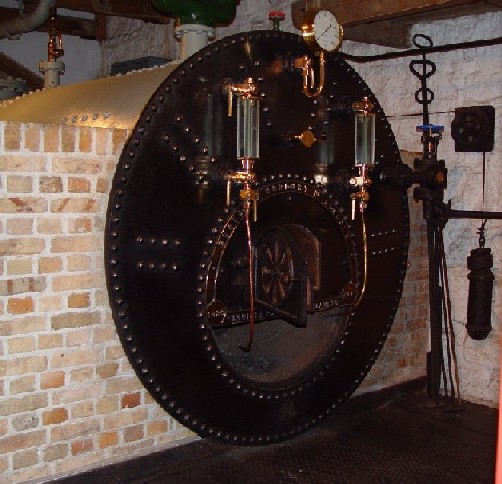
[Outdent] I'm as puzzled as anyone, but after looking at a few images of similar devices I think that the item here started life as "cornish" type of bricked-in factory boiler. Here's the sort of thing I mean. This has the single fire-tube with separate doors for the fire (above) and ash pan (below—note the notches to adjust the draught). The fittings for the water gauge can just be made out. The only thing that casts doubt is the smoke box: it looks contemporary with the rest, but did stationary boilers have them in this style?--Old Moonraker (talk) 23:14, 25 February 2008 (UTC)
- The cylindrical bit sticking out at the back reminds me of the sort of cylindrical corrugated inner firebox that was applied by Hoy to 20 Lancashire and Yorkshire Railway 0-8-0 locomotives around 1903. Can't imagine what this portable boiler could have been used for, but you can see a union pipe on the dome, so whatever its use, it fed some other system for steam heating or driving some separate plant. As long as all this remains a mystery , I can't see the point in keeping the photo in the article.--John of Paris (talk) 08:58, 26 February 2008 (UTC)
-
- The lack of photo evidence available online is not, to me, an indication that such things have not existed. Googling "portable boiler" is too coarse, but adding 'preserved' doesn't help much either. Numerous likely references come up, but the context surrounding the search results usually suggests that what is referred to is more likely a conventional portable engine. Hence I have been hoping for expert help here!
- It does not help that the photo title and caption is in Polish (although I revised the English translation a bit).
- There is at least one other preserved, and in rather better order. It is located at the Westonzoyland Pumping Station Museum, in Somerset, and is used as a steam source for their engines. It was made by Marshall's and used by Thames Water, and the museum has a webpage devoted to it. Like the Polish example, this one has a very large diameter chimney -- much larger than your average portable -- and there is a carrying cradle for it during transport, but the chimney was so heavy they needed a crane to lift it into position!
- Is it possible that these things could have been used at installations in place of fixed boilers, while the latter were receiving maintenance? (I appreciate that many locations would have multiple fixed boilers installed so that such action would be unnecessary, just trying to think of uses for a portable boiler!)
- EdJogg (talk) 10:00, 26 February 2008 (UTC)
-
-
-
- Possibly, although donkey engines used in logging and mining (that I have read about) are normally a combination of winding engine/s and adjacent (usually vertical) boiler.
- EdJogg (talk) 13:57, 26 February 2008 (UTC)
-
-