Talk:Binding energy
From Wikipedia, the free encyclopedia


Contents |
[edit] Pie
Can anyone tell me the binding energy of a pie? Auric The Rad 00:00, Aug 23, 2004 (UTC)
- The question is ill-defined. If you specify what type of pie you mean, and to what degree it is to be disassembled, it could fairly easily be calculated. However unless the disassembly is to be at least to atomic level, the calculations would be somewhat fiddly because pies are an irregular mixture of a large number of different materials. It might be a useful addition to the article to provide the detailed calculations for a neater example, such as a simple ionic compound like salt, or - even simpler - a symmetric gravitational assembly (a spherical rock in deep space). Securiger 01:20, 23 Aug 2004 (UTC)
-
- The gravitational assembly is already covered in gravitational binding energy
[edit] Graph
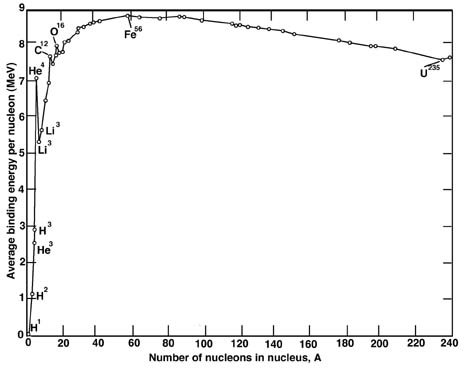
What this page lacks most is a graphic of The Nuclear Binding Energy Curve--Chealer 10:10, 2004 Nov 8 (UTC)
- done, and replaced the old one which was inaccurate and confusing mastodon 17:56, 24 December 2005 (UTC)
- Graph was removed. Should be replaced. Is government NASA graph and public domain. Put license as government-public domain found at NASA website.
- I do not know how to change license to reflect this and put back original graph.--68.231.217.170 15:38, 2 February 2006 (UTC)
[edit] Last statement about binding energy
I was browsing through articles and read the following, which struck me as not quite accurate:
" the atomic mass of hydrogen (which is a lone proton) is 1.00794 Amu, "
First, hydrogen is not a lone proton, it is a proton plus an electron (sorry, nit-picking here) and second that atomic mass represents the weighted average mass of hydrogen based on isotopic abundance. The mass of a proton is (by definition) 1.0. This makes the statement that follows about C-12 having lost mass to binding energy meaningless, doesn't it?
COMMENT: This section should probably be re-done using grams, since amu just confuses things. An amu is actually 1/12th of a carbon ATOM, so electrons are counted there, too. If you want to use amus, you have to compare a carbon atom (12 amus) to 6 hydrogen atoms plus 6 electrons plus 6 neutrons, all in amus. That gives you nuclear packing energy and ignores the small atomic binding energy. An easier way is to just back-calculate the weight of a carbon nucleus from 12 amu minus 12 electrons, and then subtract it from the mass of 6 free protons and neutrons. Sbharris 21:35, 4 April 2006 (UTC)
[edit] Section on Large Scale Binding Energies
I think we need examples where binding energies are measured in grams, kg, or tons--- not just amu. So I used the examples of nuclear weapons and stars. There was a suggestion that this material would go better in nuclear weapons, but in the past I've tried to insert such stuff only to have it rejected as too technical. No doubt they're really trying to tell me it belongs in Binding Energy. What do you think? In any case, people who delete sections, saying they belong somewhere else, are obligated to submit them to that other place to see if they're right. In many cases, they aren't. This is one of them. If you disagree, feel free to submit this to nuclear weapons and see what happens, for yourself Sbharris 21:35, 4 April 2006 (UTC)
- I am the editor who removed the section. First of all, just because the text did not get in to the nuclear weapons article doesn't make it more or less suitable for this one. Nuclear weapons is written in summary style, so technical details should go into subpages and other related pages, if it is not allready there. I'm not sure if that was your argument.
- Regarding this article: It's about binding energy, not weapons or stars. We could mention the subject of released binding energy in these systems, and how the calculating or measuring of binding energy can be applied, but I think this section contains unrelated information, eg. on fission, fusion and Mass-energy equivalence. We should just link to other articles, not duplicate them. Perhaps a rewrite would be better then just deleting it. Im a being too picky? Zarniwoot 00:44, 5 April 2006 (UTC)
You're probably right. I've found a place to discuss conservation of mass in systems in both the articles on mass-energy equivalence and conservation of mass. In both cases these articles really didn't have any discussion of the fact that "rest masses" of complex systems (always measured in the center of momentum frame) are really actually system relativistic masses, and thus conserved so long as nothing leaves the system. It's rather counterintuitive that individual rest masses of particles in a system are not conserved in many reactions, but yet the total system rest mass *is* conserved, so long as the system is closed (in closed systems, where you remain in the COM frame, you can measure, as part of system rest mass, the mass of things which don't even HAVE rest mass, like photons! Also the mass of kinetic energy, in gasses). I'm going to have to add a section on systems to the mass-energy equivalence Wiki, because there's really no good discussion of this point there.
Meanwhile I can take the section on stars and bombs out here. I'll find somewhere else to stick these examples. Sbharris 20:29, 6 April 2006 (UTC)
[edit] email to Hyperphysics
- To: RodNave:gsu.edu
- Subject: at odds with "The Most Tightly Bound Nuclei"
- Why do the masses (2003) for Fe-56 and Ni-62 show that m/A is lower for Fe-56, which is different from B/A?
- -Aut
- -lysdexia 15:09, 11 April 2007 (UTC)
- --- Rod Nave <rodnave:gsu.edu> wrote:
- > Hello, Autymn,
- >
- > I think the case for Ni-62 being the most tightly
- > bound is well
- > established.
- >
- > Does "isotopic masses(2003)" refer to a specific
- > table?
- Atomic Mass Evaluation: http://www.nndc.bnl.gov/amdc. You can also find the tables at http://wikipedia.org/wiki/Isotopes_of_nickel.
- > The only thing I can suggest is that at the required
- > level of accuracy,
- > m/A is not exactly the same thing as binding energy
- > per nucleon because
- > of the difference between neutron and proton mass.
- > Ni-62 with 28 n, 32
- > p is a slightly higher percentage neutrons than
- > Fe-56 with 26 n, 30 p
- > . Since showing their difference in binding energy
- > requires four
- > significant figures, this difference in percentage
- > neutrons may tip the
- > balance in mass per particle the other way.
- That's a good point; neutròns suffer more from the nuclear bonds.
- mn-mp = .001388
- Ni-62: 61.9283451u, .99884428u/A
- Ni-60: 59.9307864u, .99884644u/A
- Ni-64: 63.9279660u, .99887447u/A
- Fe-56: 55.9349375u, .99883817u/A
- Fe-58: 57.9332756u, .99884958u/A
- .99884428-.998833817=.000010463
- mp = 1.00727646688u; mn = 1.00866491578u
- However, that brings up a new problem, that Ni-64 seems to win out:
- Ni-62: 28mp + 34mn = 62.4983482u -> 61.9283451u => .5700031u
- Ni-60: => .5502320u
- Ni-64: => .5877120u
- Fe-56: 26mp + 30mn = 56.4491356u -> 55.9349375u => .5141981u
- Fe-58: => .5331898u
- -Aut
- -lysdexia 21:11, 23 April 2007 (UTC)
- > However, that brings up a new problem, that Ni-64
- > seems to win out:
- >
- > Ni-62: 28mp + 34mn = 62.4983482u -> 61.9283451u =>
- > .5700031u
- > Ni-60: => .5502320u
- > Ni-64: => .5877120u
- > Fe-56: 26mp + 30mn = 56.4491356u -> 55.9349375u =>
- > .5141981u
- > Fe-58: => .5331898u
- Never mind! I didn't divide by A: .0091936, .0091705, .0091830, .0091821, .0091829. Then the strongest nuclei are Ni-62, Ni-64, Fe-58, Fe-56, Ni-60.
- -Aut
- -lysdexia 23:18, 23 April 2007 (UTC)
Notice they're all EE's and involved in storing "extra neutrons". WFPMWFPM (talk) 03:02, 28 May 2008 (UTC) PS Two at a time.WFPMWFPM (talk) 03:02, 28 May 2008 (UTC)See Talk:Nuclear modelWFPMWFPM (talk) 13:50, 28 May 2008 (UTC) So the binding energy reduces the weight of an atom but the binding energy in the Gluon field gives the quarks more mass?
[edit] Mass Deficit Confusion
The terms mass deficit, mass defect, and mass difference are all thrown around in this article. Is there a difference between them? Why do the first two sometimes appear in quotation marks in the article? If there is a difference, I don't think it's adequately explained. To complicate matters, there is a Wikipedia article on Mass Excess, which provides a very similar but not identical concept! I think the article would really benefit from a clarification of these terms.