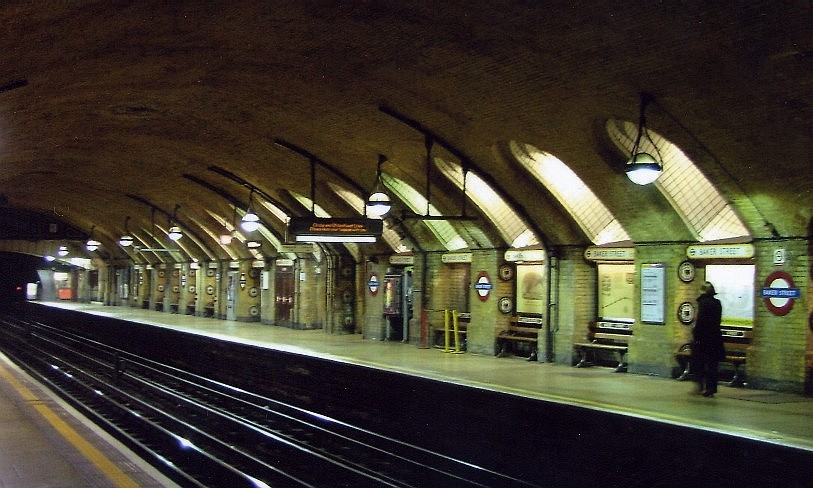
Baker Street tube station
From Wikipedia, the free encyclopedia
| Baker Street | |
 |
|
|---|---|
| Location | |
| Place | Marylebone |
| Local authority | Westminster |
| Operations | |
| Station code | ZBS |
| Managed by | London Underground |
| Platforms in use | 10 |
| Live departures and station information from National Rail | |
| Transport for London | |
| Zone | 1 |
| 2005 annual usage | 20.725 million † |
| 2007 annual usage | 24.01 million † |
| History | |
| 1863 1868 1906 1907 1939 1979 1979 1990 1990 |
Opened (MR) Opened (MR platforms to north) Opened (BS&WR, as terminus) Extended (BSWR - Marylebone) Started (Bakerloo to Stanmore) Ended (Bakerloo to Stanmore) Started (Jubilee Line) Ended (Met to H'smith/Barking) Started (Hammersmith & City) |
| Transport for London List of London stations: Underground | National Rail |
|
| † Data from Transport for London [1] | |

Baker Street tube station is a station on the London Underground located at the junction of Baker Street and the Marylebone Road. The station lies in Travelcard Zone 1 and is served by five different lines. On the Circle and Hammersmith & City lines it is between Great Portland Street and Edgware Road. On the Metropolitan line it is between Great Portland Street and Finchley Road. On the Bakerloo line it is between Regent's Park and Marylebone and on the Jubilee line it is between Bond Street and St. John's Wood.
Contents |
[edit] History
 |
Please help improve this article or section by expanding it. Further information might be found on the talk page or at requests for expansion. (December 2007) |


Baker Street station was opened by the Metropolitan Railway (MR) on 10 January 1863 as one of the original stations on the world's first underground railway - these platforms are now served by the Circle and Hammersmith & City lines. On 13 April 1868 the adjacent open platforms, now serving the Metropolitan line, opened as part of a spur to Swiss Cottage station [1] which was to be steadily extended to Willesden Green and northwards finally reaching Aylesbury Town and Verney Junction (some 50 miles from Baker Street) in 1892. The MR station mainly competed for traffic with Euston, where the LNWR provided local services to Middlesex and Watford and later with Marylebone, where the GCR provided expresses to Aylesbury and beyond on the same line.
Over the next few decades this section of the station saw much rebuilding to provide four platforms. The current Metropolitan line layout largely dates from 1925 and the bulk of the surface buildings, designed by the architect Charles Clark, also date from this period.
The Baker Street & Waterloo Railway (BS&WR, now the Bakerloo line) opened on 10 March 1906, with Baker Street as the initial northern terminus of the line before it was extended to Marylebone station on 27 March 1907. On 20 November 1939 the Bakerloo line took over the Stanmore branch of the Metropolitan line (including stopping services between Finchley Road and Wembley Park) following the construction of an additional southbound platform and connecting tube tunnels between Baker Street and Finchley Road. The Jubilee line added an extra northbound platform and subsequently replaced the Bakerloo line on the Stanmore branch from its opening on 1 May 1979.
On 23 August 1973, a bomb was found in a carrier bag in the ticket hall. The bomb was defused by the bomb squad. A week later, on 30 August a member of staff found another bomb left on the over-bridge. Again, it was defused without any injury.
[edit] Today

Of the MR's original stations, the sub-surface Circle and Hammersmith and City line platforms are the best-preserved. Plaques along the platform show old plans and photographs of the station.
The station layout is rather complex. The sub-surface station is connected to the open-air Metropolitan line station. This is a terminus for some Metropolitan line trains, but there is also a connecting curve that joins to the Circle line just beyond the platforms that allows Metropolitan line trains to run to Aldgate in the City.
Below this is a deep-level tube station for the Bakerloo and Jubilee lines. These are arranged in a cross-platform interchange, and there are connections between the two lines just to the north of the station. With ten platforms overall, Baker Street has the most London Underground platforms of any station on the network.[2]
Outside the Marylebone Road exits, a large statue of Sherlock Holmes commemorates the fictional detective's association with Baker Street. This statue was featured prominently as a landmark in the US television series The Amazing Race in 2005.
A restoration in the 1980's on the oldest portion of the Baker Street station, brought it back to something similar to its 1863 appearance.
Baker Street is operated by the Metropolitan Line sector of the London Underground. Offices of the line are within the vicinity of the station.
Although not suggested as an interchange on Transport for London maps, Baker Street is about 300m from Marylebone Station, where there are National Rail services to Aylesbury, Birmingham, and Wrexham.
[edit] References
- ^ Swiss Cottage station is a closed station, different from the current Jubilee line Swiss Cottage station.
- ^ Moorgate tube station also has ten platforms, but four of these are used by National Rail services.
[edit] See also

- Baker Street tube station is at coordinates Coordinates:
- Oldest Portion of Baker Street Station
- As shown in 1863
- As shown in 2004 (restoration)[2]
- Photograph of the Jubilee Line platform at Baker Street
| Preceding station |  London Underground London Underground |
Following station | ||
|---|---|---|---|---|
|
towards Harrow & Wealdstone
|
Bakerloo line |
towards Elephant & Castle
|
||
|
towards Victoria
|
Circle line |
towards King's Cross St. Pancras
|
||
|
towards Hammersmith
|
Hammersmith & City line |
towards Barking
|
||
| Metropolitan line |
towards Aldgate
|
|||
| Metropolitan line | Terminus | |||
|
towards Stanmore
|
Jubilee line |
towards Stratford
|