ALCO FA
From Wikipedia, the free encyclopedia
 Missouri Pacific Railroad Alco FA-1, engine number 305 plus additional diesel units on a westbound freight train with 99 cars. Photographed by Otto Perry near Prescott, Arkansas, June 18, 1950. |
|
| Power type | Diesel-electric |
|---|---|
| Builder | Partnership of American Locomotive Company (ALCO) and General Electric (GE) |
| Model | FA |
| Build date | January 1946 – May 1959 |
| Total production | 1,354 |
| AAR wheel arr. | B-B |
| Gauge | 4 ft 8½ in (1,435 mm) |
| Length | 53 ft 1 in (16.18 m) |
| Locomotive weight | 243,000 lb (110 t) 255,000 lb (116 t)(FPA-4/FPB-4) |
| Fuel capacity | 1,200 US gal (4,500 l/1,000 imp gal) |
| Prime mover | ALCO 244 MLW 251B (FPA-4/FPB-4) |
| Engine type | Four-stroke diesel |
| Aspiration | Turbocharger |
| Displacement | 8,016 cu in (131.36 l) |
| Cylinders | V12 |
| Cylinder size | 9 × 10½ in (229×267 mm) |
| Transmission | DC generator, DC traction motors |
| Top speed | 65 mph (105 km/h) |
| Power output | 1,500 hp (1,100 kW)—early FA-1/FB-1 1,600 hp (1,200 kW)—later FA-1/FB-1, FA-2/FB-2, FPA-2/FPB-2 1,800 hp (1,300 kW)—FPA-4/FPB-4 |
| Tractive effort | 60,875 lbf (270.79 kN) 63,750 lbf (283.57 kN)(FPA-4/FPB-4) |
| Locomotive brakes | Independent air. Optional: dynamic |
| Train brakes | Air |
| Locale | North America, Brazil |
The ALCO FA was a family of B-B diesel locomotives designed to haul freight trains. The locomotives were built by a partnership of ALCO and GE in Schenectady, New York, between January 1946 and May 1959. They were of a cab unit design, and both cab-equipped lead (A unit) FA and cabless booster (B unit) FB models were built. A dual passenger-freight version, the FPA/FPB, was also offered. It was equipped with a steam generator for heating passenger cars.
Externally, the FA and FB models looked very similar to the ALCO PA models produced in the same period. Both the FA and PA models were styled by GE's Ray Patten. They shared many of the same characteristics both aesthetically and mechanically. It was the locomotive's mechanical qualities (the ALCO 244V12 prime mover) and newer locomotive models from both General Motors Electro-Motive Division (EMD) and General Electric (the partnership with ALCO was dissolved in 1953) that ultimately led to the retirement of the locomotive model from revenue service. Several examples of FAs and FBs have been preserved in railroad museums, a few of them in operational states on such lines as the Grand Canyon Railway and the Napa Valley Wine Train.
Contents |
[edit] Models overview
Three different models were offered. The FA-1/FB-1, which featured a 1,500 horsepower (1,100 kW) rating, was built from January 1946 to October 1950 with a 1,600 hp (1,200 kW) version produced between March and August 1950 (many early models were subsequently upgraded to 1,600 hp). The 1,600 hp FA-2/FB-2 (along with the FPA-2/FPB-2 variants) was built between October 1950 and June 1956. The 1,800 hp (1,300 kW) FPA-4/FPB-4, powered by the 251V12 engine, was built between October 1958 and May 1959 by ALCO's Canadian subsidiary, Montreal Locomotive Works (MLW).
Externally, the FA-1/FB-1 could be distinguished from the FA-2/FB-2 (FPA-1/FPB-2) by the position of the radiator shutters — the FA-1/FB-1's shutters were at the far end of the carbody, whereas on the FA-2/FA-2 they were further forward, the design having been modified to allow the installation of a steam generator behind the radiator. The FPA-4/FPB-4 were visually different due to the additional radiator space that was positioned below the shutters. These Canadian variants were intended and used for high-speed passenger service, and remained in use into the 1990s on VIA Rail Canada.
The FA had the same distinctive styling as its larger cousin, the ALCO PA, with a long, straight nose tipped by a headlight in a square, slitted grille, raked windshields, and trim pieces behind the cab windows that lengthened and sleekened the lines. As with the PA, the overall design owed much to the Fairbanks-Morse Erie-built design, which had been constructed by ALCO's sales partner General Electric (GE) at their Erie, Pennsylvania, plant. GE's industrial designer Ray Patten styled the FA and FB, and many believe it likely that he took drawings of the Erie-built as a starting point, lengthening and squaring the nose and giving it a more aggressive look. The majority of FA components were compatible with the PA.
As with the PA, the model 244 diesel prime mover proved to be the undoing of the FA, and the locomotives failed to capture a marketplace dominated by General Motors Electro-Motive Division (EMD). The later 251-series engine, a vastly improved prime mover, was not available in time for ALCO to recover the loss of reputation caused by the unreliability of the 244, which was a key factor in the dissolution of the partnership with GE. By the time the ALCO 251 engine was accepted into widespread use, General Electric had launched their own entries into the diesel-electric locomotive market, notably the U25B. General Electric eventually supplanted ALCO as a manufacturer of locomotives, leading to ALCO's exit from the locomotive market in 1969.


[edit] Original production
[edit] Units produced by ALCO and the Montreal Locomotive Works (1946–1956)
Almost 800 FA units were built by ALCO and MLW, with just over 15% of them sold to New York Central Railroad, and another 5% each to Union Pacific Railroad, Gulf, Mobile and Ohio Railroad and Missouri Pacific Railroad. About half as many FB units were produced and sold in similar ratios.
| FA-2 units (cabs) | ||
|---|---|---|
| Railroad | Quantity | Road numbers |
| American Locomotive Company (demonstrator units) | 4 | 1602A, 1602D, 1603A, 1603D |
| Ann Arbor Railroad | 14 | 50, 50A–56, 56A |
| Baltimore and Ohio Railroad | 38 | 801, 801A–837, 837A (odd numbers only) |
| Canadian National Railway | 25 | 9408–9456 (even numbers only) |
| Canadian Pacific Railway | 20 | 4042–4051, 4084–4093 |
| Consolidated Railway of Cuba | 12 | 1600–1605, 1650–1655 |
| Erie Railroad | 8 | 736A, D–739A, D |
| Ferrocarriles Nacionales de México | 18 | 6507A–6522A, 6519A (2nd), 6534A |
| Great Northern Railway | 2 | 277A, 277B |
| Louisville and Nashville Railroad | 39 | 300–321, 353–369 |
| Lehigh Valley Railroad | 8 | 580–594 (even numbers only) |
| Missouri-Kansas-Texas Railroad | 1 | 331A (2nd) |
| Missouri Pacific Railroad | 43 | 331–386 |
| New York Central Railroad | 80 | 1044–1123 |
| Pennsylvania Railroad | 24 | 9608A–9631A |
| Secretaria de Comunicaciones de Obras Publicas (SCOP) (Mexico) | 6 | 7121-8–7121-13 |
| Spokane, Portland and Seattle Railway | 2 | 868A-1, -2 |
| Western Maryland Railway | 4 | 301-304 |
| FB-1 units (cabless boosters) | ||
|---|---|---|
| Railroad | Quantity | Road numbers |
| Canadian Pacific Railway | 24 | 4400–4423 |
| Chicago, Rock Island and Pacific Railroad | 8 | 145B–152B |
| Erie Railroad | 22 | 725B, C–735B, C |
| Great Northern Railway | 5 | 310B, 440B, C, 442B, C |
| Gulf, Mobile and Ohio Railroad | 33 | B1–B33 |
| Lehigh and New England Railroad | 3 | 751–753 |
| Lehigh Valley Railroad | 10 | 531–549 (odd numbers only) |
| Missouri Pacific Railroad | 15 | 301B–310B, 321B–325B |
| New York Central Railroad | 23 | 2300–2322 |
| New York, New Haven and Hartford Railroad | 15 | 0450–0464 |
| Pennsylvania Railroad | 8 | 9600B–9607B |
| Reading Railroad | 6 | 300B–305B |
| St. Louis - San Francisco Railway | 16 | 5300–5315 |
| Seaboard Air Line Railroad | 3 | 4300–4302 |
| Spokane, Portland and Seattle Railway | 8 | 856B-1, -2–860B-1, -2(even numbers only), 866B-1, -2 |
| Tennessee Central Railway | 1 | 801B |
| Union Pacific Railroad | 34 | 1524B–1541B, 1618B, C–1642B, C (even numbers only) |
| Wabash Railroad | 6 | 1200B–1204B |
| FB-2 units (cabless boosters) | ||
|---|---|---|
| Railroad | Quantity | Road numbers |
| American Locomotive Company (demonstrator units) | 4 | 1602B, 1602C, 1603B, 1603C |
| Baltimore and Ohio Railroad | 21 | 811x–817x (odd numbers only), 817ax, 819x–837x (odd numbers only), 837ax |
| Canadian National Railway | 15 | 9409–9437 (odd numbers only) |
| Canadian Pacific Railway | 6 | 4465–4470 |
| Erie Railroad | 8 | 736B, C–739B, C |
| Ferrocarriles Nacionales de México | 23 | 6507B–6527B, 6519B (2nd), 6534B |
| Gulf, Mobile and Ohio Railroad | 4 | 834–837 |
| Louisville and Nashville Railroad | 14 | 202–211, 330, 331 |
| Lehigh Valley Railroad | 4 | 581–587 (odd numbers only) |
| Missouri Pacific Railroad | 34 | 331B–335B, 345B–356B, 370B–386B |
| New York, New Haven and Hartford Railroad | 4 | 465–469 |
| New York Central Railroad | 50 | 3323–3372 |
| Pennsylvania Railroad | 12 | 9608B–9630B |
| Spokane, Portland and Seattle Railway | 2 | 868B-1, -2 |
[edit] Units produced by ALCO and the Montreal Locomotive Works (1950–1959)
ALCO and MLW built 130 of the various FP models with the largest quantity, 45% of the total production, sold to Canadian National Railway.
| FPA-2 units (cabs) | ||
|---|---|---|
| Railroad | Quantity | Road numbers |
| Canadian National Railway | 6 | 6706–6711 |
| Canadian Pacific Railway | 7 | 4082, 4083, 4094–4098 |
| Ferrocarriles Nacionales de México | 18 | 6500, 6501, 6502A–6506A, 6523A–6533A |
| Ferrocarril del Pacifico | 4 | 901–904 |
| Louisville and Nashville Railroad | 5 | 350–352, 383–384 |
| Missouri Pacific Railroad | 19 | 361-373; 387-392 |
| FPB-2 units (cabless boosters) | ||
|---|---|---|
| Railroad | Quantity | Road numbers |
| Canadian National Railway | 6 | 6806–6811 |
| Canadian Pacific Railway | 2 | 4463, 4464 |
| Ferrocarriles Nacionales de México | 11 | 6502B–6506B, 6528B–6533B |
| Missouri Pacific Railroad | 6 | 387B–392B |
| FPA-4 / FPB-4 units (cab units & cabless boosters) | ||
|---|---|---|
| Railroad | Quantity | Road numbers |
| Canadian National Railway (FPA-4) | 34 | 6760–6793 |
| Canadian National Railway (FPB-4) | 12 | 6860–6871 |
[edit] Surviving examples

Some 20 units of various designations exist today in a preserved state, all of which are owned by railway museums or historical societies. Several excursion railways own operating examples which are in regular service, including MLW units received from VIA Rail Canada in use on the Grand Canyon Railway and Napa Valley Wine Train.
[edit] ALCO "World Locomotive"
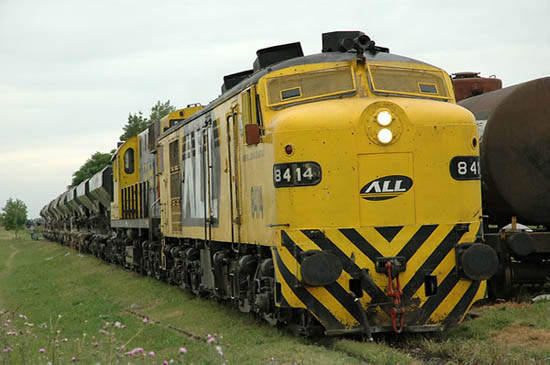
ALCO's "World Locomotive" the DL500 (introduced in 1953) originated as a newly designed demonstrator based on the FA-2. The first 25 DL500s used the model 244 engine rated at 1,600 horsepower. Later DL500s were like the FPA-4 and utilize the ALCO model 251B diesel engine as the prime mover and are rated at 1,800 horsepower. All DL500s were built with C-C trucks but B-B or paired A-1-A trucks were offered as an option. The only locale within the Americas where ALCO-built cab units, such as All America Latina Logistica (ALL) #8414, still see daily usage in freight duty is Argentina. A total of 369 DL500 locomotives were built by ALCO, A. E. Goodwin, and MLW between May 1953 and December 1967.
Variants of the ALCO "World Locomotive" saw service in Australia where it was built under licence by A.E. Goodwin Ltd. A two cab design went into service on the standard gauge New South Wales Government Railways as the 44 class,[1] and both a single cab and double cab design went into service on the 5 ft 3 in (1,600 mm) broad gauge South Australian Railways as the 930 class.[2]
Similar DL500 locomotives were also used in Greece, India, Pakistan, Peru, and Spain.
[edit] References
- ALCO 244 and 251 Diesel Engines. Pacific Southwest Railway Museum. Retrieved on March 9, 2006.
- Pinkepank, Jerry A. (1973). The Second Diesel Spotter's Guide. Kalmbach Publishing Co., Milwaukee, WI. ISBN 978-0-89024-026-7.
- The Alco FA: A Working Gal. Exotic Diesel Locomotives. Retrieved on March 7, 2006.
- Steinbrenner, Richard (2003) The American Locomotive Company A Centennial Remembrance. Chapter IX The Diesel Takes Over, Chapter X The Diesel Boom, Chapter XI Past the Peak and Diversification.
[edit] Specific
- ^ NSWRTM - 4490. nswrtm.org. Retrieved on 2007-07-22.
- ^ National Railway Museum - Port Adelaide - 930 class. nationalrailmuseum.org.au. Retrieved on 2007-07-22.
[edit] External links
- Alco FA-1/FB-1 Roster
- Alco FA-2/FB-2 Roster
- MLW FPA & FPB Roster
- Preserved Alco Cab Units
- New York Central ALCO FA-2 #1102 — documents the restoration efforts of the Western New York Railway Historical Society.
- Project 302 — documents the restoration efforts of the Western Maryland Railway Historical Society regarding Western Maryland Railway #302, an ALCO Model FA-2.
|
||||||||||||||||||||
|
||||||||||||||||||||