William Randolph
From Wikipedia, the free encyclopedia
William Randolph (November 7, 1650 - April 11, 1711) was a colonist and land owner who played an important role in the history and government of the Commonwealth of Virginia. William Randolph was born in Morton Morell, Warwickshire, England, to Richard Randolph (1620-1671) and Elizabeth Ryland (1625-1699). William was educated at home, concentrating his studies on Greek, Latin, and law. He moved to Virginia sometime between 1669 and 1673, and married Mary Isham (1652- December 29, 1735) a few years later.[1] Though his uncle, Henry Randolph, emigrated to North America in 1642, William Randolph is known as the founder of the family dynasty in Virginia.[2]
Contents |
[edit] Randolph’s Work
William Randolph owned a considerable number of slaves that he imported to work in his tobacco fields, eventually becoming one of the largest planters in Virginia. As a “privileged gentleman,” Randolph also held multiple official appointments.[3] He became clerk of Henrico County Court in 1673 and held the position until he was asked to serve as a justice of the peace in 1683. He also served as sheriff and coroner.[4]
In addition, Randolph represented Henrico County in every assembly of the House of Burgesses from 1684 to 1698, was the Speaker of the House of Burgesses in 1698, and was the Clerk of the House from 1699 to 1702.[5] He fell ill in August of 1702 and his son, William, took his place. Randolph resigned the clerkship completely in March of 1703.[6]
A proponent of education, Randolph was also one of the founders and first trustees of the College of William and Mary.[7]
[edit] Land Holdings
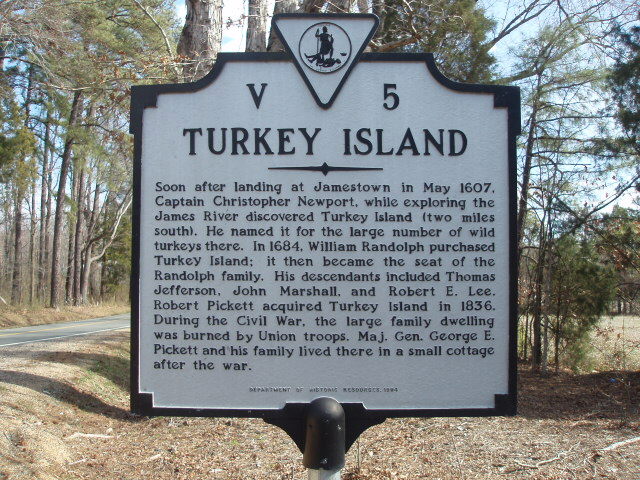
Upon arriving in Virginia, Randolph began working as a building contractor, but soon turned to tobacco farming.[8] By 1674 he had amassed enough wealth to buy 591 acres (2.39 km²) of land on Swift Creek, south of the James River in Henrico County.[9] He also bought Turkey Island, named for the wild turkeys found living on the island, after Bacon’s rebellion in 1684. In 1698 he obtained Curles, the forfeited estate of rebellion leader Nathaniel Bacon, which added an additional 1,230 acres (5.0 km²) to his land holdings.[10] Then, after the capital of Virginia moved from Jamestown to Williamsburg in 1699, Randolph was able to use his political power and influence to acquire almost 10,000 acres (40 km²) of land in the vicinity of Richmond; a 3,256-acre (13.18 km²) tract at Tuckahoe Creek and a 5,142-acre (20.81 km²) plot at Westham.[11]
[edit] Children
William Randolph’s children included:
- Elizabeth Randolph (Bland) (1680 - 1719)
- William Randolph Jr. (1681 - 1742) of Turkey Island
- Thomas Randolph (1683 - 1729) of Tuckahoe, Goochland County (different from the nearby town of Tuckahoe, Virginia)
- Isham Randolph (1685 - 1742) of Dungeness, Goochland County
- Henry Randolph (1687 - ?) of Chatsworth
- Richard Randolph (1691 - 1748) of Curles Neck Plantation
- Mary Randolph (Stith) (1692 - ?)
- Sir John Randolph (1693 - 1737) of Tazewell Hall, father of Peyton Randolph
- Edward Randolph (1695-?) of Bremo (resided in England)
The total number of children is not certain because of deaths in infancy and the tendency to name children after their deceased siblings. However, it is known that at least nine children survived into adulthood.[12] The sons of William Randolph were each distinguished by the estates left to them.[13]
[edit] Randolph’s Legacy
With William Randolph as its patriarch, the Randolph family became extremely well-respected in Virginia, and its members eventually married into the equally prominent Lee, Washington, and Harrison families. Notable descendants include President Thomas Jefferson, United States Supreme Court Chief Justice John Marshall, First Continental Congress president Peyton Randolph, Confederate Secretary of War George W. Randolph, and Confederate General Robert E. Lee. Randolph was also a close friend of William Byrd and served as an advisor to Byrd’s sons during their political careers.[14] He was also the half-nephew of English poet Thomas Randolph.[15] The sons of William Randolph were each left substantial estates, including son John Randolph, who was knighted and became Speaker of the House of Burgesses like his father. William Randolph is buried on Turkey Island.[16]
[edit] Observations
It is highly likely that the cultural term tuckahoe derives from the Randolph family of Tuckahoe Plantation, Goochland County, Virginia.
In 1972, North Carolina author Jonathan Worth Daniels (grandson of North Carolina governor Jonathan Worth), released a book through Doubleday on William Randolph's descendants, The Randolphs of Virginia.
[edit] References
- ^ Sankey, Margaret D. “Randolph, William (1650-1711), colonist in America.”
- ^ Eckenrode, H.J. 1946., Pg.31
- ^ Malone, Dumas (Ed.). 1963., Pg.372
- ^ Kukla, Jon. 1981., Pg.100
- ^ Kukla, Jon. 1981., Pg.100
- ^ Kukla, Jon. 1981., Pg.102
- ^ Kukla, Jon. 1981., Pg.100
- ^ Eckenrode, H.J. 1946., Pg. 31-32
- ^ Kukla, Jon. 1981., Pg.98
- ^ Eckenrode, H.J. 1946., Pg.38-39
- ^ Kukla, Jon. 1981., Pg.98
- ^ Sankey, Margaret D. “Randolph, William (1650-1711), colonist in America.”
- ^ Fiske, John, and James Grant Wilson, eds. 1900., Pg.174
- ^ Sankey, Margaret D. “Randolph, William (1650-1711), colonist in America.”
- ^ Malone, Dumas (Ed.). 1963., Pg.371
- ^ Sankey, Margaret D. “Randolph, William (1650-1711), colonist in America.”
[edit] Bibliography
- Sankey, Margaret D. “Randolph, William (1650-1711), colonist in America.” Oxford Dictionary of National Biography August 2004. http://www.oxforddnb.com/.
- Eckenrode, H.J. 1946. The Randolphs: The story of a Virginia family. New York: The Bobbs Merrill Company.
- Kukla, Jon. 1981. Speakers and clerks of the Virginia House of Burgesses 1643-1776. Richmond, VA: Virginia State Library.
- Malone, Dumas (Ed.). 1963. Dictionary of American biography, volume VIII: Platt-Seward, 371-372. New York: Charles Scribner’s Sons.
- Fiske, John, and James Grant Wilson, eds. 1900. Appleton’s Cyclopaedia of American Biography, Volume V: Pickering – Sumter, 174-179. New York: D. Appleton and Company. http://www.archive.org/details/appletonscyclopa05wils.