Tropical Storm Dean (1995)
From Wikipedia, the free encyclopedia
| Tropical storm (SSHS) | ||
|---|---|---|
.gif/235px-Tropical_Storm_Dean_(1995).gif) Tropical Storm Dean at landfall and peak intensity |
||
| Formed | July 28, 1995 | |
| Dissipated | August 2, 1995 | |
| Highest winds |
|
|
| Lowest pressure | 999 mbar (hPa; 29.51 inHg) | |
| Fatalities | None reported | |
| Damage | $500,000 (1995 USD) $707,000 (2008 USD) |
|
| Areas affected |
East Texas | |
| Part of the 1995 Atlantic hurricane season |
||
Tropical Storm Dean was a short-lived storm in the Gulf of Mexico early in the 1995 Atlantic hurricane season. It was the fourth tropical storm of the 1995 season.
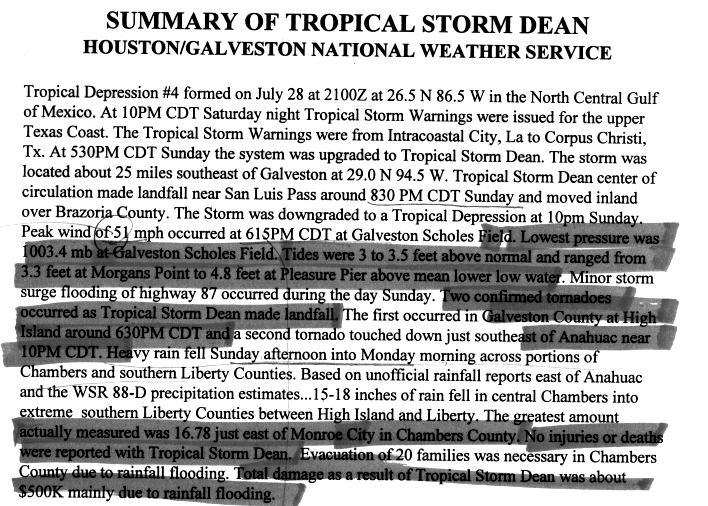
Dean formed in the central Gulf of Mexico on July 28. It spent most of its life as a tropical depression, and was only briefly a tropical storm as it made landfall on the East Texas coast on July 30 before dissipating on August 2 in north-central Texas. The damage as a result of Dean was minimal, with localized coastal and inland flooding reported despite heavy rain.[1]
Contents |
[edit] Storm history


The precursor to the storm was a stationary front in the northeastern Gulf of Mexico in the last week of July. On July 27, it developed a weak upper-level circulation as indicated by reports by buoys in the Gulf with its outflow becoming better organized. The system continued to organize early on July 28, and that afternoon, it developed a surface circulation and was declared Tropical Depression Four with the center located about 345 miles (555 km) southeast of New Orleans.[2]
At first, the depression slowly tracked westward as it was blocked by a ridge of high pressure to the north.[3] The system was under frequent reconnaissance surveillance, and over the next day, it confirmed that the depression was very poorly organized.[2] It remained a tropical depression into July 29.[4] The poor organization hindered development, despite favorable conditions with low wind shear and warm sea surface temperatures.[5] The system began to turn more to the west-northwest that afternoon and evening with an increase in forward speed, while remaining a poorly organized tropical depression south of Louisiana.[6]
On July 30, the depression began to organize better, and the first reports of tropical storm-force squalls were reported that morning as it moved closer to the Texas coast.[7] Late that afternoon, it strengthened into Tropical Storm Dean while located just 70 miles (110 km) off the coast.[2] The Hurricane Hunters confirmed that Dean strengthened in the final hours before landfall to a 45 mph (75 km/h) storm, and made landfall as such near Freeport, Texas that evening at 8:30 pm CDT (0130 UTC July 31).[8][9]
Shortly after landfall, Dean weakened back to a tropical depression as it tracked northwest. The depression stalled in northwestern Texas on July 31 and remained there until August 2, dumping heavy rain over parts of the state as it linked up with the dryline.[10] Late on August 2, it merged with a non-tropical front and dissipated.[2]
[edit] Impact
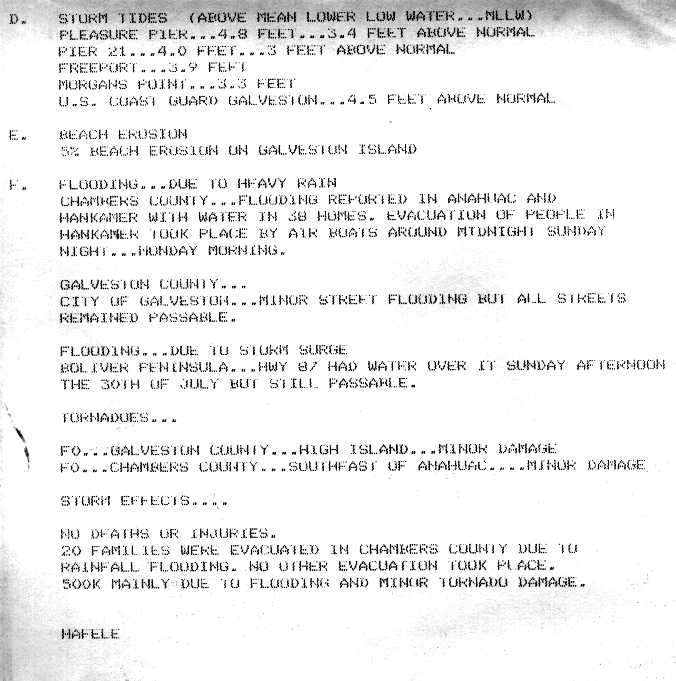
Most of the impact was as a result of Dean's heavy rainfall. Heavy rainfall of 6 to 18 inches (150 to 450 mm) was reported across a large swath of Texas.[10] The heaviest measured amount was 16.78 inches (426 mm) near Monroe City.[9] In total, 38 houses were flooded in southeast Texas.[11] The freshwater flooding resulted in the evacuation of 20 families in Chambers County.[2] The storm surge impacts were fairly minor, ranging from 3 to 5 feet (1.2 to 1.8 m) above mean sea level. A portion of State Highway 87 was flooded from the storm surge, although no significant property damage was reported as a result of it.[9] Minor beach erosion and street flooding was also reported on Galveston Island.[11]
The highest wind gust on land was 51 mph (82 km/h) at Scholes Field. There were two tornadoes confirmed as a result of Dean. One touched down on High Island in Galveston County, and the other touched down near Anahuac.[9] Both tornadoes were rated as F0 on the Fujita scale, with minor damage.[11]
Total damages were estimated around $500,000 (1995 USD). There were no reports of any fatalities as a result of Dean.
Due to the lack of any significant damage as a result of Dean, the name was not retired and was re-used in 2001 and 2007, where it was retired and replaced with Dorian.
[edit] See also
[edit] References
- ^ Halfhill, Tom (2006). Tom's Inflation Calculator. halfhill.com. Retrieved on 2006-12-09.
- ^ a b c d e National Hurricane Center (1995). Preliminary Report: Tropical Storm Dean. NOAA. Retrieved on 2006-12-09.
- ^ National Hurricane Center (1995). TD4 Discussion #1. NOAA. Retrieved on 2006-12-09.
- ^ National Hurricane Center (1995). TD4 Discussion #3. NOAA. Retrieved on 2006-12-09.
- ^ National Hurricane Center (1995). TD4 Discussion #4. NOAA. Retrieved on 2006-12-09.
- ^ National Hurricane Center (1995). TD4 Discussion #6. NOAA. Retrieved on 2006-12-09.
- ^ National Hurricane Center (1995). TD4 Discussion #7. NOAA. Retrieved on 2006-12-09.
- ^ National Hurricane Center (1995). Dean Discussion #10. NOAA. Retrieved on 2006-12-09.
- ^ a b c d NWS Houston/Galveston (1995). Summary of Tropical Storm Dean. NOAA. Retrieved on 2006-12-09.
- ^ a b Hydrometeorological Prediction Center (1995). Tropical Storm Dean. NOAA. Retrieved on 2006-12-09.
- ^ a b c NWS Houston/Galveston (1995). Summary of Tropical Storm Dean. NOAA. Retrieved on 2006-12-09.