Talk:Tritium
From Wikipedia, the free encyclopedia


I'm sure I heard that fusion bombs have a lithium/tritium core, with the interesting consequence, from the decay of tritium, that the bombs deteriorate on storage, and require remanufacture after a few years... Can anyone confirm?? Malcolm Farmer
Yes, that's true. Well, the bit about the tritium decaying and the bomb yields dropping is true, the lithium/tritium is oversimplified.
It depends on the exact design of the bomb. There's been a lot of work on making it easy to replace the tritium without completely disassembling the weapon.
Does that help? Andrewa 16:51 Mar 6, 2003 (UTC)
The line " Since tritium has the same charge as ordinary hydrogen, it experiences the same electrical repulsive force. However, due to its higher mass, it is less responsive to such forces, and thus can more easily fuse with other atoms." Seems....iffy. If it IS correct it is so oversimplified that it appears wrong. a more rigorous explanation is needed.--Deglr6328 07:43, 23 Mar 2005 (UTC)
[edit] Most common for is tritriated water
At least the EPA thinks so [1]. But this article more or less ignores that and talks about tritium as if it exists alone as a gas most of the time. That link also states that "Tritium replaces one of the stable hydrogens in the water molecule". That seems much more likely unless the tritriated water is created in the presence of pure tritrium. I couldn't find any solid sources to agree or disagree. Any thoughts? - Taxman 03:02, Apr 20, 2005 (UTC)
[edit] Mystery reactions
- [tritium is produced] by D(n,gamma)T) and 10B(n,t)8Be
I have no idea what this is supposed to mean; presumably it's some abbreviated description of nuclear reactions, but it's pretty impenetrable. If someone can clarify this, it can go back in. --Andrew 04:07, Apr 20, 2005 (UTC)
- This is shorthand for nuclear bombardments
- D(n,gamma)T means that Deuterium is bombarded with a neutron and releases gamma rays to become Tritium. 10B(n,t)8Be means that Boron-10 is bombarded with a neutron and releases a Tritium atom to become Beryllium-8. Both of these reactions produce Tritium. — oo64eva (AJ) (U | T | C) @ 04:18, Apr 20, 2005 (UTC)
[edit] Tritium keychains and US legality?
What's the deal with tritium keychains and their legality in the US? I once met a guy who had one, and he said something about having to go through a fairly complex rigamorale to acquire one. --NeuronExMachina 09:13, 16 May 2005 (UTC)
- The reason these devices cannot be imported into the U.S. is that they - unlike watches with tritium dials - are considered "frivolous" uses of technology involving nuclear radiation. As a result, he probably imported it himself, and any rigamarole he went through was probably because it set off somone's radiation detector (common at airports).dunerat 09:20, 9 Jun 2005 (UTC)
[edit] cold fusion in spiderman 2?!
"Tritium headed to Hollywood in the 2004 movie Spider-Man 2 where the character Doctor Octopus (Alfred Molina) uses the precious tritium to create cold fusion."
I didn't wan't to edit this without being sure. But I think Dr. Octopus used inertial confinement fusion and not cold fusion in spiderman 2.
In the movie, he places the deuterium-tritium ball in the middle of a spherical construction and ignites the fusion using lasers. You then see some sort of "small sun".
- Does every article need a discussion of pop culture? How about put that info and link to tritium in the Spider-Man 2 article? - Taxman Talk 13:20, Jun 3, 2005 (UTC)
I agree that spiderman 2 doesn't need to be in this article. But I found that reference to cold fusion in spiderman in there and I think that it is wrong. All I want to do is correct it. But I wanted to be sure that it is not cold fusion. Otherwise, a simple solution is to remove the reference to spiderman.
It's not cold fusion, it's not anything. It's a comic book movie, and so is completely inaccurate. They make passing references to magnetic confinement fusion and inertial confinement fusion, but that's as close as they come to science. — BRIAN0918 • 2005-08-7 20:42
It's ridiculus to have comic book/pop culture references for atomic elements. Maybe a seperate science/technology pop culture reference would be more appropriate? Media reference removed. --67.169.7.139 02:58, 9 March 2006 (UTC)
[edit] Need Info On Tritium Supply and Mfg Rate; Possible Inconsistency in Weapon Tritium Use
In any article about a substance or element, there are common quantity-related questions: how much exists, what's the annual consumption rate, and what's the annual manufacturing rate.
I'd like to see the estimated world (or US) tritium supply, the annual consumption rate, the manufacturing rate and total manufacturing capacity. I recollect this has been openly discussed, so it's not secret or unknown. At least reasonable estimates exist.
There's a possible inconsistency in this article with the article on Nuclear Weapon Design:
This article states: Tritium is used in nuclear weapons to obtain higher yields through nuclear fusion. However, as it decays and is difficult to contain, many nuclear weapons contain lithium instead
However [Nuclear Weapon Design - Boosting] states: Having the tritium reservoir outside of the bomb allows easy replenishment and removal of waste Helium-4 without having to take the bomb core apart. (Theoretically, there are ways a solid hydride or a D/T liquid could be used instead, but the use of gas is almost universal.) Joema 16:44, 9 December 2005 (UTC)
It sounds like large thermonuclear weapons (Teller-Ulam design) would use a large amount of lithium deuteride in the secondary, but that boosting in the center of a fission implosion sphere is done with a small amount of gas, which also allows varying the yield by varying the amount of gas injection. --JWB 17:31, 13 June 2007 (UTC)
- I added a reference to the IEER report on tritium production for the DOE. Their claim was 225 kg since 1955, of which 75 kg is still good. The current commercial demand is 400 g/year and the US military demand is 2.2 kg/year at 4 g/warhead/year. Autopilot 02:20, 5 August 2007 (UTC)
[edit] Question about natural abundance of Tritium
The article contains the sentence: Before the onset of atmospheric nuclear weapons tests, the global equilibrium tritium inventory was estimated at about 80 megacuries (MCi).
What is the atmospheric (or atmospheric+oceanic) content now/today?
Lunch 23:43, 18 March 2006 (UTC)
[edit] BOX
EXPLAIN, CORRECT, AND/OR DELETE
| Hydrogen-2 | [[Isotopes of Hydrogen|Isotopes]] of [[Hydrogen]] | Hydrogen-4 |
| Produced from: Hydrogen-4 |
Decay chain | Decays to: Helium-3 |
Jclerman 17:01, 19 February 2006 (UTC)
[edit] Tritium
I heard that we (I mean humanity) have only 4 kg of tritium!
- Where did you hear that? given that according to the helium-3 article 150KG of helium-3 has been obtained from decay of tritium within american nukes and the americans are still maintaining thier nukes it seems like there would be a bit more than that arround. Plugwash 01:49, 22 February 2007 (UTC)
-
- From [3], Ontario Power, which operates heavy water reactors in Canada, produces 2.5Kg of tritium a year as a byproduct. They sell it but not for bomb purposes. So any bomb use is over and above this. Paul Studier 23:05, 19 March 2007 (UTC)
[edit] Antitritium
I've always been speculating the possibility of antitritium production, possibly by a major antimatter contributer such as CERN. I've also speculated the slight possibility of antideuterium-antitritium 'fusion', so to speak.
[edit] Pronunciation
For someone who has never heard the word pronounced, but only read it, there are three plausible pronunciations: TRIT-ee-um, TRITE-ee-um, and TRISH-um. I'm pretty sure the first one is correct, but would like to see it added to the article. --Trovatore 21:54, 2 April 2007 (UTC)
- I've always heard TRIT-ee-um around here. --192.75.48.150 ( = ity1.ontariopowergeneration.com) 14:31, 13 June 2007 (UTC)
[edit] Curies?
Would it be possible for someone with a much greater grasp of physics than I to change the outdated (and very non-SI) Curies to bequerels or seiverts? Working in the nuclear industry I rarely see Curies used outside of old journals and textbooks and I was under the impression that they had been replaced internationally. 62.25.108.10 21:47, 8 May 2007 (UTC)
- Curious that you work in the nuclear industry and suggest using Seiverts[sic] for the total quantity of tritium, since the Sievert is a unity for the dosage received by biological tissues. The Becqurel is too small and I find it useful when measuring activities of the order of disintegrations per second. The Curie, instead, as roughly equivalente to the activity of a gram of radium appears more suitable. Jclerman 08:39, 9 May 2007 (UTC)
[edit] Production from N-14
This article gives this formula:

The Carbon-14 article gives
- 1n + 14N → 14C + 1H
What are the relative rates of those two reactions? Nik42 00:50, 30 May 2007 (UTC)
- Take a look at [4]. The tritium-producing reaction only appears to happen with >4MeV neutrons. The C-14 reaction is listed at 1.819 barns for thermal neutrons and graphs are given for fast neutrons. --JWB 02:35, 3 June 2007 (UTC)
[edit] Tritium in Ground Water
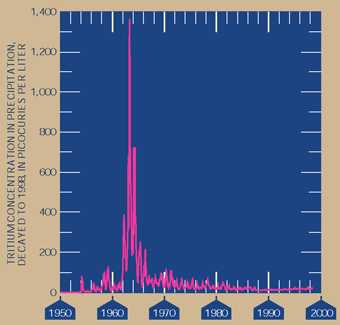
The USGS uses this picture http://pubs.usgs.gov/circ/circ1213/images/cab_fig18a.gif representing world atmospheric tritium levels. There is a sharp spike in the early 60s. Can these spikes be linked to specific tests? Also the USGS uses a figure of 800 Kg of tritium was produced by nuclear tests making it posible to find the recharge rate of ground water. (If it is below 2.5 picocuries then it was recharged before 1953 when hydrogen weapons testing started).
http://toxics.usgs.gov/definitions/tritium.html
- Must have been the Tsar Bomba. Timing was right for the start of that spike, the yield was the largest ever, and consisted almost entirely of fusion; the case and tampers were made of lead which does not absorb neutrons, instead of uranium. Any neutrons absorbed by lithium-6 after the explosion had already receded from peak compression and temperature would result in tritium that would no longer be destroyed by fusion. --JWB (talk) 04:09, 16 December 2007 (UTC)
[edit] Tritium as a Toxic Waste
Tritium is found as a toxic waste around nuclear processing facilities.
http://www.nrc.gov/reactors/operating/ops-experience/grndwtr-contam-tritium.html
Official US Sites are:
- Indian Point
- Braidwood
- Callaway
- Dresden
- Byron
- Palo Vrede
- Quad Cities
http://www.nrc.gov/reactors/operating/ops-experience/tritium/sites-grndwtr-contam.html
—Preceding unsigned comment added by 71.139.198.162 (talk) 02:05, 16 December 2007 (UTC)
[edit] Tritium Fizzle
Has anyone here read Sum of All Fears by Tom clancy? In it, a group makes a multi-stage nuclear weapon and uses tritium for maximum detonation. Unfortunately, most of it had decayed, so the bomb's explosion was less than normal. They called this effect a "Fizzle". is this a true phemenon? any help I can get will be good. StealthNinja360 (talk) 16:15, 29 January 2008 (UTC)