User:Tinned Elk/Sandbox Bells
From Wikipedia, the free encyclopedia
Eva Zeisel http://www.purecontemporary.com/FeatureArticle/article/17
about town and country pattern http://www.mindspring.com/~dway/town.html
Wikipedia:WikiProject User Page Help/Do-It-Yourself/Formatting Text
| Year | No. of Stores |
|---|---|
| 1876 | 67 |
| 1915 | 1600 |
| 1925 | 13,961 |
| 1930 | 16,000 |
| 1955 | 10,000 |
| 1965 | 5,000 |
| 1970 | 4,000 |
| 1978 | 3,500 |
| 1980 | 2,000 |
| 1990 | 1,000 |
| 2000 | 600 |
| 2002 | 500 |
- 000000
 |
This user is a member of WikiProject Amusement Parks. |
|
|||
| Project Navigation Links | |||
|---|---|---|---|
| Main project page | talk | ||
| Portal | |||
| Watchlist | talk | ||
| Participants | |||
| Departments | |||
| → Assessment | talk | ||
| → Collaboration | talk | ||
| → Jumpaclass | talk | ||
| → Translation | talk | ||
| → Peer review | talk | ||
| Useful links | |||
| Infoboxes and templates | |||
| Tasks | talk | ||
| Project category | talk | ||
| Relevant categories | |||
| Userboxes | talk | ||
| edit · changes | |||

Bell's Amusement Park is a traditional amusement park in Tulsa, Oklahoma. Bell's is a privately owned park, that was formerly located on Expo Square, a 250 acre multiuse complex operated by the Tulsa County Public Facilities Authority and home to the annual Tulsa State Fair. Expo Square is the home of Zingo, a classic wooden roller coaster and currently Oklahoma's largest roller coaster. The company's lease with the Tulsa County Public Facilities Authority expired on November 8, 2006, On November 9, 2006, the Tulsa County Fair Board offered no new contract for the park and Bell's Amusement Park was given notice to vacate the property in 120 days.
Contents |
[edit] History
Robert K. Bell laid the foundation for what was to become Bell's just after World War II. He began by making flat kiddy rides in his front yard to entertain neighborhood children. These included car rides, carousels, a Shetland pony ride, airplane rides (made of WW II fighter belly tanks) and 12" gauge train ride. A lot of these ended up in drive-in movie theater playgrounds, but it was the start of his involvement with the amusement park industry. Though relatively crude by modern design standards, Bell's rides were innovative, well built, and very popular.
In March of 1951, Bell decided to start his own amusement park as a kiddieland. Throughout the 1960’s and 70’s the park grew into a more family oriented park. During the 1970’s the park began opening only in the late afternoons due to the stifling heat combined with competition from the local lakes and the new water parks which attracted the day business. In 1976 Bell's son Bob became president of Bell’s Amusement Park. With the dawning of 1981, the park started feeling the effects of the loss of income from employees of the oil and agriculture industries, the same problems affecting parks in Texas and Georgia. Bell’s, however, had the wear-with-all to stick it out until better times came back, and is still going strong today.
[edit] Attractions
[edit] Chili Pepper Plunge
The Chili Pepper Plunge is a set of two water slides entertwined. Riders ride down the enclosed water tube on dinghies. They are splashed with water as they ride down, and get a big splash of water at the end.
[edit] Himalaya
The Himalaya is a circular flat ride with undulating hills that runs in two directions with music and special lighting effects.
[edit] Log Ride
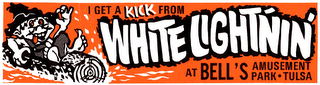
The White Lightnin' Log Ride is an open-air log flume ride. Carts resembling logs float lazily down a water track, through some logging-themed builidings which have, since their construction, become littered with graffiti and chewing gum. A classic bumper sticker advertising the White Lightnin' ride at Bell's.
[edit] Mad Mouse, 1959 to 1974
The Mad Mouse was a steel roller coaster designed by the Allan Herschell Company. It was relocated to Joyland Amusement Park in Lubbock, Texas where it is still operational.
[edit] Mind Melt, 2004 to current
The Mind Melt takes you 124 ft (as high as a 12 story building) in the air before releasing a freefall.
[edit] Phantasmagoria, 1973 to current
The Phantasmagoria is a deteriorating haunted house ride. The two-person track cars that carry the riders were made by Bell's, but the ride itself, including psychedelic tunnels and a mannequin freak show, was designed by Bill Tracy.
While many of today's haunted house rides are cute and fuzzy, the Tracy ride could please even hardcore horror film fans with its lack of restraint concerning gore. It was certainly not G-rated. In one portion of the ride there was once a naked woman to tantalize the male riders. However, when the bare bottomed vixen spun around, she revealed that the front half of her body had been skinned down to muscle and bone.
The ride is dark, but not without very humorous novelties. A waterfall pouring over the track threatened to drench the riders, but would shut off as the car passed underneath. In one pitch black room, the riders are teased by nothingness, but startled when a bus's horn blares and headlights reveal the front end of an actual bus, driven by a rotting corpse. A classic sticker advertising the Phantasmagoria.
[edit] Pharaoh's Fury 1997 to current
Pharaoh's Fury is an Egyptian-themed Swinging Ship.
[edit] Wildcat, 1974 to 1997
The Wildcat was dismantled and removed following a fatality accident during operation.
[edit] Zingo, 1968 to current
The Zingo is a classic wooden roller coaster, designed by John C. Allen and bulit by Philadelphia Toboggan Coasters, Inc. in 1968. The Zingo is Tulsa's only real roller coaster, and as the largest wooden roller coaster in Oklahoma, is undoubtedly Expo Square's biggest attraction. A classic bumper sticker advertizing the Zingo.
The Zingo is approximately 2,500 feet long, and includes stifflingly sharp banked curves, gravity-defying bumps and dips, and a scary near-collision with an image of Zingo the clown. As the train rounds its highest turn, riders view a panorama of South Tulsa.
The entrance to Bell's Amusement Park at Expo Square was located near the southwest corner of the park, underneath a hump of the Zingo roller coaster. In the past, trains of the roller coaster screamed overhead as you purchased a park ticket.
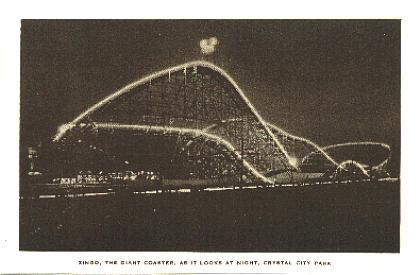
The Zingo was named after Tulsa's original Zingo roller coaster in West Tulsa's Crystal City amusement park.
[edit] Others
Ferris wheel, bumper boats, skee ball, sky tram, penny and video arcades, bumper cars, miniature golf, go karts, hydro-horse races.
[edit] Accidents
On April 20, 1997, a car near the top of the Wildcat roller coaster on a chain hill disengaged from the chain and rolled backwards, colliding with another car. The accident killed a fourteen-year-old and injured six others.[1] The Wildcat was disassembled following the accident.
[edit] Storm Damage
In the early morning hours of June 6, 2006, a large thunderstorm moved through Tulsa. A microburst developed over the amusement park, creating winds estimated over 80 miles per hour. The wind caused widespread damage to areas of midtown Tulsa, including Bell's. The 1920s-era ferris wheel was bent almost in half, and a large tree fell across Zingo's tracks. The park was closed until the Ferris Wheel could be removed and the damage to other rides repaired, then was reopened.
[edit] The Future
The Tulsa World reported on October 22, 2006 that The Bell's company's lease with the Tulsa County Public Facilities Authority expires on November 8, 2006.
On November 9, 2006, the Tulsa County Fair Board offered no new contract for the park.[2] Bell's Amusement Park will have at least 120 days to vacate the property.
[edit] References
- Bell's Amusement Park (Official website)
- Rick Davis's Phantasmagoria article
- Zingo photographs
- U.S. roller coaster fatalities (1972-1997)
- ^ Oklahoma Department of Labor (1997-07-03). "Labor Commissioner Issues Interim Report on Amusement Park Accident". Press release. Retrieved on 2006-08-31.
- ^ No Change Likely On Bell's Amusement Park Decision KOTV.com Retrieved on November 9, 2006
[edit] External links
- Tinned Elk/Sandbox Bells is at coordinates Coordinates:
- Bell's at Wikimapia
http://www.ultimaterollercoaster.com/coasters/yellowpages/parks/bells_ok.shtml
Bell's classic wooden roller coaster Zingo was dismantled starting in February 2007 and has also been placed in storage. The park started in 1951 and in its final season this Tulsa family amusement park had grown to 10 acres and over 50 rides and attractions, including the state's largest wooden roller coaster. Bell's Amusement Park was formerly located at the Tulsa Expo Square fairgrounds.