Thermopylae
From Wikipedia, the free encyclopedia


Thermopylae (pronounced /θɚˈmɒpəli/) (Ancient and Katharevousa Greek Θερμοπύλαι, Demotic Θερμοπύλες: "hot gateway") is a location in Greece where a narrow coastal passage existed in antiquity. It derives its name from several natural hot water springs.
Contents |
[edit] Geography
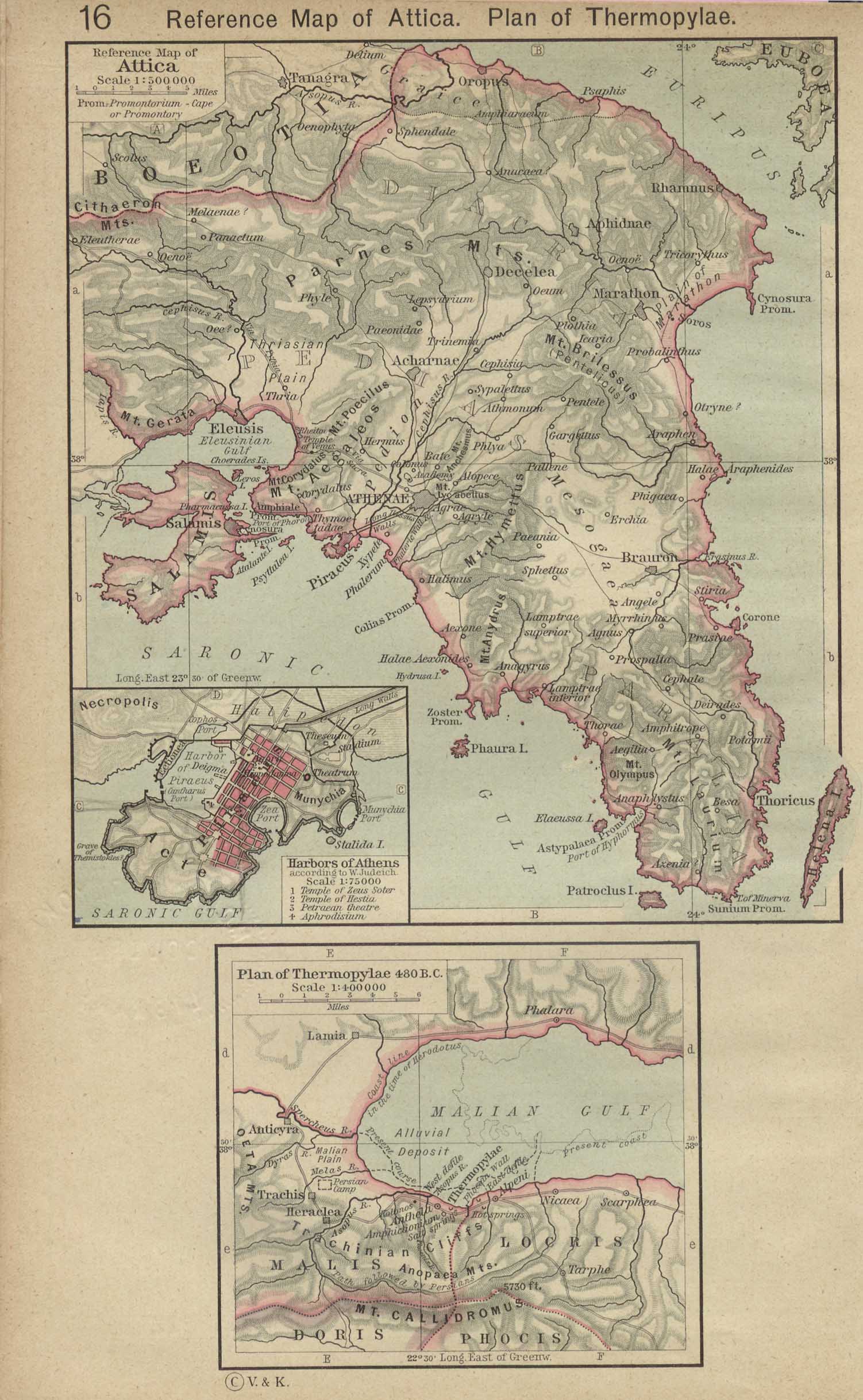
Thermopylae is located in eastern central Greece on the only land route large enough to bear any significant traffic between Lokris and Thessaly. Passage from north to south along the east coast of the Balkan peninsula requires use of the pass. Further west the way is blocked by mountains and the Gulf of Corinth. For this reason the vicinity has been the site of several battles.
In the time of Leonidas in 481 BC, the pass was a narrow track (probably about 14 metres/yards wide) under the cliff. In modern times, the deposits of the Spercheios River have widened it to a breadth of 2 to 5 kilometers (1 to 3 miles).[1] The short part of the path has thus migrated to the East so the battle of Spercheios in 10th century between the forces of Samuil of Bulgaria and the Byzantine general Nikephoros Ouranos took place more to the north. While in the 1821 revolution the Battle of Alamana and the Battle of Gravia were very close, they did not take place right at Thermopylae.
A main highway now splits the pass, with a modern-day monument of Leonidas on the east side of the highway. It is directly across the road from the hill where Simonides of Ceos's epitaph is engraved in stone at the top. Thermopylae is part of the infamous "horseshoe of Maliakos" also known as the "horseshoe of death": it is the narrowest part of the highway connecting the north and the south of Greece. It has many turns and has been the site of many vehicular accidents.
The hot springs from which the pass derives its name still exist close to the foot of the hill.
[edit] Geology
 |
Please help improve this section by expanding it. Further information might be found on the talk page or at requests for expansion. |
This area has rich limerock formations with overlapping trees and mountains on the right and a beautiful highway on the left of it.
[edit] Battles
[edit] Greeks and Persians
Thermopylae is primarily known for the battle that took place there in 480 BC, in which an outnumbered Greek force of approximately 7,000 (including the famous 300 Spartans) held off a force of perhaps 100,000-200,000 Persians (although that number is disputed) under Xerxes. For two days they held out between two narrow cliff faces to prevent the use of Xerxes' vast cavalry force, before being outflanked on the third via a hidden goat path. The name since then has been used to reference heroic resistance against a more powerful enemy.
[edit] Greeks and Gauls
In 279 BC a Gallic army led by an Brennus (not to be confused with the Brennus who sacked Rome in 387 BC) successfully defeated a Greek army under the Athenian Calippus.
[edit] Roman-Seleucid wars
In 191 BC Antiochus III the Great of Syria attempted in vain to hold the pass against the Romans under Manius Acilius Glabrio.
Less famous is the confrontation of 353 BC/352 BC during the Third Sacred War when 5,000 Athenian hoplites and 400 horsemen denied passage to the forces of Philip II of Macedon and the battle of 267 when the Heruli defeated the Greek force that tried to stop them.
[edit] Greek War of Independence
In 1821, a force of Greek fighters led by Athanasios Diakos made a stand near the pass to stop a force of 8,000 Turks from marching down from Thessaly to put down revolts in Roumeli and the Peloponnese. Diakos, after making a last stand at the bridge of Alamana with 48 of his men, was captured and killed.
[edit] World War II
In 1941 during World War II the ANZAC forces delayed the invading German forces in the area enough to allow the evacuation of the British expeditionary force to Crete. This conflict also became known as the Battle of Thermopylae. Such was the fame of Thermopylae that the sabotage of the Gorgopotamos bridge in 1942 was referred in German documents of the era as "the recent sabotage near Thermopylae".
[edit] Note
- ^ Kraft, John C.; George Rapp, Jr.; George J. Szemler; Christos Tziavos; Edward W. Kase (1987). "The Pass at Thermopylæ, Greece". Journal of Field Archaeology 14 (2): pages 181–198.
[edit] See also
|
|
Please help improve this section by expanding it. Further information might be found on the talk page or at requests for expansion. |
[edit] External links
|
||||||||||||||||||||||||||||