Thebes, Egypt
From Wikipedia, the free encyclopedia


Thebes (Θῆβαι, Thēbai) was a city in Ancient Egypt located about 800 km south of the Mediterranean, on the east bank of the river Nile (). It was the capital of Waset, the fourth Upper Egyptian nome. (Waset was also a name for the city.) It was the capital of Egypt during part of the 11th Dynasty (Middle Kingdom) and most of the 18th Dynasty (New Kingdom), though the administration probably remained at Memphis for much of this. With the 19th Dynasty the seat of government moved to the Delta. The archaeological remains of Thebes offer a striking testimony to Egyptian civilization at its height. The Greek poet Homer extolled the wealth of Thebes in the Iliad, Book 9 (c. 7th Century BC): "... in Egyptian Thebes the heaps of precious ingots gleam, the hundred-gated Thebes."
The name Thebai is the Greek designation of the ancient Egyptian niwt "(The) City" and niwt-rst "(The) Southern City". At the seat of the Theban triad of Amun, Mut, and Khonsu, Thebes was known in the Egyptian language from the end of the New Kingdom as niwt-imn, "The City of Amun." This found its way into the Hebrew Bible as נא אמון nōˀ ˀāmôn (Nahum 3:8),"no" in Hebrew meaning city with "no amon" or "City of Amon" referring to the Egyptian deity Amon-Re, most likely it is also the same as נא ("No") (Ezekiel 30:14). In Greek this name was rendered Διόσπολις Diospolis, "City of Zeus", as Zeus was the god whom the Greeks identified with Amun, see interpretatio graeca. The Greeks surnamed the city μεγάλη megale, "the Great", to differentiate it from numerous other cities called Diospolis. The Romans rendered the name Diospolis Magna.
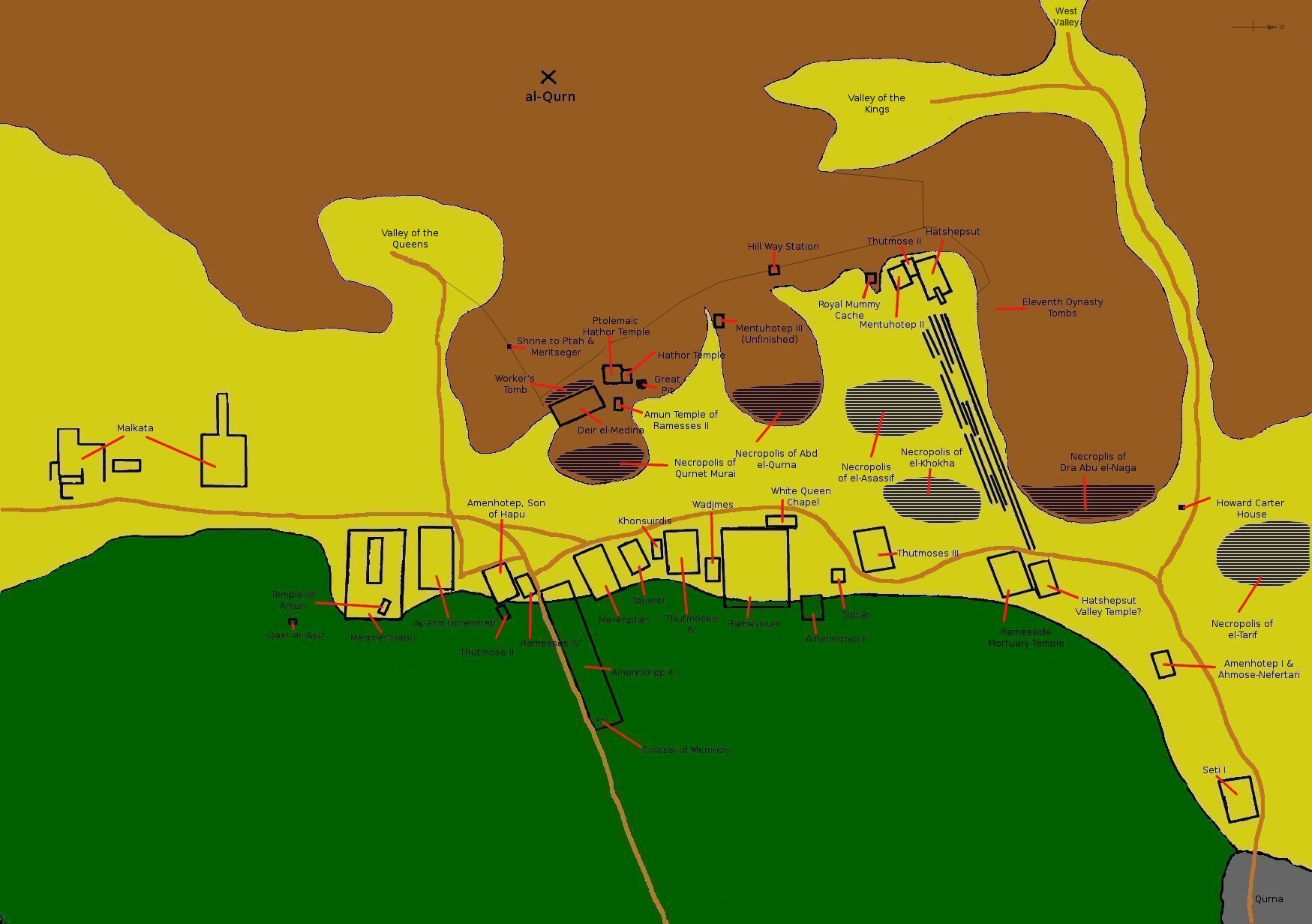
In modern usage, the mortuary temples and tombs on the west bank of the river Nile are generally thought of as part of Thebes.
Two towns at or near two important temples on the outskirts of the city are now called Luxor (Arabic: الأقصر, Al-Uqṣur, "The palaces") and al-Karnak (الكرنك).
Contents |
[edit] Etymology
The name Thebes is often mistakenly thought to derive from the name of the Greek town called Thebes. Although the etymology is unclear, Thebes is likely a hellenization of ancient Egyptian t3 ipt-swt (lit. "The Most-Select of Places"), one of the names of the temple of Karnak, which is located in the city. Thebes is now known as the modern day city of Luxor.
[edit] Major Archaeological Sites


[edit] East Bank
[edit] West Bank
- Valley of the Kings
- Valley of the Queens
- Medinet Habu (mortuary temple of Ramesses III)
- The Ramesseum (mortuary temple of Ramesses II)
- Deir el-Medina (workers' village)
- Tombs of the Nobles
- Deir el-Bahri (temples of Mentuhotep II, Hatshepsut, etc.)
- Malkata (palace of Amenhotep III)
- Colossi of Memnon (part of the mortuary temple of Amenhotep III)
[edit] Sources

- Gauthier, Henri. 1925–1931. Dictionnaire des noms géographiques contenus dans les textes hiéroglyphiques. Vol. 3 of 7 vols. Cairo: Imprimerie de l’Institut français d’archéologie orientale du Caire. (Reprinted Osnabrück: Otto Zeller Verlag, 1975). 75, 76.
- Polz, Daniel C. 2001. "Thebes". In The Oxford Encyclopedia of ancient Egypt, edited by Donald Bruce Redford. Vol. 3 of 3 vols. Oxford, New York, and Cairo: Oxford University Press and The American University in Cairo Press. 384–388.
- Redford, Donald Bruce. 1992. "Thebes". In The Anchor Bible Dictionary, edited by David Noel Freedman. Vol. 6 of 6 vols. New York: Doubleday. 442–443. ISBN 0-385-42583-X (6-volume set)
- Strudwick, Nigel C., & Strudwick, Helen, Thebes in Egypt: A Guide to the Tombs and Temples of Ancient Luxor. London: British Museum Press, 1999, ISBN 0-8014-3693-1 (hardcover)/ISBN 0-8014-8616-5 (paperback)
[edit] External links
- Theban Mapping Project
- Ramesseum/Ancient Thebes Digital Media Archive (photos, laser scans, panoramas), data from an Egyptian Supreme Council of Antiquities/CyArk research partnership
| Preceded by Herakleopolis |
Capital of Egypt 2060 BC - 1785 BC |
Succeeded by Avaris |
| Preceded by Avaris |
Capital of Egypt 1580 BC - c. 1353 BC |
Succeeded by Akhetaten |
| Preceded by Akhetaten |
Capital of Egypt c. 1332 BC - 1085 BC |
Succeeded by Tanis |
|
|||||||

|
|||||||