Talk:Thai numerals
From Wikipedia, the free encyclopedia
This is not correct (or maybe not just enough detailled). Take a look at the Thaï or French versions.
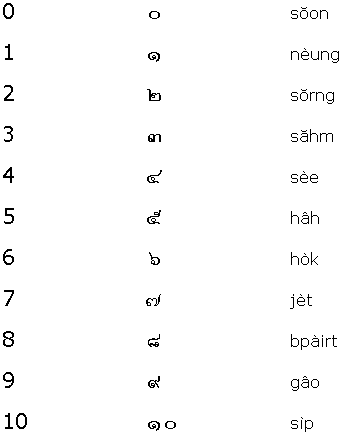
- ๑ (neung) is "1"
- หนึ่ง (neung) is "one" (written)
And both are pronounced "neung".
Another example with eleven :
- ๑๑ (sip et) is "11"
- สิบเอ็ด (sip et) is "eleven"
And both are pronounced "sip et".
Vberger 13:03, 25 January 2006 (UTC)
Contents |
[edit] Numbers above a trillion (10^12)
Are there any words in Thai for numbers above a trillion (10^12)? --84.61.6.185 18:45, 12 May 2006 (UTC)
and how about the more ancient Thai numeral derived from pali? the 'ek, to, tri, chatu...' it would be nice to know its relation with latin as well...
- I've added the ancient numerals. I could use some help with their history. (I didn't know they were from Pali.) I've also added the ordinal numbers. I'm planning to work on "==Decimals and fractions==" (using #จุด# and #ใน# and #'tub'#) and "==Negative numbers==" (using ลบ#) next, but if anyone wants to do it, then go right ahead--the help would be much appreciated.
- Wikky Horse 2006-10-22 14:57 UTC-6
- One more thing: I'm not sure if I got the transcriptions correct in RTGS.
- Wikky Horse 2006-10-22 14:57 UTC-6
[edit] Clearly Chinese
Gentlemen, Thai numerals appear to be 99% related to Chinese numerals. Therefore it is just plain not fair not discussing their origin. Jidanni 02:12, 2 October 2007 (UTC)
- Well, they aren't from modern Chinese but you'll have to respect that the Thais did come from China. Archaic loan into their languages may have persisted and even naturalized as native numbers. —Preceding unsigned comment added by 4.239.33.20 (talk) 22:28, 20 February 2008 (UTC)
-
- It's not clearly evidenced that Thai took numeral counting from Chinese. Although the relationship between Chinese and Thai exists, it cannot say if the Thai borrowed the Chinese. It can be the other way round as well. There are also enormouse evidence that Tai language (as a part of Bai Yue cultures) also influences Chinese language esp. in its Southern Dialect such as Cantonese. I don't recall it in detail but can give one example that I rememeber. It is widely accepted that the word "Kam" (gold) in Cantonese is taken from an archaic Tai language (คำ), such as in ทองคำ (gold), หอคำ (golden pavillion) or in other archaic names of various places and things. Therefore, as long as there's no enough evidence to support the claim about one-way direction of Chinese influence in Thai numerical counting, I don't think it's appropriate to put this information in Wikipedia. It's academically dangerous. Thanks. —Preceding unsigned comment added by U4268722 (talk • contribs) 11:15, 16 March 2008 (UTC)
- I agree, and will make this change tomorrow if no one objects. Pawyilee (talk) 10:59, 18 March 2008 (UTC)
[edit] Zero to nine
The Thai name for zero, which also means center, depending on context, is clearly from Sanskrit śūnya, as are context-driven names for Alternate numbers 2 to 4, given below; but not one or its alternatives. Thai names for regular digits two through nine resemble those in Cantonese as spoken in Southern China, putative homeland of the Tai. Shown below, without implying who borrowed from whom, is a comparison between the two languages using Cantonese characters and pronunciations. The Thai transliteration uses the Royal Thai General System of Transcription (RTGS).
Nobody objected, so I posted it to the main article. Pawyilee (talk) 17:08, 19 March 2008 (UTC)
[edit] 'Numbers above a million' and 'Alternate numbers' sections
Hi, seeing as the Japanese and other language articles on numerals include the mostly unused ancient numerals over million and trillion and such all the way to infinity, even though they are basically obsolete, why don't you include the ancient Siamese ones too to be fair (by the way there is also no mention of the Thai numerical systems' native names such as ภัณฑสังขยา phanthasangkhaya and อักโขภินี akkhophini or the history of why they were adopted (Buddhism, recordkeeping problems during trade with the native number ล้านล้าน lanlan being often misinterpreted, etc)?
โกฏิ kot = ten million/10,000,000
ปโกฏิ pakot = hundred million/100,000,000
โกฏิปโกฏิ kottipakot = billion/1,000,000,000
นหุตะ nahuta = ten billion/10,000,000,000
นินนหุตะ ninnahuta = hundred billion/100,000,000,000
อักโขภนี akkhophani = quadrillion/1,000,000,000,000
พินทุ phinthu = ten quadrillion/10,000,000,000,000
อัพพุทะ apphutha = hundred quadrillion/100,000,000,000,000
นิรัพพุทะ nirapphutha = quintillion/1,000,000,000,000,000
อพพะ aphapha = ten quintillion/10,000,000,000,000,000
อฏฏะ atata = hundred quintillion/100,000,000,000,000,000
อหหะ ahaha = sextillion/1,000,000,000,000,000,000
กุมุทะ kumutha = ten sextillion/10,000,000,000,000,000,000
โสคันธิกะ sokhanthika = hundred sextillion/100,000,000,000,000,000,000
อุปปละ uppala = septillion/1,000,000,000,000,000,000,000
ปุณฑรีกะ puntharika/pundarika = ten septillion/10,000,000,000,000,000,000,000
ปทุมะ pathuma = hundred septillion/100,000,000,000,000,000,000,000
กถานะ kathana = octillion/1,000,000,000,000,000,000,000,000
มหากถานะ mahakathana = ten octillion/10,000,000,000,000,000,000,000,000
อสังเขยยะ asangkhoeiya = hundred octillion/100,000,000,000,000,000,000,000,000
...etc...until อสงไขย asongkhai = the largest number in Thai, meaning infinity, but literally, ten to the power of 140.
Plus, there are the other Pali/Sanskrit-derived numerals used only as prefixes (without the final ะ written of course) or in Siamese given names/surnames or in terminology for astrology, Buddhism and such:
ทสะ thasa = ten/deca-/10
สตะ sata = hundred/cent-/100
สหัสสะ sahatsa = thousand/kilo-/1,000
นยุตตะ nayutta = ten thousand/10,000
ลักขะ sakkha = hundred thousand/100,000
ทสสตสหัสสะ thotsatasahatsa = million/mill-/1,000,000
...and any other Pali-based numerical prefix; there are so many such as, randomly, for six/hexa-: ษัฏ sat, ษัฑ sat, ษัณ san, ษัษ sat, ษัษฏี satsati (meaning 'sixty'), โษฑศะ sota (meaning 'sixteen'), and thats just some starting with ษ....
I can't understand how to reference the information in Wiki way so only posting it in Discussion but you can find these things in any chunky enough Thai dictionary or Buddhist treatise. One for example is: "สังขยาปกาสกปกรณ์และฎีกา: การตรวจชำระและการศึกษาเชิงวิเคราะห์" by Chulalongkorn Uni, Dept. of East Asian Languages (in Thai: วิทยานิพนธ์อักษรศาสตรมหาบัณฑิต ภาควิชาภาษาตะวันออก จุฬาลงกรณ์มหาวิทยาลัย). The prefixes though are everywhere in any good dictionary, even the half-assed Royal Thai Institute's one online. I hope someone Wiki-literate enough will add them..I would but I have been deleted at times from not understanding how to reference... Cheers Kyrinth (talk) 15:35, 29 March 2008 (UTC)
[edit] Thai Numerals are identical to Khmer
I think it'll be noteworthy to add something referencing them. Its clearly nearly, if not exactly identical. Thai http://www2.hawaii.edu/~hlibcat/images/14.gif Khmer http://www.mekong.net/cambodia/images/khmernum.jpg —Preceding unsigned comment added by 4.239.87.131 (talk) 20:47, 1 April 2008 (UTC)
- You can compare them in the chart at Hindu-Arabic numeral system#List of symbols in contemporary use. You need appropriate fonts to see it. - TAKASUGI Shinji (talk) 04:05, 2 April 2008 (UTC)