Talk:Sino-Indian War
From Wikipedia, the free encyclopedia


 Archives |
||||||
|
Contents |
[edit] Some points may be worth considering
I have refrained myself from editing this article because, being an Indian, I might have a certain POV towards this conflict and might not be able to write an unbiased account of the war. However, from different sources, I have come across certain information which might be worth considering -
- India had some kind of military co-operation treaty with Tibet before the annexation by the PLA. (Did it contribute anything to the war?)
- India had supported PRC to be given the UN seat instead of the Nationalist China (Taiwan).
- The then Indian Prime Minister, Nehru had actually entered in to a Panchsheel (five policies for peaceful co-existence) with China.
- India had a forward policy, which led to direct confrontation with China.
- PRC decisively won the battle and could have captured much more than what it chose to retain.
- Also the can someone do a comparison between the IAF and the Chinese Air Force during that time? As I have come across numerous articles from defence experts, that India could have had a more favourable outcome had it chosen to use the Air Force.
Shovon 16:00, 14 April 2008 (UTC)
In response to 1 yes India post Colonel Young Husband's Lhasa expedition had and after the lapse of British Paramountancy the treaty would have been transferred to India, unlike the position that is claimed by Chinese i.e. one of it lapsing in 1947 —Preceding unsigned comment added by 59.178.165.98 (talk) 10:47, 16 May 2008 (UTC)
[edit] The Batle of 1962 versus the War that is continuing today
- ;) Just like China got CREAMED by the Japanese ..;) ? or - Like China got CREAMED by the Vietnamese in 1979 ?? :) ? - ;) Just like the way tiny Tibet is taking on China just now ?
We can go on insulting each other - or try to resolve the issue
Fact of the matter is India did lose the 1962 battle . There can be many explanations. but Bottom line China was prepared and India was not ( arrogance of the then Indian Govt is definetly one of the reasons)
Lets talk about the consequences of 1962 and the situation as it stands NOW
Now - India and China are extremely far apart and are poised directly against each other ( the existence of the above arguments by so may prove this point) Now - India is every day ready for a war with China - thanks to 1962 . ( so is that progress ? ) Now - India developed and deployed nukes against China Now - People of India have a strong understanding and support Tibet....... thanks to 1962.
India has maintained the Tibet card and using it to slowly pin prick China - and will continue to do so. Is China better of since 1962 ?? ( if not for 1962 - would this have happened?) The Free Worlds opinion is against China right now.
India lost the battle of 1962 - but the War seems to be in India's favor at the moment.
-
- First, China did NOT get creamed by the Vietnamese. Second, the fact that China got creamed by the Japanese during WW2 has nothing to do with this article. Third, Sino-Indian war has ended in 1962, you are the one who is still fighting it (along with a handful of other Indians)
-
- No one is insulting each other. This is an enclyclopedia on a historic event. If you lose the war you lose the war. No body is insulting anybody just by stating this historical fact.
[edit] Location of Aksai Chin
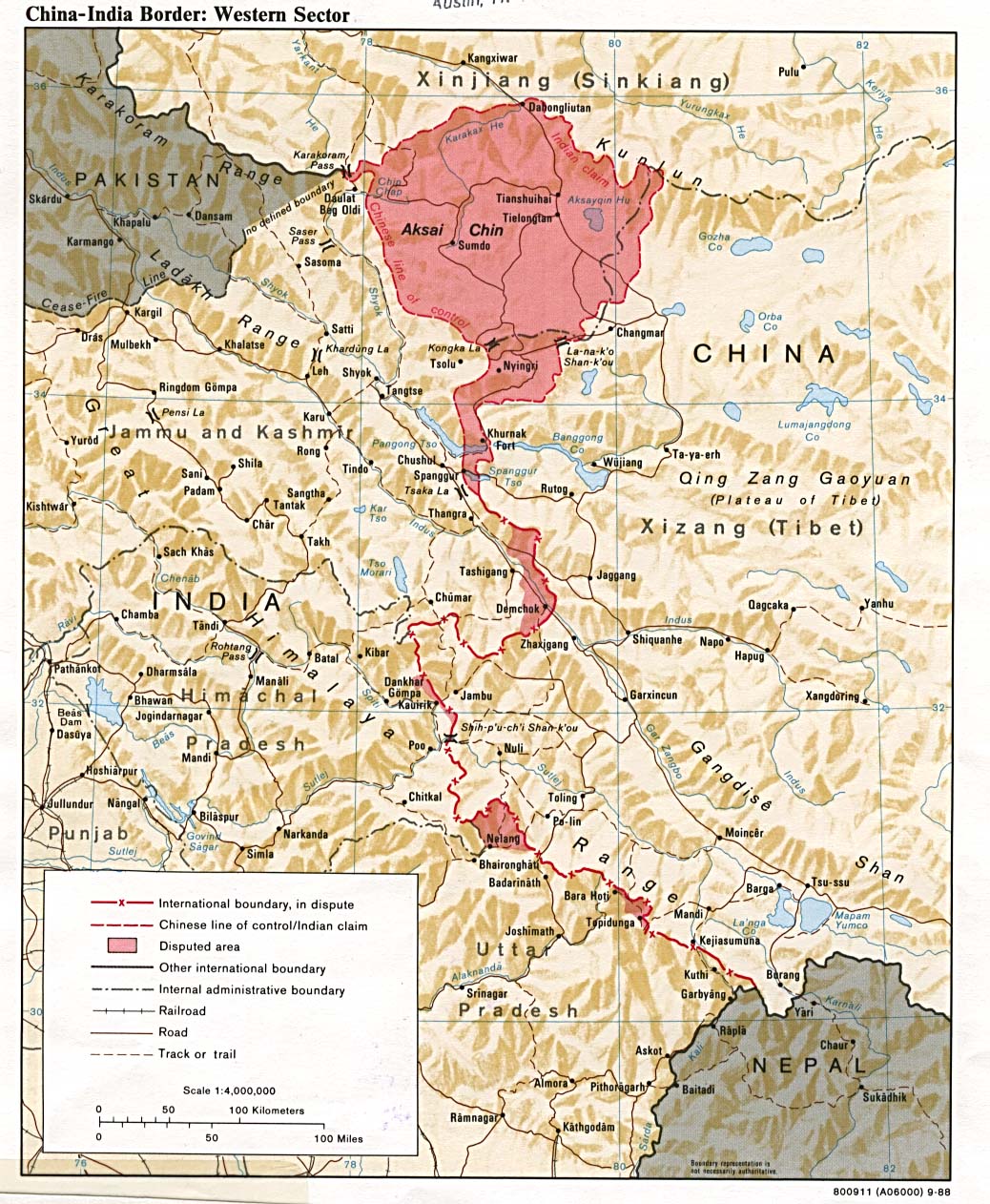
Looking at a map of the area (http://upload.wikimedia.org/wikipedia/commons/5/56/China_India_western_border_88.jpg), it seems to me that the current description of the region's location is misleading:
   "...the Aksai Chin region, an area the size of Switzerland, that sits between the
   Chinese provinces of Tibet and Xinjiang."
The description of the region's location on the Wikipedia Aksai Chin page reads as follows:
"Aksai Chin is a region located at the juncture of China, Pakistan, and India."
Would not both be better replaced by something like
   "... [a disputed region lying] between India and China ..." or
   "... [a disputed region lying] between China and India ..."?
Incidentally, I'm neither Indian nor Chinese; I'm Dutch-Canadian.
Heavenlyblue (talk) 02:39, 20 April 2008 (UTC)
[edit] Sources for solution
Quotes from the Encyclopedia Britannica:
"McMahon Line." Encyclopedia Britannica, 2008:
Delegates of the Chinese republican government also attended the Simla Conference, but they refused to sign the principal agreement on the status and boundaries of Tibet on the ground that Tibet was subordinate to China and had not the power to make treaties. The Chinese maintained this position until the frontier controversy with independent India led to the Sino-Indian hostilities of October–November 1962. In that conflict the Chinese forces occupied Indian territory south of the McMahon Line but subsequently withdrew after a ceasefire had been achieved.
"Arunāchal Pradesh." Encyclopedia Britannica, 2008:
After the independence of India in 1947, China made claims to practically the whole area covered by the districts of East and West Kāmeng, Lower and Upper Subansirī, East and West Siang, and Lohit, arguing that the McMahon Line had never been accepted by China and was the result of British “aggression.” In letters to the Indian prime minister, Jawaharlal Nehru, the Chinese prime minister, Zhou Enlai, quoted a map in the 1929 edition of Encyclopædia Britannica showing the disputed territory as Chinese, with the boundary following the alignment of Chinese maps. Some Chinese maps before 1935 showed the North East Frontier Agency (Arunāchal Pradesh) as part of India, and since then as part of Tibet. The Survey of India (1883) showed the disputed tribal areas as de facto administered by British India. British and Indian maps since 1914 have usually followed the McMahon Line. If the Chinese claims were allowed, the Indian-Chinese border would follow roughly the margin of the Assam plain, a frontier almost impossible to defend. Following this dispute, Chinese troops crossed the McMahon Line on August 26, 1959, and captured an Indian outpost at Longju, a few miles south of the line. They abandoned this in 1961 but in October 1962 crossed the line, this time in force. After first striking toward the Tanglha ridge and Tawang near the Bhutan border, the Chinese later extended their attack along the whole frontier. Deep inroads were made at a number of points. Later the Chinese agreed to withdraw approximately to the McMahon Line and in 1963 returned Indian prisoners of war.
Play nice now, Goring 53 (talk) 16:29, 5 May 2008 (UTC)
-
- I can't agree with the whole "border dispute" theory of the war, although the current version of the article states this as if it was a simple fact. The territory that is supposedly being disputed is almost worthless. India presented the McMahon Line to Zhou in 1954, and China did not object. Mao was always looking to stir up a war or crisis somewhere because that was his style. Why India? Mao felt humiliated when Nehru gave the Dalai Lama asylum in 1959. China took several years to prepare the offensive against India. This is a documented fact because during the buildup period, the Chinese sent military supplies to Tibet through Calcutta, right under the noses of clueless Indian customs agents. So the reasons for the war pre-date both the Dhola issue and the forward policy. The Chinese withdrew when they ran out of supplies, even though that meant returning the disputed territory to India. Kauffner (talk) 06:14, 11 May 2008 (UTC)
-
-
- The territory is almost worthless but people dispute over less. India rejected the McMahon line. They tried to insist on it and when they saw that the legal claim was weak they opted to argue that the watershed was the traditional border and so made an argument based on past usage. The war started when India began moving soldiers beyond the MM line to the watershed. To assert that the Chinese planned the War is a-historic as far as I can see. Mao did not go around starting wars because of he felt humiliated. He did not even do so despite the fact the Indians were supporting Tibetan guerillas. The Chinese did not withdraw because of a lack of supplies. They withdrew to the border they wished to have and which India would not accept - the McMahon line. In the end the war is about the border. Lao Wai (talk) 09:03, 11 May 2008 (UTC)
-
-
-
-
- This article by the author of the official Indian history of the war makes a convincing case that China planned its offensive against India well in advance, although the stuff at the end about the Cuban missile crisis strikes me as a bit speculative. If China planned from the beginning to withdraw from the disputed territories, that suggests the motivation was something other than territory. Mao liked to keep China in a permanent state of crisis and this a reoccuring theme in his foreign policy -- think of Zhenbao Island, a dispute that nearly led to a Sino-Soviet nuclear war in 1969. Kauffner (talk) 15:28, 11 May 2008 (UTC)
-
-