Retractable hardtop
From Wikipedia, the free encyclopedia


.JPG/225px-VOLVO_C70(in_transforming).JPG)

A Retractable Hardtop (also known as coupé convertible or coupé cabriolet) is a type of convertible that forgoes a folding textile roof in favor of an automatically operated, multi-part, self-storing roof where the rigid roof sections are opaque, translucent or independently operable.
A 2006 New York Times article suggested the retractable hardtop may herald the demise of the textile-roofed convertible,[5] and a 2007 Wall Street Journal article suggested "more and more convertibles are eschewing soft cloth tops in favor of sophisticated folding metal roofs, making them practical in all climates, year-round."[6]
Contents |
[edit] Construction
Retractable hardtops can vary in material (steel, plastic or aluminum), can vary from two to five in the number of rigid sections and often rely on complex dual-hinged trunk (British: boot) lids that enable the trunk lid to both receive the retracting top from the front and also receive parcels or luggage from the rear — along with complex trunk divider mechanisms to prevent loading of luggage that would conflict with the operation of the hardtop. Construction variations:
- The Volkswagen Eos features a five-segment retractable roof where one section is itself an independently sliding transparent sunroof.[6]
- The Cadillac XLR features a retractable hardtop of aluminum (i.e.,lightweight) requiring 6'-10½" of vertical clearance during retraction, and manufactured by a supplier joint venture between Mercedes-Benz and Porsche.[2]
- The Mercedes SL hardtop features a glass section that rotates during retraction to provide a more compact "stack."
- The Mazda MX-5 retractable hardtop is manufactured by the German firm Webasto[7] and is marketed alongside a largely identical folding-textile convertible, with an increase of 77lbs[1] and no reduction in cargo capacity — the hardtop is constructed of polycarbonate.[1]
- Daihatsu marketed the Copen in the ultra-compact Japanese Kei class.
- The Chrysler Sebring's retractable hardtop is marketed also alongside a softop. According to development engineer Dave Lauzun, during construction, the Karmann-made tops are dropped into a body that is largely identical: both softop and retractable feature the same automatic tonneau cover, luggage divider and luggage space.[8] The retractable does feature an underbody cross-brace not included in the softop.
- The Volvo C70, it's retractable hardtop manufactured by Webasto[7] includes a global window switch that allows simultanious raising or lowering of all windows,[9] and a button to power-activate the raising of the folded top stack within the trunk to access cargo below.[9]
[edit] Pros and cons
The retractable hardtop convertible trades higher initial cost, mechanical complexity and, with rare exception, diminished trunk space — for the increased acoustic insulation, durability and break-in protection similar to that of a fixed roof coupe.
Pro: The retractable hardtop eliminates:
- the need for a storage-consuming, manually-from-outside-the-vehicle-installable, separate or integral, rigid or foldable, tonneau cover to conceal the mechanicals of a folded textile top.
- the need to protect the vulnerable underside of a folded textile top from UV fading.
- the need for a separate rigid hardtop requiring space-consuming off-season storage and a cumbersome twice-yearly, two-person manual installation and removal — a system popularized, for example, by the Mercedes-Benz SL-Class of 1963 to 1988.
Con: In addition to higher initial cost, diminished trunk space, and increased mechanical complexity — and thereby potentially higher repair cost:
- The retractable hardtop may lift the articulating sections of the roof during retraction, requiring increased vertical clearance. For example, the Volvo C70 requires 6.5 feet of clearance during operation.[4] The Cadillac XLR requires 6'-10½" of vertical clearance.
- The retractable hardtop may, such as in the case of the Mercedes SLK, require additional rear clearance behind the car during operation of the top, the trunklid extending rearward while retracting or raising the top.
- The retractable hardtop relies on battery power, and in the event of battery failure, can leave a retracted roof vulnerable to a downpour. Volvo includes an emergency roof cover with each Volvo C70.[4] The Cadillac XLR owners manual contains seven pages of detailed instructions on how to manually raise the top.
- With numerous articulated sections, each joint or seal is an opportunity for water leakage.
[edit] History
1922 An American named Ben P. Ellerbeck conceived the first practical retractable hardtop system in 1922 — a manually operated system on a Hudson coupe that allowed unimpeded use of the rumble seat even with the top down [10] — but never saw production.[3]
1935 Peugeot introduced the first production, power-operated retractable hardtop in 1935, the 402 Éclipse Décapotable,[5] designed and patented by Georges Paulin, a Parisian, Jewish dentist and part-time car designer who later died in the Holocaust.[5] The French coachbuilder, Marcel Pourtout, custom-built other examples of Paulins designs on a larger Peugeot chassis as well.[5] The first Eclipse 402s offered a power-retractable top, but in 1936, that replaced by a manually operated version on a stretched chassis, built in limited numbers until World War II.[10]
1941 Chrysler presents the retractable hardtop concept, the Thunderbolt "dream car."[10]
1953 Ford Motor Company next spent an estimated $2 million to engineer a Continental Mark II with a servo-operated retractable roof — the project having been headed in 1953 by a 30-year-old draftsman named Ben Smith.[11] Though successful, the concept was rejected for marketing reasons.[10]
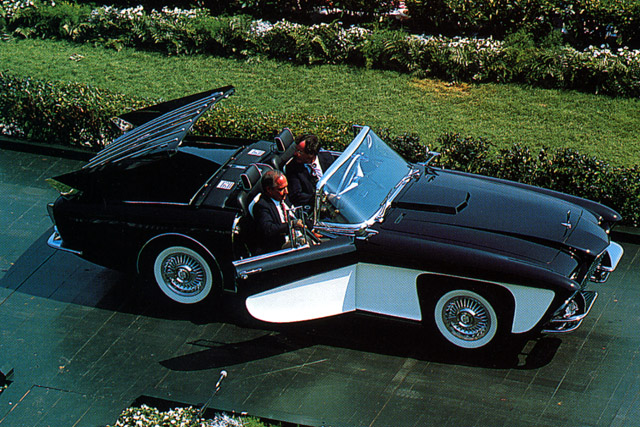
1955 Brothers Ed and Jim Gaylord showed their first prototype at the 1955 Paris motor show[12], but the car failed to reach production.
1957 Shortly thereafter, Ford marketed the Skyliner in the United States beginning in 1957. Noted for its complexity and only intermitant reliability, 48,394 were built from 1957 to 1959.[10] In the pre-transistor era, its mechanism with 10 power relays, 10 limit switches, four lock motors, three drive motors, eight circuit breakers and 610 feet of electrical wire[10] could raise the or lower the top in about 40 seconds — when functioning. The Skyliner was a halo vehicle with little luggage space (i.e., practicality), costing twice that of a baseline Ford sedan — to be withdrawn from the market after three years.
1995 The era of the modern retractable hardtop began with the 1995 Mitsubishi 3000GT Spyder, sold in Japan and the US[3] — and further popularized by such cars as the 1998 Mercedes-Benz SLK[5] and 2001 Peugeot 206 CC.
Notably, Peugeot presented the a concept four-door retractable hardtop convertible, the Peugeot 407 Macarena in 2006.[13] Produced by French coachbuilding specialist Heuliez, the Macarena's top can be folded in 60 seconds, [13] and to incorporated a steel reinforcing beam behind the front seats, incorporates LCD screens for the rear passengers into the crossmember. [13]
-
- View: 1957 TV ad for the Ford Skyliner featuring Lucille Ball and Desi Arnaz.
- View: Peugeot 407 Macarena, with top retracting.
- View: Photographs of a 1938 Peugeot 402 Éclipse Décapotable
- View: time lapse photograph of Mercedes SLK, with top retracting
- View: Sales brochure of the 1995 Mitsubishi Spyder
[edit] List of retractable hardtop models
[edit] Early Models
- Hudson 1922
- Peugeot 402 Éclipse Décapotable (1935)
- Chrysler Thunderbolt concept car 1941
- Continental Mark II concept car c.1953
- Ford Skyliner (1957-1959)
- Gaylord (1956)
[edit] Later Models
|
|
[edit] References
- ^ a b c d 2007 Mazda MX-5 Miata Power Retractable Hardtop. Autoweek.com, Mark Vaughn.
- ^ a b 2004 Cadillac XLR. Motor Trend, Jack Keebler.
- ^ a b c Volvo C70. retractable hardtop online.
- ^ a b c 2007 Volvo C70. Volvocars.com, C70 owner documentation, Page 93.
- ^ a b c d e New Again: The Hideaway Hardtop. The New York Times, Rob Sass, December 10, 2006.
- ^ a b Convertibles with Hard Tops. The Wall Street Journal, Matt Vella, April 26, 2007.
- ^ a b Follow-Up Test: 2007 Mazda MX-5 Miata PRHT. Edmunds.com, Kevin Smith, 08-28-2006.
- ^ 2008 Chrysler Sebring Convertible, Dave Lauzun.. Chrysler Sebring, Intro Video, Autonetwork.com.
- ^ a b 2007 Volvo C70. Joe Wiesenfelder, Cars.com, August 21, 2006.
- ^ a b c d e f Ford Skyliner. DrivingToday.com, Jack Nerad.
- ^ Lucy Loved Ford's First Hard Top Convertible. GreatcarsTV.com, Bob Merlis, March 06 2007.
- ^ 1950 Gaylord concept cars. Howstuffworks.com, The Auto Editors of Consumer Guide, 2007.
- ^ a b c ¡Hey, Macarena! Heuliez Creates an Open-Top Peugeot 407. Edmunds, 01-28-2006.