Talk:Proxima Centauri
From Wikipedia, the free encyclopedia


Contents |
[edit] Why is Proxima so dim?
According to the wikipedia page on Luminosity, stellar luminosity can be calculated from knowing the radius and surface temp using "Luminosity = 4Pi x R-squared x (const) x Temp to the 4th" (see http://en.wikipedia.org/wiki/Luminosity, about half way down). Put these numbers in for most stars, and you get the right values (plus or minus 10%). Proxima Centauri is different, it seems to be ten (or eleven) times dimmer than this calculation would have it. Any ideas as to why?
Tim
- So:
- For Proxima Centauri:
- Yeah, something looks to be off. However, SolStation gives a luminosity range of 0.00013–0.000053, so perhaps the approximation breaks down for M dwarfs? Or else the R* or Teff is wrong. — RJH (talk) 15:54, 10 October 2007 (UTC)


The SolStation figure is correct. The approximation does indeed break down at the cooler temperature end of the spectral range. I have no clue as to why this is. J P (talk) 17:09, 17 March 2008 (UTC)
-
-
- This problem is due to a failure to distinguish between different measurements of luminosity. The bolometric luminosity, Lbol, measures the power of the total amount of electromagnetic radiation emitted by a star at all wavelengths. Using this definition of luminosity, we have Lbol=4π R2 σ Teff4, where Teff is the effective temperature of the star, R is its radius, and σ is the Stefan–Boltzmann constant. This equality is exact as it is a restatement of the definition of effective temperature. However, other measures of luminosity are frequently used which weight the measured radiation using various passbands, so that we have V-band luminosity (LV), R-band luminosity, etc. These measures can be approximately related to each other by using the bolometric correction, given in magnitudes, which can be estimated from the spectral type of the star. For an M5.5 star we may take a V-band bolometric correction of −2.76 ([1], Table 1), meaning that LV(Proxima)/Lbol(Proxima) ~= 10−2.76·2/5 ~= 0.079. For the Sun we should take a bolometric correction of 4.75−4.83 = −0.08, so LV(Sun)/Lbol(Sun) ~= 10−0.08·2/5 ~= 0.93. Using the value computed above for Lbol(Proxima)/Lbol(Sun), we find that LV(Proxima) is approximately 0.000136 LV(Sun), in good agreement with [2]. The reason the bolometric correction becomes so large for cooler stars is that these stars radiate most of their energy in the infrared. Spacepotato (talk) 02:58, 18 March 2008 (UTC)
-
[edit] image?
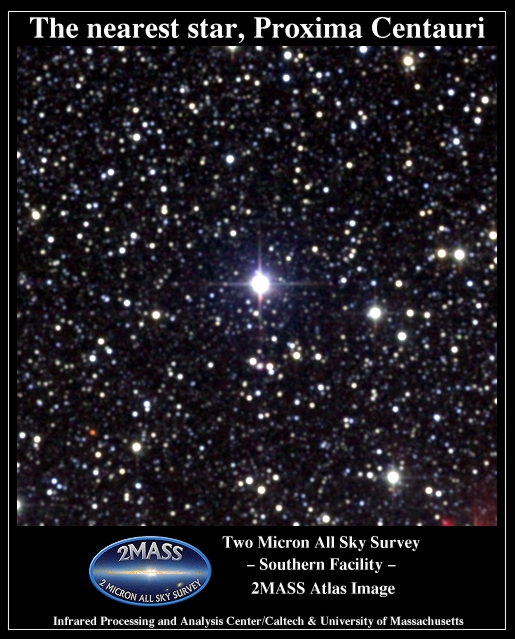
2MASS Image and caption.
Can anyone find a decent image of this star to put on the main page? --DaveGorman 19:14, 14 Jun 2005 (UTC)
- There are two good and high-res images here, credited to NASA/CXC/SAO (National Aeronautics and Space Administration, Chandra X-ray Observatory Center, Smithsonian Astrophysical Observatory) and works under such US institutions should be public domain. However, I am not able to confirm this (see [3] [4] for confusion). One should be able to just put up the image and use the appropriate PD tags? Splarka 00:45, 12 August 2005 (UTC)
[edit] concretisation???
what, pray tell, does that mean?
would someone care to change the word to something a few more people might be familar with?
-
- It means you're sitting in front of the biggest encyclopedia in the history of mankind and you'd rather whine about a word you don't know than look it up and learn something. —The preceding unsigned comment was added by 69.12.181.181 (talk) 15:45, 7 May 2007 (UTC).
[edit] Merge
Since Proxima (α Cen C) is part of the Alpha Centauri system, this ought to be part of the article on that system. The suggestion is not merely for the sake of neatness, but for the practical point that the vast majority of readers who look at one article will look at the other. Might as well save them the trouble of checking two separate pages. B00P 11:13, 7 February 2006 (UTC)
Will do so March 1st unless there are objections. B00P 14:36, 14 February 2006 (UTC)
- Although I do not consider them valid, as there are objections, I shall hold off on the merger. I would like to see more opinions though. B00P 22:06, 1 March 2006 (UTC)
- I would prefer no merger: Though Proxima Centauri is astronomically insignificant, it is more culturally significant because it is THE closest star to the sun. It has its own REAL name (unusual for a red dwarf), and it probably is the most studied red dwarf star. Just my 2c worth. Gazjo 04:45, 12 April 2006 (UTC)
Proxima Centauri is so significant culturally that 2 Wikipedians have chosen that user name.Proxima Centauri 2 (talk) 16:32, 17 April 2008 (UTC)
[edit] Proxima Centauri in fiction
This section lacks content. Please populate it.--Jyril 17:47, 1 March 2006 (UTC)
-
- Please don't.
- Wiki's weird science fiction bias gets really tiresome. Keep fiction where it belongs. jackbrown
[edit] Traveling to Proxima Centauri
This section seems overly speculative to me. Granted, that's somewhat the nature of the beast in a topic like this. But I think this section borders on Original Research. I'd feel more comfortable if some sources were Cited to back up some of these statements. This article is the first (and only place) I've read anything about taking the Space Shuttle or Helios II style Deep Space Probes to Proxima Centauri. And VASIMIR, interstellar ramjets, nuclear pulse drives and warp drives are all nonexistent, hypothetical technology as of 2006. This section can (and should) be fleshed out. But when dealing with speculative subject matter, extra care must be taken to cite sources and provide External Links to guard against original research. 66.17.118.207 16:07, 12 July 2006 (UTC)
I don't believe this section belongs here at all. This is not particularly relevant to the star Proxima Centauri, but general to a discussion of interstellar space travel. I move this whole section be put in an article appropriate to that subject (surely there is one, or else start it), and that article text can happily link to the Proxima Centauri article for people who want to know about this star in particular. Myrrhlin 19:55, 12 April 2007 (UTC)
- I largely agree - it should be cut down to a sentence; I suggest something like the following:
-
- Proxima Centauri has been suggested as a logical first destination for interstellar travel [linking to an appropriate article], although as a flare star it would not be particularly hospitable. However, even at the fastest speed currently attained by a manmade object [link to speed records page?] the journey to Proxima Centauri would take ~17,800 years.
- better? --Neo 20:03, 12 April 2007 (UTC)
[edit] Traveling to Proxima Centauri?
What this section doesn't address is that close to relativistic speeds, time is 'slower'. Hence it wouldn't seem as long for those inside this spacecraft. —The preceding unsigned comment was added by 209.202.82.139 (talk) 20:04, 21 December 2006 (UTC).
- This isn't a big deal unless you get to a very large fraction of the speed of light (like 3/4 cuts travel time in half). WilyD 22:56, 24 January 2007 (UTC)
[edit] Switching places with Barnard's star?
So in 9K years Barnard's star according to the article will be the closest star to the sun. Why? Is the centauri system rotating on a 35K year timeframe? Or is Proxima getting farther from the sun? Important question, unanswered in article. jackbrown 10:31, 25 April 2007 (UTC)
- I think it is that Barnard's star will move closer to the solar system, as it is currently the second closest star system (after the alpha cen system). Nothing to do with anything internal to the alpha cen stars. Check out its page for more details. --Neo 20:28, 25 April 2007 (UTC)
[edit] Date of discovery
In the text, 1915 is mentioned as year of the discovery.
http://www.eso.org/public/outreach/press-rel/pr-2002/pr-22-02.html "Proxima is the nearest of the three. It was discovered in 1894 by a Scottish astronomer, Robert Thorburn Ayton Innes (1861 - 1915), ..."
On this source, there is another date: http://www.observatory.za.net/content/view/103/144/ "...so he started a systematic search for it; he took numerous photographs - and in 1912 he found it." --FrancescoA (talk) 09:15, 22 January 2008 (UTC)
- Yes it looks like that may be an issue. The Robert T. A. Innes page gives 1915, but that also may be in error. I think we need a primary source. Thanks.—RJH (talk) 17:16, 17 March 2008 (UTC)
-
- This source:
- Orchiston, Wayne (2001). "From Amateur Astronomer to Observatory Director: The Curious Case of R. T. A. Innes". Publications of the Astronomical Society of Australia 18 (3): 317-328.
- is a comprehensive biography that gives the year of discovery as 1917. It is based on a 1933 obituary in the Journal of the British Astronomical Society 43:260. Unfortunately I don't have access to the latter.—RJH (talk) 17:31, 17 March 2008 (UTC)
- This source:
[edit] If the Sun were to become as dim as Proxima
The sun would be around -15 to - 16 m. A kind of twillight, though remarkable brighter than the full moon with about -12 m. I consider about the fact, if colour would be discernable. What colour would be faint or not visible in the light of a red dwarf? --FrancescoA (talk) 11:13, 3 April 2008 (UTC)
- It depends on what you mean by "dim". If the temperature didn't change, the colors would just be fainter (becoming gray because of poor color sensitivity of the human eye in low light). A hypothetical planet in orbit around Proxima Centauri, by contrast, should receive less energy at the shorter wavelengths. I.e. less blue. See stellar classification and black body.—RJH (talk) 16:48, 3 April 2008 (UTC)
-
- Thank you. Yes I also thought that the colors "grey out" in a way. Hm, would be very cold on that hypothetical earth-sun distant planet orbiting Proxima. -200°C(??), faint red twillight-light. Would be a scary stuff for a story. :) --FrancescoA (talk) 21:28, 3 April 2008 (UTC)
-
-
- Well the habitable zone would be much closer to the star, so on average an Earth-like world could be just as warm. But at that distance the rotation would be tidally locked; one side would bake and the other freeze. Any hypothetical "proximans" would probably think that no life could possibly exist around a hot, short-lived star like the Sun. ;-) I'll bet they would also be adapted to see in the infrared, so it would all look quite normal to them. —RJH (talk) 21:38, 3 April 2008 (UTC)
-
-
-
-
- Hello again. I forgot the tidal lock. Of cource, the proxima people or beings would have special developed eyes. :) --FrancescoA (talk) 21:57, 3 April 2008 (UTC)
-
-
Given the Sun's absolute magnitude of 4.83 and Proxima's 15.49, there is a difference of 10.66 which would apply to the magnitudes of all Solar System objects in orbit. Venus at greatest brilliancy is magnitude -4.5 to -4.7; apply the difference of approximately 10.7 and we see that Venus under a Proxima-like Sun wouldn't be brighter than 6th magnitude. Jupiter and Mars at their brightest would be roughly 8th magnitude, and Mars at times would dim almost to 13th. Mercury at best would be near 9th magnitude. Saturn would be around 11th or 12th magnitude most of the time, brightening to 10.3 at its most favorable oppositions. The Moon's illuminated surface would appear to be in total eclipse, dim and just discernibly red, and only the sharpest human eye would ever detect shadows under its light. -- Tony (talk) 03:14, 23 April 2008 (UTC)
- Thanks, The full moon would be IIRC -12.7m + 10.66 ~ -2m. Some people mean, Venus could cast a shadow under good circumstances. But when the full moon would be even almost 10 times "darker" then Venus, I doubt, that it could throw a shadow. --FrancescoA (talk) 08:30, 23 April 2008 (UTC)
- To be habitable by life as we know it, the Earth would need to be much closer to Proxima Centauri. Hence the luminosity of the Moon would increase accordingly. The full moon may have a comparable apparent magnitude to our own, although the reflected spectra would appear redder; perhaps more like that during a lunar eclipse.—RJH (talk) 14:49, 23 April 2008 (UTC)
[edit] Possibility of life
This section seems purely speculative and applies mainly to red dwarfs in general. Is there a specific source that discusses (in particular) life on Proxima Centauri? If not, then I think that a link to "Habitability of red dwarf systems" in the "See also" section should be sufficient.—RJH (talk) 14:47, 22 May 2008 (UTC)