Peoples Temple
From Wikipedia, the free encyclopedia
This is not the Temple of the People, a theosophically-oriented religious organization headquartered at Halcyon, California. For the independent church in Fresno, California affiliated with the Assemblies of God, see Peoples Church.


Peoples Temple was an organization founded in 1955 by Reverend James Warren Jones (Jim Jones). Peoples Temple is best known for the death of over 900 of its members that occurred in Jonestown, Guyana, a nearby airstrip and Georgetown, Guyana, on November 18, 1978. At the airstrip, Temple members murdered, among others, Congressman Leo Ryan, the first and only murder of a Congressman in the line of duty in United States history.
Contents |
[edit] Philosophy
The Peoples Temple purported to practice what it called "apostolic socialism."[1] In doing so, the Temple openly preached to established members that "religion is an opiate to the people."[2] Accordingly, "those who remained drugged with the opiate of religion had to be brought to enlightenment -- socialism."[3] In that regard, Jones also openly stated that he "took the church and used the church to bring people to atheism."[4] Jones often mixed those concepts, such as preaching that "If you're born in this church, this socialist revolution, you're not born in sin. If you're born in capitalist America, racist America, fascist America, then you're born in sin. But if you're born in socialism, you're not born in sin."[2]
[edit] Temple activities Before Jonestown
[edit] Activities in Indiana
Before forming a church, Jim Jones had become enamored with communism and frustrated by harrassment communists received in the U.S.[5] This, among other things, provoked a seminal moment for Jones where he asked himself "how can I demonstrate my Marxism? The thought was, infiltrate the church."[5][6]
In 1952, Jones became a student pastor in Sommerset Southside Methodist Church, but left that church because they barred him from integrating African Americans into his congregation.[6] In 1954, Jones began his own church, at first naming it the Community Unity Church.[6]
In 1955, he renamed the church Wings of Deliverance, and later that year the "Peoples Temple Full Gospel Church", the first title incorporating the name "Peoples Temple."[6] In 1959, the church joined the Christian Church (Disciples of Christ), and Jones renamed it the Peoples Temple Christian Church Full Gospel.[6] This affiliation was a successful attempt to both raise the dwindling membership and restore the reputation of the group.
Jones had previously witnessed a faith-healing service at the Seventh Day Baptist Church, observed that it attracted people and their cash and concluded that with financial resources from such healings, he could help accomplish his social goals.[6] Jones and Temple members faked healings because they found this increased faith, which generated financial resources was to help the poor.[6] These faked healings of newcomers involved using chicken livers and other animal tissue that existing Temple members and Jones claimed were cancerous tissues removed from the body.[7]
[edit] The Temple's move to California
After traveling in Brazil, Jones returned to Indiana in 1963.[6] While Jones had always spoke of the social gospel's virtues, before the late 1960s, Jones did not reveal that his gospel was actually communism.[6] By the late 1960s, Jones began openly revealing in Temple sermons his "Apostolic Socialism" concept.[6] During this period, Jones preached to new members that the Holy Spirit was within themselves, but that Jones' healing power demonstrated that he was a special manifestation of "Christ the Revolution."[6] He also preached that the United States was the Antichrist and capitalism was "the Antichrist system."[6]
Jones preached of an imminent nuclear holocaust, and that the surviving elect would then create a new socialist Eden on earth.[6] In 1965, he predicted this would occur on July 15, 1967.[6] Accordingly, Jones preached that the Temple must move Redwood Valley, California.[6] Jones led approximately 70 families, half of whom were black, to Redwood Valley and officially opened church there in 1968.[8] The addition of deputy district attorney Tim Stoen greatly increased the Temple's credibility in the area, quickly increasing membership.[8]
In 1970, the Temple opened branches in San Francisco, on Geary Street, and Los Angeles, on South Alvarado Street.[9]
Jones began deriding traditional Christianity as "fly away religion," and rejected the Bible as being white mens' justification to dominate women and enslave of people of color.[6] Jones authored a booklet he would distribute in the Temple titled "The Letter Killeth,"[10] pointing out what he felt were the contradictions, absurdities, and atrocities in the Bible, but also stating that the Bible contained great truths. Jones preached that the "Divine Principle" equated with "Love," and Love was equated with "Socialism."[6] He stated that the Bible only contained beliefs about a "Sky God" or "Buzzard God," who was no God at all.[6]
In 1972, Lester Kinsolving wrote the earliest public expose on the Temple, a seven part story that began to run in the San Francisco Examiner and Indianapolis Star.[11] Kinsolving reported on several aspects of church dealings, the healings and that Jones would throw bibles down in church, yelling "This black book has held down you people for 200 years. It has no power."[12] The Temple picketed the Examiner, yelled at the Examiner's editor in a car (seated between burly Temple "Red Brigade" security guards) and threatened both papers with libel suits.[11] Both papers canceled the series after the fourth of the seventh installments.[11]
[edit] Temple expansion in the 70s
After Jones began a series of recruiting drives in Los Angeles and San Francisco cities, the membership in the Peoples Temple increased from approximately 700 in 1970 to 2,200 in 1972. Despite exaggerated claims by the Temple, one source claims its greatest actual registered membership was around 3,000..[13] However, 5,000 individual membership cards photos were located in Temple records after its dissolution.[14] The Temple also regularly drew 3,000 people to its San Francisco services alone, whether or not they were technically registered members. [15] Of particular interest to politicians was the Temple's ability to produce 2,000 people for work or attendance in San Francisco with only six hours notice.[8]
At the same time, Jones and his church earned a reputation for aiding the cities' poorest citizens, especially racial minorities, drug addicts, and the homeless. Soup kitchens, daycare centers, and medical clinics for elderly people were set up, along with counseling programs for prostitutes and drug addicts who wanted to change their lives. The Peoples Temple made strong connections to the California state welfare system. During the 1970s, the Peoples Temple owned and ran at least nine residential care homes for the elderly, six homes for foster children, and a state-licensed 40 acre ranch for developmentally disabled persons. They had a college tuition and dormitory program at Santa Rosa Junior College. The Temple elites handled members' insurance claims and legal problems, effectively acting as a client-advocacy group. For these reasons, sociologist John Hall described Peoples Temple as a "charismatic bureaucracy",,"[16] oriented toward Jones as a charismatic leader, but functioning as a bureaucratic social service organization.
Although some descriptions of Peoples Temple emphasize Jones’ autocratic control over his followers, in actuality it had a complex leadership structure with decision-making power unevenly dispersed among its members. At its core, the Peoples Temple was ruled by Jones and his inner circle, but members of the Planning Commission also had much of the power. The Planning Commission, including approximately 120 members,[17] were responsible for the day-to-day operations of the Temple, including key decision-making, financial and legal planning, and oversight of the organization.[18]
By the Spring of 1976, Jones openly admitted even to outsiders that he was an atheist.[19] Despite the Temple's fear that the IRS was investigating its religious tax exemption, by 1977, Jones' wife, Marcy, openly admitted to the New York Times that Jones had not been lured to religion because of faith, but because it served his goal of social change through Marxism.[8] She stated that, as early as age 18 when he watched his idol Mao Tse Tung overthrow the Chinese government, Jones realized that the way to achieve social change in the United States was to mobilize people through religion.[8] She admitted that "Jim used religion to try to get some people out of the opiate of religion," and had slammed the bible on the table yelling "I've got to destroy this paper idol!"[8]
[edit] Mid-70s Temple political activity
In the mid-1970s journalists, law enforcement, and politicians were showing interest in the Peoples Temple. Regarding any negative attention, Jones reacted with frequent long and angry speeches to his followers, claiming that the defectors were lying, and the outside world was trying to destroy them.
At the same time, unlike most other figures deemed as cult leaders, Peoples Temple leader Jones enjoyed public support and contact with some of the highest level politicians in the United States. For example, in the heat of the 1976 Presidential Campaign, Jones met with Vice Presidential Candidate Walter Mondale on his campaign plane.[20] Likewise, First Lady Rosalynn Carter personally met Jones for a private dinner at the Stanford Court Hotel.[21] Mrs. Carter later called Jones personally.[22] At the 1976 grand opening of the San Francisco Democratic Party Headquarters, Jones packed the audience with Temple members and garnered louder applause when he spoke than Mrs. Carter.[9]
[edit] San Francisco Housing Commission And Bay Area political support
In 1975, Willie Brown helped to bring together George Moscone and the Peoples Temple.[23] Thereafter, Moscone held a meeting with Jones and Peoples Temple member Mike Prokes requesting Peoples Temple volunteers for campaign work.[24] After work by the Peoples Temple and votes by Temple members were instrumental in delivering a close victory for Moscone, Moscone appointed Jones as Chairman of the San Francisco Housing Commission.[25]
In September of 1976, Willie Brown served as master of ceremonies at a large testimonial dinner for Jones, also attended by Governor Jerry Brown, Lieutenant Governor Mervyn Dymally, among others.[26] Dymally also personally visited Jonestown.[9]
Willie Brown had visited the Temple perhaps a dozen times, some by invitation and some on his own. [27] Harvey Milk also spoke at political rallies of the Peoples Temple.[28] Willie Brown also interviewed Jim Jones for a television show about the Peoples Temple and stated "You've managed to make the many peoples associated with the Peoples Temple a part of a family. If you're in need of health care, you GET health care. If you're in need of legal assistance of some sort, you get that. If you're in need of transportation, you get that."[25]
In August of 1977, after Jones had fled to Guyana following an article alleging criminal wrongdoing, numerous politicians attended a rally at the Peoples Temple, including Willie Brown, Harvey Milk and Art Agnos.[29] Moscone's office issued a press release stating "The Mayor's Office does not and will not conduct any investigation" because the article was "a series of allegations with absolutely no hard evidence that the Rev. Jones has violated any laws, either local, state or federal."[24]
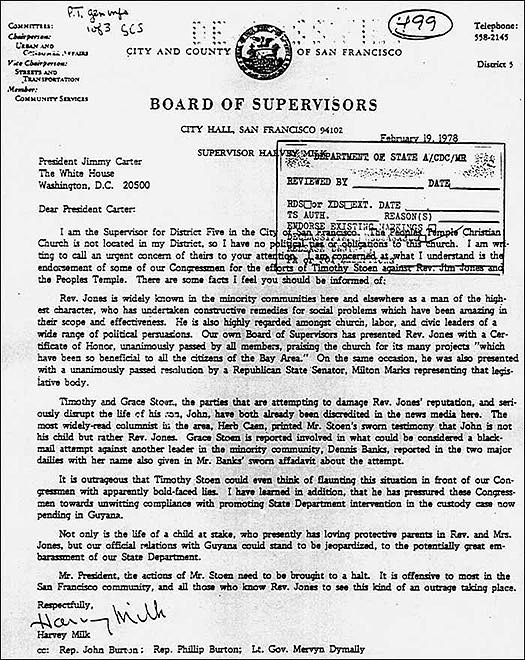
Amidst growing pressure in the United States to investigate the Temple, on February 19, 1978, Harvey Milk wrote a letter of support for the Peoples Temple to President Jimmy Carter.[30] After Congressman Leo Ryan announced that he would investigate Jonestown after the November 1978 elections, Willie Brown was still planning a fundraising dinner for the Temple that was to be held on December 2, 1978.[31]
[edit] Tragedy at the Temple's Jonestown agricultural commune
In 1974, the Peoples Temple signed a lease to rent land in Guyana.[32] Former Temple member Tim Carter describes the reason for this move as "in seventy four (1974), what we saw in the United States was creeping fascism."[33] Carter explained, "It was apparent that corporations, or the multinationals, were getting much larger, their influence was growing within the government, and the United States is a racist place."[33] Carter said the Temple concluded that Guyana was "a place in a black country where our black members could live in peace", "it was a socialist government" and it was "the only English speaking country in South America."[33]


The town created on this property, Jonestown, had as few as 50 residents in early 1977.
Increasing media scrutiny based upon allegations by former members placed further pressure on Jones in 1977; in particular, an article by Marshall Kilduff in New West Magazine.[9] Just before publication of the New West Magazine piece, editor Rosalie Wright telephoned Jones to read him the article.[34] Wright explained that she was only doing so before publication because of "all the support letters we received on your behalf, from the Governor of California (Jerry Brown)" and others.[35] While still on the phone listening to the allegations contained in the article, Jones wrote a note to Temple members in the room with him that said "We leave tonight. Notify Georgetown (Guyana)."[35]
After Jim Jones left for Guyana, he encouraged Temple members to follow him there. The population grew to over 900 people by the end of 1978. Those who moved there were promised a tropical paradise, free from the supposed wickedness of the outside world.
On November 17, 1978, the group was visited at Jonestown by Leo Ryan, a United States Congressman from San Francisco, California, who was investigating claims of abuse within the Peoples Temple. During this visit, a number of Temple members expressed a desire to leave with the Congressman, and on the afternoon of November 18, these members accompanied Ryan to the local airstrip at Port Kaituma. There they were intercepted by Temple security guards who opened fire on the group, killing Congressman Ryan, three journalists, and one of the Temple defectors. A few seconds of gunfire from the incident were captured on video by Bob Brown, one of the journalists killed in the attack.
On the evening of November 18, in Jonestown, Jones ordered his congregation to drink cyanide-laced Flavor Aid. It was later determined that Jones died from a gunshot, with a contact wound in a location and angle consistent with being self-inflicted. His body was also found to contain high doses of drugs. In all, 918 people died, including over 270 children.[36][37] This includes four that died at the Temple headquarters in Georgetown that night.[38]
[edit] Aftermath of the tragedy
At the end of 1978, the Temple declared bankruptcy and its assets went into receivership.[39] A few Temple members remained in Guyana through May 1979 to wrap up the movement’s affairs, then returned to anonymity within the U.S.[39]
Eleven years after the mass suicide at Jonestown, the building housing the Peoples Temple in San Francisco (at 1849 Geary Boulevard in the city's Western Addition neighborhood) sustained structural damage in the Loma Prieta earthquake.[39] Since the owner was unwilling to reinforce the structure, the building was demolished, and the property remained undeveloped until the United States Postal Service opened a post office at the site in the late 1990s.
The Temple’s buildings in Los Angeles (1366 S. Alvarado St.), Indianapolis and Redwood Valley are intact, and some are used by church congregations.[39] The Central Spanish Seventh-day Adventist Church is currently located at the Temple's former Los Angeles building at 1366 South Alvarado St.[40]
[edit] Quote

- "When you meet the friendliest people you have ever known, who introduce you to the most loving group of people you've ever encountered, and you find the leader to be the most inspired, caring, compassionate and understanding person you've ever met, and then you learn the cause of the group is something you never dared hope could be accomplished, and all of this sounds too good to be true-it probably is too good to be true! Don't give up your education, your hopes and ambitions to follow a rainbow." by Jeannie Mills who was an early defector from the Peoples Temple.[citation needed]
[edit] See also
[edit] References
- ^ Jones, Jim. "Transcript of Recovered FBI tape Q 1023." Alternative Considerations of Jonestown and Peoples Temple. Jonestown Project: San Diego State University.
- ^ a b Jones, Jim. "Transcript of Recovered FBI tape Q 1053." Alternative Considerations of Jonestown and Peoples Temple. Jonestown Project: San Diego State University.
- ^ Layton, Deborah. Seductive Poison. Anchor, 1999. ISBN 0-3854-8984-6. page 53.
- ^ Jones, Jim. "Transcript of Recovered FBI tape Q 757." Alternative Considerations of Jonestown and Peoples Temple. Jonestown Project: San Diego State University.
- ^ a b Jones, Jim. "Transcript of Recovered FBI tape Q 134." Alternative Considerations of Jonestown and Peoples Temple. Jonestown Project: San Diego State University.
- ^ a b c d e f g h i j k l m n o p q r Wessinger, Catherine. How the Millennium Comes Violently: From Jonestown to Heaven's Gate. Seven Bridges Press, 2000. ISBN 978-1889119243.
- ^ Layton, Deborah. Seductive Poison. Anchor, 1999. ISBN 0-3854-8984-6. p. 65-6.
- ^ a b c d e f Lindsay, Robert. "How Rev. Jim Jones Gained His Power Over Followers." New York Times. 26 November 1978.
- ^ a b c d Kilduff, Marshall and Phil Tracy. "Inside Peoples Temple." New West Magazine. 1 August 1977 (hosted at Alternative Considerations of Jonestown and Peoples Temple. Jonestown Project: San Diego State University).
- ^ Jones, Jim. "The Letter Killeth." Original material reprint. Department of Religious Studies. San Diego State University.
- ^ a b c Reiterman, Tim and John Jacobs. Raven: The Untold Story of Reverend Jim Jones and His People. Dutton, 1982. ISBN 0-525-24136-1. p. 211-4.
- ^ Kinsolving, Lester. "SEX, SOCIALISM, AND CHILD TORTURE WITH REV. JIM JONES." San Francisco Examiner. September 1972.
- ^ Hall, John R. "The Impact of Apostates on the Trajectory of Religious Movement: The Case of the Peoples Temple", in David G. Bromley (ed.) Falling from the Faith: Causes and Consequences of Religious Apostasy. Sage Publications, 1988. ISBN 0-8039-3188-3. page 234.
- ^ 'The Opposition, The Returned, Crisis & White Nights', Jonestown Institute, San Diego State University, May 2008.
- ^ Hall, John R. (1987). Gone from the Promised Land: Jonestown in American Cultural History. New Brunswick, New Jersey: Transaction Publishers. ISBN 0-88738-124-3. page 166
- ^ Hall, John R. (1987). Gone from the Promised Land: Jonestown in American Cultural History. New Brunswick, New Jersey: Transaction Publishers, 95. ISBN 0-88738-124-3.
- ^ Lewis, Mike. "Jones disciple recovers from, recalls painful past." Seattle Post-Intelligencer. 19 November 2003. at rickross.com.
- ^ Dickerson, Toby. Peoples Temple (Jonestown). The Religious Movements Homepage Project. University of Virginia. 5 February 2005.
- ^ Jones, Jim in conversation with John Maher. "Transcript of Recovered FBI tape Q 622." Alternative Considerations of Jonestown and Peoples Temple. Jonestown Project: San Diego State University.]
- ^ Reiterman, Tim, Tom Reiterman, and John Jacobs. Raven: The Untold Story of Reverend Jim Jones and His People. Dutton, 1982. ISBN 0-525-24136-1. page 302.
- ^ Reiterman, Tim, Tom Reiterman, and John Jacobs. Raven: The Untold Story of Reverend Jim Jones and His People. Dutton, 1982. ISBN 0-525-24136-1. page 304.
- ^ Jim Jones, "Transcript of Recovered FBI tape Q 799." Alternative Considerations of Jonestown and Peoples Temple. Jonestown Project: San Diego State University.
- ^ Reiterman, Tim, Tom Reiterman, and John Jacobs. Raven: The Untold Story of Reverend Jim Jones and His People. Dutton, 1982. ISBN 0-525-24136-1. page 266.
- ^ a b Kinsolving, Kathleen and Tom. "Madman in Our Midst: Jim Jones and the California Cover Up." 1998. at rickross.com.
- ^ a b Jonestown: The Life and Death of Peoples Temple. PBS.org.
- ^ Layton, Deborah. Seductive Poison. Anchor, 1999. ISBN 0-3854-8984-6. p. 105.
- ^ Dooley, Nancy, and Tim Reiterman. "Jim Jones: Power Broker." San Francisco Examiner. 7 August 1977.
- ^ "Another Day of Death." Time Magazine. 11 December 1978.
- ^ Reiterman, Tim, Tom Reiterman, and John Jacobs. Raven: The Untold Story of Reverend Jim Jones and His People. Dutton, 1982. ISBN 0-525-24136-1. page 327
- ^ Milk, Harvey. Letter Addressed to President Jimmy Carter, Dated February 19, 1978.
- ^ Richardson, James (1997). Willie Brown: A Biography. Berkeley: University of California Press. ISBN 0585249857.
- ^ Reiterman, Tim, Tom Reiterman, and John Jacobs. Raven: The Untold Story of Reverend Jim Jones and His People. Dutton, 1982. ISBN 0-525-24136-1. page 240-41.
- ^ a b c Tim Carter. There was no choice in Jonestown that day... Oregon Public Broadcasting Radio interview. 9 April 2007.
- ^ Layton, Deborah. Seductive Poison. Anchor, 1999. ISBN 0-3854-8984-6. page 111-116.
- ^ a b Layton, Deborah. Seductive Poison. Anchor, 1999. ISBN 0-3854-8984-6. page 113.
- ^ Nakao, Annie. "The ghastly Peoples Temple deaths shocked the world." San Francisco Chronicle. 14 April 2005.
- ^ Knapp, Don. "Jonestown massacre + 20: Questions linger." CNN.com. 18 November 1998. Accessed on 9 April 2007.
- ^ Reiterman, Tim, Tom Reiterman, and John Jacobs. Raven: The Untold Story of Reverend Jim Jones and His People. Dutton, 1982. ISBN 0-525-24136-1. page 544-5.
- ^ a b c d "What happened to Peoples Temple after 18 November 1978?" Alternative Considerations of Jonestown and Peoples Temple. San Diego State University: Jonestown Project. 2007-03-08.
- ^ Central Spanish Seventh-day Adventist Church. AdventistChurchConnect.org.
[edit] Further reading
- Klineman, George and Sherman Butler. The Cult That Died G.P. Putnam's Sons, 1980. ISBN 0-399-12540-X.
- Naipaul, Shiva. Black and White. London, 1980. ISBN 0-241-10337-1.
[edit] External links
- San Diego State University: Extensive site with source documents, list of dead, pictures
- Audio Recording of Jonestown Suicide
- Encyclopaedia Britannica, Peoples Temple
- Transcription of Suicide Tape
|
||||||||||||||||||||
|
|||||||||||||||||
|
|||||||||||||||||||||||