Pandur 8X8 APC
From Wikipedia, the free encyclopedia
| Pandur 8X8 APC | |
|---|---|
| Type | Armoured personnel carrier |
| Place of origin | Austria |
| Production history | |
| Manufacturer | Steyr-Daimler-Puch |
| Specifications | |
| Weight | 22 tonnes |
| Length | 7.02 m (23 ft) |
| Width | 2.67 m (8 ft 9in) |
| Height | 1.85 m (6ft 1 in) |
| Crew | 2 + 12 (APC version) |
|
|
|
| Primary armament |
Up to 105 mm gun in turret |
| Secondary armament |
Machine gun |
| Engine | 6-cylinder in-line liquid-cooled turbo-charged intercooled diesel 335 kW |
| Payload capacity | 8.5 tonnes |
| Operational range |
Approx. 700 km |
| Speed | 105 km/h (65 mph) (road) |
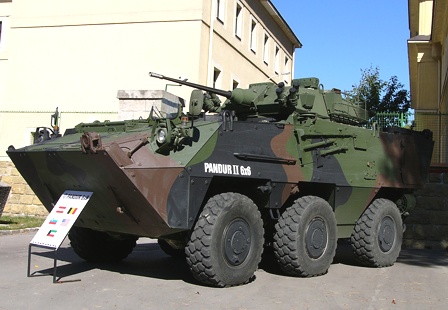
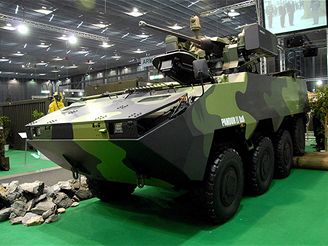
The Pandur II 8 X 8 is an improved modular all-wheel-drive version of the Pandur 6X6 APC wheeled armoured vehicle. It was developed as a private venture by the Austrian company Steyr-Daimler-Puch Spezialfahrzeuge and is currently in production for the Portuguese Armed Forces. Steyr-Daimler-Puch Spezialfahrzeuge is part of General Dynamics European Land Combat Systems, which is also the parent company of Mowag of Switzerland and Santa Barbara Sistemas of Spain.
The most significant change is the introduction of an 8 x 8 configuration with more interior space. The construction is an all-welded steel hull with optional armour upgrades. The basic armour package is designed to protect against 7.62mm (0.3in) to 14.5mm armour piercing rounds (Customer is allowed to choose armour thickness). The vehicle is designed to be transportable in a Lockheed Martin C-130 Hercules transport aircraft. The driver is seated on the left at the front and the engine is to the right. The driver is provided with a single piece hatch cover as well as three day periscopes, one of which can be replaced by a passive periscope for night missions. The vehicle is fitted with a two stage synchronized distribution gear box for both road and cross country use. Improved suspension will be fitted for optimum cross country mobility. It is designed to take a number of turret systems, such as the SP 30 turret also mounted on the ASCOD AFV of the Spanish and Austrian Armies, or can be used as a standard APC with a mounted machine gun.
With the turret the vehicle can carry six infantry. Without the turret, it can carry 12.
Contents |
[edit] Versions
[edit] Variants
 |
This article may require cleanup to meet Wikipedia's quality standards. Please improve this article if you can. (June 2008) |
[edit] Portuguese variants
- Transport with machine gun: armed with 12.7mm machinegun and capable of transpor 11 soldiers.
(Portuguese Army:140) (Portuguese Marines:10)
- Transport with machinegun in a turret: armed with 12.7mm machinegun in a turret and capable of transport 9 soldiers. (Portuguese Army:7)
- Command: HQ vehicle.
(Portuguese Army:24) (Portuguese Marines:3)
- Mortar: equipped with a 120mm mortar, a 10 shots/min. capability to a 6 mile range and with a 5 or 6 man crew.
(Portuguese Army:31) (Portuguese Marines:2)
- Recovery and Maintenance:
(Portuguese Army:9) (Portuguese Marines:1)
- 105mm turret:
(Portuguese Army:7)
- Ambulance:
(Portuguese Army:12) (Portuguese Marines:2)
- Anti-Tank:
(Portuguese Army:20)
- 25mm cannon: capable of transport 5 to 7 soldiers.
(Portuguese Army:32) (Portuguese Marines:2)
- NBQ:
(Portuguese Army:2)
- Engineering:
(Portuguese Army:9)
- Signals:
(Portuguese Army:9)
- Surveillance:
(Portuguese Army:4)
[edit] Pandur II 8x8 CZ
- Update - 17 Pandurs II CZ have been produced in Austria.
On 11.12.2007 - Czech rep. announced Pandur II does not meet 24 contract points from 94 total.
On 8.1.2008 - Czech rep. definitely withdraw from contract. It is very likely that Czech armed forces will choose Patria AMV as the second option. Patria is able to deliver first vehicles within 3 months so that Czech soldiers can use them in Afghanistan in spring.
On 29.2.2008 - Czech government is still negotiating with Steyr company about the contract. Now it seems probable that Czech armed forces with order only 107 Pandurs (so the price of contract should be approximetely halved).
On January 2005 Czech Rep. ordered 199 Pandurs II 8x8 for almost 1 billion USD.[5][6] However the contract was cancelled on December 2007, because the vehicles failed military tests and the producer was not able to fix problems in time.
The Czech Pandur II differs from its original version in a new, from inside of the vehicle controlled breakwater, and driver's hatch equipped with CDND-1 night vision aparature. The armor is designed to protect against 14.5x114 (with RAFAEL add-on passive armour; the Portuguese Army chose Steyr add-on armour). SSAB ARMOX 5000[14] armour steel is used for the bottom side of the hull. (The Slovak Aligator 4x4 is equipped with ARMOX 540HB. Its six millimetre ARMOX armour protects the crew from 7.62mm AP rounds.) Standard Pandur II has a flat bottom, but Pandur II CZ has its bottom shaped to the "/\" (reversed "V"). Due to some sources this shape is better because it doesn't reflect the mine blast on the wheels. There are three robust cameras (left, right and rear) giving the ability to driver to reverse without leader's help or observe around the vehicle. Driver has one monitor for this purpose. The cameras are from Orlaco company[15] much like monitor in troop section.[16]
But we can find some changes on RCWS-30 too.
The Czech IFV version (KBVP) will be equipped with upgraded Rafael RCWS-30. Upgraded RCWS-30 include: 30mm ATK MK 44, optional launcher pod for two RAFAEL Spike-LR anti-tank/multi-purpose guided missiles, coaxial 7.62mm General-Purpose Machine Gun, and two triple (2×3) smoke grenade launcher tubes. Fire-ready ammunition accommodates 140 high-explosive (HE) and 60 armor-piercing (AP) 30mm rounds, 2 Spike-LR missiles, 460×7.62mm rounds, and 6×76.2mm smoke grenades. The missiles container is newly located vertically.
In contradistinction to "ordinary" RCWS-30, the Czech RCWS has 2 new CCD/IR cameras with rangefinder/laser designator with 360° coverage. The original camera was replaced by a new one and a second camera is mast-mounted on the right side of the RCWS (circa 3,5 meters above the ground). The commander's hatch visor was removed. With new mast-mounted camera the commander gained new ability to independently observe the surroundings and to seek and track enemies (commander can take over weapons's control or designate target for gunner). All Czech IFVs will be equipped with mast-mounted meteorological sensor with laser illumination warner connected to FCS. This mast-mounted system will be located on the left side of RCWS just like commander's independent thermal viewer.
- Other differences
Czech Pandurs II 8x8 also include navigation, information, communication and identification system. The Pandurs without RCWS-30 will be unarmed or equipped with Rafael Mini-Samson RCWS-12.7[19][20] or 120mm mortar. Rafael RCWSs bought by Czech republic: 78x RCWS-30, 14 RCWS-30 (with no Spike-LR missiles), 93 Mini-Samson RCWS units that carry 12.7mm machine gun. Its engine can be removed and replaced in 30 minutes.
[edit] Operators
In 2005 the Portuguese Government signed a deal for 260 vehicles in 15 different variants, of which 218 will be produced locally under license by Fabrequipa. The purchase price was EUR 364 million. The armament includes variants with Steyr SP 30 turrets and ranges from cal. 12.7 mm machine gun to cal. 120 mm mortar. The first batch of vehicles arrived in early 2008. On October 1, 2007 the first batch was rejected by the Portuguese Government, citing "unfulfilled technical requirements".[21] Also cited were "technical problems"[22] with the vehicle's hydraulic and night vision systems, detected during the initial trials.
Steyr SSF scored another export success in 2006, when the Czech Republic ordered 199 (plus 35 optional) Pandur II 8x8 vehicles for delivery between 2007 and 2012. 18 different variants will be delivered. The most numerous will be the IFV version (63) equipped with a remote-controlled weapons station produced by Rafael of Israel. This system will feature an ATK 30mm MK 44 cannon, 7.62mm co-axial machine gun and a launcher for the Spike-LR anti-tank guided weapon system. [1]. The contract was however cancelled following delivery and acceptance, as well as to domestic politics.[23]
Currently Steyr Spezialfahrzeuge is participating in two competitions, in Croatia and Macedonia. In both countries the Pandur faces a tough competition from the Patria AMV.
The Austrian Army has stated a requirement for up to 128 Pandur II, to equip two army battalions, but is currently lacking funds for this purchase.
The Pandur 8X8 APC is manufactured in Austria while export versions are also built in the Czech Republic and licensed versions in Barreiro, Portugal.
 Austrian Army (224 Pandur I and II)
 Gabon (1 Pandur II for testing)
 Portuguese Army (240 Pandur II)
- Portuguese Navy (20 Pandur II)
[edit] Criticisms
The Czech military recently purchased 199 Pandur IIs worth over 23 billion crowns. The supply of the first units has been delayed as they've performed poorly in recent test. Steyr is expected to revise the vehicles to deal with the various shortcomings.[24] Dec 11, 2007 the contract with Steyer has been resigned due to delay in delivery of Pandur IIs.
[edit] See also
[edit] References
- ^ Picture: Pandur I 6x6
- ^ Picture: Pandur II 8x8
- ^ Picture: Pandur II 6x6
- ^ Picture: Pandur II 6x6
- ^ Picture gallery: First two czech Pandurs II 8x8
- ^ Picture gallery: First two czech Pandurs II 8x8
- ^ Picture: Czech IFV Pandur 8x8 (notice two new cameras)
- ^ Picture: Czech IFV Pandur 8x8 (Also notice new one inch thick "water shield")
- ^ Picture: Czech IFV Pandur 8x8
- ^ Picture: Czech IFV Pandur 8x8
- ^ Picture: Czech IFV Pandur 8x8
- ^ Picture: Czech IFV Pandur 8x8
- ^ AUT - Pandur II :: forum.valka.cz
- ^ SSAB Armox
- ^ Orlaco company
- ^ Picture: Orlaco camera
- ^ RCWS-30
- ^ RCWS-30
- ^ Mini-Samson RCWS-12.7mm (Czech Pandur has the version mounted on Namer APC)
- ^ The Mini-Smason RCWS by which is Czech IFV equipped
- ^ Correio da Manhã newspaper, Ministro cancela entrega de novos blindadosAccessed 2 October 2007
- ^ Correio da Manhã newspaper, "Defesa: Pandur 8x8 sem sistema de vigilância nocturna". Accessed 2 October 2007.
- ^ www.defenseindustrydaily.com Dec 11/07: The Czech Government cancels the Pandur contract.
- ^ Czech Military to purchase Iveco MLV