Talk:North American Union
From Wikipedia, the free encyclopedia


 Archives |
|
Archive 1 Apr 2006 - Dec 2007 |
Contents |
[edit] Ron Paul
Are the references to Rep. Paul really necessary? —Preceding unsigned comment added by 75.199.143.8 (talk) 02:55, 26 April 2008 (UTC)
[edit] Eventual inclusion of Central America in North American Union
With the establishment of the Union of South American Nations on 8 December 2004, it seems inevitable that if a North American Union is established that is will need to expand soon after its establishment to also include the nations of Central America, which are now linked with the United States in CAFTA. Keraunos (talk) 03:45, 13 March 2008 (UTC)
If Central America joins a future North American Union, then the nation of Panama will have to decide whether to join the North American Union or the Union of South American Nations. It seems likely that they would choose to join the Union of South American Nations because Panamanians generally regard themselves as South Americans because Panama used to be part of Colombia before it was detached by the United States from that country in order to construct the Panama Canal. Keraunos (talk) 02:56, 16 March 2008 (UTC)
- Why stop there? Why not assume a "World Union"? Or even better, how about a "Federation of Planets"? Since Nafta-plus seems increasingly likely to be limited to issues of security, and fine-tuning trade issues, making the concept of a North American Union an even more distant dream - or nightmare, depending on your point of view - it is, to put it politely, premature to start talking about trade groups which barely even exist on paper and how they might on day unite.
Canada Jack (talk) 17:52, 13 March 2008 (UTC)
I’m a futurist. It’s my job to think ahead! Keraunos (talk) 02:56, 16 March 2008 (UTC)
[edit] Fox source of North American Union talk
This line, which I think comes from Devil, is, I believe, false: The source of most mainstream contemporary interest in a North American Union is President Vicente Fox of Mexico's proposal for a "NAFTA-Plus" agreement with the United States and Canada during President Bush's first term.
AS far as I know, "interest" in the concept of the North American Union came once Corsi etc started to suggest plans were in the work. And that conclusion was based on his observations of the lax policiing of the Mexican border, in his view, combined with the SPP, and then the Task Force recommendations. And this "interest" commenced during the year 2005. Subsequently, Corsi and others have seized on Fox's pro-integration comments, in particular during his recent book tour, as "confirmation" that the NAU is in fact in the works. From that viewpoint, others have dredged up old comments by Fox which support the concept of an enhanced Nafta, put to pretend that concern over a North American Union started with Fox's comments is not supported by anything I have seen. If no citation can be found, then the line should be reworked or deleted. Canada Jack (talk) 18:02, 13 March 2008 (UTC)
-
- CNN talks about North American Union too all the time... ESP. on the segments by Lou Dobbs....
- A Google search of "Lou Dobbs and North American Union" -- Look at all the on-air transcripts of CNN with the words "North American Union. CaribDigita (talk) 22:54, 18 March 2008 (UTC)
- I think that is part of the point that Canada Jack is trying make: President Fox is not necessarily the source of contemporary interest in a NAU. --Kralizec! (talk) 01:11, 19 March 2008 (UTC)
- Absolutely. I think we have the structure here right - the SPP, the task Force, etc., then how Corsi etc started to make this an issue, and Lou Dobbs. But this was not an issue until Corsi and others made it an issue. Indeed, Dobbs himself didn't say anything about the NAU until June 2006, as far as I can tell. And if you check some of the articles on the subject I fail to see how Vicente Fox fits in. The genesis of the issue, clearly, is the reaction to the SPP. And the process from Nafta to the SPP as far as I can tell involved business interests. Even the articles suggesting a conspiracy seem to suggest this. Fox's role is peripheral, but the way the article is set up it seems as if it was his push that was the catalyst. Canada Jack (talk) 17:16, 19 March 2008 (UTC)
- CNN talks about North American Union too all the time... ESP. on the segments by Lou Dobbs....
- Devil: What you just added makes this look a lot better, but we need to clean this up to make it somewhat more coherent. First, and I am pretty sure this wasn't your contribution, but in terms of the flow here, the "technate" stuff should probably go as I fail to see how this is connected to anything we are talking about in terms of a North American Union - it is in my view one of many proposals over many years to unite North America or the Americas in some fashion, not as far as I am aware something cited by any of the players as driving the current process. If this was an article about general proposals for economic unions within the Americas, then fine. But this article is more specifically about something called the North American Union which has nothing to do with the technate as far as I know.
- Next, I think we should omit a lot of what Fox said in 2001/2 as it is no longer relevant, except a few points in passing, such as to suggest he had more ambitious plans. Your approach to focus on the SPP and cite Fox as at least a major focus in that is the best approach. I think it is fair to state that the NAU as an issue was not brought forth until the appearance of the SPP, (which was my initial point you have now addressed) so describing that and then moving onto Fox as a driver behind that is good. But I don't see the point in getting bogged down in what Fox wanted years ago, I think it suffices to say that more ambitious plans were met by the political realities post911, which turned the political focus within America to security issues. And then the Task Force stuff, and then the general reaction towards what was perceived to be a movement towards the NAU. Agreed? Canada Jack (talk) 22:36, 13 March 2008 (UTC)
- The article mentions a theoretical continental union. When talking about the origins it is only natural to have such proposals included.--The Devil's Advocate (talk) 19:23, 14 March 2008 (UTC)
- No, Devil, it does not follow. There have been many theoretical proposals in the past, and there are numerous ones now. The only reason the technate should be included here, since we are talking about a rather specific concept called the North American Union, is if it is somehow explicitly connected to it. Such as Nafta-plus, such as Fox's statement, such as the SPP, such as the Task Force. All of which are cited as being part of the process leading to one of the other elements, or claimed by others to be. We can include talk of the technate if, say, Vicente Fox cited it as an inspiration when he was discussing Nafta-plus. Or if, say, Corsi suggested that the technate is what the three governments are using as an inspiration, or what have you. In other words, for this to be included, there should be an explicit cited connection. If none exists, we should delete the references as it by definition adds nothing to the article and is not relevant to it. Canada Jack (talk) 20:11, 14 March 2008 (UTC)
- So because they use the word technate rather than union it shall not stay? The proposal while different in substance is the same in concept. It involves the union of North American states with a government regulating affairs. This article may have originally been created to paint the NAU as some nonsense cooked up in a conspiracist nutterball convention but I honestly don't think it should stick to that. The introduction already treats it as a theoretical union and a concept. Overall it is referring to the concept or idea. It includes comments about present events and how they have spurred modern-day discussion about an NAU, but that doesn't mean anything not dealing with that is irrelevant.--The Devil's Advocate (talk) 20:02, 15 March 2008 (UTC)
- No, Devil, it does not follow. There have been many theoretical proposals in the past, and there are numerous ones now. The only reason the technate should be included here, since we are talking about a rather specific concept called the North American Union, is if it is somehow explicitly connected to it. Such as Nafta-plus, such as Fox's statement, such as the SPP, such as the Task Force. All of which are cited as being part of the process leading to one of the other elements, or claimed by others to be. We can include talk of the technate if, say, Vicente Fox cited it as an inspiration when he was discussing Nafta-plus. Or if, say, Corsi suggested that the technate is what the three governments are using as an inspiration, or what have you. In other words, for this to be included, there should be an explicit cited connection. If none exists, we should delete the references as it by definition adds nothing to the article and is not relevant to it. Canada Jack (talk) 20:11, 14 March 2008 (UTC)
- The article mentions a theoretical continental union. When talking about the origins it is only natural to have such proposals included.--The Devil's Advocate (talk) 19:23, 14 March 2008 (UTC)
And, as I revisit the "Fox" stuff, where the SPP is said to have emerged from Nafta-plus proposals as put forward by Fox, I have found a rather large disconnect between what the text here says and what the links which supposedly cite this say. In the "SPP" part, the "Nafta-plus" stuff is cited, but the linked article doesn't mention Fox in this regard, it suggests instead that business leaders saw the post-911 climate as one where certain economic goals could be achieved, with some 13 proposals emerging from the business community. Then, we have Fox describing what Nafta-plus would entail, (such as common energy policy etc) but the linked article in fact simply talks about his efforts vis-a-vis immigration reform and how such reform would greatly enhance the current trade bloc. And the various political realities (it being early 2004 with Bush up for re-election when the cited article was written). Then, "according to other reports" other elements are described. But the linked article in fact is description of a 2002 conference where various scholars discuss concepts with no mention at all of Fox. Indeed, the link is simply to a think tank with no indication as to why this particular meeting was of any importance, as it seems from the earlier SPP link that most of the Nafta-plus stuff came not from think tanks, not from Vicente Fox, but from various business groups. Finally, we go back to Fox again where he states a hope for a "convergence" of economies, quotes from a 2001 interview. But that interview simply describes his hopes then for a Nafta-plus process without saying anything about what that should entail, outside of the hope for a convergence of the standards of living.
In other words, given the above, this has to be rewritten. First, omit the "technate" stuff as this is irrelevant as no one seems to have cited this concept. Next, start with SPP as we have it, note what the sources note - that the Nafta-plus movement was propelled by the business community in light of the post911 atmosphere, with support from Fox in particular who had been on the record for wanting this. The latter point about the influence of 911 should be moved up as the true (and citable) impetus for SPP as there is nothing I have seen here so far to suggest that Fox started the process, just that he was amenable to it. And then note that the Task Force, a think-tank, proposed much more ambitious convergence and supported the SPP.
The advantage here is that all this would be supported by the cited links. Unless we can get something more concrete as to Fox propelling the SPP process, we should go with the post-911 business community instead as this is what the sources describe. Cheers Canada Jack (talk) 21:46, 14 March 2008 (UTC)
- It seems you have a tendency to misread what other people state. The site linking SPP and NAFTA plus refers to the "continentalist right" making proposals, but then says, "These groups, realizing no such deal was emerging, started thinking about creating the necessary preconditions for what they often term a NAFTA-Plus, to advance the concept of a North American Community. For them, the SPP is about incremental steps leading to a customs union of common external tariffs and perhaps even a monetary union with the U.S." Actually it even seems you're not reading the sources as the conference you brought up explicitly mentions Fox and in fact says, "Mexican President Vicente Fox’s proposal to develop a “NAFTA plus,” which would include a common market, development fund, migration agreement and new institutions". The Fox News interview also mentions NAFTA plus at the end. So nothing you've said is accurate. I don't see how it can even be questioned whether all the talk of increasing integration led to the SPP. Did the SPP just appear out of thin air? How was 9-11 at all connected to economic integration? Things like the SPP emerge out of negotiations and these negotiations were for increased integration and proposals for a NAFTA-plus were a big part of this.--The Devil's Advocate (talk) 20:02, 15 March 2008 (UTC)
Absolutely the North Americn technate should remain in the article because this was the first serious proposal ever made for the creation of a North American Union and as such it is highly relevant. Keraunos (talk) 03:05, 16 March 2008 (UTC)
- Says who? That's my point. Who says the technate led to what we are talking about now? Canada Jack (talk) 14:43, 17 March 2008 (UTC)
More on the technate - anything I have read on this reveals this was proposed as a union of the Americas, not a "North American Union" at all! All the more reason for its deletion as it does not a) speak to a North American Union, it speaks instead to a Union of the Americas and b) no link between what we speak today when we discuss the NAU or the SPP or even Nafta makes any reference to this proposal. It is therefore not relevant. Even if you want to include, for historical interest, past proposals for a north american union, that won't work either as it wasn't a proposal for such an entity! Canada Jack (talk) 18:10, 17 March 2008 (UTC)
- The numerous proposals for European unification prior to the EU are included in the history of the EU. Also it is very much a "North American Union" they call it the "North American Technate"! Central America is traditionally considered part of North America and the Caribbean is traditionally oriented towards North America. The technate proposal includes a small part of South America and so you're going to say it isn't a proposal for a North American Union even when they actually say it is North America not the entire Americas they want to unify? Russia is often included in Europe even though most of the country is actually in Asia.--The Devil's Advocate (talk) 23:03, 17 March 2008 (UTC)
[edit] Fox source section break
Devil, the only precursors to the EU mentioned on the European Union page are those entities which formed part of the European Union! Such as the European Coal and Steel Community. These various entities are pertinent to a discussion on the origins of the EU as they led directly to the EU! Where, prey tell, does the technate fit in? I remind you that the heading says "Origin of the Concept of the North American Union," not "Previous proposals for continental union." Again, if you cannot establish how the technate led to, say, Nafta, or any other of the proposals/pacts we have already established, then the part should be deleted as it no where is it established how the technate concept led to the North American Union concept. Your argument about the technate's inclusion of the Caribbean and South America shows to me you are missing the point - how did the technate lead to the North American Union? I mentioned all that because if this did lead to Nafta or what have you, then what caused all those other countries to not be included? My answer is that it would seem that the technate was not a concept considered by the countries in question and unless you can show otherwise, it should be excised. Canada Jack (talk) 15:28, 18 March 2008 (UTC)
-
- As for your response, Devil, you are right - I didn't see the part at the end where he says exactly what the text says. What you say Fox's proposals are in fact correct as per the sources. However, this does not negate the major problem I see with what exactly Fox's role here in what Nafta has become.
-
- As I have said on many occasions, it is clear that Fox has been long in favour of a greater integration with America and Canada, along the lines of the ECC or EU. However, we must be careful in explicitly making the link from Fox's desires for an enhanced Nafta (whatever one chooses to call it) to what emerged in terms of the SPP. Because, despite you correctly pointing out that I had not read some key sections of the cited documents where Fox indeed was correctly credited with pushing for those aspects (on Fox TV and at the Conference), the article about the SPP does not make the connection between what Fox has proposed and what SPP became. In other words, the disconnect is still there. Both documents, it should be noted, came before the formation of the SPP, therefore can't establish that Fox's concepts were part of the impetus for the SPP.
-
- I don't see how it can even be questioned whether all the talk of increasing integration led to the SPP. Did the SPP just appear out of thin air? How was 9-11 at all connected to economic integration? Things like the SPP emerge out of negotiations and these negotiations were for increased integration and proposals for a NAFTA-plus were a big part of this.
-
- Sure, the SPP didn't pop out of thin air. And that is the aim of this section, to trace the origins of the SPP as it relates to the NAU. But the push which led to SPP - at least according to the cited article - did not come from Fox, but from others. And, it would seem this is merely your reading of his role in terms of the source for the SPP, and, thus far, not the reading we are getting from the cited article. It is, therefore, original research. While I admit that you are correct as to what Fox said in that interview and what the conference said in terms of what he saw for a "Nafta-plus" you thus far have not made the connection to SPP. And that is the key point. So far, the cited article suggests that the impetus for the SPP was a) Canada, coming up with, after 911, the Smart Border Accord, and b) business leaders and the "continentalist right" after 911 coming up with 13 proposals to move beyond Nafta, eventually settling on incremental reforms they often called "Nafta-plus." It would seem that you have embraced what the article terms as "Nafta-plus" and conflated that with what Fox has also called "Nafta-plus" not realizing that what the article here says propelled SPP was not what Fox was talking about, as there is no indication that the "continentalist right" was receiving their cues from Vicente Fox.
-
- But I am leaving the most important part to the last. Earlier, it was suggested we insert text from Fox's recent book on this matter, on the NAU in general and on his role in the SPP/NAU in particular. And when I actually saw his book, what I have found, coming from Fox himself, is a denial that Bush took his push for Nafta-plus seriously. Indeed, he says the precise opposite and in terms reflecting bitterness. It is clear from Fox's own take on this, written, I should note, after he left office and when he could let down his diplomatic guard, that Fox himself didn't see his goals for something akin to the NAU taken seriously and the actual impetus to SPP came from the political climate after 911, not from his own proposals for an enhanced Nafta. I shall endeavour to get a copy of this book to transcribe his precise take on this. So, while Fox's ideas for a Nafta-plus may be of some academic interest, we still need the explicit link between his proposals and the SPP, which, thus far, is lacking. Canada Jack (talk) 16:17, 17 March 2008 (UTC)
- The article does establish that his proposals were shot down already at least as far as immigration is concerned, which is really why there is a big deal made about it in the U.S. The sources do attest to Mexico pushing immigration reform but 9-11 causing this to get shot down. The sources do attest to Nafta Plus discussion and talk of further integration among all three nations being the cause of the SPP. All that is established in the article is specifically what Vicente Fox wanted, in particular on immigration and that those concerns on immigration were left out of the SPP.--The Devil's Advocate (talk) 23:03, 17 March 2008 (UTC)
- But I am leaving the most important part to the last. Earlier, it was suggested we insert text from Fox's recent book on this matter, on the NAU in general and on his role in the SPP/NAU in particular. And when I actually saw his book, what I have found, coming from Fox himself, is a denial that Bush took his push for Nafta-plus seriously. Indeed, he says the precise opposite and in terms reflecting bitterness. It is clear from Fox's own take on this, written, I should note, after he left office and when he could let down his diplomatic guard, that Fox himself didn't see his goals for something akin to the NAU taken seriously and the actual impetus to SPP came from the political climate after 911, not from his own proposals for an enhanced Nafta. I shall endeavour to get a copy of this book to transcribe his precise take on this. So, while Fox's ideas for a Nafta-plus may be of some academic interest, we still need the explicit link between his proposals and the SPP, which, thus far, is lacking. Canada Jack (talk) 16:17, 17 March 2008 (UTC)
Wrong. The article here suggests that talk of the NAU started with the SPP, which found its origins in proposals for "Nafta-plus." So far, so good. But then it immediately describes what Vicente Fox had in mind in terms of "Nafta-plus" giving the reader who doesn't check the source the clear impression that the "Nafta-plus" proposals which evolved into SPP came from Vicente Fox, which they did not, at least according to the source here. Even worse, it implies that the proposals Fox is credited with coming up are in fact what the SPP is dealing with, which also is not accurate. The source on the SPP describes those proposals which led to the SPP as coming from the business community (who also described their concepts as "Nafta-plus") and from Canada. For that reason, while it is pertinent to note Fox's desire for enhancing Nafta, it is wrong to suggest that he was the impetus for this, the clear implication the page here gives, and wrong to describe his proposals as being the basis for SPP. Unless, of course, you can supply another source on this. Canada Jack (talk) 15:44, 18 March 2008 (UTC)
- It wouldn't be too hard to address. Just add Canada's involvement to the article.--The Devil's Advocate (talk) 19:39, 19 March 2008 (UTC)
-
- Have you not read the above? The article says that the SPP had its origins with "nafta-plus." But the sources for that say those "nafta-plus" proposals came from the business community, not from Fox. Yet it then reads "...according to Fox they include..." and a list of his "nafta-plus" proposals. Either we find a source which describes his proposals as the ones with which the SPP was enacted, or we delete the Fox reference as it is wrong as it stands. Canada Jack (talk) 19:52, 19 March 2008 (UTC)
[edit] Proposed new text for "origins" section
The "origins" section as it stands does not accurately describe where, exactly, the concept of the NAU came from and how various people have reacted to it. As it stands, it does not read well, so I have rewritten the section, leaving some parts intact, and most points within the body of the text. Tell me what you all think... (please excuse some of the links I've left intact. Also, I've not included the various footnotes, but the advantage here is that all statements are backed up by citations)
Since at least the mid-19th century, numerous concepts for a continental union between Canada, Mexico and the United States, often including South American and Caribbean countries, have been proposed, such as the North American Technate and the Free Trade Zone of the Americas. However, current discussions on a “North American Union” emerged as a reaction to the founding of the Security and Prosperity Partnership of North America (SPP) on March 23, 2005, rather than as a reaction to any government proposal for a North American Union. The SPP was described by the leaders of Canada, Mexico and the United States as being designed to provide greater cooperation on security and economic issues. Some commentators saw the SPP instead as an effort to create an entity, which they called the North American Union (analogous to the European Union), outside of normal economic and political channels. All three governments deny that any such plans are being contemplated.
The belief that a North American Union is currently being planned and implemented has been spread in part by right-wing commentators such as Jerome Corsi, left-wing groups in Canada, internet conspiracy blogs, widely viewed videos and films such as “Zeitgeist,” and prominent critics including CNN’s Lou Dobbs and Republican presidential candidate Ron Paul. Others who dismiss these beliefs maintain they are the latest example of a long line of incorrect conspiracy theories which suggest the United States’ sovereignty is being eroded by a secret cabal of foreign and domestic players.
The SPP emerged out of the efforts of business leaders and the Canadian government to streamline border controls and further economic integration, enhancing the current NAFTA agreement, after the events of September 11, 2001. These efforts have variously been described as being a direct response to the attacks, or as an opportunity to further various economic and political goals while the citizenry were distracted by the security concerns emerging from the 9-11 attacks. Business groups proposed numerous integration plans, which eventually became various “Nafta-plus” proposals worked on by the SPP. And the Canadian government proposed enhanced border operations to ensure trade was not hindered by increased security measures taken after the attacks. While some business groups and think-tanks have proposed entities which resemble the North American Union, the proposals which actually formed the basis for the SPP were much more modest in scope.
One of those think-tanks often mentioned by critics who claim a North American Union is being enacted is the Independent Task Force on North America, a project organized by the Council on Foreign Relations (U.S.), the Canadian Council of Chief Executives, and the Mexican Council on Foreign Relations. It was launched in October 2004 and published two documents calling for greater integration between the three countries: Trinational Call for a North American Economic and Security Community by 2010 (March 2005) and its final report Building a North American Community[12] (May 2005).
Their final report, which has been described as "an academic exercise with pretensions of reaching policymakers,"[11] proposed increased international cooperation between the nations of Canada, the United States, and Mexico, similar in some respects to that of the European Community that preceded the European Union. The report called for "establishment by 2010 of a North American economic and security community, the boundaries of which would be defined by a common external tariff and an outer security perimeter." No recommendation was made for a common currency or a supranational institution like the European Union. The report said that a North American Community should not rely on "grand schemes of confederation or union".[12]
In reference to the March 2005 summit in Waco, Texas that established the SPP, the task force's final report stated, "We welcome this important development and offer this report to add urgency and specific recommendations to strengthen their efforts."[13] These specific recommendations include developing a North American customs union, common market, investment fund, energy strategy, set of regulatory standards, security perimeter, border pass, and advisory council, among other common goals.
Critics have cited the Independent Task Force’s goals as confirming the belief that a North American Union is in fact being contemplated, as it mentions specific goals said to be secretly planned by the SPP while praising the efforts of the SPP.
Of the three leaders at the 2005 founding of the SPP (American president George W. Bush, Canadian prime minister Paul Martin, Mexican president Vicente Fox), and the two subsequent leaders (Canadian prime minister Stephen Harper, Mexican president Felipe Claderon), only Fox has voiced support for the ultimate goal of an entity like the North American Union. Before the SPP and since, he has noted the success countries like Ireland and Spain have had in modernizing their economies and bringing higher standards of living for their citizens by joining what is now the European Union and has expressed the hope that Mexico could have a similar experience in a trade body of comparable scope in North America. However, he has also expressed frustration with the lack of progress towards that goal as issues such as immigration reform proved to be contentious within the United States. Various positive comments about a North American Union concept by Vicente Fox, in particular some made during a promotional tour for a book in 2007, have been cited by critics as evidence that the body is in fact being enacted or planned.
However, the three current leaders of Canada, Mexico and the United States have all characterized the goals of the SPP as being far more modest than the goals Vicente Fox has expressed and what critics have alleged is actually being contemplated.
Nevertheless, critics maintain that despite these denials, plans are being implemented beyond the scrutiny of the normal political processes in all three countries. CNN’s Lou Dobbs frequent anti-North American Union commentaries and Jerome Corsi's columns on WorldNetDaily and Human Events, as well as his best-selling book The Late Great U.S.A.: The Coming Merger With Mexico and Canada, form the core of NAU conspiracy theories.[5] Corsi is often referred to as the leader of the anti-North American Union movement.[4]
—Preceding unsigned comment added by Canada Jack (talk • contribs) 19:28, 19 March 2008
- If you want to convince people that you're not pushing a POV you should pay more attention your proposed "fixes" to the article. It seem every time one of you comes to "fix" the article you end up adding more POV, a POV that wants to paint anyone who talks about the NAU as a crazy little conspiracy wacko who refuses to acknowledge reality or logic. Some of what you put works, but a great deal of it does not.--The Devil's Advocate (talk) 20:46, 20 March 2008 (UTC)
-
- The section re-write proposed by Canada Jack looks great to me. In response to concerns expressed by The Devil`s Advocate, as long as the relevant passages are properly sourced and cited to reliable, third-party, published sources, I have no objections to it. As has been noted before, WP:NPOV#Undue weight is very clear that while minority views absolutely should be included in articles, they should not be given undue weight or made more notable than they truly are. Therefore it is entirely appropriate that this Wikipedia article frame the NAU as such, because that is what our half-dozen mainstream sources say. --Kralizec! (talk) 21:20, 20 March 2008 (UTC)
- Of course you think it looks great, you're of the same POV, you, Hemlock, and Jack all have the same POV. Undue weight does not mean you're free to ridicule a POV in an article or paint it in a negative light. Nowhere is there undue weight given to conspiracy theories on this article. The very issue being discussed does not give undue weight to said theories. Lou Dobbs and Corsi talk about the SPP as something that would eliminate borders and merge the three countries, yet the article certainly doesn't favor this view. It does point out that Fox of Mexico has advocated such action in a few decades.--The Devil's Advocate (talk) 20:53, 21 March 2008 (UTC)
- The section re-write proposed by Canada Jack looks great to me. In response to concerns expressed by The Devil`s Advocate, as long as the relevant passages are properly sourced and cited to reliable, third-party, published sources, I have no objections to it. As has been noted before, WP:NPOV#Undue weight is very clear that while minority views absolutely should be included in articles, they should not be given undue weight or made more notable than they truly are. Therefore it is entirely appropriate that this Wikipedia article frame the NAU as such, because that is what our half-dozen mainstream sources say. --Kralizec! (talk) 21:20, 20 March 2008 (UTC)
I think you should take a deep breath here, Devil. This is not about imposing some "POV" take to this, it is about making the section coherent. It isn't coherent, and your fixes today do little to make them more coherent. For example, if there is anything "POV" it is in your insistence to include Fox's "nafta-plus" proposals even though a) the SPP sources say nothing about this and b) those who criticize the NAU cite the SPP and Task Force, not what Fox was musing about in 2001. You have yet to establish a coherent reason to include this stuff.
My rewrite I believe makes a much more coherent presentation while keeping much of the material intact from the current version. Before, it is hard to see why the "technate" is described in such detail when there is no indication this had any bearing on the SPP or what have you. It was simply one of many past proposals, so in the rewrite I say as much and make note that the current reaction is not based on any government proposal, but on a perception that this is being planned.
And you seem overly defensive on the fact that this became an issue - indeed, the term was coined as far as I am aware - when Corsi and Dobbs started to talk about it in 2005. So that is where it should truly start. There is a conflation here of two distinct things - the concept of the North American Union, which emerged in 2005, and the general history of proposals towards continental unions. This article is about the former, you seem to want to pull it into the latter. Since the opening line of the article says:
The North American Union (abbreviated NAU) is a theoretical continental union of Canada, Mexico and the United States similar in structure to the European Union, sometimes including a common currency called the Amero... it is clear this article is about the former thing, not a general history of continental unions. So your instistence on including the "technate" should only be relevant if it can be connected specifically to the NAU, just as Fox's desires for a nafta-plus.
So to suggest that "Most mainstream interest in the union" began with the SPP ignores the fact that all interest started with the SPP as it didn't exist in the form it existed until several people mentioned above suggested it did. Unless, of course, you can find references to the North American Union preceding the SPP. But what I have done, to avoid the argument about when it did or didn't begin is to simply note past proposals and then note that talk of the NAU commenced in reaction not to a government proposal, but to the SPP and the Task Force. I think this neatly sidesteps the debate. And it has the beauty of not requiring us to link those old ideas to the SPP or NAU. I'm kinda surprised you have chosen to label this "POV" when it is a good-faith solution.
It seem every time one of you comes to "fix" the article you end up adding more POV, a POV that wants to paint anyone who talks about the NAU as a crazy little conspiracy wacko who refuses to acknowledge reality or logic.
This is a bit over-the-top, Devil. Where is the "POV"? As it stood, the POV was the inclusion of the "technate" stuff which bore no relation to anything that followed, and your insistence on inserting Fox's ideas for nafta-plus which you have yet to connect to anything found in the SPP which is where it supposedly found resonance.
As for the "conspiracy wacko" I supposedly portray those who claim a NAU is in the works, here are the phrases I use to describe those who claim a NAU is in the works:
Some commentators saw the SPP instead as an effort to create an entity, which they called the North American Union... Hmmm. "Commentators." Such a pejorative!
The belief that a North American Union is currently being planned and implemented has been spread in part by right-wing commentators such as Jerome Corsi, left-wing groups in Canada... You will not that in that section, the word "conspiracy" is not present. Where I do include it is when I mention those who dismiss those claims as being the latest example of a long line of incorrect conspiracy theories... and this will be attached to citation from those who say as much.
One of those think-tanks often mentioned by critics who claim a North American Union is...
Again, "critics" in my mind is a rather neutral way of portraying those who claim a NAU is in the works.
Critics have cited the Independent Task Force’s goals as confirming the belief that a North American Union... There I go again with "critics." Should I say "consipracy whackos" instead, Devil?
Various positive comments about a North American Union concept by Vicente Fox, in particular some made during a promotional tour for a book in 2007, have been cited by critics as evidence... Please note that I again avoid the use of the word "conspiracy" when it could have been employed.
Nevertheless, critics maintain that despite these denials... Again, "critics" which is an even-handed word. At the very end we see form the core of NAU conspiracy theories. which I hasten to point out is taken straight from the current version.
If you re-read what I have done, you will see I have inserted the "critics" into the text more readily as it is they who perceive various elements here as being evidence for the NAU. But the only time "conspiracy" is mentioned is as an aside to represent the views of those who dismiss those claims and they call this a "conspiracy theory."
In the end, as Kralizec points out, all of what I have written is backed up by reliable sources, and that is the fundamental reason why the old section has to be modified. Your modifications don't do the trick, in fact, they smack of "original research" as you draw connections that are not cited, in particular with Fox. Canada Jack (talk) 23:08, 20 March 2008 (UTC)
- Sorry - I did say "conspiracy blogs". Canada Jack (talk) 23:17, 20 March 2008 (UTC)
[edit] New text section break
- The notion that somehow past proposals aren't relevant is ridiculous. It's a theoretical union and so the history of the concept certainly would merit mentions of the technate idea. Readers should be informed that this idea isn't entirely new. In fact, showing it is not entirely new only serves to discredit the conspiracy theories, not reinforce them. Fox's inclusion has the same effect, it shows one person pushing for a union and ultimately says such issues were not dealt with by the SPP. If I had my hands on Fox's book I could probably make this clearer providing WND accurately quoted the book. As present the connection is clear enough, though.
- The "North American Union Farce" article does back up what the article says by pointing out the push for deeper integration as the source of the SPP not specifically any one government's actions or proposals. That's a non-NPOV problem with your proposals as it focuses on Canada, when other sources depict the SPP as being something resulting from an overall push for deeper integration. Fox's proposals only indicate what his specific proposals for deeper integration were and where he saw it headed, which is relevant to the NAU as he is clearly advocating for such a body. Your main concern, that of Fox's proposals being connected to the SPP is dealt with by painting talks of integration period as being the catalyst for the SPP with Fox's proposals simply being the most specific and ultimately does connect to the general NAU idea as he proposes eventually getting rid of the border. The article then notes that Mexican proposals for immigration were sidelined in the SPP with Canadian proposals for reducing congestion at the border being included.
- I also find your suggestion that somehow calling them critics means you're not pushing a POV. The fact your second paragraph talks about the conspiracy theories and starts out by mentioning right-wing commentators, left-wing groups in Canada, conspiracy blogs, and the movie Zeitgeist then goes on to mention Lou Dobbs, who arguably is the most prominent and much more clearly the source of present-day discussion of an NAU, is just ridiculous. Never mind this little gem of "neutrality":
| “ | Others who dismiss these beliefs maintain they are the latest example of a long line of incorrect conspiracy theories which suggest the United States’ sovereignty is being eroded by a secret cabal of foreign and domestic players. | ” |
- You call that neutrality? That's half of the paragraph devoted to painting the same people as wacky conspiracy theorists and of course being just plain wrong. This isn't the only time it happens either:
| “ | Critics have cited the Independent Task Force’s goals as confirming the belief that a North American Union is in fact being contemplated, as it mentions specific goals said to be secretly planned by the SPP while praising the efforts of the SPP. | ” |
- Which lumps all critics into the same group. Many critics of the SPP have cited the level of secrecy and the heavy police presence surrounding such meetings and some are simply opposed to NAFTA already and so they don't want to take it any further. It is simply a biased proposal.--The Devil's Advocate (talk) 20:53, 21 March 2008 (UTC)
-
- Considering the article has a half-dozen reliable, third-party, published sources that describe the NAU in terms ranging from "conspiracy theory" to "urban legend," describing it as being anything less would would appear to be a violation of WP:WEIGHT. --Kralizec! (talk) 22:23, 21 March 2008 (UTC)
- Maybe you don't get this. Verifiability does not mean neutrality. The people who wrote all of those articles are clearly not neutral and are expressing a rather poignant bias. You're suggesting we take these biased opinions and assert them as facts, which is obviously conflicting with neutrality.--The Devil's Advocate (talk) 02:45, 22 March 2008 (UTC)
- Considering the article has a half-dozen reliable, third-party, published sources that describe the NAU in terms ranging from "conspiracy theory" to "urban legend," describing it as being anything less would would appear to be a violation of WP:WEIGHT. --Kralizec! (talk) 22:23, 21 March 2008 (UTC)
-
-
-
- By your "verifiability does not mean neutrality" argument, I cannot help but feel that you are attempting to add legitimacy to an idea that is otherwise viewed as being little more than a conspiracy theory or urban legend by the bulk of the mainstream media. As such, this appears to violate both WP:WEIGHT ("we should not attempt to represent a dispute as if a view held by a small minority deserved as much attention as a majority view") and WP:FRINGE ("an appearance on Wikipedia should not make something more notable than it actually is"). Since we have a half-dozen reliable, third-party, published sources that refer to the NAU as being a "conspiracy theory" or "urban legend," and as there are very few if any reliable, third-party, published sources that say otherwise, the article needs to reflect these facts.
- Personally I feel that Canada Jack has bent over backward to try and accommodate what is clearly an extreme minority view, but this article needs to reflect the facts that we have gathered from our sources. The Devil`s Advocate, we have been trying to work with you for weeks to come up with a consensus version, but your refusal to accept the verifiable facts has forced us into an impasse.
- Truly I am sorry if you do not like the version of the article that the rest of us have collaborated on. If you still find our consensus version an egregious affront, you are free to open a RfC on the issue. However, given the absence of minority-held "conspiracy" or "hoax" views in articles such as September 11, 2001 attacks, Oklahoma City bombing, or Apollo Moon Landing, I seriously doubt that the greater Wikipedia community would be willing to ignore the verifiable facts and give undue focus to the views of a small minority in this article. --Kralizec! (talk) 06:52, 22 March 2008 (UTC)
- The current version doesn't give undue focus is the thing. It doesn't even legitimize their views. The suggestion Jack made would ultimately give more focus, but that focus would be entirely negative.--The Devil's Advocate (talk) 20:01, 22 March 2008 (UTC)
- But the fact remains that the text proposed by Canada Jack is entirely consistent with all of our mainstream media sources. To use the Flat Earth example from WP:WEIGHT, no doubt members of the Flat Earth Society feel that the Earth article is a travesty of neutrality and negativity, however it is consistent with the views held by the vast majority of mainstream sources. --Kralizec! (talk) 23:50, 22 March 2008 (UTC)
- So point me to the part of the article on Earth where it says, "modern proponents of a flat Earth are generally accepted to either be insane or ignorant, because that's wrong." Obviously you'd be able to find plenty of mainstream sources to back up this statement, but the article on Earth doesn't make these comments. However, the comparison is invalid as the term North American Union has been popularized by those people so they must be mentioned. Also Ron Paul, Tom Tancredo, Duncan Hunter, Lou Dobbs, Glen Beck, while maybe not people everyone agrees with are definitely not fringe. You're saying we should favor the biased opinions of some journalists over the opinions of big media personalities like Dobbs and Beck and simultaneously lump those same media personalities into the one big negative grouping of "conspiracy wackos". I said it before and I'll say it again WP:FRINGE does not mean you have a free hand to say all the nasty things about people you want.--The Devil's Advocate (talk) 03:08, 23 March 2008 (UTC)
- That is quite true to for the Earth article, however the Flat Earth makes it clear that the idea is crap. --Kralizec! (talk) 04:41, 23 March 2008 (UTC)
- I'm sorry but how does it do this exactly? It seems to me it deals primarily with the idea of a flat Earth and doesn't spend much time trying to discredit it only being descriptive of those who believed in a flat Earth and noting those who later concluded it was spherical. Given the profound neutrality of the article on something as obvious and verifiable as the Earth not being flat I fail to see how you can justify discrediting and trying to downplay an opinion on something which we can not verify one way or the other. There may be official government plans to create such a union, we simply can not know and in such a case where knowledge either way is impossible to gain your notion that we should somehow favor one side over another is the most blatant violation of neutrality.--The Devil's Advocate (talk) 19:35, 23 March 2008 (UTC)
- That is quite true to for the Earth article, however the Flat Earth makes it clear that the idea is crap. --Kralizec! (talk) 04:41, 23 March 2008 (UTC)
- So point me to the part of the article on Earth where it says, "modern proponents of a flat Earth are generally accepted to either be insane or ignorant, because that's wrong." Obviously you'd be able to find plenty of mainstream sources to back up this statement, but the article on Earth doesn't make these comments. However, the comparison is invalid as the term North American Union has been popularized by those people so they must be mentioned. Also Ron Paul, Tom Tancredo, Duncan Hunter, Lou Dobbs, Glen Beck, while maybe not people everyone agrees with are definitely not fringe. You're saying we should favor the biased opinions of some journalists over the opinions of big media personalities like Dobbs and Beck and simultaneously lump those same media personalities into the one big negative grouping of "conspiracy wackos". I said it before and I'll say it again WP:FRINGE does not mean you have a free hand to say all the nasty things about people you want.--The Devil's Advocate (talk) 03:08, 23 March 2008 (UTC)
- But the fact remains that the text proposed by Canada Jack is entirely consistent with all of our mainstream media sources. To use the Flat Earth example from WP:WEIGHT, no doubt members of the Flat Earth Society feel that the Earth article is a travesty of neutrality and negativity, however it is consistent with the views held by the vast majority of mainstream sources. --Kralizec! (talk) 23:50, 22 March 2008 (UTC)
- The current version doesn't give undue focus is the thing. It doesn't even legitimize their views. The suggestion Jack made would ultimately give more focus, but that focus would be entirely negative.--The Devil's Advocate (talk) 20:01, 22 March 2008 (UTC)
-
-
I've read your responses here, Devil and I get the impression that you really don't understand what wikipedia is about. What I have been patiently saying here for a while and what I feel my rewrite above addresses is the fact that you, in large part, have inserted material that has no particular relevance to the issue at hand - the development of the NAU. The technate is a good example of something that may be of interest but, the way you had it, is of no seeming relevance. It is not good enough to state, as you have that the NAU is "theoretical," the technate is "theoretical," therefore we should talk about the technate, as, it would seem, "theoretical" talk is nothing new. Well, sure, but why the technate in particular? There have been dozens of different concepts over the last 150 years or so on some form of a union. But you seem to want to focus on the technate. Again, why? What I did - which you have thus far avoided commenting on - is simply to note that past concepts have been around, including the technate, but that talk of the NAU stems not from one of these concepts but from the SPP and Task Force. And, again, the beauty here is that we need not make any link to the technate's relevance to the NAU.
Fox's inclusion has the same effect, it shows one person pushing for a union and ultimately says such issues were not dealt with by the SPP.
But that is not how the article here is written, which is why it has to change. Until there is a source saying Fox's nafta-plus proposals were the ones which led to the SPP, then we have to change this, as that is what someone reading the piece will come to believe. My solution? To mention that Fox, alone among the leaders, actually does want something like the NAU but that he was frustrated by the level of progress on the issue. His particular goals are not relevant as a) they did not form the basis of anything (unless you can cite sources which say otherwise) and b) he no longer is in a position to enact changes or engage in talks on the same.
The "North American Union Farce" article does back up what the article says by pointing out the push for deeper integration as the source of the SPP not specifically any one government's actions or proposals. That's a non-NPOV problem with your proposals as it focuses on Canada, when other sources depict the SPP as being something resulting from an overall push for deeper integration.
Actually, Devil, the source specifically mentions Canada which is why I wrote the article in this manner. It's not POV as I simply repeated what the source said. And the source said that the genesis of the SPP was in proposals from the business community and from Canada re borders. Your insistence of including Fox is the issue is the "POV" problem as it seems to stem from your personal contention this emerged from his proposals. You have yet to site a source for this, and I first raised the issue weeks ago. So it is quite rich for you to suggest "POV" when I have written the above with the very sources you cite! Again, unless you find a source describing Fox's role, we have to omit the implication that a) he pushed for what became SPP or b) his proposals formed the basis for SPP. We do have sourced information for business/Canada.
Your main concern, that of Fox's proposals being connected to the SPP is dealt with by painting talks of integration period as being the catalyst for the SPP with Fox's proposals simply being the most specific and ultimately does connect to the general NAU idea as he proposes eventually getting rid of the border.
It is not dealt with, Devil. Where is your source for your contention Fox's proposals being a catalyst? The cited source, as I have stated repeatedly, does not say this. It says business and Canada. Fox, I agree, had ideas to enhance Nafta 2001/02. But this is not the same as saying his ideas formed the catalyst. This is "original research" as you have supplied a conclusion without supplying a source which specifically states the link.
And, as others may see here, we see the conflation of two separate ideas: The source for SPP; The source for NAU. Does the SPP propose eliminating the border? I don't see that. But some say that that is what the NAU proposes. So how did the "catalyst" for the SPP as you claim suddenly morph into the premise for the NAU? This is the sort of sloppy and lazy writing which misleads people into seeing something here that there is not. By mixing these things up, as you have, you give a misleading impression that Fox's ideas form the basis for SPP and that among his ideas are what the SPP supposedly will become - the NAU. But that is not supported by the sources.
I also find your suggestion that somehow calling them critics means you're not pushing a POV. The fact your second paragraph talks about the conspiracy theories and starts out by mentioning right-wing commentators, left-wing groups in Canada, conspiracy blogs, and the movie Zeitgeist then goes on to mention Lou Dobbs, who arguably is the most prominent and much more clearly the source of present-day discussion of an NAU, is just ridiculous.
How is this ridiculous, Devil? This is an issue precisely because these sources say it is being planned. It is because official sources deny it! Calling them "critics" is in fact what these people are - they are criticizing the concept of the NAU. I'm not sure what your real problem here is, Devil. Is it simply that I placed Lou Dobbs at the end, and not at the top? That's an easy fix, it was not an attempt to "hide" him. The way I have done this is to accurately reflect the sources of much of the criticism. If you would care to google "NAU" you will find the source of much of the heat from those precise sources I mention. Political parties, for example, are not making much of this issue, though certain politicians are.
You call that neutrality? That's half of the paragraph devoted to painting the same people as wacky conspiracy theorists and of course being just plain wrong.
???? Devil, those who dismiss the views of the Lou Dobbs of the world describe their beliefs in precisely the manner I have stated it! I really think you are confused about what "NPOV" is - we are here to portray a phenomena as it is described, not to pretend that there are no disputes at play. The critics aren't portrayed as "wacky conspiracy theorists," they are described by where the critics come from. In America, largely from the right (who aren't "wacky conspiracy theorists"), the left in Canada (ditto), conspiracy blogs (like it or not, there are those out there who can plainly be called conspiracy theorists), the film Zeitgeist (surely a source for much NAU talk, not sure how mentioning it "tars" it, and Dobbs and Corsi. It might be fair to say that all blogs which mention the NAU are not "conspiracy" blogs per se, so that could be changed to, say, "blogs on the Internet" or what have you. But it seems rather bizarre to see your objections here.
And what do those who dismiss the above say? Many call these beliefs "conspiracy theories" which purport that a secret cabal is eroding American sovereignty etc. Are you trying to pretend that there are none out there who suggest precisely that? I am merely mentioning that there are significant numbers who dismiss the beliefs for those reasons. Nothing POV about that, and if you can't understand why, then you have much to learn about how wiki works. We are merely describing those who take issue with the NAU. We are describing the controversy.
My proposed text: Critics have cited the Independent Task Force’s goals as confirming the belief that a North American Union is in fact being contemplated, as it mentions specific goals said to be secretly planned by the SPP while praising the efforts of the SPP.
Devil's critique: Which lumps all critics into the same group. Many critics of the SPP have cited the level of secrecy and the heavy police presence surrounding such meetings and some are simply opposed to NAFTA already and so they don't want to take it any further. It is simply a biased proposal.
??? Are you completely confused, Devil? Sure, other critics had other problems with the SPP, but the point being made here is how it relates to the SPP and Task Force. Your point about "lumping" all critics together is completely irrelevant and, frankly, nonsensical. The section is "origins" for the NAU. One wants to know where this came from. It emerged as a response to the SPP, and to the goals of the Task Force in large part, according to the sources I have read, and from the stuff I have read from Corsi and Dobbs which stem from those two things in chief. But why are they so hard on the Task Force which is just a think tank? Because some of those critics (I can cite sources) contend that the goals of the Task Force are being integrated into the SPP and that its praise for the SPP therefore "confirms" the goals for the NAU.
Or did you simply not know this?
Why do you think that Dobbs and Corsi go on and on about the Task Force which proposals things which sound close to the NAU? And why do they claim that the NAU is being planned for implementation by 2010? In my view, and in the view of many who dismiss the conspiracy beliefs, it is because critics have been conflating the goals of the SPP with the goals of the Task Force and have created something they call the North American Union. But instead of describing it in that manner, (which is an opinion) I have chosen to be as neutral as possible and simply describe the contention that the Task Force in fact forms the basis for what some claim the true goals of the SPP are. Which is precisely what they in fact say. SO it is a fact that some claim this to be so. Which is the best we can do here. Canada Jack (talk) 18:46, 25 March 2008 (UTC)
- On the technate there is nothing anywhere suggesting it's somehow connected to what is nowadays thought of as the NAU, it just points out a similar proposal in the past. I didn't put the information on a technate in there I simply moved it from the bottom to the top because it dealt with origin of the concept. The concept has been around longer than the SPP and Fox's comments show this though he did not outright use the term NAU. If you have some other historical sort of idea of note then by all means point it out.
- As far as Fox's comments the point is that he proposed something similar to a North American Union as a future goal for NAFTA integration in the long term. The article however does note that Mexcio's talk on immigration and the border didn't get incorporated into the SPP, but instead a more moderate proposal from Canada. This could be made clearer, if you want.
- The non-NPOV comment was meant to mean it was a problem that isn't related to POV. The SPP didn't simply come out of Canada and we have sources that do not reflect this notion of it coming out of there so it shouldn't be included.
- It's also unnecessary to talk so much about conspiracy theories especially as it is talked about in your proposal. Most of the reasons you bring up for what's in your proposal are satisfied by the present version.--The Devil's Advocate (talk) 03:38, 26 March 2008 (UTC)
I also approve of what the compromise was that Canada Jack wrote. --DavidD4scnrt (talk) 08:20, 12 April 2008 (UTC)
[edit] Is infobox appropriate?
While I appreciate the bold edits Supaman89 (talk · contribs) made in adding the {{Infobox Geopolitical organization}} to this article, I have concerns regarding its propriety. Since the NAU is -at best- just a theorized organization, virtually all of the information listed in the infobox fails either WP:OR and/or WP:SYN, and should be removed. Does anyone else have thoughts they would like to share on the matter? --Kralizec! (talk) 21:25, 27 May 2008 (UTC)
- Agree, OR/SYN. I concur with removal. Certainly there is no place for a fictional flag made up by a wikipedia user, so I have removed it. --Dual Freq (talk) 22:07, 27 May 2008 (UTC)
I understand but really the box is just representative, the whole article is this theorical union, the box simply gives some facts indicators that the union would have (like land mass, economy, etc.), all the other union-articles have one, I think it only improves the article's quality. Supaman89 (talk) 21:13, 31 May 2008 (UTC)
- Wikipedia is descriptive not prescriptive. It is not our place to determine such things. The infobox may mislead readers into believing it actually exists. The infobox is in articles about unions that actually exist, like the European Union or UNASUR. I've removed it from the Pacific Union article for the same reasons above. --Hemlock Martinis (talk) 21:19, 31 May 2008 (UTC)
-
- I would think that a possible solution would be to include the info box, but change the name to "Theoretical North American Union"--that way, people could see the stats if the NAU was formed, but they'd see that it is purely theoretical at this point in time.--Fox P McCloud (talk) 20:34, 5 June 2008 (UTC)
I don't know about that. It's one thing to, say, post a theoretical map of the European Union as it would look like with its applicant (failed and current etc) countries, as these countries are currently involved in a process towards accession, so this or something very similar to it stands a good chance of coming to pass. However, it is quite another thing to insert a "theoretical" map of something that none of the attendant countries have made any moves towards implementing, and for which any serious proposals are completely lacking. In other words, all we have are the claims from some that this is being implemented, yet people coming to the page might be given the impression that this is in fact a serious proposal being considered by the governments in question. It isn't. It's "theoretical" just as the Federation of Planets from Star Trek is "theoretical" - it's pure fiction. Canada Jack (talk) 20:56, 5 June 2008 (UTC)
- Exactly! Which version would you use: US+Canada? US+Canada+Mexico? US+Canada+Mexico+Bahamas? US+Canada+Mexico+Puerto Rico? ad infinitum.... --Orange Mike | Talk 20:59, 5 June 2008 (UTC)
[edit] Map Change
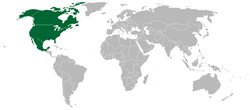
I propose that shaded portion of the the map here:
http://upload.wikimedia.org/wikipedia/commons/thumb/3/3e/Map_of_NAFTA.png/250px-Map_of_NAFTA.png
be changed to the same color as the map here:
This is an attempt to create greater color unison for the "continental union" page--I have proposals there as well to match the colors of the South American Union and the African Union, and for the European Union's color to be changed completely as well.--Fox P McCloud (talk) 21:12, 8 June 2008 (UTC)