Talk:Never Say Never Again
From Wikipedia, the free encyclopedia


This film is not considered a James Bond film by most fans, though it was made by Harry Saltzman, one-time partner of Cubby Broccoli, the force behind the Bond films.
Never Say Never Again also marks the beginning of a long legal battle between United Artists and one of the writers of the original scripts, in that copyright of the primary Bond villain Ernst Stavro Blofeld seemed to belong to the writer, and not UA. Oddly enough, the previous 1981 Bond film For Your Eyes Only opened with James Bond finally getting his revenge on Blofeld (albeit uncredited for legal reasons) for the death of his wife Tracy by killing him off... or so we thought. How Blofeld managed to survive this to appear in "Never Say Never" is left up to the viewer.
Was it Saltzman? I thought the link is Kevin McClory. Back in the late 1950s McClory collaborated with Flemming on an original story for a proposed Bond movie which fell through. Flemming later adapted the plot into the book Thunderball, but McClory sued and got a court to rule that a) all future printings of the book must state it is based on a film treatment by McClory, Whittingham and Flemming (in that order) and b) the McClory held the film rights. He sold them to United Artists for 10 years so they made Thunderball and other movies with SPECTRE. Then in the mid 1970s the rights reverted and McClory decided to try again. A further court case established that McClory owns the film copyright on Blofeld and SPECTRE and so they were removed from the script of The Spy Who Loved Me.
The battle was ongoing for many years. The Blofeld lookalike is included in For Your Eyes Only as United Artist's way of writing out the character (to show he was no longer needed) and as a one up to McClory. Never Say Never Again simply doesn't fit the UA films' continuity since NSNA is a remake of Thunderball. So issues of survival are irrelevant. Timrollpickering 10:24, 26 Apr 2004 (UTC)
Maximilian Largo not Emilio in NSNA! ciao 15:32, 8 sept 2004
MGM/UA (through their Orion division) currently holds the broadcast rights to NSNA. I noted that about last week and you changed it. WHY? —The preceding unsigned comment was added by 71.111.209.99 (talk • contribs) .
- Because Orion is defunct. All Orion releases now bear the MGM name. K1Bond007 20:44, 16 January 2006 (UTC)
If Orion is defunct, then how come I saw the 1997 Orion logo before NSNA instead of the Lion? And no, I don't know my signature. 206.211.69.253
-
- When did you see this? It is common for defunct studio logos to still be shown. You still see Carolco's logo before broadcasts/DVD release of Total Recall, and RKO Pictures has been out of business for decades but the logo still appears on the DVD releases of those old Fred Astaire musicals... 23skidoo 16:20, 17 January 2006 (UTC)
I saw it on AMC about a week ago. I asked a dumb question. When did YOU last see this? What logo is on the DVD release? Should the current distributor be listed in the summary? Sorry, forgot to sign it. 206.211.69.253 16:55, 17 January 2006 (UTC)
- I last saw it about a year ago on TBS. I can't remember what logo was on it. 23skidoo 16:56, 17 January 2006 (UTC)
Well, I listed MGM as the current distributor and made a reference to Orion. So there. 206.211.69.253 17:01, 17 January 2006 (UTC)
Hey, buddy! What did you do with Orion? You must give credit where credit is due. 206.211.68.217 17:04, 17 January 2006 (UTC)
I fixed it. (PS, I'm the same guy from before.)71.111.209.99 22:10, 17 January 2006 (UTC)
Contents |
[edit] 'Official' films
More importantly is how we define "official". I would say Fleming can help us here- the novel Thunderball is officially credited with being "based on a screen treatment by Kevin McClory". Kevin McClory wrote NSNA, aswell as "Thunderball" (the EON film). Arguably, NSNA is considerably closer to teh Fleming novel than theEON version (subjective, I know, but still often claimed). This lends the film some degree of "officialdom" surely? Im not arguing that the "unofficial" tag be dropped- it is true that the canonical Bond films, dubbed "official", are the EON ones, but it is certainly not clear cut enough for it to dominate the article. Patch86 23:35, 1 December 2006 (UTC)
Regarding 23skidoo's edit, the reason I take exception to "unofficial" in describing this film is that McClory won the right to produce a "James Bond" film as the centerpiece of his lawsuit; the option on the story and characters is every bit as valid legally as Broccoli's films. In that sense it is just as "official" (i.e. authorized) as the franchise films. Besides, what does "official" mean? Is there an "Office of James Bond films" somewhere? Heh heh. MFNickster 16:40, 11 December 2005 (UTC)
- Actually, yes there is. It's called EON Productions and/or Ian Fleming Publications. And they do not consider NSNA or the 1967 Casino Royale to be official productions. 23skidoo 18:46, 11 December 2005 (UTC)
-
- Well, Broccoli sure doesn't, being dead and all. MFNickster
-
- 23skidoo is right. EON Production's 21 films are considered the official series. You can check anywhere. This is widely accepted. Never Say Never Again and Casino Royale (1954/1967) are unofficial. K1Bond007 22:07, 11 December 2005 (UTC)
- I know what you mean and I agree with the distinction, I just think the term "official" is unnecessarily vague and has strong connotations. If it means "part of the franchise" or "canonical", then NSNA isn't "official." If it means "authorized" or "licensed", then it is. MFNickster
- All I'm saying is that this "official/unofficial" label is an established practice. Even EON Productions refers to it this way in their "authorized" books. There could be reasons for the use of this exact term. For instance, EON was 'authorized' by Ian Fleming, while McClory (regardless if he needed to be or not) was not. EON claims, have claimed, and even have won a few court cases that establishes them as the exclusive holder to the film rights to James Bond (the character) on film. This may be part of the whole argument. I really don't know - and I truthfully don't care that much since this is widely acknowledged and accepted. K1Bond007 22:34, 11 December 2005 (UTC)
- That's fine by me, I don't think any further editing is necessary. MFNickster 22:42, 11 December 2005 (UTC)
- All I'm saying is that this "official/unofficial" label is an established practice. Even EON Productions refers to it this way in their "authorized" books. There could be reasons for the use of this exact term. For instance, EON was 'authorized' by Ian Fleming, while McClory (regardless if he needed to be or not) was not. EON claims, have claimed, and even have won a few court cases that establishes them as the exclusive holder to the film rights to James Bond (the character) on film. This may be part of the whole argument. I really don't know - and I truthfully don't care that much since this is widely acknowledged and accepted. K1Bond007 22:34, 11 December 2005 (UTC)
- I know what you mean and I agree with the distinction, I just think the term "official" is unnecessarily vague and has strong connotations. If it means "part of the franchise" or "canonical", then NSNA isn't "official." If it means "authorized" or "licensed", then it is. MFNickster
- Is the official/unofficial distintion so important that it is the very first adjective to describe the movie in the acticle, and consumes the first three paragraphs? It is so UNimportant and needless, that it should be at the very very end of the article, or not in there at all. Who cares?! Point 2, just because the producers here were different, and EON (predicably!) calls other productions "unofficial" - all this in NO WAY makes "unofficial" a proper term. It's very misleading; you should replace "unofficial" with just "non-EON produced" and link to the EON Productions article. The problem with Wikipedia is that me, and 99% of the people who have seen this movie (or will read this article) are not obsessive enough to come here and change it over and over again and make it clear. Well, back to regular life.[Anonymous] 5 November 2006
- 23skidoo is right. EON Production's 21 films are considered the official series. You can check anywhere. This is widely accepted. Never Say Never Again and Casino Royale (1954/1967) are unofficial. K1Bond007 22:07, 11 December 2005 (UTC)
I've cited a source (mi6.com) that establishes the status of NSNA as an "unofficial" film. Can we let this drop now? Editus Reloaded 17:25, 30 April 2007 (UTC)
[edit] Distribution Rights
How did Orion Pictures (and MGM with it) get the distribution rights to NSNA from Warner Bros.?
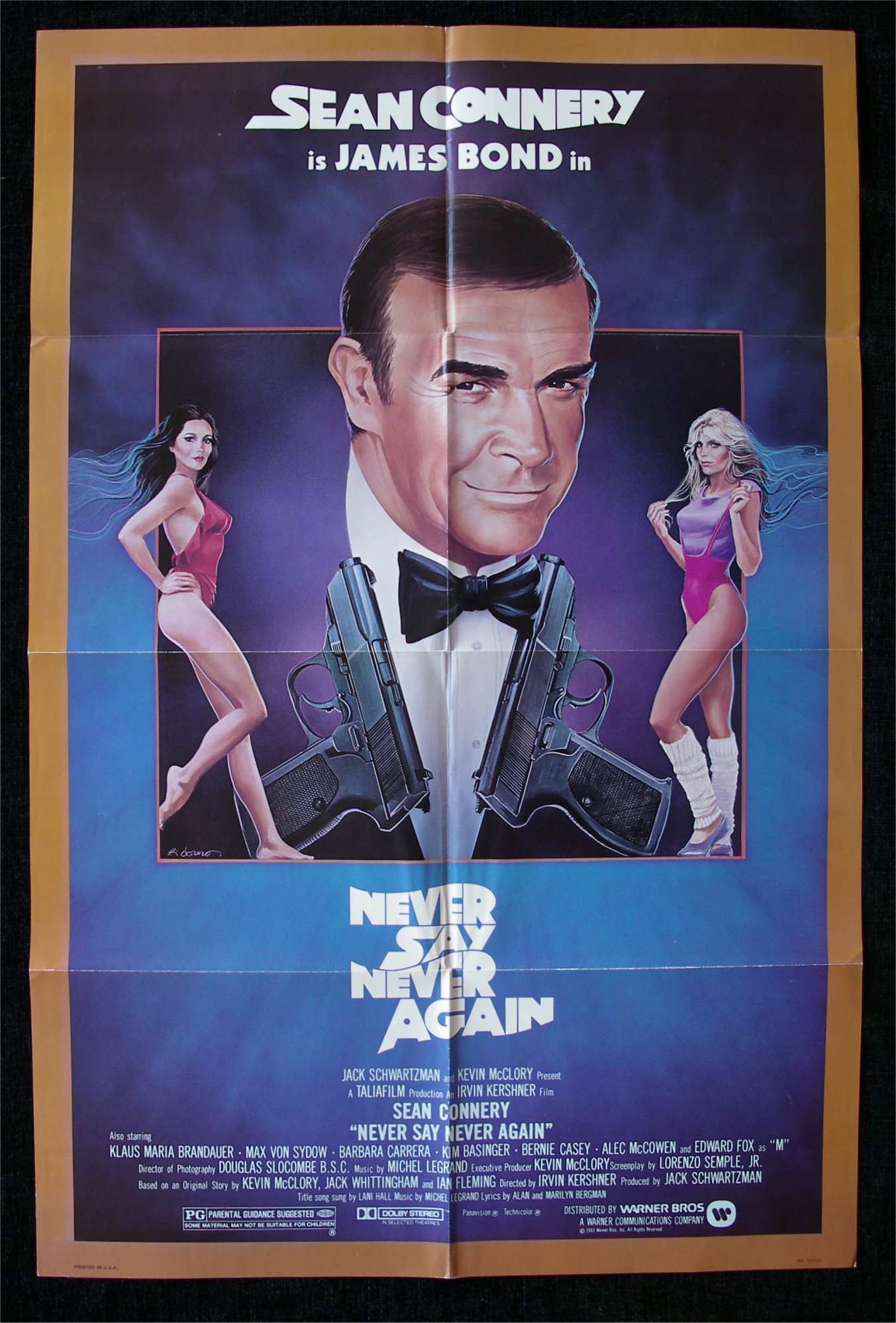
- It's a confusing mess to me. Orion was originally formed as a joint venture between Warner Bros and UA, however it became independent in 1982. Never Say Never Again was made by TaliaFilm (owned by Talia Shire and Jack Schwartzman) and distributed by Warner Bros (see poster) even on home video (VHS) way into the 90s. So your guess is as good as mine. If anyone finds any info on this, let me know. K1Bond007 18:15, 18 January 2006 (UTC)
- According to imdb.com's list of company credits, Orion was the film's original distributor. NSNA was (I believe) a negative pick-up, like Superman or The Empire Strikes Back. Warner Bros. agreed to pay a sum for the distribution rights in America - a sum usually equivalent to half the agreed budget - when the film was finished. The producer would sell the international, video and TV rights to make up the other half. It was therefore up to Schwartman to raise the money and make the film. If the movie ran over budget, it would be up to him to pay the difference. Probably, like the Salkinds and George Lucas, Schwartzman had to go cap-in-hand to Warners when the film went overbudget by about $6 million and sell them the video rights. Of course, now MGM/Sony own the rights and put out the rather bland DVD in 2000/2001. Scott197827 22/1/2006
Thanks. 71.111.215.224 18:14, 1 April 2006 (UTC)
[edit] Q's real name
The fact that Q's name is given as Algernon does not necessarily conflict with the fact that he is called Major Boothroyd in the official films, because Boothroyd is his surname, whereas Algernon is clearly a Christian name (cf. Algernon Moncrieff in The Importance of Being Earnest). For all we know, then, Q's full name is Algernon Boothroyd. I don't know if this was the only evidence suggesting that this Q was not the same person as the "official" one, so I have let that part of the statement stand. It might be worthwhile, however, to check out if there is any other evidence for this contention. Nude Amazon 11:44, 3 March 2006 (UTC)
- “Q” - as such - does not appear in the Ian Fleming novels, and in particular not in the novel Thunderball. There is a Q-Branch and there is a character called Major Boothroyd, but it is the films (specifically Christopher Wood in The Spy who Loved Me) that suggest they are the same character. Part of the deal for making NSNA was that it couldn't be adapted from the movies, only from the book - hence, Algernon the Armorer. Scott197827 12/2/2006
- Actually the film version of From Russia With Love also makes the same connection Wood does by having Major Boothroyd appear and be identified as Q. I'm pretty certain there is a reference to "Q" in the Goldfinger novel; I just checked and there is a direct reference to "Q's craftsmen" re: the briefcase in the FRWL novel. And both Gardner and Benson directly link Boothroyd and Q as the same man. Regardless of all this, Die Another Day confirm that, at least in terms of the films, Q (or Quartermaster) is a title passed from person to person; when Boothroyd retired or died, John Cleese's unnamed character became Q. In all likelihood Algernon was the NSNA's equivalent of Cleese. There's nothing to suggest he's the same man played by Desmond Llewellyn (unlike Moneypenny who is supposed to be the same person Lois Maxwell played). 23skidoo 22:44, 12 March 2006 (UTC)
- An early screenplay of The Man with the Golden Gun featured both Q and Boothroyd as two seperate characters (I guess he became the character Colthorpe in the movie). TSWLM is the first film in which Desmond Llewellyn is called Boothroyd. As another interesting note, the James Bond Role Playing Game - licensed from both the novels and films - identifies Q as Major Geoffrey Boothroyd, the name of the real life armorer who advised Ian Fleming, even though the Boothroyd in Doctor No is not given a first name. You're right that there are mentions of Q in the book as if he was a man, but the point I was making is this, and it it brings it back to the subject of this article; Jack Schwartzman and Lorenzo Semple, Jr. were under pressure to do a literal adaptation of the book. They could use the names James Bond, 007, Miss Moneypenny, M, Largo, Blofeld, Domino, Petachi, etc. because they were in the book. Other ideas like the gunbarrel and the Bond theme obviously couldn't be used. Less obviously, the writer couldn't copy the same interactions between Eon's Moneypenny and Q. It was a tightrope. Scott197827 13/2/2006
- Actually the film version of From Russia With Love also makes the same connection Wood does by having Major Boothroyd appear and be identified as Q. I'm pretty certain there is a reference to "Q" in the Goldfinger novel; I just checked and there is a direct reference to "Q's craftsmen" re: the briefcase in the FRWL novel. And both Gardner and Benson directly link Boothroyd and Q as the same man. Regardless of all this, Die Another Day confirm that, at least in terms of the films, Q (or Quartermaster) is a title passed from person to person; when Boothroyd retired or died, John Cleese's unnamed character became Q. In all likelihood Algernon was the NSNA's equivalent of Cleese. There's nothing to suggest he's the same man played by Desmond Llewellyn (unlike Moneypenny who is supposed to be the same person Lois Maxwell played). 23skidoo 22:44, 12 March 2006 (UTC)
[edit] First appearence of an older Bond?
The 'Changes to the Bond Universe' section notes that it's the first time an older Bond is potrayed. Roger Moore is three years older than Connery though, and was older in For Your Eyes Only two years prior than Connery is in Never Say Never Again. 142.68.204.246 20:58, 13 March 2007 (UTC)
- True and for that matter David Niven was an "older Bond" in the comedy version of Casino Royale. I think what the text is trying to say is that this is the first serious attempt to present a Bond who is meant to be older than the more regular norm. Films where the hero is an older version of a classic hero returning to the fray are not unknown - for example Connery himself appeared as an old Robin Hood in Robin and Marian in 1976 - and NSNA fits this genre, the only time this was done with Bond. (Although three of the Brosnan films - GoldenEye, The World Is Not Enough and Die Another Day - feature conflict taking place over a long scale than normal, with flashbacks, discussion of past events and a one year gap respectively, this doesn't come close to the sub-genre.) Timrollpickering 20:08, 4 September 2007 (UTC)
[edit] Now I know the reason....
When I saw it I thought this film was really bad and not the standard you expect of James Bond films. Now I know why.
[edit] change not all bad
i have to say, when comparing this to the latest bond i think many of the people within the bond franchise really didn't like the sleek slippery bond and instead opted for the rough edged Never Say Never Again style bond. also the way the current Casino Royal is filmed looks very cheap compared to the slik big *bang* pierce brosnan movies "this is not bad", it's really like the writers were sick of the old James Bond can do all attitude and forgetting he's human. my point is that some of the quirks of this movie ended up in the Casino Royal 2006 James Bond Markthemac 00:56, 30 July 2007 (UTC)