Talk:Nebuchadnezzar's statue vision in Daniel 2
From Wikipedia, the free encyclopedia


Contents |
[edit] Feet of Clay
The phraze "feet of clay" is a common (and cliched) figure of speach. It can mean: - A non-obvious lack of power or unwillingness to act. "The politician said he was committed to fighting pollution, but in the end he had feet of clay." - A weak spot. I only ever heard it used figuratively and usually in a political context.
I'm not sure if this belongs on the page (and it would have to be better written). Also, this page doesn't come up when you search for "feet of clay." not on the first page anyway.
Response:
This expression came from this vision. It does not shed light on the vision, but reflects its meaning. Here is the definition:
Feet of clay - fundamental weakness (of a person) Also idol with feet of clay: a person (occasionally thing) much admired but fatally flawed. The reference is to a biblical event during the reign of Nebuchadnezzar, a great king of Babylon (604-561 BC) during the Jewish captivity there. He had a dream of a great image: 'This image's head was of fine gold, his breast and his arms of silver, his belly and his thighs of brass, his legs of iron, his feet part of iron and part of clay' (Daniel, 2: 32-3). Called in to explain this dream-image, Daniel interpreted it as a vision of the declining kingdom: 'And as the toes of the feet were part of iron, and part of clay, so the kingdom shall be partly strong, and partly broken' (verse 42).
From: http://users.tinyonline.co.uk/gswithenbank/sayingsf.htm
[edit] Remembering the Dreams
Traditional interpretation of the KJV indicates that Nebudchadnezzar could not remember his dreams: "The thing is gone from me," he says. Modern translations suggest that his words actually mean, "I have already given my command...tell me the dream and its interpretation...." Later, Nebuchadnezzar indicates why he won't tell his dream interpreters the dream. Essentially, he fears they will just agree on an interpretation that may or may not be correct. He figures that if they can miraculously conjure up the dream correctly, then he can also trust their interpretation.
Does anyone think this information should be included as its own section/subheading with references, or should it simply be a single sentence? -Milkncookie 23:00, 12 December 2006 (UTC)
[edit] Ties to Daniel 7 & 8
In Daniel 7 and 8, Daniel receives visions of his own, the interpretations of which bear a strong resemblance to Nebuchadnezzer's dream in Daniel 2. Should this be referenced and expanded upon anywhere? -Milkncookie 23:00, 12 December 2006 (UTC)
[edit] Dream and Interpretation parallel illustration
This is not original research. Its published source is the Bible. All that is done in the illustration is to take the dream and interpreation of Daniel 2 exactly as they appear in the NIV and place related words and phrases in obvious parallels. There is nothing added to the Bible or taken away from the Bible. This is completely a NPOV. Allenroyboy 17:59, 30 December 2006 (UTC)
- Isn't that exactly what is meant by a "novel synthesis" in the wording of the policy? ፈቃደ (ውይይት) 18:14, 30 December 2006 (UTC)
-
- What is so novel? That there are new ideas? or The arrangment in parallel? Everyone who has ever studied the prophecy and interpretation has in their mind (or perhaps on paper) the arranged related verses and synthsized them. This illustration does not do anything unusual.
- And usually, a "novel synthesis" means a new, different or strange interpretation or understanding of some topic. I present nothing new or different here. This is what the Bible says. Allenroyboy 18:36, 30 December 2006 (UTC)
- It may be old material, but the synthesis itself seems to be novel. Can you show that anyone else has arranged them in exactly that way? You should be able to if it is not OR. Like you said, anyone might make them parallel in their mind, but they might not all do it in exactly the same way as you have done. I want to know if any published source has ever arranged it exactly as you have done. ፈቃደ (ውይይት) 18:49, 30 December 2006 (UTC)
-
- So are you saying that EVERYTHING ELSE that is presented in the rest of the article is EXACTLY the way it is presented by others elsewhere? No one has ever done any paraphrasing? Allenroyboy 18:57, 30 December 2006 (UTC)
-
-
- No, of course not... I suppose maybe I am being a little stricter in this case, because this is an image that you created yourself... I guess I should see if I can get some other opinions on the image from some other editors, it just strikes me as kind of being a 'novel synthesis or arrangement' but I could be wrong... ፈቃደ (ውይይት) 19:06, 30 December 2006 (UTC)
-
-
- I created the image because it was easier to insert into the document rather than a large table with the Bible verses in parallel in it. I could have written this same information in sentence and paragraph format quoting the verses from the bible side by side. The purpose being to show the Biblical relationship between the verses. This was purely mechanical. My POV is irrelevant. Allenroyboy 19:46, 30 December 2006 (UTC)
-
- Instead of making the spreadsheet illustration I could have written:
- Prophecy: "The head of the statue was made of pure gold," vs. 32
- Interpretation: "You, O king, are the king of kings. The God of heaven has given you dominion and power and might and glory; in your hands he has placed mankind and the beasts of the field and the birds of the air. Wherever they live, he has made you ruler over them all. You are that head of gold." vs. 37-38
-
- What's the difference? None that I can see. There is no original thinking or research. It is just obviously related verses of the Bible put in intimate context. There is none my POV Allenroyboy 01:05, 31 December 2006 (UTC)
A question on the Interpretation: Is there any sources that argue that the clay-iron mix is the Western Roman and Byzantine Empires as one crumbled away and the other existed for another 1000 years? The vision of the stone that crushes the statue is associated with Christianity and you could extend that to the Crusades that sacked Constantinople and the conquest by the Muslim Turks. The Crusades at least directed by "God" (and the Pope of course!) and perhaps the Islamic desire to spread their religion as a motivating factor in Turkish expansion (along with the obvious secular power). SSJPabs 06:42, 8 August 2007 (UTC)
- I have never seen or heard of sources for any such argument, so absent those, it would strictly be OR. Til Eulenspiegel 13:49, 8 August 2007 (UTC)
-
- The illustration with the synthesis seems like a user's original work, why is it totally replacing the literal account? Til Eulenspiegel 16:04, 23 August 2007 (UTC)
[edit] Paraphrase
"A restatement of a text or passage in another form or other words, often to clarify meaning." [dictionary.com] The 'Dream and Interpretation in parallel' illustration is a paraphrase of the original published document (i.e. the Bible). The Biblical texts are not changed in anyway but simply presented in another form. Just how common or unusual the method of paraphrasing of the Bible is completely irrelevant. And it does not reflect my POV. It seems to me that this does not in any way violate the rules of Wikipedia. So, I'm putting it back into the text, untill someone can prove otherwise. Allenroyboy 16:20, 31 December 2006 (UTC)
- Don't put it in the text. I thought you were going to wait for a second or third opinion. But it just looks bad and ruins the article. Even when I click on it, it is extremely hard to read and forces me to squint. The colors are garish. A wiki-table at least would be much easier for other editors to edit if they disagree with any aspect of it. And now that I look at it again, I am more convinced than ever that it is OR and the very definition of a "novel synthesis" because there is no authority provided but your own for deciding which verses are parallel to which verses. Find someone else published who draws these same parallels, please. ፈቃደ (ውይይት) 17:13, 31 December 2006 (UTC)
-
- 1. If other editors agree with you they can remove it.
- 2. The .jpg is easy to read. click on it once to go to the image's wiki page. Then click on it again which will download the image to your browser. If it still is not full size, click on the zoom and it will appear perfectly clear. It's not my fault that wikipedia doesnt disply the image correctly on the image page.
- 3. If you have not seen the parallel image clearly, then it is likely that you have not yet seen how simple and easy to comprehend the parallel paraphrase is.
- 4. I will look into doing it in a table, however, it would shove the rest of the article down several pages worth. Allenroyboy 21:16, 31 December 2006 (UTC)
-
-
- The Colors Garish?
- The colors were chosen to go with the metals. Gold -- Yellow, Silver -- light gray, Brass -- yellow-orange, Iron -- dark gray, Iron and Clay -- brown, Stone -- Sky Blue (the color of the Law). Allenroyboy 06:15, 7 January 2007 (UTC)
-
- Furthermore, which text of Daniel are you using? If you looked at the pre-Theodotion Greek LXX version for instance, which is the oldest known version and substantially different from later ones, chances are you would not find the same number of parallels. The reason the pre-Theodotion Greek LXX is substantially different from later versions (other than the Dead Sea Scrolls with which it agrees) is because a team of rabbis revised the now-lost original Hebrew version of Daniel some time around the 2nd C. BC and produced an entirely different Hebrew text, now known as the MT, which is what all modern versions are based on but not at all the original Book of Daniel. ፈቃደ (ውይይት) 17:19, 31 December 2006 (UTC)
-
- I'd be more than happy to consider what Theodotion's Daniel says. Where can I find one? It certaly isn't very common. Allenroyboy 21:16, 31 December 2006 (UTC)
-
-
- Theodotion's Daniel is the revised version that took the place of the original in the LXX. I'm talking about the pre-Theodotion, and you're right, it is even harder to find, let alone in English translation. I have seen it on the web before, however; I will see if I can dig up a link for you... ፈቃደ (ውይይት) 21:22, 31 December 2006 (UTC)
-
The wikipedia Paraphrase page states
"A paraphrase (from the Greek paraphrasis) is a statement or remark explained in other words or another way, so as to simplify or clarify its meaning."
The paraphrase illustration on this page is ONLY a paraphrase, putting the text in another way physically so that the text itself clarifies its own meaning. The paraphrase is NOT an analysis nor is it OR. It is simply a paraphrase. Paraphrasing has a long established and well founded history on Wikipedia. If you think the paraphrase is in error change the table at the bottom of the page.
The synthesis is merely a recapitulation of the paraphrased illustration. The only POV is that of the text itself. It does not matter whether someone likes what the text itself says or not. Therefore I am removing false assertion of original research. --Christian Skeptic 05:06, 4 October 2007 (UTC)
[edit] The Medes
Under analysis listed as the silver chest and arms of the statue the Medes are listed. i was wondering when it was that the Medes took Babylon and so became a part of this "geneology" of empires. The verbage in the article states that this is the opinion of scholars but lacks any reference. —The preceding unsigned comment was added by Dieci (talk • contribs) 03:00, 22 January 2007 (UTC).
The main article states:
"The four empires represented by the statue have often been interpreted by scholars as 1) Babylonia, 2) the Medes, 3) Persia, and 4) Alexander the Great’s Empire. This is in keeping with the scholarly theory that the book of Daniel is a pseudepigraph dated to 168 BC, and refers to Antiochus Epiphanes and the successors of Alexander.
However, some Christians do not accept this interpretation, because Jesus is said in Matthew 24 to have quoted Daniel as a prophet who foretold the "end times" immediately preceding Judgement Day, and not in reference to Epiphanes who had lived nearly 200 years before Jesus."
This gives the impression that 'scholars' are not Christians and Christians are not 'scholars.' However, no references to the 'scholars' or their findings is mentioned, nor do the 'scholars' have anything to say about the reference of Jesus in Matthew 24 to the book of Daniel?
[edit] Citations, encyclopedic quality and POV
Just a general comment on this article. This is not a place for debates about interpretation of the prophecies, or assertions of personal views and personal analyses. We must strive to create an article of Encyclopedic quality, which is adheres to neutral point of view, and all content must be verifiable. This is the Wikipedia standard. As such, the article needs many more citations from reputable sources--in other words, published, scholarly material such as commentaries, Bible dictionaries and theological journal articles.
Can I please also point out that merely referencing the Bible is not sufficient. The Bible can be interpreted in a variety of ways, and by citing the Bible you are only citing your own private interpretation--as such it is not NPOV.
I agree with Codex Sinaiticus that the tables appearing on this article (and other Daniel related articles) are Original Research, totally subjective, and "just looks bad and ruins the article". Unless they can be clearly demonstrated as a reproduction of a reputable published work, they should be removed. Tonicthebrown 10:53, 27 May 2007 (UTC)
[edit] Rationale for recent edition
This is addressed to an unnamed user 71.253.143.177, who reverted the content of the article on 25/5/07 on the grounds that "Original Research arrangement; also this is a BC article formst, not BCE".
Please note that my editions significantly improved the encyclopedic quality of this article. Factual information about the dating and Aramaic language of Daniel 2 is more appropriate in a separate section near the beginning (as will be found in most commentaries on the passage), rather than lumped in with interpretation. Secondly, I strongly dispute that my changes were "Original Research". I have added citations from a reputable Daniel commentary, where previously there were none, thus adding to the verifiability of this article (by contrast the previous edition was more liable to the charge of OR). Thirdly, the older edition was somewhat convoluted with unnecessary repetition and poor prose; both these problems were addressed in my changes. Fourthly, according to Wikipedia:Manual of Style, "CE" and "BCE" are acceptable for use on Wikipedia--if you prefer BC/AD notation, you are welcome to change it yourself, without reverting all of my work. If you disagree with what I have said, please raise it here on the talk page before making unreasonable reversions. Thank you Tonicthebrown 09:53, 27 May 2007 (UTC)
- You don't seem to understand the policy regarding BC and BCE. Yes, both formats are acceptable, but the policy is that they should be consistent within an article. Articles should not be going back and forth between one format and the other. If the article is in BC format, it should not be changed to BCE format, nor vice versa. All dates should use a consistent format which in this case is BC format and it is not acceptable to change from one to the other. As for whether or not you improved the article by moving the dating section to the top, that is a subjective opinion, not a fact. Since as it is written, starting out "aside from the scholarly view that..." it presupposes that the scholarly view has already been discussed, as it was in the orginal version. Moving it to the beginning is therefore too jarring, and it should be restored to the order in which it was written for coherence sake. Starting a section out with the word "However" is also extremely bad form, not necessarily an "improvement". And talk about "personal views and analyses" - how about your version that asserts Jesus was referring to the events of 70 AD? That is pure speculation. Rather than insert ou personal views, we should adhere faithfully to the text without adding our own window dressing. The text states clearly several times that these are prophecies of the "Last Days" immediately preceding Judgement Day, both throughout Daniel and in Matthew, I am quite sure that this is usually taken to mean the Last Days of this corrupt world, not the Last Days of the Second Temple. So the original version that reads "Last Days" is more accurate to the actual text than your version, which seems unnecessarily partial to the 70 AD interpretation. Also I do not see any good reason for cutting out the statement that the identification of the gold head is not in dispute. In short, I do not see any of these changes as improvements, with the possible exception of your source, which needs verification. However, rather than engage in a wholesale revert, I will fix these problems one at a time. 71.253.129.35 12:57, 27 May 2007 (UTC)
Thank you for taking the time to respond, and for not reverting my work again. I appreciate that.
- I do not object to BC/AD notation. I'm more than happy for it to be used here.
- Aramaic language discussion belongs in a separate section, as it is not an analytical/interpretative issue, but a text-critical one.
- AD 70 view is held by the majority of New Testament scholars -- it is not my private opinion. I've added a citation from Craig Blomberg, a prominent NT scholar. I have also read numerous commentaries on Mark 13 and Matthew 24, which all support the AD 70 interpretation.
- The "last days" interpretation is only held by a minority of futurist interpreters. If you want it to have credibility, you will need to add a reputable reference.
Tonicthebrown 02:04, 28 May 2007 (UTC)
- Hint: Try looking for some modern artistic representations of the statue. Pay close attention to the labels. Til Eulenspiegel 02:37, 28 May 2007 (UTC)
-
- Exactly. There are numerous artistic representations of it, just look on Google images, you can find hundreds of different ones, and every one I have ever seen that has labels, has the legs as Rome and the feet as the world powers who are the heirs of Babylon in the last days, long after 70 AD. Most of them put the split of the Roman Empire into East and West as the two legs. In the artistic world, this view is the absolute majority, maybe even a monopoly, since I have never yet seen a "70 AD" scheme for the image.
- However, it seems the crowd who wants to push the POV that Daniel and Jesus were prophesizing events of 70 AD, have a rather condescending view towards all those of the other POV who take the texts that say clearly "Last Days" as meaning exactly that, and that condescension is rearing its head now with comments like "only held by a minority of futurist interpreters." I propose we do not push either POV (or the 130 BC POV either) or try to squeeze out the views you DON'T like by suggesting they are somehow more fringe and less valid than your own view that they were prophets speaking of 70 AD. As you can easily verify just by looking up the above mentioned images, there are numerous futurist interpretations and schemes that could be cited, and whether they are indeed a "minority" just because you have the other POV, is highly contentious. But the problem we usually see on wikipedia once you start the condescension and demonizing of a certain POV, and the "enshrining" of a rival POV as having the "blessing" of the "consensus" (there are actually very few consensi whatsoever anywhere in the field of prophect interpretation) is that no matter how many hundreds of these futurist views are cited, you will bat each one away and claim that they are all invalid because you think you have demonstrated that only the "Prophecy of 70 AD" view is justified.
- Please try to be open minded and allow the majority of futurist sites to exist here, since they do in the real world as well, rather than try to make the encyclopedia dig its head in the sand and say only the lazy virgins exist and the wise ones don;t, "I am I and who else is there", and therefore everyone should be complacent and not give these pophecies due attention that the text of Matthew demands for them. There are many who believe in a Messiah today, ONLY because they see Babylon all around them today and are waiting for it to change, not pretending that all this prophecy already happened in 130 BC or 70 AD and therefore this is now the Kingdom of Heaven. Maybe the perspective of some is different because they see the Kingdom of Heaven all around them on the Earth today, well just remember that POV is not the only one. 71.253.129.35 10:34, 28 May 2007 (UTC)
I am disappointed that you feel the need to criticise me so harshly. I am not trying to be "condescending" or to "demonise" people with a futurist interpretation. One wonders whether you are perhaps over sensitive about this issue. I have merely stated the simple fact that the majority of the scholarly world applies Daniel and Mark 13/Matthew 24 (particularly the reference to "abomination of desolation") to AD 70 primarily, and to the end times secondarily or not at all. Wikipedia is an encyclopedia, and as such it must represent all points of view fairly. Popular views certainly deserve mention (and please note that at no point have I ever attempted to remove the futurist interpretation from the article), but in the end, the interpretation of scholars (from across the liberal-evangelical spectrum) must have precedence over what you find on Google. Please read Wikipedia's policy on verifiability, and you will find that there are certain standards for what counts as a reliable source. I have provided numerous citations from reputed scholars, such as N.T. Wright and Craig Blomberg. If you can cite reliable sources for the futurist perspective, that will increase the support for your position, and I invite you to do so. You might find that George Eldon Ladd has a semi-futurist perspective, but in the end he also makes a link to AD 70. Perhaps there are other scholars you can consult. Tonicthebrown 15:36, 28 May 2007 (UTC)
- It's your attitude manifested by statements that the opinions oif the scholars and scribes "must have precedence" that causes me to feel so strongly. "Must have precedence" is not NPOV. Equal means equal. A statement like "must have precedence" is proof of a pov pushing agenda. The POV of the gospel itself with regard to the scholars and the scribes is also clear. Then there are those who are Christian in name, but who obviously sympathize more with the powers represented by the statue, than with the one symbolized by the rock. The "popular" view as you describe it is of vital importance because this chapter is the thing that gives millions of suffering people hope in God's Kingdom, so it's not going away and wikipedia is a place to report faithfully on what people actually believe, not a place to make yet another attempt to "teach" them to believe something other than what they believe. What the scholars and scribes believe is not surprising, and only to be expected, but they already have enough bvenues to make their case. So, have you found any 70 AD folk who actually say anything like the Statue of Babylon finally collapsed in 70 AD, in specific relation to Daniel chap. 2? Or are they just talking about the other chapters in Daniel in general? 71.253.129.35 15:58, 28 May 2007 (UTC)
-
- Please understand that I'm merely trying to uphold wikipedia's standards.
- Quote from WP:V: "Articles should rely on reliable, third-party published sources with a reputation for fact-checking and accuracy.... Anyone can create a website or pay to have a book published, then claim to be an expert in a certain field. For that reason, self-published books, personal websites, and blogs are largely not acceptable as sources."
-
- Wikipedia itself says that reliable sources (such as found in published books, commentaries and articles) have priority over websites found on a Google search (which are by and large self-published). As I have said repeatedly, if you can find a reputable source which supports the futurist view, then by all means include it in the article.
- My agenda is not to "teach" a particular POV and suppress another, it is to represent the range of POVs fairly. If one view has more scholarly support, then that has to be mentioned. Other views of course should be mentioned too, and again I point out that I have never deleted the futurist statements from the article, nor relegated them to footnotes (as someone did to the AD 70 view). If you want to stress the (alleged) wide popularity of the futurist view, then the best thing would be to find an article with a statistic saying "xxx% of Christians believe in futurism". Provided it is a reputable source, it would be very appropriate here.
- In response to your question, the AD 70 view relates mainly to the later parts of Daniel; however, many people who hold this view believe that AD 70, along with Jesus' birth, death and resurrection, were part of the inauguration of the kingdom of God which is represented by the stone in the vision. The kingdom is considered spiritually rather than physically of course. Tonicthebrown 16:22, 28 May 2007 (UTC)
-
- Well you still haven't answered the question. Have you found any who SPECIFICALLY assert the 70 AD view with relation to the Statue vision of Daniel 2? That would be relevant to this article. 71.253.129.35 16:31, 28 May 2007 (UTC)
-
-
- At the moment I lack the time to track down specific views of individual commentators. However, most proponents of realized eschatology (such as C. H. Dodd) and inaugurated eschatology (such as J. Jeremias and Ladd) would most likely say that to some extent the kingdom of God is here already, since the time of Jesus, and thus the stone of Daniel 2 is already partially fulfilled (although the kingdoms of men, represented by the statue, are still active). Tonicthebrown 08:48, 30 May 2007 (UTC)
-
[edit] Artistic representations of the statue.
I will do the homework for you. Here is a catalogue list of artistic representations of the statue I can find, with the labels. Take a look at each one of these pics if you want to see some great art, each one adds some unique perspectives on the subject.
1. http://www.bibleexplained.com/prophets/daniel/da2-img.jpg
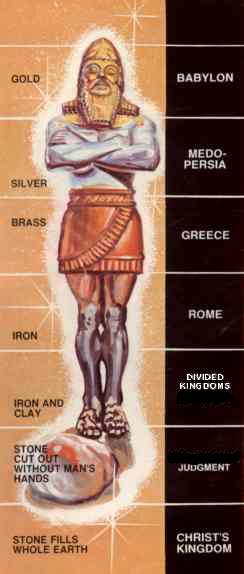
- Labels: Head - "Babylon"; Chest/arms - "Medo-Persia"; Loins - "Greece"; Legs - "Rome" "Divided Kingdoms"; Stone - "Judgement" "Christ's Kingdom"
2. http://www.accordingtothescriptures.org/pictures/RC/4KINGS.jpg
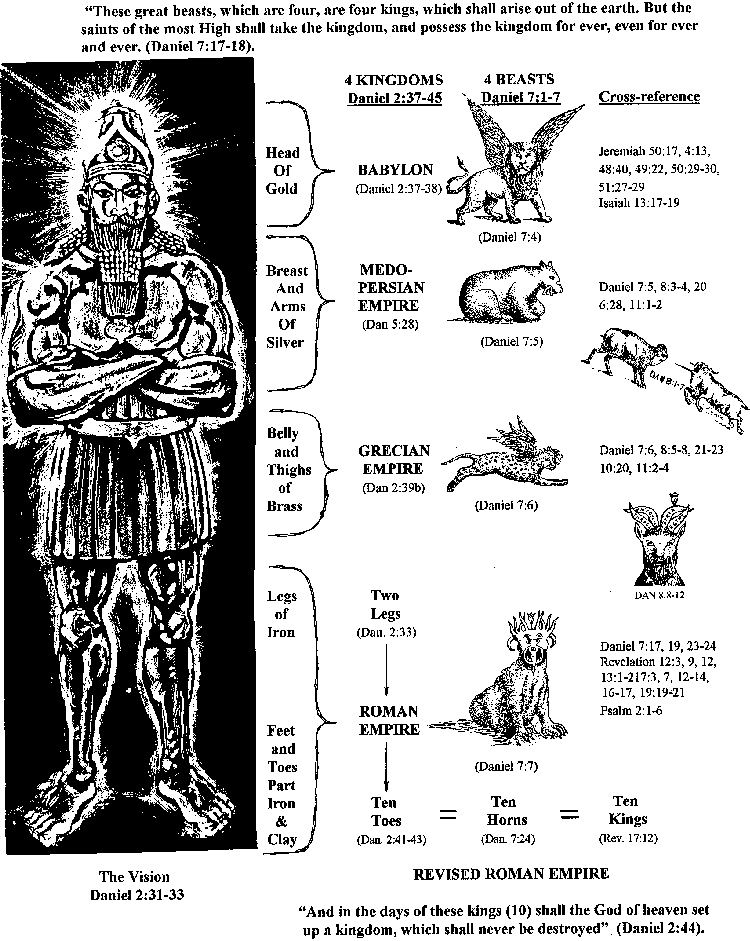
- Labels: Head - "Babylon"; Chest/arms - "Medo-Persian Empire"; Loins - "Grecian Empire"; Legs - "Roman Empire"; Feet and Toes - "Revised Roman Empire"
3. http://www.lastdaysreporter.com/ASSETS/daniel_imag2.jpg
- Labels: Head - "Babylonian Empire"; Chest/arms - "Medo-Persian Empire"; Loins - "Grecian Empire"; Legs - "Roman Empire"; Feet and Toes - "Either Ancient Kingdoms or EU Nations"
4. http://www.bible.ca/pre-daniel-2.gif
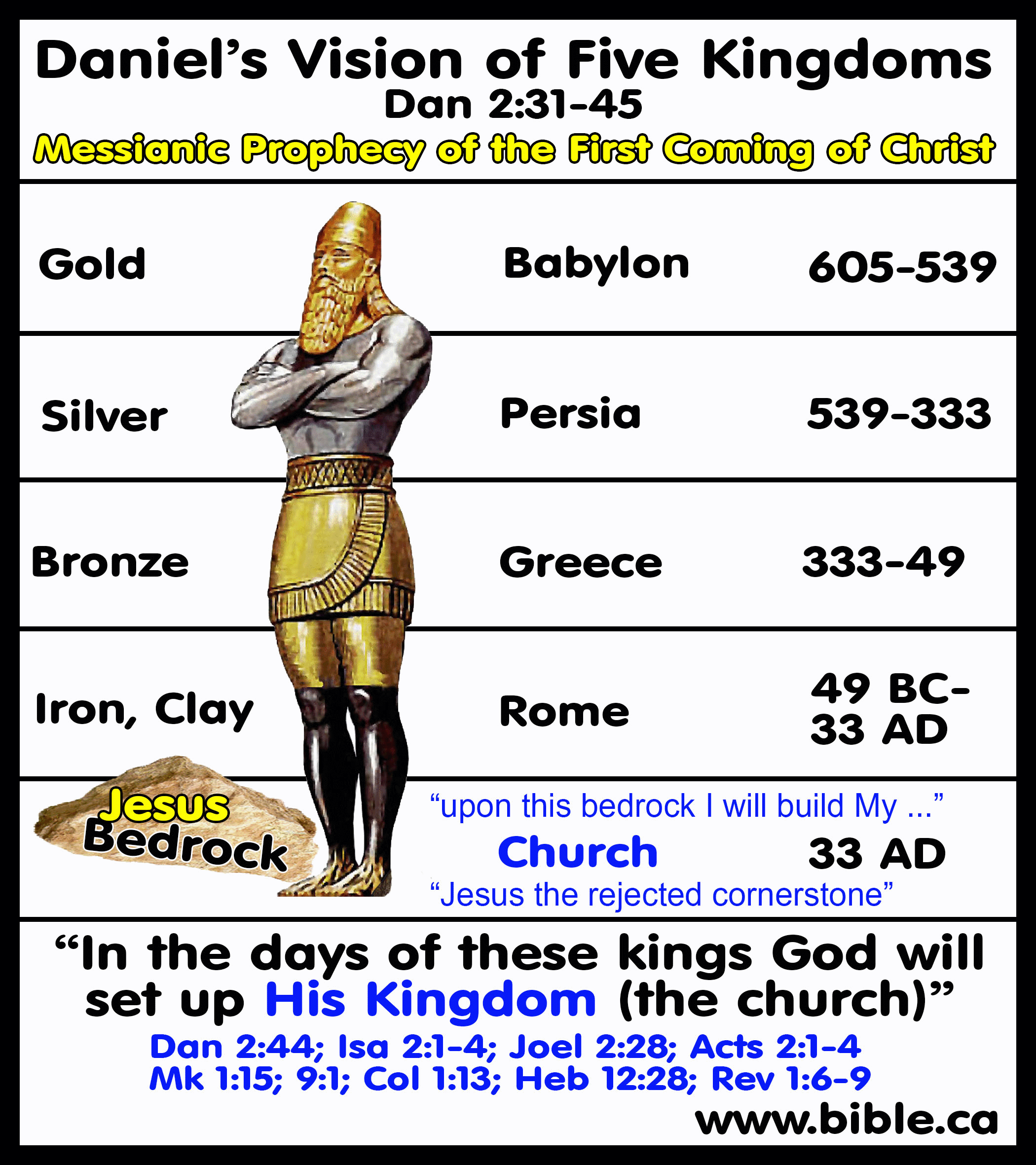
- Labels: Babylon, Medo-Persia, Greece, Rome.
5. http://rev14ver12.tripod.com/3AngelsImageLibrary/Daniel2.gif
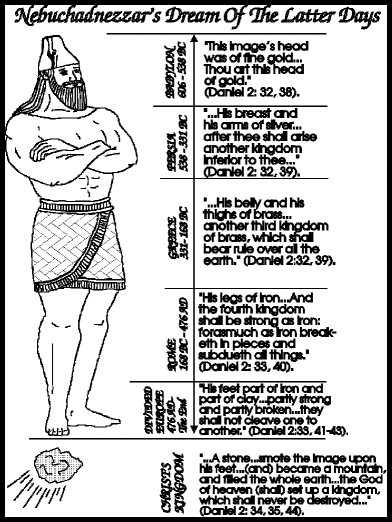
- Labels: Babylon, Persia, Greece, Rome, "Revised Empire", Christ's Kingdom.
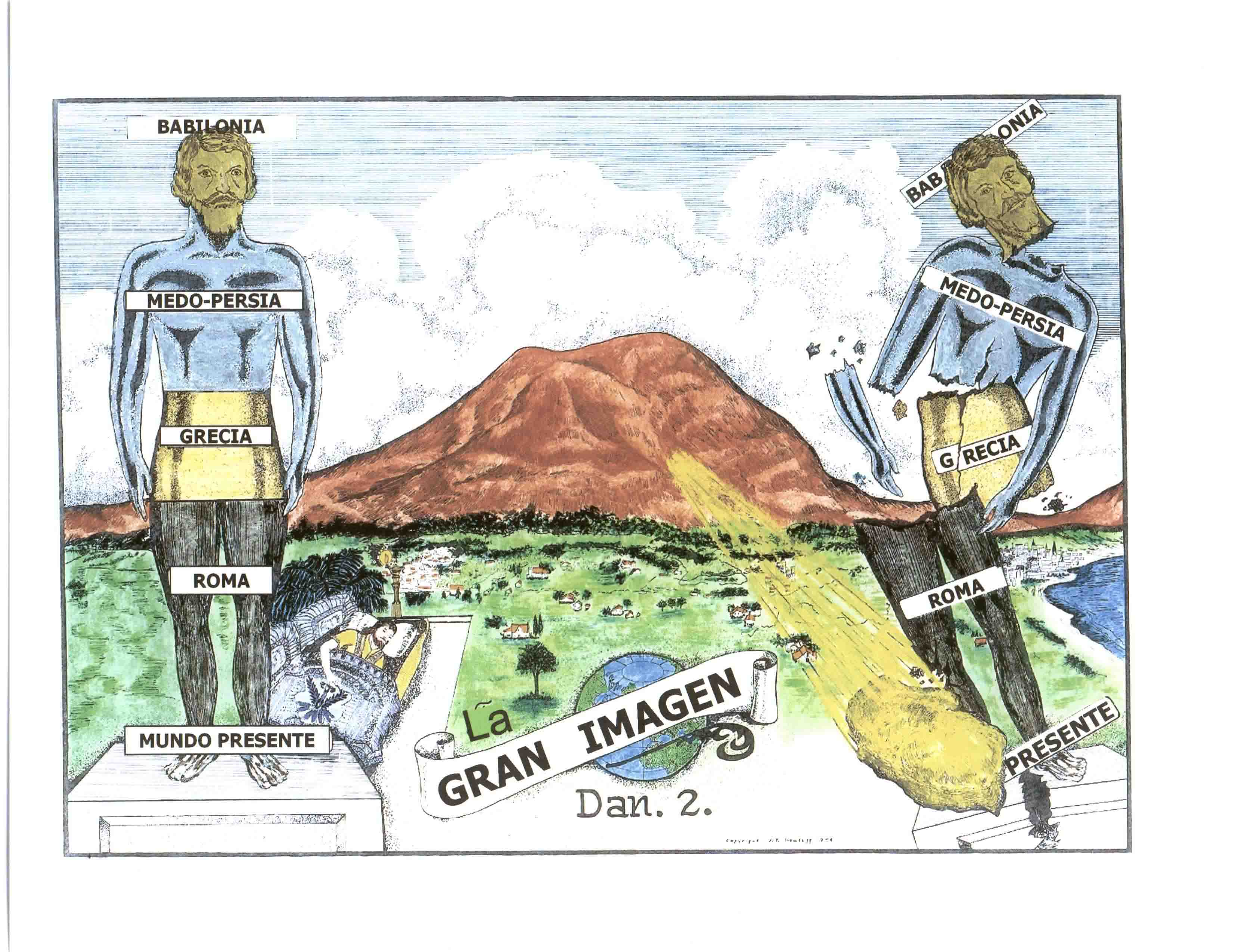
6. http://www.davidiansda.org/Daniel%202.jpg
- Labels: (in Spanish): Babilonia, Medo-Persia, Grecia, Roma, Mundo Presente
7. [1]
- Labels: Babylon, Medo-Persia, Greece, Rome, "Enlarged Roman Empire" / "Ten Kingdoms"
8. http://biblia.com/jesusbible/daniel-statue-10-2.gif
- Labels: Babylon, Persia, Greece, Rome, European Union
9. http://www.ktc.net/jcthwychurch/Images/Statue.gif
- Labels: Babylon, Persia Greece, Rome
That's all I have time for now, but I have only scratced the surface, I may come back and expand this list later. 71.253.129.35 16:52, 28 May 2007 (UTC)
- If there's one thing this list demonstrates, it is that there is a lack of consensus among futurists as to what the feet and toes represent. Are they a reconstituted Roman empire or the EU? Something still future or already present? Perhaps this is why most Christian scholars have so much problems with such interpretations. It's all a guessing game. I've also heard that it could be the UN, the United States, Saddam Hussein, Britain, the World Bank, the IMF, a Muslim empire, the Pope... take your pick :-) Tonicthebrown 08:53, 30 May 2007 (UTC)
- This article was fine for years until just recently. It strictly avoided getting into a contentious battle over interpretations by, sticking to what the actual text actually says. There are many interpretations of the statue but we still do not have a quote saying specifically that anyone holds the statue vision in Chapter 2 to be any kind of prophecy of the fall of the Jewish Temple in AD 70. This would seem to be a rather forced "interpretation" that has been synthesized from various interpreters' comments on OTHER chapters in Daniel. Til Eulenspiegel 11:25, 30 May 2007 (UTC)
-
- Please allow me to point out that the article, as it stood for "years", asserted a futurist POV about Matthew 24 without any citation or verification:
However, some Christians do not accept this interpretation, because Jesus is said in Matthew 24 to have quoted Daniel as a prophet who foretold the "end times" immediately preceding Judgement Day, and not in reference to Epiphanes who had lived nearly 200 years before Jesus. Therefore, their identification of the metals in the statue with empires tends to differ somewhat from the above-mentioned view of the scholars. (20 May 2007 version)
-
- All I have done is to counterbalance this POV by adding the preterist POV that Daniel and Jesus were prophesying about events close to their time. Plus I have supplied numerous citations to support this POV. The futurist POV is still uncited Tonicthebrown 08:17, 1 June 2007 (UTC)
-
-
- I'd just like to point out that there is more than just the Futurist and Preterist views to be considered. There is also the Historistical view of the Protestant fathers. The mutually exclusive views, Futurism and Preterism, were devised by two Jesuit Priests as part of the Catholic Counter-reformation. And don't forget Dispensationalism, which is an interesting combination of Futurism and Preterism. Allenroyboy 03:58, 2 June 2007 (UTC)
-
[edit] Duplicate Sections
The section 'Daniel's Interpretation' is a later addition and duplicates the same information (but in lesser detail) found in 'Synthesis of Dream and Interpretation'. I removed "Daniel's Interpretation" section because it was unnecessary. Allenroyboy 16:10, 23 August 2007 (UTC)



![[1]](http://www.bibliquest.org/images/Substance_Sujets/at-27-Statue_et_4empires.jpg)

