National Maximum Speed Law
From Wikipedia, the free encyclopedia


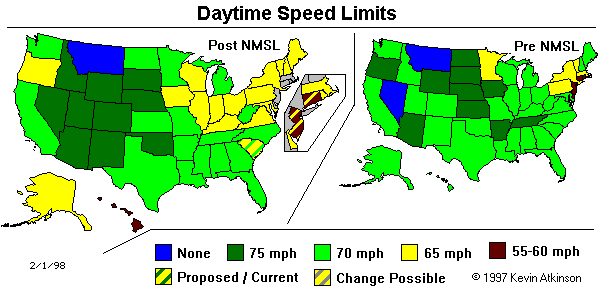
The National Maximum Speed Law (in the United States) was a provision of the 1974 Emergency Highway Energy Conservation Act[1] that capped all speed limits at 55 mph (90 km/h). This cap was intended to conserve gasoline in response to the 1973 oil crisis. This law was modified in the late 1980s to allow 65 mph (105 km/h) limits. In 1995 it was repealed, returning the power of setting speed limits to the states.
- See also: Speed limits in the United States
Contents |
[edit] History
[edit] Before the federal speed limit
Historically, the power to set speed limits belonged to the states. Immediately before the National Maximum Speed Law became effective, speed limits were as high as 75 mph (120 km/h).[2] (Kansas had lowered its turnpike speed limit from 80 before 1974.) Montana and Nevada generally posted no numeric speed limit on rural roads.
[edit] 1974 — 55 mph National Speed Limit
As an emergency response to the 1973 oil crisis, the U.S. Congress and President Richard Nixon imposed a nationwide 55 mph (90 km/h) speed limit in 1974 by requiring the limit as a condition of each state receiving highway funds, a use of the Commerce Clause of the United States Constitution[3].
It was also believed that, based on a drop in fatalities the first year the limit was imposed, the 55 mph limit increased highway safety. Other studies were more mixed on this point, and a Cato Institute report showed that the safety record actually worsened in the first few months of the 55 mph speed limit, suggesting that the fatality drop was a short-lived anomaly that regressed to the mean by 1978.[4] After the oil crisis abated, the 55 mph speed limit was retained mainly due to the possible safety aspect.
In 1986 The Heritage Foundation, a conservative think tank, published a study claiming that the total fuel savings during the national speed limit was no more than 1% overall.[5]
[edit] Opposition and noncompliance
The 55 mph limit was wildly unpopular. To wit:
- From April through June 1982, speed was monitored on New York's Interstate highways, and an 83% noncompliance rate was found despite extreme penalties ranging from $100 (1982 dollars) or 30 days jail on a first offense to $500 (1982 dollars), up to 180 days in jail, and a six month driver's license revocation upon third conviction in 18 months. [6]
- Arizona, Idaho, Montana, Nevada and Utah replaced traditional speeding fines with $5-$15 energy wasting fines as long as drivers did not exceed the speed limit in effect before the 55 mph federal requirement.[7] Nevada's energy wasting fine was enacted on April 15, 1981 when signed by Governor Robert List. Motorists not exceeding 70 mph in 55 mph zones could be issued $5 "energy wasting" fines. However, standard speeding tickets were still allowed and "troopers were directed not to take the new law as a signal to stop writing tickets."[8]
- In 1981, 33 state legislatures debated measures to oppose the 55 mph speed limit.[9]
- Even organizations supporting the 55 mph limit, like the American Automobile Association, provided lists of locations where the limit was strictly enforced.[10]
- On June 1, 1986, Nevada ignored the 55 mph speed limit by posting a 70 mph (110 km/h) limit on a 3 mile (5 km) stretch of Interstate 80. The Nevada statute authorizing this speed limit included language that invalidated itself if the federal government suspended transportation funding. Indeed, the Federal Highway Administration immediately withheld highway funding, so the statute quickly invalidated itself.[11]
[edit] 1987 and 1988 — 65 mph limit
In the April 2, 1987 Surface Transportation and Uniform Relocation Assistance Act, Congress permitted states to raise speed limits to 65 mph (105 km/h) on rural Interstate highways,[12] and in 1988 Congress extended the same 65 mph limit to any rural roads built to Interstate standards even if they were not signed as Interstates (although states had to apply for this privilege).
[edit] 1995 — Repeal of federal limits
Congress lifted all federal speed limit controls in the November 28, 1995 National Highway Designation Act, fully delegating speed limit authority to the states. Several states immediately reverted to already existing laws. For example, most Texas rural limits that were above 55 mph in 1974 immediately reverted to 70 mph (110 km/h), causing some legal confusion before the new signs were posted. Montana reverted to non-numerical speed limits on most rural highways, although its legislature adopted a 75 mph (120 km/h) limit in 1999 (see the Montana section of speed limits in the United States for more details).
Hawaii was the last state to raise its speed limit above 55 mph when, in response to public outcry after an experiment with road safety cameras in 2002, it raised the maximum speed limit on parts of Interstates H-1 and H-3 to 60 mph.[13]
Despite repeal of federal speed limit controls, current maximum speed limits are on average lower than in 1974:
- States with same speed limit as pre-1974: 251
- States with higher speed limit than pre-1974: 8
- States with lower speed limits than pre-1974: 172
1Includes Texas where despite some 75 and 80 mph limits, the same pre-1974 speed limits are applicable on the vast majority of rural roads. 2Includes Virginia where the vast majority of rural freeways have a 65 mph limit.
(Source: comparison of Reasonable Drivers Unanimous historical chart against Wikipedia Speed limits in the United States.)
[edit] Reclassified roads
A few roads that weren't Interstate highways but were built to Interstate standards were designated as Interstate highways to qualify for the 65 mph speed limit:
- Kansas petitioned the Federal Highway Administration on May 14, 1987 to "designate the turnpike as an interstate highway between Topeka and Emporia". This Kansas Turnpike segment had existed since 1956 without a federal designation. Interstate status was granted, Interstate 335 was designated, and the 65 mph speed limit signs went up.[14]
- Western Interstate 88 in Illinois had previously been designated as Illinois Route 5.
- 50 miles of the Maine Turnpike between Portland and Gardiner were designated as Interstate 495 in 1988. The designation for this segment was changed in 2004 to Interstate 95 to simplify the Interstate numbering scheme in Maine.[15]
[edit] Popular culture
The 55 mph limit morphed into the popular culture:
- Government television campaigns (including ads featuring Willie Nelson) proclaimed "55 Saves Lives" and "Don't Be Fuelish."
- The film Smokey and the Bandit II featured a state trooper holding a radar gun with the "55" on the dial, reflecting the era.
- Sammy Hagar's hit single "I Can't Drive 55".
- Speedometers of the 1980s were required by the NHTSA to have special emphasis on the number 55 and a maximum speed of 85 mph.[16][17]
- The term "double nickel" came into widespread usage.
- In "The Way We Was," a teenage Homer Simpson prepares for a debate on the 55 mph speed limit, arguing that, "Sure, it'll save a few lives, but millions will be late!"
- The films: Gumball Rally, Cannonball (film), as well as the Cannonball Run / Cannonball Run II / Speed Zone! series of films.
- C.W. McCall (alias of Bill Fries) has stated that his 1975 hit song Convoy was inspired by the debate over the national speed limit.
[edit] External links
- Photograph of 55 mph speed limit replacing a 70 mph limit on Feb. 12, 1974
- Photograph of KSDOT workers changing a 75 mph sign to 55 mph in 1974
[edit] Other reading
- "A Cost-Benefit Analysis of the 55 MPH Speed Limit: Reply", Larry D. Singell and Robert F. McNown,
Southern Economic Journal, Vol. 52, No. 2 (Oct., 1985), pp. 550-553
- "Assessing the 55 m.p.h. National Speed Limit," Clotfelter, Charles T. and John C. Hahn, Policy Sciences 9 (June, 1978): 281-294. reprinted in David Nachimas (ed.), The Practice of Policy Evaluation (New York: St. Martin's Press, 1980), 396-412
[edit] References
- ^ TMIP: Urban Transportation Planning In the United States: An Historical Overview
- ^ http://www.ibiblio.org/rdu/sl-attud/maps/sl-map.gif
- ^ http://www.usdoj.gov/osg/briefs/1989/sg890328.txt
- ^ Moore, Stephen (1999-05-31). Speed Doesn't Kill: The Repeal of the 55-MPH Speed Limit 7-9. Cato Institute. Retrieved on 2007-04-19.
- ^ Copulos, Milton R. (1986-09-09). The High Cost of the 55 MPH Speed Limit. The Heritage Foundation. Retrieved on 2007-04-19.
- ^ PRACTICAL TRAVELER: THE 55-M.P.H. SPEED LIMIT - New York Times
- ^ PRACTICAL TRAVELER: THE 55-M.P.H. SPEED LIMIT - New York Times
- ^ Nevada Speeders Getting $5 'Energy Wasting' Fines. Associated Press (1981-04-16).
- ^ PRACTICAL TRAVELER: THE 55-M.P.H. SPEED LIMIT - New York Times
- ^ PRACTICAL TRAVELER: THE 55-M.P.H. SPEED LIMIT - New York Times
- ^ http://www.usdoj.gov/osg/briefs/1989/sg890328.txt
- ^ http://www.usdoj.gov/osg/briefs/1989/sg890328.txt
- ^ Honolulu Star-Bulletin Hawaii News
- ^ "65 mph approved for route", Wichita Eagle-Beacon, October 24, 1987.
- ^ Maine Interstate Redesignation 2004 (PDF)
- ^ Kramer, Larry. "Odometer Security Rules Due" (fee required), Washington Post, 1978-03-10, p. B11.
- ^ NHTSA regulation: 49 CFR 571.127 "Standard No. 127 Speedometers and Odometers" (effective Sept. 1, 1980)