Image:LunarPhotons.png
From Wikipedia, the free encyclopedia

No higher resolution available.
LunarPhotons.png (491 × 360 pixels, file size: 62 KB, MIME type: image/png)

| This is a file from the Wikimedia Commons. The description on its description page there is shown below.
|
[edit] Summary
| Description |
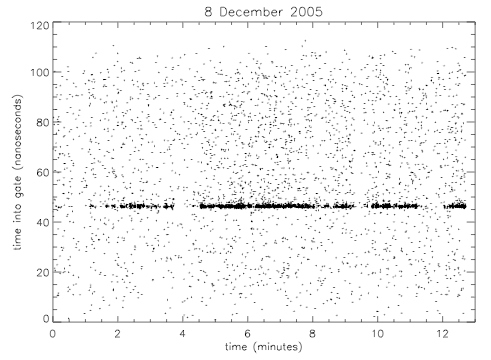
Time of arrival of lunar photons |
|---|---|
| Source | |
| Date |
26 Jan 2008 |
| Author |
APOLLO Collaboration, found here. |
| Permission (Reusing this image) |
Atribution required to the 'APOLLO Collaboration'. |
Emails showing permissions -------
Hi Lou,
You are absolutely welcome to use the image. I've been meaning to learn how to do Wikipedia edits for some time, so I could add APOLLO to the lunar laser ranging page (and make its own page). As for credits, I can't claim *all* the credit for this image (unlike a photo, e.g.). So probably credit it to the APOLLO collaboration, and put the APOLLO website as the reference.
We've had truly outstanding runs in the last months, blowing away the graphic you are going to use. Go ahead and put the one you want up now as a placeholder, and I'll provide a more dramatic version later (see attached for flavor).
(In the attached image, the "fiducials" at bottom are returns from the local corner cube, showing the system response. The lunar is broadened by the physical shape of the array, whose theoretical profile--based on the moon's orientation at the time--is overplotted in magenta. Convolving the trapezoid with the fiducial response should give the lunar response.)
Tom
> Hi, Prof. Murphy! > > I'm a co-investigator with Slava Turyshev, enjoy adding to Wikipedia > articles, and watch with interest your new lunar ranging program.. > I'm hoping to add the picture > > http://physics.ucsd.edu/~tmurphy/apollo/run_1208.png > > to Wikipedia, for use in the article "Independent evidence for Apollo > Moon landings" > > http://en.wikipedia.org/wiki/Independent_evidence_for_Apollo_Moon_landings > > The cluster of photons in your picture shows very clearly that there > is something on the lunar surface, of very small size, reflecting a lot > more photons than all the rest of the surface. And I think the photo > shows it more convincingly than a text description could do. > > So if you are willing to release this photo either into the public > domain, or with no restrictions except attribution, then it would be > great to add it to the article. You could add it yourself, or I could > do it. In this case, all you need do is give your OK - I can quote > the email in the permissions section. > > Thanks, > Lou Scheffer >
Tom Murphy Assistant Professor of Physics UC San Diego 858.534.1844 office 858.534.0177 FAX 858.822.1410 Lab tmurphy [] physics.ucsd.edu
-
- Note: Atsign removed from signatureblock onwiki to prevent SPAMs to the professor. 150.250.191.154 00:57, 13 February 2008 (UTC)
[edit] Licensing
  |
This file is licensed under the Creative Commons Attribution 3.0 Unported License. In short: you are free to distribute and modify the file as long as you attribute its author(s) or licensor(s). Official license
Català | Česky | Deutsch | English | Ελληνικά | Español | Français | 한국어 | Italiano | עברית | Lietuvių | Magyar | Nederlands | Polski | Português | Русский | Türkçe | 中文(繁體) | +/- |
File history
Click on a date/time to view the file as it appeared at that time.
| Date/Time | Dimensions | User | Comment | |
|---|---|---|---|---|
| current | 03:05, 27 January 2008 | 491×360 (62 KB) | LouScheffer | ({{Information |Description=Time of arrival of lunar photons |Source=http://physics.ucsd.edu/~tmurphy/apollo/run_1208.png |Date=26 Jan 2008 |Author=Apollo Collaboration |Permission=Atribution required to the 'Apollo Collaboration'. |other_versions= }} ---) |