Independent evidence for Apollo Moon landings
From Wikipedia, the free encyclopedia


Independent evidence for Apollo Moon landings is evidence from independent groups that supports the idea that NASA conducted manned Moon landings. One of the reasons for such an endeavor is to counter the Apollo Moon Landing hoax theories, by showing there is evidence independent of NASA and the US government that the manned moon landings really happened as NASA claims.
Contents |
[edit] Existence and age of Moon rocks
A total of 382 kilograms (842 lb) of Moon rocks and moon dust were collected during the Apollo 11, 12, 14, 15, 16 and 17 missions of the Apollo program.[1] Some 10 kg (22 lb) of the moon rocks have been destroyed during hundreds of experiments done by both NASA researchers and planetary scientists at research institutions unaffiliated with NASA. These experiments have confirmed the age and origin of the rocks as lunar and were used to identify lunar meteorites subsequently collected from Antarctica.[2] The Moon rocks are up to 4.5 billion years old [3], making them 700,000,000 years older than the oldest Earth rocks, which are from the end of the Hadean period, 3.8 billion years ago.
[edit] Evidence of landing

The presence of retroreflectors (mirrors used as targets for Earth-based tracking lasers) from the Lunar laser ranging experiment (Laser Ranging RetroReflector; LRRR) left on the Moon is evidence of a landing.[4][5] Quoting from James Hansen's biography of Neil Armstrong:
For those few misguided souls who still cling to the belief that the Moon landings never happened, examination of the results of five decades of LRRR experiments should evidence how delusional their rejection of the Moon landing really is.[6]

The NASA-independent Observatoire de la Côte D’Azur, McDonald, and Haleakala observatories are regularly using the Apollo LRRR.[7] The photo on the left shows some of the most un-ambiguous evidence. This experiment repeatedly fires a laser at the moon, at the spots where the Apollo landing were reported. The dots show when photons are received from the moon. The dark line shows that a large number come back at a specific time, and hence were reflected by something quite small (well under a meter in depth). Photons reflected from the surface would come back over a much broader range of times (the whole vertical range of the plot corresponds to only 30 meters or so in range). This only happens when the laser is aimed at the spots where the lunar landings were reported, otherwise the expected featureless distribution is observed.[8]
Although the reflectors are strong evidence that human-manufactured artifacts currently exist on the moon, they do not prove humans have visited the moon. Similar retroreflectors were carried by un-manned missions such as Lunokhod 2, and like the Apollo reflectors, are still in use today[9].
[edit] Apollo missions tracked by independent parties
Aside from NASA, a number of entities and individuals observed, through various means, the Apollo missions as they took place. On later missions NASA released information to the public explaining where third party observers could expect to see the various craft at specific times according to scheduled launch times and planned trajectories.[10]
[edit] Observers of all missions
The Soviets monitored the missions at the Space Transmissions Corps, which was "fully equipped with the latest intelligence-gathering and surveillance equipment".[11] Vasali Mishin ("The Moon Programme That Faltered."), in Spaceflight. 33 (March 1991): 2-3 describes how the Soviet Moon programme lost energy after Apollo.
The missions were tracked by radar from several countries on the way to the Moon and back.[12]
In Australia, Honeysuckle Creek Tracking Station monitored transmissions from Apollo missions, from:
- Tidbinbilla radio telescope made observations.
- Carnavon received radio transmissions
- Deaking Switching Station was the switching station for the Apollo television broadcasts.
[edit] Apollo 8
- December 21, 1968 - 18:00 UT - Amateur astronomers (H.R. Hatfield, M.J. Hendrie, F. Kent, Alan Heath, and M.J. Oates) in the UK photographed a fuel dump from the jettisoned S-IVB stage. [1]
- Pic du Midi Observatory (in the French Pyrenees); the Catalina Station of the Lunar and Planetary Laboratory (University of Arizona); Corralitos Observatory, New Mexico, then operated by Northwestern University; McDonald Observatory of the University of Texas; and Lick Observatory of the University of California all filed reports of observations. [2]
- Dr. Michael Moutsoulas at Pic du Midi reported an initial sighting around 17:10 UT on December 21 with the 1.1-meter reflector as an object (magnitude near 10, through clouds) moving eastward near the predicted location of Apollo 8. He used a 60-cm refractor to observe a cluster of objects which were obscured by the appearance of a nebulous cloud at a time which matches a firing of the service module engine to assure adequate separation from the S-IVB. This event can be traced with the Apollo 8 Flight Journal, noting that launch was at 0751 EST or 12:51 UT on December 21. [3]
- Justus Dunlap and other at Corralitos Observatory (then operated by Northwestern University) obtained over 400 short-exposure intensified images, giving very accurate locations for the spacecraft.[citation needed]
- The 2.1 m Struve telescope at McDonald, from 01:50-2:37 UT observed the brightest object flashing as bright as magnitude 15, with the flash pattern recurring about once a minute.[citation needed]
- The Lick observations during the return coast to Earth produced live TV pictures broadcast to West Coast viewers via KQED-TV in San Francisco.
- An article in the March 1969 issue of Sky & Telescope ("Optical Observations of Apollo 8" by Harold B. Liemon (Geo-Astrophysics Laboratory, Boeing Scientific Research Laboratories), pp. 156-160) compiled a number of observations [4] (Boeing was a NASA subcontractor).
- The first post-launch sightings were from the Smithsonian Astrophysical Observatory (SAO) station on Maui, and observed the TLI burn near 15:44 UT on December 21. (The Smithsonian Institute is funded by the US government).
- Table Mountain, a Deep Space Network station, reports that they tracked all the Apollo lunar missions except 17.
- Bernard Scrivener (at Honeysuckle Creek) personally recorded forty-five to fifty hours of the radio conversation between Houston and Apollo 8. These are recordings of the raw audio, not what was released to the public through NASA. [13]
[edit] Apollo 10
- A list of sightings of Apollo 10 were reported in "Apollo 10 Optical Tracking", Sky & Telescope, July 1969, pp. 62-63.
[edit] Apollo 11
- The Bochum Observatory director (Professor Heinz Kaminski) was able to provide confirmation of events and data independent of both the Russian and US space agencies. [5]
- A compilation of sightings appeared in "Observations of Apollo 11", Sky and Telescope, November 1969, pp. 358-359.
- The Madrid Apollo Station, part of the Deep Space Network, built in Fresnedillas, near Madrid, Spain tracked Apollo 11. [6]
- Goldstone Tracking Station in California tracked Apollo 11. [7]
- At Jodrell Bank Observatory in the UK the telescope was used to observe the mission, as it had been many years previously for Sputnik.[14]
[edit] Apollo 12

Paul Maley reports several sightings of the Apollo 12 Command Module. [8]
Parts of Surveyor 3, which landed on the Moon in April 1967, were brought back to Earth by Apollo 12. .[15] These samples were determined to have been exposed to lunar conditions. [9]
[edit] Apollo 13
Chabot Observatory calendar records an application of optical tracking during the final phases of Apollo 13, on 17 April 1970. "Rachel, Chabot Observatory's 20-inch refracting telescope, helps bring Apollo 13 and its crew home. One last burn of the lunar lander engines was needed before the crippled spacecraft's re-entry into the Earth's atmosphere. In order to compute that last burn, NASA needed a precise position of the spacecraft, obtainable only by telescopic observation. All the observatories that could have done this were clouded over, except Oakland's Chabot Observatory, where members of the Eastbay Astronomical Society had been tracking the Moon flights. EAS members received an urgent call from NASA Ames Research Station, which had ties with Chabot's educational program since the 60's, and they put the Observatory's historic 20-inch refractor to work. They were able to send the needed data to Ames, and the Apollo crew was able to make the needed correction and to return safely to Earth on this date in 1970." [10]
[edit] Apollo 14
Elaine Halbedel, from the Corralitos Observatory photographed Apollo 14.[10]
[edit] Apollo 16
Jewett Observatory at Washington State University reported sightings of Apollo 16.[10]
Honeysuckle Creek tracked Apollo 16 and recorded the Audio of the landing.
[edit] Apollo 17
Sven Grahn describes several amateur sightings of Apollo 17. [11]
[edit] Ultraviolet photos

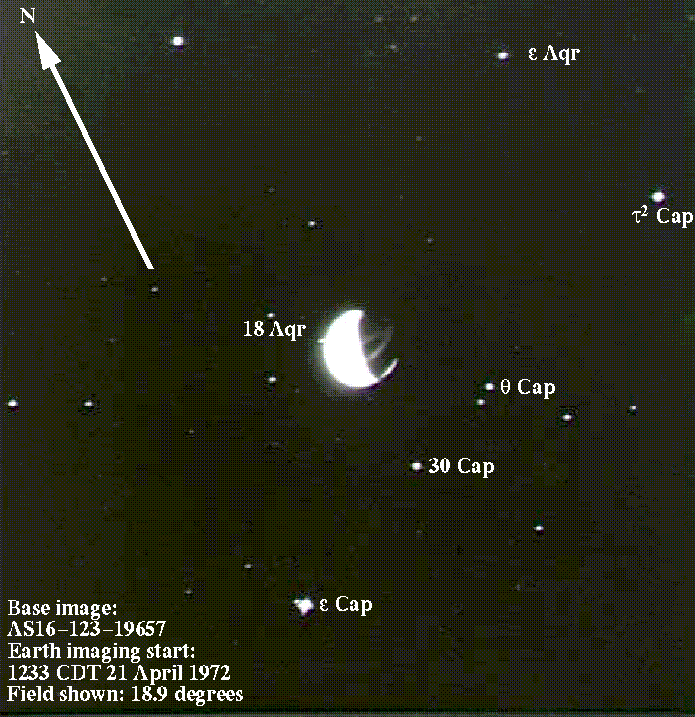
Long-exposure photos were taken with a special far-ultraviolet camera by Apollo 16 on April 21, 1972 from the surface of the Moon. (This photo has some stars labeled.) Some of these photos show the Earth with stars from the Capricornus and Aquarius constellations in the background. The joint Belgium/U.K./Holland satellite TD-1 later scanned the sky for stars that are bright in UV light. The TD-1 data obtained with the shortest passband is a close match for the Apollo 16 photographs.[16]
[edit] Future plans that may generate evidence
As new research facilities such as orbiters and telescopes are built, the question naturally comes up whether they can see the Apollo artifacts on the moon. At least two scientific missions have capabilities that could make this possible:
- The Descent Module of the Apollo landers and lunar rovers are planned to be photographed by the 2008 Lunar Reconnaissance Orbiter camera.[17] The much smaller Mars landers have already been photographed from Mars Orbit.[18]
- The landing sites may be visible with the Very Large Telescope.[19]
[edit] References
- ^ James Papike, Grahm Ryder, and Charles Shearer (1998). "Lunar Samples". Reviews in Mineralogy and Geochemistry 36: 5.1–5.234.
- ^ House passes bill to award Apollo astronauts moon rocks 27 September 2000
- ^ James Papike, Grahm Ryder, and Charles Shearer (1998). "Lunar Samples". Reviews in Mineralogy and Geochemistry 36: 5.1–5.234.
- ^ What Neil & Buzz Left on the Moon July 20, 2004
- ^ Laser Ranging Retroreflector. NSSDC Master Catalog Display: Experiment. National Space Science Data Center, NASA (2006-12-04). Retrieved on 2007-02-07.
- ^ First Man: The Life of Neil A. Armstrong, by James R. Hansen, 2005, Simon & Schuster, pp 515-16.
- ^ Contribution of SLR Results to LLR Analysis (PDF). Retrieved on 2007-07-26.
- ^ Tom Murphy. the Apache Point Observatory Lunar Laser-ranging Operation.
- ^ Lunar Geophysics, Geodesy, and Dynamics, James G. Williams and Jean O. Dickey
- ^ a b c Telescopic Tracking of the Apollo Lunar Missions May 2007
- ^ David Scott and Alexei Leonov (2004). Two Sides of the Moon. St. Martin's Press, 247. ISBN 0-312-30865-5.
- ^ Hansen, James (2005), First Man: The Life of Neil A. Armstrong, Simon & Schuster, 636, ISBN 978-0-7432-5631-5
- ^ A Tribute to Honeysuckle Creek Tracking Station
- ^ BBC/OU Open2.net - History - The other space race: Transcript. Retrieved on 2006-02-06.
- ^ anon (2007). "50th anniversary of first microbes in orbit". Astronomy 35, #11: 22.
- ^ Keel, William C. "The Earth and Stars in the Lunar Sky", Skeptical inquirer, Vol. 31, #4, July 2007, pp 47-50.
- ^ Dr. Tony Phillips and Patrick L. Barry. Abandoned Spaceships and Moon Buggies. NASA.
- ^ NASA Mars Orbiter Photographs Spirit and Vikings on the Ground (2006-12-04). Retrieved on 2007-07-26.
- ^ Telescope to challenge moon doubters (2002-11-25). Retrieved on 2007-07-26.
[edit] See also
- Apollo Moon Landing hoax accusations
- Examination of Apollo moon photos
- Moon landing
- Moon rock
- Project Apollo