List of Germanic peoples
From Wikipedia, the free encyclopedia


Germanic Peoples.
Contents |
[edit] Introduction
The first known sociologist or the Germanic ethnic group was Aristotle, who said that
- "Man is an animal of the polis (politikon zoon) by nature (physei)"
The Greeks assigned names to populations they considered distinct based on the city-state (polis) to which they belonged. Intermingled with this system was an earlier one derived from the idea of a family tree. They grouped primary families into clans and the clans into tribes. The highest unit was the ethnos, i.e. people, or race, which they believed descended from a single ancestor. If they couldn't identify the ancestor, they simply invented him.
As a result, the classical historians conceived of history as a story unfolding between ethnic identities led by heroic men. They always named the identity: a Roman, a Germanic tribesman, the Thracians, the Carthaginians, an Athenian. It was operant even though sometimes not factual as understood: an individual behaved in a certain way because he was a Germanic tribesman and not a Roman or vice versa. Moreover these identities are often still operant today or have been replaced by those that are. The individual learns their expected behaviors and attendant lore as part of the socialization process growing up, just as an actor would learn to play a role.
The main article on this topic is about one such identity, the Germanic. The article attempts to define it and to present some of the associated ideology. This is not an idle exercise, as history and national politics are still to a large extent viewed as a story of the interactions between such groups.
Scholars divide Germanic identities into the historical and the contemporary. There is some overlap, as many of the ancient have descended to the contemporary.
[edit] Ancient and Medieval

The ethnic names below come from ancient and mediaeval sources dating from the late 1st millennium BC to the early 2nd millennium AD. They do not necessarily represent contemporaneous, distinct or Germanic-speaking populations or have common ancestral populations. Some closely fit the concept of a tribe. Others are confederations or even unions of tribes. Some may not have spoken Germanic at all, but were bundled by the sources with the Germanic speakers.
Some were undoubtedly of mixed culture. They may have assimilated to Germanic or to other cultures from Germanic. Long-lasting ethnic identities changed population base and language over the centuries. As for genetic characteristics, they must be considered unrelated to these names.
Apart from these limitations, it is probably safe to assume that, on the whole, most of these populations spoke some branch of Germanic and contributed to pools of descendants who currently live in the Germanic-speaking countries.[citation needed] Many of the names descend to modern place names.
[edit] Alphabetic list
A
Adogit, Aelvaeones, Aeragnaricii, Ahelmil, Alamanni or Alemanni, Ambrones, Ampsivarii or Ampsivari, Angles, Angrivarii or Angrivari, Arochi, Augandzi, Avarpi, Aviones
B
Baemi, Banochaemae, Batavii or Batavi today known by Batavians, Batini, Bavarii, Bergio, Brisgavi, Brondings, Bructeri, Burgundiones, Buri
C
Calucones, Canninefates, Casuari, Caritni, Chaedini, Chaemae, Chaetuori, Chali, Chamavi, Charudes, Chasuarii, Chattuarii, Chauci, Cherusci, Chatti, Cobandi, Condrusi, Corconti, Curiones
D
Danduti, Dani, Dauciones, Diduni, Dulgubnii, Dutch, Danes
E
Eburones, English, Eudoses, Eunixi, Evagre,
F
Faroese, Favonae, Fervir, Finni, Firaesi, Flemish, Forsi, Franks, Frisians, Fundusi
G
Gall-Gaidheal, Gambrivii, Gauthigoth, Geats, Gepidae, Goths, Gutar Grannii
H
Hallin, Harii, Harudes, Hasdingi, Helisii, Helveconae, Heruli, Hermunduri, Hilleviones, Horder
I
Ingriones, Ingvaeones (North Sea Germans), Intuergi, Irminones (Elbe Germans), Istvaeones (Rhine-Weser Germans) Icelanders
J
L
Lacringi, Landi, Lemovii, Levoni, Lombards or Langobardes, Liothida, Lugii
M
Manimi, Marcomanni, Marsi, Marsigni, Marvingi, Mattiaci, Mixi, Mugilones
N
Naharvali, Narisci or Naristi, Nemetes, Nertereanes, Nervii, Njars, Norn, Nuitones, Norwegians
O
Ostrogoths, Otingis
P
Pharodini
Q
R
Racatae, Racatriae, Ranii, Raumarici, Reudigni, Rugii, Ruticli
S
Sabalingi, Saxons, Scirii, Segni, Semnoni or Semnones, Sibini, Sidini, Sigulones, Silingi, Sitones, Suarini or Suardones, Suebi or Suevi, Suetidi, Suiones, Sugambri
T
Taetel, Tencteri, Teuriochaemae, Teutonoari, Teutons, Theustes, Thuringii, Toxandri, Treveri, Triboci, Tubantes, Tungri, Turcilingi, Turoni
U
Ubii, Ulmerugi, Usipetes, Usipi or Usippi
V
Vagoth, Vandals, Vangiones, Vargiones, Varini, Varisci, Vinoviloth, Viruni, Visburgi, Visigoths, Vispi
Z
Zumi
[edit] Mythical founders
The preserved mythical founders and namesakes of some Germanic tribes:
- Angul — Angles (the Kings of Mercia, according to the Anglo-Saxon Chronicle, other Anglo-Saxon dynasties are derived from other descendants of Woden)
- Burgundus — Burgundians
- Cibidus — Cibidi
- Dan — Danes
- Nór — Norwegians
- Gothus — Goths
- Ingve — Ynglings
- Irmin — Irminones
- Longobardus — Lombards
- Seaxnēat — Saxons
- Valagothus — Valagoths
- Suiones — Suiones (Svear)
- Thüringer — Thuringii
[edit] Contemporary
Germanic languages are spoken by hundreds of millions of modern people. For these languages, Germanic languages.
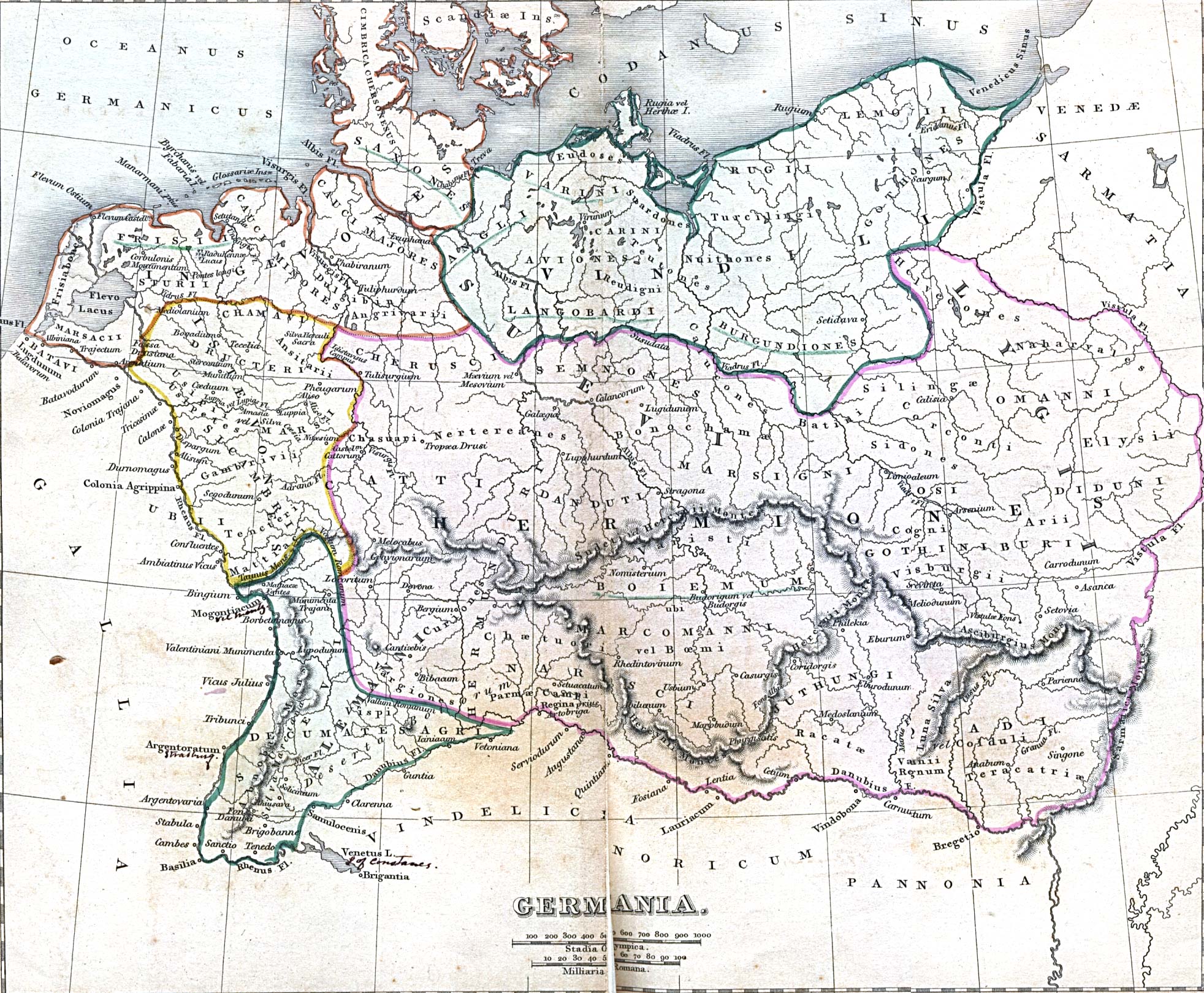
[edit] Links to maps
Some tribal maps of Germania can be found at:
These maps or any other maps represent an interpretation of the information available to the map-maker. Typically the ancients did not know or did not leave enough information for us to locate them exactly. The maps only give us a rough idea of the features and ethnic locations of Germania. In addition, some of tribes, e.g. the Bastarnae are not identified as Germanic with any certainty and large areas in Central Europe the Germanic tribes probably only constituted a newly arrived minority among Slavs and remaining Celts. Wolfram (1990:91f), for instance, points out that the early Visigoths, called Tervingi also comprised many Taifalans (unknown origin) and Alans (Iranians). The Alans became so Gothicized that non-Germanic people considered them to be Goths.
[edit] See also
- Confederations of Germanic Tribes
- Germania
- Germanic Europe
- Germanic peoples
- German clan
- Norse clans
- Sippe
|
|||||||||||||||||