Knygnešiai
From Wikipedia, the free encyclopedia


Knygnešiai (singular: knygnešys) were book smugglers who brought Lithuanian publications printed in the Latin alphabet, the historic orthography of the Lithuanian language, into Lithuania from 1866 to 1904, during the period of Lithuanian press ban, following the program to replace the Latin alphabet with Cyrillic, instituted by the Russian authorities. "Knygnešys" may be translated as "book peddler" (knyga book + nešti carry). This word has come to be reserved for those people who smuggled printed matter across the border from Lithuania Minor, a part of East Prussia, and from the United States into the Lithuanian-speaking areas of Imperial Russia. The knygnešiai became a symbol of the resistance of the Lithuanians against Russification.
After the Polish-Lithuanian insurrection of 1863, the Russian Imperial government intensified its efforts to turn the Lithuanian population away from its historic roots, including the Roman Catholic faith, which had become widespread during the years of the Polish-Lithuanian Commonwealth.
In the summer of 1863 Tsar Alexander II issued "Temporary Rules for State Junior Schools of the Northwestern Krai, ruling that only Russian-language education would be allowed there. In 1864 the Governor General of Vilna Governorate, Mikhail Muravyov ordered that Lithuanian language primers were to be printed only in the Cyrillic alphabet. Muravyov' s successor, Konstantin Kaufman, in 1865 banned all Lithuanian-language use of the Latin alphabet. In 1866 the Tsar issued an oral ban on the printing or importing of printed matter in Lithuanian. Although formally, the order had no legal force, it was executed de facto until 1904. During this time there were approximately 55 printings of Lithuanian books in Cyrillic.
Most of the Latin-alphabet Lithuanian-language books and periodicals published at the time were printed in Lithuania Minor and then smuggled into Lithuania. When caught, knygnešiai were punished by fines, banishment, and exile, including deportation to Siberia. Some of them were shot while crossing the border.
In 1867, Motiejus Valančius, the Bishop of Samogitian episcopate, began to organize and finance this printing abroad, and sponsored its illegal distribution within Lithuania. In 1870 his organization was uncovered, with the help of Prussian authorities, and five priests and two knygnešiai were exiled to remote areas of Russia. Other knygnešiai carried on his work.
During the final years of the ban an estimated 30,000 to 40,000 books were smuggled in annually. About one-third of them were seized by authorities. Lithuanian books reached every settlement in Lithuania, and many legal institutions served as undercover transfer points for the books. A number of secret organizations distributed the books throughout Lithuania, including Sietynas, Atgaja, Teisybė, Prievarta, Aušrinė, Atžala, Lizdas, Akstinas, Spindulys, Svirplys, Žiburėlis, Žvaigždė, and Kūdikis.
The ban's lack of success was recognized by the end of the 19th century, and in 1904, under the official pretext that the minorities within the Russian Empire needed to be pacified after the Russo-Japanese War, the ban on Lithuanian was lifted. In 1905, soon after the ban was lifted, one of the most renowned book smugglers, Juozas Masiulis, opened his own bookstore in Panevėžys. This bookstore is still operational, and a chain of bookstores operates in Lithuania under his name.
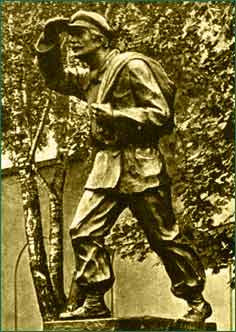
This historical episode was widely suppressed during the years when Lithuania was occupied by the Soviet Union. After the dissolution of the Soviet Union, knygnešiai were honored in Lithuania by museums, monuments, and street names. A statue dedicated to "The Unknown Book Smuggler" stands in Kaunas.
The knygnešiai were an important part of the Lithuanian National Revival. Knygnešys Jurgis Bielinis, who created a distribution network for banned Lithuanian books, was born on 16 March, 1846. This date is commemorated in Lithuania as the "Day of the Knygnešiai".
[edit] References
- Ruseckas, Petras (1992-1997) Knygnešys : 1864-1904 (Booksmuggler: 1864-1904) (3 vols.) Valstybinis leidybos centras, Vilnius, ISBN 998681006X (Volumes 1 & 2, reprint, originally published: Spaudos fondas, Kaunas, 1926-1928) (in Lithuanian);
- Merkys, Vytautas (1994) Knygnešių laikai: 1864-1904 (The era of the booksmugglers: 1864-1904) Valstybinis leidybos centras, Vilnius, ISBN 9986090180 (in Lithuanian);
- Merkys, Vytautas (1994) Draudžiamosios lietuviškos spaudos kelias: 1864-1904: informacinė knyga (The path of the banned Lithuanian press: 1864-1904: An information book) Vilnius: Mokslo ir enciklopedijų leidykla, Vilnius, ISBN 5420011816 (in Lithuanian);
- Kaluškevičius, Benjaminas and Žemaitytė-Narkevičienė, Ona (1998) Šimtas knygnešių: knygnešių sienelės vardai Lietuvos kultūros fondas, Lietuvos Knygnešio draugija, Vilnius, ISBN 9986917506 (in Lithuanian);
- Čiplytės, Joana Vigos (2005) Juozas Masiulis: knygnešys ir knygininkas Žara, Vilnius, ISBN 9986-34-140-X (in Lithuanian);
[edit] See also
[edit] External links
- Statue entitled Knygnešys by Juozas Zikaras in Kaunas.
- Booksmugglers