Talk:King Philip's War
From Wikipedia, the free encyclopedia


[edit] topics
Some of the tribes mentioned deserve their own articles and links. For others, we need a grouping that will allow short descriptions within some longer article, something like Indians of New England.
The town links also need to be checked and / or updated. In the 17th century, the collonial names we are used and some don't to didn't fit. Providence Plantaions went on the become Rhode Island. Massachusetts was officially divided into Massachusetts Bay and Plymouth Colonies, and claimed jurisdiction in New Hampshire and Maine. Though Connecticut would later emerge, many settlers in 1675 considered themselves to be expatriots of Massachusetts. —The preceding unsigned comment was added by LouI (talk • contribs) 15:12, September 6, 2003 (UTC)
[edit] Convert to Puritanism or die?
The bit about forced conversions on the sometimes enforced threat of death need some reference, it does not seem plausible. —The preceding unsigned comment was added by Leandrod (talk • contribs) 18:11, August 11, 2005 (UTC)
- I, on the other hand think it seems quite plausable considering how poorly the Colonists treated the Native Americans. —The preceding unsigned comment was added by 152.163.100.72 (talk • contribs) 15:32, December 15, 2005 (UTC)
-
- The main article doesn't seem to mention forced conversion anymore. rewinn 20:42, 26 June 2006 (UTC)
Europeans have practiced forced conversion for over fifteen hundred years. It's entirely plausible. 69.248.95.22 22:20, 17 September 2007 (UTC)
The National Book Award winner "Mayflower" by Philbrook that came out a year or two ago is a pretty exhaustive account of the period from the Mayflower's voyage through King Philip's War. Philbrook doesn't spare the Pilgrims or Puritans from criticism; but there aren't any examples of forced conversions. Indeed, many colonists distrusted "Praying Indians" and opposed other colonists efforts at prosylitizing and converting the native population. As a practical matter, it would have been difficult to "force" Indians to convert by the sword since they were a mobile population and not tied to ghettos or fixed towns like Jews (or Protestants in France), etc. They could simply leave, or pretend to convert and then flee at the first opportunity. It is remarkable that most converted Indians maintained their faith even when the Puritans, in the war's latter stages, started capturing and sending many to the West Indies as slaves. 169.253.4.21 (talk) 22:42, 23 January 2008 (UTC)TexxasFinn
[edit] Mahican or Mohegan?
This article mentions the Mohicans, but that term could refer to either of two distinct groups: the Mahicans or the Mohegans, which are commonly confused with each other. We need to clarify which group is being referred to in each case, and correct the Mohican link, which currently goes to a disambiguation page. I don't have the knowledge or sources to do the correction myself. --Wechselstrom 06:15, 4 December 2005 (UTC)
- According to the book, Mayflower by Nathaniel Philbrick, Mohegan is correct. —The preceding unsigned comment was added by 68.194.164.200 (talk) 02:46, 15 May 2007 (UTC).
[edit] Neutrality
I understand the mistreatment of the Native Americans by the colonialists, and I for one am hugely in favour of the Natives on any discussion on this topic, but we are an encyclopedia, and surely should write like one. "Direct result of the English rapacity for land" is not neutral language, and the entire article is POV. Jdcooper 00:14, 9 May 2006 (UTC)
- That is a disappointly simplistic explanation of the causes. It was far more complicated than that, both a civil war and a war against the English, and a really blunt example of why trade balance matters. --iMb~Meow 03:20, 5 June 2006 (UTC)
-
- It should be possible to npov edit this. Similar problems arise throughout WikiProjectNorthAmNative and it's all solvable. I just npov'd the former "Surrounded" section, but there's more to do.... rewinn 01:39, 25 June 2006 (UTC)
[edit] References
I see a whole bunch of sources being added to this article, with no particular indication where or if they are being used. This article would greatly benefit from inline citations (for example, the <ref> system) to show where the analyses are coming from and to alleviate concerns that this article may contain original research. --iMb~Meow 06:51, 6 June 2006 (UTC)
[edit] Population
The subsection Population: two views says that the indigenous population was "significantly larger" than the colonist population. But author Nathaniel Philbrick in his new book Mayflower says that there were about 20,000 Indians and about 50,000 colonists in the area by 1675. Is there a published source for the current statement in the article, or should it be updated? --Blainster 04:43, 10 July 2006 (UTC)
Though we do need a citation, I would hardly think of Philbrick as the last word on the topic. See Jill Lepore's review in the New Yorker about six months back.
-
- Nobody "knows" the population of Indians in 1675 and the guesses differ by orders of magnitude from a few thousand to a few tens of thousand. When they finally counted the Indians in a 1680 census they only came up with about a 1,000. The Indian casualties, as recorded by the colonists, would appear to be about the same as the colonists as each side "won" and "lost" various battles. Going through the different battles its posssible to come up with a few hundred colonists killed--600 is plausible. Where the 3,000 Indians killed comes from is not attributed and is probably an exaggeration unless it includes deaths by disease or some other unlisted calamity. The colonial New England population in 1675 can be gotten with a reasonable certainity from colonial records at 50,000 to 60,000. A "best guess" would be that the colonist probably out numbered the Indians 10:1 or more. That's one of the things that indirectly lead to the war as colonial population growth lead to the "need" for new land as the colonial population doubled in roughly every 25 years. On the other side the Indians desire for iron age tools like kettles, tomahawks and flintlocks was getting harder and harder to meet as they stripped the land of fur bearing animals to trade.
D'lin 07:17, 22 February 2007 (UTC)
[edit] Neutrality Tag?
- Is the article still deserving of the "Neutrality in Dispute" tag?
- If so, what elements are in dispute? Surely we can fix that! rewinn 06:01, 1 December 2006 (UTC)
[edit] Needs work
This article still needs work, especially for one on subject which is so important. The disparity of power that had already been established between Native and European peoples of this time period could be better conveyed through non-POV narrative than by veering from encyclopedic standards. Also, the narrative is a bit convoluted and it is difficult to discern that “a, b, & c” were on one side and “x, y, & z” where on the other. I’m putting this article on my to-do list and will make improvements soon. Happy Holidays. House of Scandal 00:33, 25 December 2006 (UTC)
[edit] Different begining to the war
I have this statmen which gives a reasn for the start of King Phillip's War. Death Notes- First incidents of King Phillip's War at Swansea in June 1675. On the 23rd of June, it is said that, John Salisbury killed an Indian who "was pilfering his house". Indians returned the next day and killed him and his father. When troops arrived, from Boston and Plymouth, on the 28th of June, they found the heads of the murdered Englishmen set on poles at a place called Keeamuit ( now Warren, RI ) Accounts of these incidents vary but it is generally accepted that the first victims of the war were "John Salisbury, William Salisbury, Gershom Cobb, Joseph Lewis, John Ives, Robert Jones, and John Fall, Nathaniel and William Lohun". -I found this statement at the local historical society done by a local historian from the Mass. area. Bcody 02:05, 9 February 2007 (UTC)
[edit] Inadequate Treatment of Aftermath
It appears that this article still hasn't freed itself from the triumphalism of the Puritan historical tradition. While it is true that the New England Indians were practically wiped out as a result of King Philip's War, the Puritans were also substantially harmed, nearly ruined, by the war. As pointed out by Francis Jennings toward the end of his book The Invasion of America: The Cant of Conquest, the weakened Puritans, now having to depend on the British government for protection, particularly the aggressive, aristocratic governor of New York Sir Edmund Andros, soon lost their independence altogther with the revocation of the charter of Massachusetts Bay in 1684 (enforced 1686), and they never got it back, even when Andros was deposed. At the same time, an Anglican church was established in Boston for the first time, and new religious freedom ended the Puritan monopoly on religion that had persisted 1629-1686. This was followed by the collusion of the Puritan clergy in the Salem witchcraft delusion, an attempt to recover their lost power which backfired and discredited them forever. This was all direct fallout from the ruin of their enterprise in King Philip's War. While the Puritan ethos undoubtedly contributed to the later character of the United States, the Puritans themselves were thoroughly discomfited and lost everything they had held dear. JimBDavis 04:32, 14 February 2007 (UTC)
[edit] Wamsutta
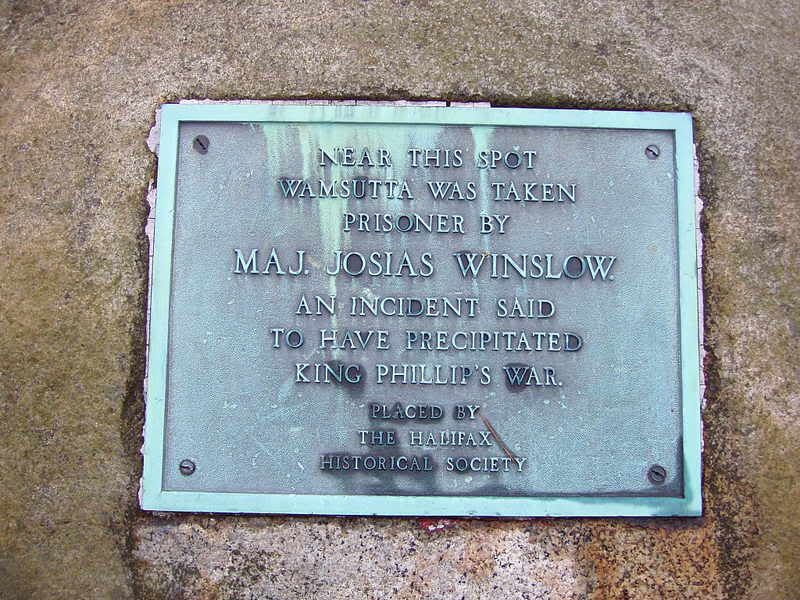
I'm posting a link to a picture [IMG]http://i101.photobucket.com/albums/m70/lzthomas/Image019.jpg[/IMG] that is in Halifax, Massachuseets, mentioning the capture of Wamsutta at that site. It is on the north end of White Island road, off Route 58 (Monponsett street).
[edit] The estimations are off by a few thousand...
although it's not verifiable, most sources say that the losses inflicted on both sides was about 20,000, not 3,600. That may seem steep, but the author even said "the war was one of the costliest in American history." 24.28.27.57 07:02, 4 May 2007 (UTC)
-
- I've seen NO reliable source indicate anywhere near the casualties you mention. The colonial casualties of around 600 are pretty well known, down to even the individual names in most cases as they kept pretty good pay records, town records etc. The Indian casualties are a much greater unknown since they and the colonials kept essentially no records on Indian casualties before or after the conflict. There are no reliable estimates of even how many Indians there originally were. I suspect most of their casualties would be due to disease as it continued for about the next 150 years to severly reduce their numbers. D'lin 12:07, 25 June 2007 (UTC)
[edit] Eight in Seven?
Can somebody explain the logic behind the following sentence in the introduction: " Colonial historian Francis Jennings estimated that nearly 8 in seven overall among the Indians and 30 in sixty five among the English were killed." How can nearly 8 in seven be killed? I guess technically, 7 is "nearly 8", but that is a stretch. —Preceding unsigned comment added by Freakboy (talk • contribs) 22:15, 11 December 2007 (UTC)
[edit] Sassamon
I was just reading a book about Indian names of place in Middleboro, Carver, Lakeville, and Plymouth - and it indicated that when Sassamon was murdered, they found his body under a frozen cove in Assawompset Pond in Lakeville. There was some significance in terms of the death and a related naming somewhere in the pond I think, but it escapes me. —Preceding unsigned comment added by 72.74.16.80 (talk) 21:41, 7 January 2008 (UTC)
[edit] Indian servants
I added a paragraph about the regulations governing the interactions between colonists and the Native Americans in Hingham, but it might perhaps be better moved elsewhere in the article. Thank you.MarmadukePercy (talk) 04:10, 15 April 2008 (UTC)
[edit] Indians?
I changed all references of "Indians" to "Native Americans"... any objections? Binarypower (talk) 05:12, 26 May 2008 (UTC)
[edit] "Killed 6 out of 13 settlers"? Really?
I find it hard to believe that the war killed 6 out of 13 "settlers," because the word "settlers" implies the entire population, including the women, children, and people who didn't leave home. "Colonial soldiers" would be much easier to believe. I am similarly dubious of the 7 out of 8 Native Americans figure.Fluoborate (talk) 18:13, 1 June 2008 (UTC)