Kimba the White Lion
From Wikipedia, the free encyclopedia
| Kimba the White Lion | |||
|---|---|---|---|
| ジャングル大帝 (Janguru Taitei (Jungle Emperor)) |
|||
| Genre | Coming of age | ||
| Manga: Jungle Emperor | |||
| Author | Osamu Tezuka | ||
| Publisher |  Gakudosha Kobunsha Kodansha Gakudosha Kobunsha Kodansha |
||
|
|||
| Magazine | Manga Shōnen | ||
| Original run | November 1950 – April 1954 | ||
| Volumes | 3[1] | ||
| TV anime | |||
| Director | Eichi Yamamoto | ||
| Studio | Mushi Productions |
||
| Network | Fuji Television |
||
| Original run | October 6, 1965 – September 28, 1966 | ||
| Episodes | 52 | ||
| Animated film: Jungle Emperor Leo: Feature Film | |||
| Director | Eichi Yamamoto | ||
| Studio | Mushi Productions Tezuka Productions |
||
| Released | July 31, 1966 | ||
| Runtime | 75 min. | ||
| TV anime: The New Adventures of Kimba The White Lion | |||
| Director | Takashi Ui | ||
| Studio | Tezuka Productions | ||
| Licensor | Pioneer Family Entertainment | ||
| Network | TV Tokyo |
||
| Original run | October 12, 1989 – October 11, 1990 | ||
| Episodes | 52 | ||


Jungle Emperor (ジャングル大帝 Janguru Taitei?), known in the United States as Kimba the White Lion, is a Japanese anime series from the 1960s, created by Osamu Tezuka, and based on his manga of the same title which began publication in 1950. It was the first color TV animation series created in Japan. The entire series of manga was first published in serialized form in Manga Shōnen magazine.
This anime series has enjoyed immense popularity worldwide — most notably in Australia, the United States, Europe and even in Middle East especially among Arab viewers — from the middle 1960s to today.[citation needed]
Contents |
[edit] Story
Africa, mid-20th century: In the face of the encroachment of mankind, a white lion, Caesar, seeks to give all wild animals a safe haven, free from fear. And, to a very large degree, he is successful. His mistake is to steal the cattle from nearby villages for the carnivores to eat.
A professional hunter, Viper Snakely, known as Ham Egg in the original Japanese, is called in to stop these raids. He avoids directly attacking Caesar — instead, Snakely records the sounds of Caesar and uses that as bait to trap his mate, Snowene, who then becomes bait in a trap for Caesar. Caesar is killed for his hide, and the pregnant Snowene is shipped overseas, destined for a zoo.
Kimba is born on the ship. Snowene teaches him his father's ideals. As a huge storm approaches, she urges Kimba out to leave through the bars of her cage. The storm wrecks the ship, leaving Kimba floundering in the ocean. The fish help him to survive and learn to swim. As he begins to despair, the stars in the sky form his mother, and she encourages him with loving guidance. Guided by butterflies, Kimba makes it back to land.
Kimba lands far from his ancestral home and is found and cared for by some people. Kimba learns the advantages of human culture, and he makes up his mind that when he returns to his wild home he will bring civilized culture to the jungle and stand for peace like his father.
The show follows Kimba's life after he returns to the wild (still a young cub) and shows his learning and growing during the next year. One thing Kimba soon learns is that true peace will require communication and mutual understanding between the animals and humans.
[edit] Global syndication
English and Spanish versions were created in 1966. The show has also been translated into many other languages (see Worldwide Translations, below).
[edit] Broadcast history
United States
- syndication (1966-1978)
- Kids & Teens TV
- America One
Japan
- Fuji Television (1965-1966)
Australia
Canada
[edit] Characters
Note: The original Japanese names are given first, with the English names given in Parentheses. If no English name was given to replace the character's original name, then no parentheses are given. If there are parentheses or names with question marks, then it is unknown what the Japanese, or English, name is at this time.
- Panja (Caesar): Leo's father and Emperor of the Jungle. He is killed by Ham Egg while trying to rescue his wife and Queen.
- Eraiza/Eliza (Snowene): Leo's mother who is used as bait by Ham Egg and shipped overseas. While on the ship, she gives birth to Kimba and urges him to escape, before the ship is overturned during a storm with her on it.
- Leo (Kimba): The main character of the story whose life is detailed from birth to death. He believes that it is possible for there to be peace between animals and humans alike if given a chance to understand each other.
- Leona (Reona): Kimba's sister. She was Kimba's aunt, as well as something of a foster mother to Kitty in the 1989 remake.
- Lira (Lea/Kitty/Raya): A lioness who would later be Kimba's mate and bear him two lion cubs. She tends to notice things that Kimba sometimes overlooks. She is always there for Kimba when he needs advice, someone to calm him down when his temper gets the better of him, a shoulder to cry on, or someone to fight at his side.
- Lune (Rune): Kimba's son who would go on adventures and seek an understanding of humans just like his father. Main character in the movie Jungle Emperor Leo.
- Rukkio/Lukio (Ruki): Kimba's daughter who is more cautious than her adventurous brother. She tends to back him up in troubled times.
- Tommy (Bucky/T.K.): An antelope that tends to always get into some kind of mischief, and is almost always seen wearing a straw hat (as Kimba had used to appoint him Secretary of the Jungle Economy)
- Coco (Pauley Cracker): A parrot who spent some time living with humans and believes that he should be put in charge of mentoring Kimba and Lune.
- Mandy/Burazza (Dan'l Baboon): A wise, aged mandril who acts as Kimba and Rune's mentor. In the original Japanese, he has been known as Mandy in the original anime series, but his name was changed to "Burazza" for the 1997 feature film according to Osamu Tezuka's website.
- Pagoola (Kelly Phunt): A stubborn elephant who has absolutely no trust for humans or human culture whatsoever.
- Bizo (???): Pagoola's son who often bosses around Kimba's son Rune.
- Bubu (Claw/Jamar): A one-eyed lion who wants nothing more than to see Kimba and his family dead so that he may take the role of Jungle Emperor for himself.
- Totto (Cassius/Shaka): A black panther working with Bubu to see Kimba and the white lions dethroned. He often acts as Bubu's advisor on what moves they should make next.
- Dick (Tom): A tall lanky hyena working with Bubu and Totto who assists them in their fiendish plans. He helps provide the comic relief aspect of the villainous animals. He is almost always seen with Bo.
- Bo (Tab): A short, squat hyena working with Bubu and Totto who assists them in their fiendish plans. He helps provide the comic relief aspect of the villainous animals. He is almost always seen with Dick.
- The Black Four: A group of four panther assassins that seem to have supernatural powers (able to fade and manipulate their bodies in the darkness). They are summoned by Cassius during one episode to do away with Kimba. Much of their scenes was cut from the American dub, most notably their trademark song.
- Kenichi Shikishima as "Kenichi" ("Roger Ranger" or "Johnathan"): Shunsaku Ban's nephew who takes in Kimba after he is washed ashore. After about a year living with Leo in human civilization, he decides to go to the jungle with Leo and live among him and the other animals. He plays a pivotal role in teaching the animals how to speak to humans.
- Mary/Tonga: A young girl who works with Kenichi as he lives with the animals. However, on occasion she can have outbursts of a split-personality where she becomes Tonga, a woman who has no compassion for animals.
- Shunsaku Ban/Higeoyaji as himself (Mr. Pompous): Kenichi's uncle who helps take care of Kimba at the Arabian peninsula. He goes on to help return Kimba to the jungle, and is one of the first to discover Mt. Moon. However, he often tries to get his nephew, Kenichi, to return to human civilization.
- Duke Red as "Dr. Plus": A chief representative of the Science and Technology Agency who is willing to pay Ham Egg for leading them to the source of the Moon Stones. He has also gathered plenty of information on Ham Egg's activities and seems to be willing to blackmail him if necessary.
- Notaarin as "Dr. Minus": A member of the Science and Technology Agency that hopes to use the Moon Stone to provide a clean and potent energy source for the planet. His assistant is Mr. Lemonade.
- Tick/Ramune as "Mr. Lemonade": In place of Kenichi and Mary for the 1997 movie, Mr. Lemonade is an associate of the Science and Technology Agency seeking the Moon Stone. He, like Shunsaku Ban, is appalled at Ham Egg's actions.
- Ham Egg as himself (Viper Snakely): A nasty poacher who will do anything for money, regardless of the consequences. He is responsible for most of the death and tragedy that befalls Kimba's jungle. He is interested in the Moon Stone with the hopes of making a fortune from it.
- Kutter as himself (Tubby): A sidekick to Ham Egg, but who has reservations about what the two of them are doing.
- Rommel as himself (???):
[edit] Voice cast
- Billie Lou Watt - Kimba, Snowene, Dodie Deer, Gypsy
- Gilbert Mack - Pauley Cracker
- Frank Fontaine - Bucky
- Hal Studer - Roger Ranger
- Ray Owens - Narrator, Dan'l, Caesar
- Sonia Owens- Kitty
[edit] Chronicle


- 1950 — Original Jungle Emperor story started in Manga Shōnen (Comic Boy) magazine.
- 1965 — Anime series started as the first color TV anime series in Japan.
- 1966 — Theatrical version of Jungle Emperor (Dir. Eiichi Yamamoto) released in Japan. Jungle Emperor Symphonic Poem (by Isao Tomita) released on LP. Kimba The White Lion (translated version of Jungle Emperor TV series) airs in U.S. A sequel series, Janguru Taitei: Susumu Leo! (Jungle Emperor: Onward, Leo!) airs in Japan. Features Leo (Kimba) as an adult.
- 1967 — Jungle Emperor theatrical feature awarded the St. Mark's Silver Lion Award at the 19th Venice International Film Festival.
- 1978 — Adult Leo character becomes mascot for Seibu Lions baseball team.
- 1984 — Jungle Emperor: Onward Leo! finally comes to the US, as Leo the Lion on the Christian Broadcasting Network (CBN).
- 1989 — Dr. Osamu Tezuka dies at age 60 on February 9. A remake of Jungle Emperor is made and shown in Japan. This series bares little resemblance to the original manga or the first TV series, as the plot is extremely different and the characters have been completely reworked and changed.
- 1991 — A new animated film is created, using the Symphonic Poem for its audio.
- 1993 — The first Jungle Emperor/Kimba The White Lion series is dubbed into English again.
- 1994 — In Japan, over 1100 manga and anime artists and fans sign a petition requesting that the Disney company acknowledge that their movie The Lion King was based on characters and situations from Jungle Emperor.
- 1997 — New Janguru Taitei theatrical feature (Jungle Emperor Leo; Dir. Hiroo Takeuchi) released in Japan, based on the second half of Dr. Tezuka's original manga story. It is not entirely faithful however.
- 1998 — Several heavily edited episodes of the 1989 remake of Kimba The White Lion are dubbed into English and released directly to video under the name: The New Adventures of Kimba the white Lion, by Pioneer Family Entertainment.
- 2003 — The 1997 Jungle Empeor movie is dubbed into English and released on DVD under the name Jungle Emperor Leo, by Anime Works.
- 2005 — The original 1966 dub of Kimba The White Lion is released as an 11-disc DVD set by Madman Anime of Australia and Right Stuf International of the U.S. It was a best seller.
[edit] Worldwide translations
This is a list of translations into various languages of the original Kimba the White Lion (ジャングル大帝/Janguru Taitei/"Jungle Emperor") TV show.
- Arabic: "الليث الأبيض" (El Leith El Abyad)
- Bulgarian "Кимба, белият лъв"
- Chinese: "森林大帝"
- Croatian: "Kimba Bijeli Lavic"
- Dutch: "Kimba de Witte Leeuw"
- Finnish: "Kimba Valkoinen Leijona"
- French: "Le Roi Léo"
- German: "Kimba der Weiße Löwe"
- Hebrew: "קימבה האריה הלבן" (Kimba Ha-Arie Ha-Lavan)
- Hungarian: "Kimba a Fehér Oroszlán"
- Indonesian: "Kimba Singa Putih"
- Italian: "Kimba il Leone Bianco"
- Korean: "밀림의 왕자 레오"
- Polish: "Kimba Biały Lew"
- Portuguese: "Kimba o Leão Branco"
- Russian: "Кимба"
- Slovenian: "Kimba Beli Levcek"
- Spanish: "Kimba el León Blanco"
- Turkish: "Aslan Kral Simba"
[edit] Stations
Alphabetized by city.
- WSB-TV / Channel 2• Atlanta, Georgia
- WXNE-TV / Channel 25• Boston, Massachusetts
- WKBG-TV / Channel 56• Boston, Massachusetts
- WKBF-TV / Channel 61• Cleveland, Ohio
- WKBD-TV / Channel 50• Detroit, Michigan
- WTTV-TV / Channel 4• Indianapolis, Indiana
- KHJ-TV / Channel 9• Los Angeles, California
- KBSC-TV / Channel 52• Los Angeles, California
- WPIX-TV / Channel 11• New York, New York
- WKBS-TV (Philadelphia) / Channel 48• Philadelphia, Pennsylvania
- KBHK-TV / Channel 44• San Francisco, California
- KEMO-TV / Channel 20• Santa Rosa, California
- WDCA-TV / Channel 20• Washington, D.C.
[edit] The Lion King controversy
 |
This section may contain original research or unverified claims. Please improve the article by adding references. See the talk page for details. (November 2007) |
- See also: The Lion King#Story origin

In 1994, controversy arose over the possible connection of Disney's animated feature The Lion King with Kimba the White Lion. Fans in Japan and the U.S. called for the Disney company to acknowledge the use of characters and situations from the Japanese production in the Disney movie. The situation has remained a controversy due to the Disney Company's statement that no one in the company had heard of Kimba until after The Lion King was released — in spite of the fact that people related to the production of The Lion King had referred to "Kimba" as the main character of The Lion King.
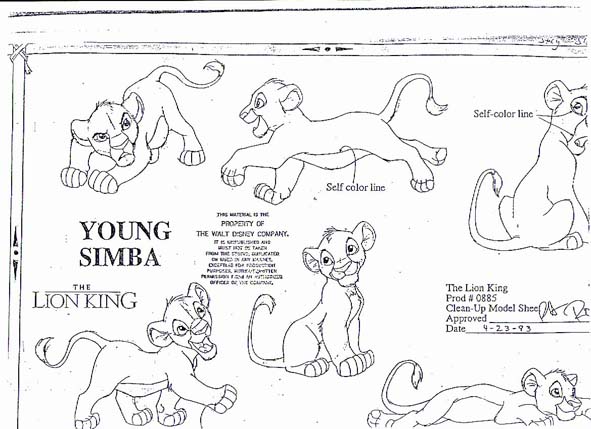
For example, in July 1993, a person asked Roy Disney in a Prodigy online-chat session whether there would be any nice motherly figures in future Disney animated films, and Disney replied that Kimba's mother in the following year's The Lion King will be lovely. On the other hand, a clean-up model sheet of young Simba proves that the name "Simba" had been in use at Disney since as early as April 1993, three months before the Prodigy session. The word "simba" means "lion" in Swahili.[2]
Matthew Broderick stated that he understood he was being hired as a voice actor for a Disney remake of Kimba The White Lion.[3][4][5][6]
Additionally, an early presentation reel of the film, included in the Platinum Edition DVD of The Lion King, features a piece of concept art depicting a white lion cub.

The controversy does not involve the story of The Lion King. Disney movies often diverge from the story of the works on which they are based, so this cannot be considered as proof one way or the other. It is the similarity of characters and certain specific scenes and situations that are in question.
The Tezuka/Disney connection extends back for years. Dr. Tezuka sought out and obtained the license to adapt Disney's Bambi into manga for the Japanese market. Tezuka met Walt Disney at the 1964 World's Fair, at which time Disney said he hoped to "make something just like" Tezuka's Astro Boy. And Disney animators were hired to train Tezuka's crew in the use of color when production was started on the Jungle Emperor/Kimba the White Lion TV series.
[edit] Kimba in pop culture

The Simpsons brought the Lion King controversy to the general public in the episode "'Round Springfield". At the end of the episode, Mufasa appears in the sky as he did in The Lion King and says: "You must avenge my death, Kimba... dah, I mean Simba." The picture at the right references the look and usage of imagery in The Lion King; see Kimba episode 13 ("The Trappers") for how that series addressed the concept of "avenging" the death of Kimba's parents.
Kimba has made cameo appearances in several video games. Two of these are Astro Boy: Omega Factor (as Pook, a shape-shifting robot) for the Game Boy Advance, and Columns with a large number of other Osamu Tezuka characters.
Kimba has made several cameo appearances in the anime series Black Jack.
Kimba's adult form serves as the mascot and logo for the popular Japanese baseball team, the Seibu Lions.
The Pokémon Shinx resembles a blue and black version of Kimba.
[edit] Music
- Japanese Opening Theme (1966 version): "Leo´s Song [The New Adventures Of Jungle Emperor Leo - Go Ahead Onward Leo !]" written by Isao Tomita, sung by Mieko Hirtoa
- Japanese Closing Theme (1966 version): "Leah´s Song [The New Adventures Of Jungle Emperor Leo - Go Ahead Onward Leo !]" written by Isao Tomita, sung by Mieko Hirota
[edit] References
- ^ Kimba the White Lion (manga) at Anime News Network's Encyclopedia. Accessed on 2007-06-13.
- ^ As shown in a search for either term at Online Swahili - English Dictionary.
- ^ Peter Schweizer and Rochelle Schweizer, "Disney: The Mouse Betrayed", pp. 167-168.
- ^ Trish Ledoux and Doug Ranney, "The Complete Anime Guide: Japanese Animation Video Directory and Resource Guide", p. 16.
- ^ Charles Buress, "Uproar Over 'The Lion King'", The San Francisco Chronicle July 11, 1994, pp. A1, A13.
- ^ uncredited article, "Did Japanese Animator Inspire 'Lion King'?", The Washington Times July 15, 1994, p. C15.
[edit] See also
- Jungle Emperor Leo, the 1997 feature movie based on the last half of the manga.
- Leo the Lion (aka The New Jungle Emperor - Onward Leo!), the second season of Kimba the White Lion.
- List of Osamu Tezuka anime
- List of Osamu Tezuka manga
- Osamu Tezuka
- Osamu Tezuka's Star System
[edit] Further reading
- Fred Patten Watching Anime, Reading Manga: 25 Years of Essays and Reviews. ISBN 1-880656-92-2
- Frederik L. Schodt Dreamland Japan: Writings on Modern Manga. ISBN 0-7567-5168-3 ISBN 1-880656-23-X
[edit] External links
- Essay on the connection between The Lion King and Kimba
- Fan site with full details on the show and its sequels
- "How Kimba Came To Be" (full history)
- Jungle Emperor 1965 anime series at TezukaOsamu@World
- Jungle Emperor 1966 film at TezukaOsamu@World
- Jungle Emperor 1989 anime series at TezukaOsamu@World
- Jungle Emperor Leo: Hon-o-ji film at TezukaOsamu@World
- Jungle Emperor manga at TezukaOsamu@World
- Many links and texts including Machiko Satonaka's letter to Disney signed by hundreds of Japanese animators
- Worldwide History of Kimba on TV and Video