Indus script
From Wikipedia, the free encyclopedia
| Indus script | ||
|---|---|---|
| Type | Undeciphered (most often believed to be logographic, syllabic, or a mix of both) | |
| Spoken languages | Unknown | |
| Time period | 2600–1900 BC | |
| ISO 15924 | Inds | |
| Note: This page may contain IPA phonetic symbols in Unicode. | ||


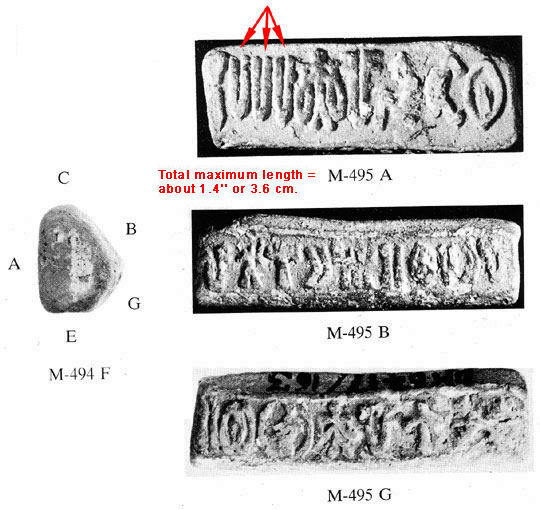
The term Indus script (Harappan script) refers to short strings of symbols associated with the Harappan civilization (Indus Valley Civilization—most of the Indus sites are distributed in present day Pakistan and parts of North West and Western India) used between 2600–1900 BC. In spite of many attempts at decipherments and claims, it is as yet undeciphered. That the underlying language is unknown and the lack of a bilingual (a "Rosetta stone") makes the decipherments extremely difficult.
The script generally refers to that used in the mature Harappan phase, which perhaps evolved from a few signs found in early Harappa after 3500 BC,[1] (correctly, 3300 BC), and was followed by the mature Harappan script. A few Harappan signs are said to appear until around 1100 BC. The Harappan signs are most commonly associated with flat, rectangular stone seals and steatite tablets, but they are also found on at least a dozen other materials. The first publication of a Harappan seal dates to 1873, in the form of a drawing by Alexander Cunningham. Since then, well over 4000 symbol-bearing objects have been discovered, some as far afield as Mesopotamia. After 1900 BC, the systematic use of the symbols ended, after the final stage of the Mature Harappan civilization. Some early scholars, starting with Cunningham in 1877, thought that the script was the archetype of the Brahmi script used by Ashoka. Cunningham's ideas were supported by G.R. Hunter, Iravatham Mahadevan and a minority of scholars continue to argue for the Indus script as the predecessor of the Brahmic family. However most scholars disagree, claiming instead that the Brahmi script derived from the Aramaic script.
Contents |
[edit] Script characteristics

The script is written from right to left,[2] and sometimes follows a boustrophedonic style. Since the number of principal signs is about 400-600,[3] midway between typical logographic and syllabic scripts, many scholars accept the script to be logo-syllabic[4] (typically syllabic scripts have about 50-100 signs whereas logographic scripts have a very large number of principal signs). Several scholars maintain that structural analysis indicates an agglutinative language underlies the script. However, this is contradicted by the occurrence of signs supposedly representing suffixes at the beginning or middle of words.
[edit] Attempts at decipherment
Over the years, numerous decipherments have been proposed, but none has been accepted by the scientific community at large. The following factors are usually regarded as the biggest obstacles for a successful decipherment:
- The underlying language has not been identified, nor the language family to which it belongs.
- The average length of the inscriptions is less than five signs, the longest being one of only 27 signs.
- No bilingual texts have been found.
[edit] Dravidian hypothesis
The Russian scholar Yuri V. Knorozov (or Knorosov), who has edited a multi-volumed corpus of the inscriptions, surmises that the symbols represent a logosyllabic script, with an underlying Dravidian language as the most likely linguistic substrate.[5] Knorozov is perhaps best known for his decisive contributions towards the decipherment of the Maya script, a pre-Columbian writing system of the Mesoamerican Maya civilization. Knorozov's investigations were the first to conclusively demonstrate that the Maya script was logosyllabic in character, an interpretation now confirmed in the subsequent decades of Mayanist epigraphic research.
The Finnish scholar Asko Parpola repeated several of these suggested Indus script readings. The discovery in Tamil Nadu of a late Neolithic (early 2nd millennium BC, i.e. post-dating Harappan decline) stone celt that some think is adorned with Indus script markings has been considered to be significant for this identification.[6][7]
[edit] Script vs. ideographical symbols
If the signs are purely ideographical, they may contain no information about the language spoken by their creators: they would qualify either as a purely logographic script, or as a system of symbols not qualifying as a script in the true sense (pictograms) that represents spoken language.
Steve Farmer, Richard Sproat, and Michael Witzel[8] make the case that the symbols were not coupled to oral language, which in part explains the extreme brevity of the inscriptions. This view has been challenged by Parpola.[9]
Subimal Sinharoy notes that "there is abstraction in symbolic depiction, whether it is modern art or an ancient Harappan seal."[10]
[edit] Decipherment claims
The topic is popular among amateur researchers, and there have been various (mutually exclusive) decipherment claims. None of these suggestions has found academic recognition to date.
List of decipherment claims:
- Iravatham Mahadevan - (Tamil, 'The Indus Script: Texts, Concordance, and Tables', Archaeological Survey of India, 1977. Tamil-Brahmin inscriptions, Madurai University, 1970)
- Clyde Ahmad Winters (Dravidian, 1981[2])
- R. Mathivanan (Tamil, 1991, 1995[11])
- S. R. Rao (Indo-Aryan, 1992)[12]
- Egbert Richter-Ushanas (Vedic Sanskrit, 1992, 2001)[13]
- Dr. Madhusudan Mishra (Grandmother of the Vedic language, 1996-2006) :The Indus numeral script identified with the syllabic order of the Mahesvarasutra: http://www.indusscript.com/
- B.V. Subbarayappa ("number mysticism", 1996)
- S. Gurumurthy (Dravidian, 1999)
- Natwar Jha and N. S. Rajaram (Vedic Sanskrit, 2000;), Indus Script Deciphered[14]
- S. V. Rjabchikov (Proto-Indo-Aryan, 2006) A New Key to the Proto-Indian Writing System. AnthroGlobe Journal
- Srinivasan Kalyanaraman ("Mlecchita hieroglyptic writing system", "mleccha language", 2004)[15]
- R. Hasenpflug ("pure Indo-European language", 2006), indus-civilization.info
- Daniel F. Salas (Sanskrit), indoeurohome.com
[edit] Late Indus script

Onshore explorations near Bet Dwarka in Gujarat revealed the presence of late Indus seals depicting a 3-headed animal, earthen vessel inscribed in what is said to be late Harappan script, and a large quantity of pottery similar to Lustrous Red Ware bowl and Red Ware dishes, dish-on-stand, perforated jar and incurved bowls which are datable to the 16th century BC in Dwarka, Rangpur and Prabhas. The thermoluminescence date for the pottery in Bet Dwaraka is 1528 BC. This evidence suggests that signs of the late Harappan script were used until around 1500 BC. [3] Other excavations in India at Vaisali, Bihar [4] and Mayiladuthurai, Tamil Nadu [5] are thought by some to reveal that Indus symbols were used as late as 1100 BC.
[edit] Notes
- ^ Whitehouse, David (1999) 'Earliest writing' found BBC
- ^ (Lal 1966)
- ^ (Wells 1999)
- ^ (Bryant 2000)
- ^ (Knorozov 1965)
- ^ (Subramanium 2006; see also A Note on the Muruku Sign of the Indus Script in light of the Mayiladuthurai Stone Axe Discovery by I. Mahadevan (2006)
- ^ Significance of Mayiladuthurai find
- ^ (Farmer 2004)
- ^ (Parpola 2005)
- ^ Thoughts on Tibet Frontline - Dec. 9 - 22, 2000
- ^ Indus Script among Dravidian Speakers, Coimbatore: Rukmani Offset Press (1995); see also Mahadevan (2002) and M. Witzel in: Archaeological Fantasies: How Pseudoarchaeology Misrepresents the Past and Misleads the Public, Routledge (2006), p. 220.
- ^ see Koenraad Elst, Remarks in expectation of a decipherment of the Indus script
- ^ review: Karel Werner, Bulletin of the School of Oriental and African Studies, University of London (1999); zeenews.com article
- ^ review: "Horseplay in Harappa" by Witzel and Farmer
- ^ Srinivasan Kalyanaraman (2004), Sarasvati in 7 vols., Babasaheb Apte Smaraka Samiti, Bangalore.[1]
[edit] References
- Bryant, Edwin (2000), The Quest for the Origins of Vedic Culture : The Indo-Aryan Migration Debate Oxford University Press.
- Farmer, Steve et al. (2004) The Collapse of the Indus-Script Thesis: The Myth of a Literate Harappan Civilization, EJVS, vol. 11 (2004), issue 2 (Dec) [6] (PDF).
- Knorozov, Yuri V. (ed.) (1965) Predvaritel’noe soobshchenie ob issledovanii protoindiyskikh textov. Moscow.
- Mahadevan, Iravatham, Murukan In the Indus Script (1999)
- Mahadevan, Iravatham, Aryan or Dravidian or Neither? A Study of Recent Attempts to Decipher the Indus Script (1995-2000) EJVS (ISSN 1084-7561) vol. 8 (2002) issue 1 (March 8).[7]
- Parpola, Asko (2005) Study of the Indus Script. 50th ICES Tokyo Session.
- Possehl, Gregory L. (1996), Indus Age: The Writing System, University of Pennsylvania Press, ISBN 081223345X.
- Subramanian, T. S. (2006) "Significance of Mayiladuthurai find" in The Hindu, May 01, 2006.
- Wells, B. "An Introduction to Indus Writing" Independence, MO: Early Sites Research Society 1999.
[edit] See also
[edit] External links
- Indus Script (ancientscripts.com)
- "Discovery of a century" in Tamil Nadu ("Discovery of a century" in Tamil Nadu )
- The Indus Script (From harappa.com)
- BBC - 'Earliest writing' found
- How come we can't decipher the Indus script? (from The Straight Dope)
- Iravatham Mahadevan, Towards a scientific study of the Indus Script
- Script Image;Article
- Collection of essays about the Indus script (Steve Farmer)