Talk:Ikurriña
From Wikipedia, the free encyclopedia


Someone please add an image of the flag. Kent Wang 20:15, 12 Mar 2004 (UTC)
- From eo:Ikurrina http://eo.wikipedia.org/upload/c/c5/Es-pv.gif -- Error 04:18, 15 Mar 2004 (UTC)
Contents |
[edit] Inspiration?
I've added a line about the Ikurriña's resemblance to the Union flag, after reading the following items:
"...the red, green and white ikurriña, modelled on the Union Jack (like many basques, he admired the feisty island nation as a role model" - Cadogan guide to Bilbao & the Basque Lands (1st ed.), p39
"Even Arana's Ikurriña was modeled on the union jack." - Mark Kurlansky, 'The Basque History of the World', p169
If anyone knows that this is definitely wrong, please feel free to correct me! --RobC 19:54, 1 Jan 2005 (UTC)
There is a rumour (sorry, but I can not quote a source): Sabino´s father owned a shipping company, so Sabino thought that a flag resembling a Union Jack would be and excellent protection against piracy for the basque ships. In sea conditions, it is very difficult to distinguish a Union Jack from a Ikurrina.
- From memory, Sabino's father was ruined before the development of the ikurriña. --Error 01:13, 21 March 2006 (UTC)
-
- I read somewhere that, despite being a germanophile himself, Sabino Arana sought inspiration in the Union Jack, given the long time relationship between the Basque Country and the Islands and in an attempt to get close to what was seen as a historical arch-enemy of Spain and, thus, a potential ally for Basque nationalism.
- This sounds quite likely, but even if it wasn't, it is obvious that the Union Jack design was known to Arana.
- I am thus adding the Union Jack reference. Mountolive 07:47, 12 February 2007 (UTC)
- Sabino was not a germanophile.On the opposite, he was a staunch anglophile, as all the first Basque Nationalists at large. Perhaps you're referring to his brother Luis, although it's not clear to what extent he was germanophile.On the other hand, the Union Jack was not the British naval or merchant ensign in 1894, just the naval jack. The ikurriña doesn't look neither like the white ensign (naval) nor like the red coaster (merchant).The 1894 ikurriña was basically red. The white cross and the green saltire were rather thin to say the least.
[edit] Baserri profile
- Although this may seem artificial, the colors work because they reflect the common image of a white-washed, red-trimmed Basque house near a lush green mountain.
This seems dubious without a citation. All I have to connect a baserri with the Ikurrina is that the Basque pavilion in Expo 92 Seville was said to be inspired by a a baserri profile in those three colors. --Error 01:13, 21 March 2006 (UTC)
[edit] SAINT-PIERRE and MIQUELON flag?
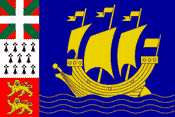
Anyone else notice that the St Pierre and Miquelon flag have the Basque flag in the corner? think it's worth mentioning? The flag:You are mistaken. It's the official one or nearly so, really. The Breton and Norman flags are also part of the local flag. It's just an homage to the islanders' ancestors. The actual official flag, anyway, is the French one.
[edit] France
- (it kept being used in the Basque provinces under French sovereignty).
What was the attitude of the German occupiers? --Error 23:25, 18 September 2006 (UTC)
[edit] A French battalion's colour (1698-1741)
A Walloon regiment in French service carried in 1698-1741 a colour that was basically an ikurriña "avant la lettre". It was known, among some other titles, as the De la Vallière's Regiment or D'Escars' Regiment. It's a funny coincidence. —Preceding unsigned comment added by 212.142.175.22 (talk) 12:40, 11 December 2007 (UTC)
- "http://www.drapeaux.org/France/Ancien_Regime/N_Des_Cars.htm" —Preceding unsigned comment added by 212.142.175.22 (talk) 10:46, 28 January 2008 (UTC)